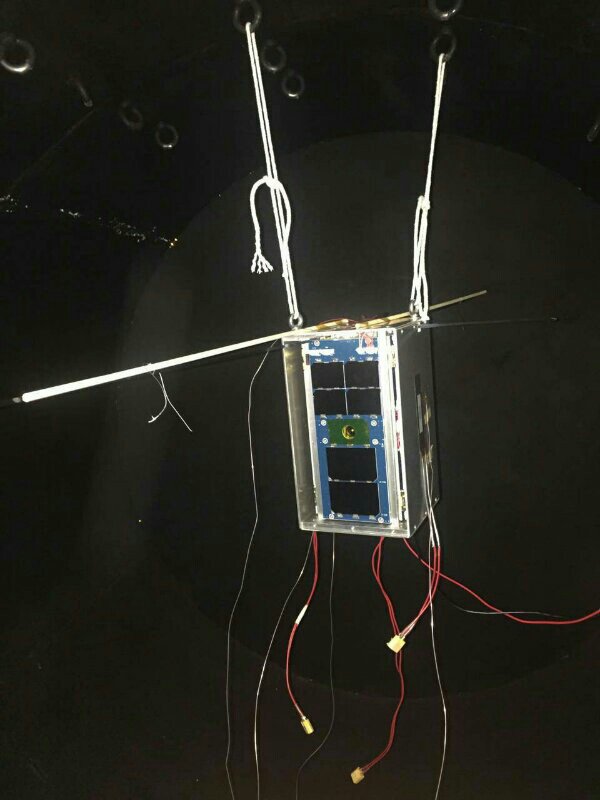
BY70-1 FM transponder contact video

Christian Jacobs 2E0ICL has released a video of his recent contact with Peter Goodhall 2E0SQL via the new amateur radio FM satellite BY70-1.

The satellite was launched into orbit on December 28, 2016. This is orbit #27.

Watch New FM transponder satellite BY70-1

BY70-1 information https://amsat-uk.org/2016/12/27/by70-1-fm-transponder-satellite/

Christian Jacobs 2E0ICL has also released a video of his recent FM contact via the SO-50 satellite during a recent Summits On The Air (SOTA) activation at Walbury Hill (summit identifier G/SE-001).

A total of 13 contacts were made, mostly on 2m SSB, including some FM satellite working via SO50 with 10 watts to an Arrow dual-band antenna.

Watch Summits on the Air: G/SE-001, Walbury Hill

SO-50 satellite https://amsat-uk.org/satellites/communications/saudi-oscar-50/

BY70-1 FM transponder satellite https://amsat-uk.org/2016/12/27/by70-1-fm-transponder-satellite/

Arrow 2m/70cm dual-band antenna
http://shop.amsat-uk.org/Arrow_2m70cms_antenna/p3815740_16665431.aspx

Making contacts through the ISS APRS UHF Digipeater

International Space Station - Image Credit NASA

International Space Station – Image Credit NASA

John Brier KG4AKV has released a video showing his contact through the International Space Station packet radio digipeater on 437.550 MHz FM (+/-10 kHz Doppler shift).

This was my second contact through the ISS digipeater. I actually contacted the same station I contacted in this video, W8LR, three days before, but I wasn’t recording any video.

For this video I recorded the audio from my Kenwood TH-D72a and later played it back to Soundmodem+UISS. Soundmodem decodes many more packets than my radio does. I made a screen capture of UISS and its map so you can see the complete details of every received packet.

Another thing this video shows is how hard it can be to track a near overhead pass (close to 90 degrees elevation). When I was beginning in satellites I only tried to work overhead passes because I knew the signal would be strongest when the satellite was closest to me. While that is true, the closer the satellite is to you the faster its relative speed is. When it passes overhead it switches from coming towards you to going away from you very fast, and drops 10s of degrees in seconds. That makes the satellite very easy to lose track of.

In this video I got distracted while changing settings on my radio and lost the ISS after it went overhead. It didn’t help that I was using a tripod for the first time. I prefer to hold the antenna in my hand precisely because I find it’s easier to track, as I can make quick adjustments and listen for the signal going up and down. To control the radio for packet, it helps to have two hands.

Watch I made CONTACT! UHF ISS Digipeater

You can subscribe to John’s Space Comms YouTube Channel at
https://www.youtube.com/SpaceComms1?sub_confirmation=1

Tomsk-TPU-120 CubeSat to deploy during EVA

Tomsk-TPU-120 CubeSat - Credit Tomsk Polytechnic University

Tomsk-TPU-120 CubeSat – Credit Tomsk Polytechnic University

The amateur radio CubeSat Tomsk-TPU-120 may be deployed during a Russian spacewalk (EVA) in July 2017.

The satellite was developed by students at the Tomsk Polytechnic University to test new space materials technology and is the world’s first space vehicle with a 3D-printed structure. It was launched from Baikonur in Kazakhstan to the ISS on March 31, 2016 in a Progress-MS-2 cargo vessel.

It will be deployed by hand during a Russian spacewalk, which is why unlike other CubeSats this one has a handle. The call sign of the satellite is RS4S.

According to Alexey Yakovlev, head of the Tomsk Polytechnic University’s Institute of High Technologies, the 3D printed satellite is something of a landmark for additive manufacturing, being the first example of a fully 3D printed satellite: “The Tomsk-TPU-120 is the first such project in the world, in which the entire casing of a satellite is fully 3D printed using dynamic modeling,” Yakovlev recently told Sputnik. “The combination of these technologies can significantly reduce the development time and the number of full-scale tests, find new engineering solutions, and reduce the project’s cost.”

In May 2016 the Tomsk Polytechnic University celebrated its 120th anniversary. As part of the celebrations on May 10/11 the Tomsk-TPU-120 was activated in the ISS and transmitted a greeting to Earth inhabitants, recorded by students of the university in 10 languages: Russian, English, German, French, Chinese, Arabic, Tatar, Indian, Kazakh and Portuguese.

The greeting message was transmitted once a minute on 437.025 MHz FM. A Kenwood transceiver on the ISS provided a cross-band relay, re-transmitting the signal on 145.800 MHz FM.

Read the 3ders article at
http://www.3ders.org/articles/20161229-russian-scientist-says-3d-printed-satellite-entering-orbit-in-2017.html

Sputnik News – Unique 3D-Printed Siberian Satellite to Orbit Earth
https://sputniknews.com/science/201612261049011599-russia-satellite-3D-printer-experiments/

ISS Calendar http://spaceflight101.com/iss/iss-calendar/

Tomsk-TPU-120 CubeSat Video https://amsat-uk.org/2016/05/23/tomsk-tpu-120-cubesat-video/

BY70-1 FM transponder satellite

BY70-1 CubeSat

BY70-1 CubeSat

A CZ-2D rocket carrying the amateur radio FM transponder satellite BY70-1 was launched on Wednesday, December 28 at 03:23 UT.

Update: Paul Stoetzer N8HM reports working Wyatt Dirks AC0RA through the FM transponder during the 1709 UT pass on December 28. Paul says “Uplink requires precise frequency adjustment and there’s a delay on the downlink, but the signal is strong”. A recording of the transponder can be heard at https://soundcloud.com/paul-stoetzer/by70-1-1706z-28-dec-2016

The launch from the Taiyuan Space Launch Center was planned for December 26 but postponed due to adverse weather. It had been planned it would go into a 530 km circular Sun-Synchronous Orbit (SSO) but instead the orbit appears to be 524 x 212 km which will give an orbital lifetime of just one or two months.

BY70-1 is a 2U CubeSat project for school education and amateur radio. It features 3-axis stabilization and deployable solar panels. In addition to the FM transponder BY70-1 has a camera and it is planned to download images and telemetry via a 9600 bps BPSK downlink.

The IARU amateur satellite frequency coordination pages list these frequencies:
• 145.920 MHz uplink
• 436.200 MHz downlink
A 67 Hz CTCSS (PL Tone) is required.

On the AMSAT Bulletin Board Mac AE5PH has provided a list of the channel settings he uses:

 Chan        RX          TX     TX PL Tone
BY70-1    436.2100    145.9175    67 Hz
BY70-2    436.2075    145.9175    67 Hz
BY70-3    436.2050    145.9175    67 Hz
BY70-4    436.2025    145.9200    67 Hz
BY70-5    436.2000    145.9200    67 Hz
BY70-6    436.1975    145.9200    67 Hz
BY70-7    436.1950    145.9225    67 Hz
BY70-8    436.1925    145.9225    67 Hz
BY70-9    436.1900    145.9225    67 Hz

His rig supports 2.5 kHz channel spacing, for 5 kHz step rigs just omit the intermediate channels.
Note: If your rig has selectable FM filters the wider filter should give better results.

For the SatPC32 Doppler.sqf file Henk PA3GUO suggests: BY70-1,436200,145920,FM,FM,NOR,0,0,FM

BY70-1 has been added to the satellite pass predictor at

See the article by Daniel Estévez EA4GPZ / M0HXM – GNU Radio decoder for camera images from BY70-1 satellite http://destevez.net/2016/12/looking-at-by70-1-image-downlink/

BY70-1 links
http://www.amsatuk.me.uk/iaru/finished_detail.php?serialnum=531
https://twitter.com/cnspaceflight/status/802863365013942272

Follow Mingchuan Wei BG2BHC https://twitter.com/bg2bhc

Keplerian Two Line Elements (TLEs) ‘Keps’ for new satellites launched in past 30 days. It is believed BY70-1 may be object 41909, 2016-083C http://celestrak.com/NORAD/elements/tle-new.txt

Adding new satellites to SatPC32, Gpredict and Nova
https://amsat-uk.org/2013/11/23/adding-new-satellites-to-satpc32/

Winter issue of OSCAR News now available

OSCAR News 216 December 2016 Front CoverE-members of AMSAT-UK can now download the Winter edition of OSCAR News here.

In this edition “FUNcube Update” has the latest information on the new Jordanian satellite JY1Sat which will carry a 435/145 MHz amateur radio linear transponder and will transmit images.

The paper edition should be sent to postal members in 2-3 weeks.

In this issue:
• From the Secretary
• 2017 Meetings & Events calendar
• The AMSAT-UK Shop
• A 25MHz reference for ADF4350/4351 based synthesisers
• ISS Packet Digipeater on 437.550 MHz
• Change in AMSAT-UK Membership ‘Rules’
• Orbital Debris
• UK Radio Amateur Receives Sir Arthur Clarke Award
• ARISS International Face to Face Meeting
• AMSAT-NA Space Symposium at Sea
• EO79 FUNcube transponder commences regular operation
• Spacecraft currently active with FM or linear transponders
• HamTV update
• Robin Haighton, VE3FRH – Silent Key
• SatCamp
• The “handover” of the ESEO AMSAT payload Engineering Model
• FUNcube (and other projects) update Dec 2016
• Satellite Orbits

AMSAT-UK FUNcube Mission Patch

AMSAT-UK FUNcube Mission Patch

Membership of AMSAT-UK is open to anyone who has an interest in amateur radio satellites or space activities, including the International Space Station (ISS).

E-members of AMSAT-UK are able to download OSCAR News as a convenient PDF that can be read on laptops, tablets or smartphones anytime, anyplace, anywhere. Join as an E-member at Electronic (PDF) E-membership

PDF sample copy of “Oscar News” here.

Join AMSAT-UK using PayPal, Debit or Credit card at
http://shop.amsat-uk.org/

E-members can download their copies of OSCAR News here.

Pratham student satellite returns to life

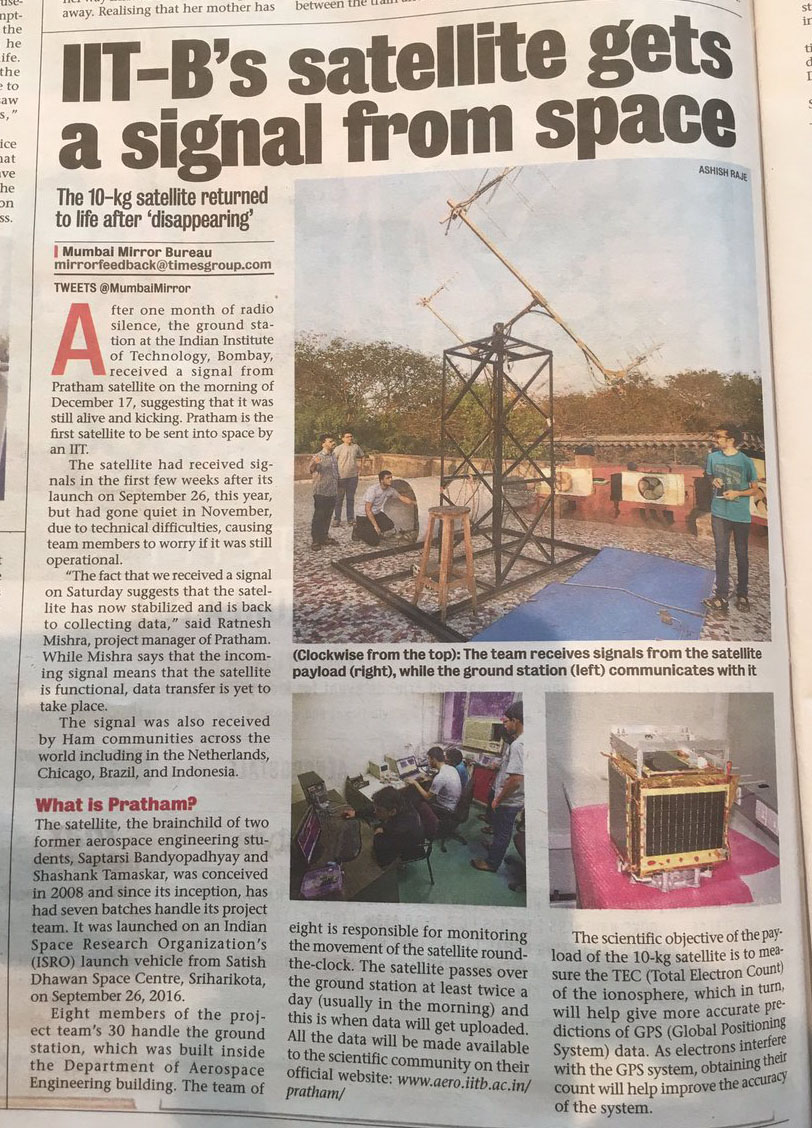
Pratham satellite in Mumbai Mirror

Pratham satellite in Mumbai Mirror

The Mumbai Mirror reports on the return to life of the Pratham satellite launched on September 26, 2016. Pratham carries an amateur radio payload and was built by students at the Indian Institute of Technology Bombay (IIT-B).

The newspaper says:

After one month of radio silence, the ground station at the Indian Institute of Technology, Bombay, received a signal from Pratham satellite on the morning of December 17, suggesting that it was still alive and kicking. Pratham is the first satellite to be sent into space by an IIT.

The satellite had received signals in the first few weeks after its launch on September 26, this year, but had gone quiet in November, due to technical difficulties, causing team members to worry if it was still operational.

“The fact that we received a signal on Saturday suggests that the satellite has now stabilized and is back to collecting data,” said Ratnesh Mishra, project manager of Pratham. While Mishra says that the incoming signal means that the satellite is functional, data transfer is yet to take place.

Read the full article at http://mumbaimirror.indiatimes.com/mumbai/other/IIT-Bs-satellite-gets-a-signal-from-space/articleshow/56075162.cms

Pratham info https://amsat-uk.org/2016/09/07/pratham-student-satellite/