
Hector Martinez CO6CBF
Thanks to the efforts of Patrick Stoddard WD9EWK/VA7EWK and other AMSAT members Hector Martinez CO6CBF was able to attend the AMSAT Symposium in Orlando, Florida.
Hector Martinez CO6CBF
Thanks to the efforts of Patrick Stoddard WD9EWK/VA7EWK and other AMSAT members Hector Martinez CO6CBF was able to attend the AMSAT Symposium in Orlando, Florida.

Sunita Williams KD5PLB on the International Space Station
The Times of India reports that a group of students in Gujarat will reach out to the stars. About 500 students hope to have a live amateur radio contact with the Commander of the International Space Station Sunita Williams KD5PLB. It is believed this would be the first ISS contact made by Indian students and should take place using the ham radio station at Science City in Ahmedabad.
The newspaper says it is hoped to hold the contact between November 12 and 16. Read the story at
http://timesofindia.indiatimes.com/city/ahmedabad/Ahmedabad-students-to-make-space-call-to-Sunita-Williams/articleshow/16975944.cms

F-1 Altitude – Credit Nguyễn Trần Hoàng
Thu Trong Vu XV9AA has provided this update on F-1:
Despite many efforts from the amateur radio community and the team ourselves in tracking F-1, we still haven’t heard from F-1 other than a few uncertain reports during the first few days. The team has been collecting information, analyzing different scenarios and experimenting with F-1’s backup unit in the laboratory. However communication with our American partner to trace back information about F-1 when it was in the States is limited due to ITAR. We hope to come up with an official report about the satellite status by November 4th, and this is not the final conclusion. Thank you for all your support and please continue to help us tracking F-1 if possible!
Nguyễn Trần Hoàng has plotted the descent of the F-1 CubeSat in the 3 weeks since its deployment from the International Space Station (ISS). He comments that the altitude of F-1 appears to be falling faster than the ISS.
F-1 frequency information can be found at http://fspace.edu.vn/?page_id=27

FUNcube Dongle Pro+ Presentation at AMSAT Symposium in Orlando – Image Credit Mark Hammond N8MH
Howard Long G6LVB travelled to Orlando, Florida to give a presentation on Friday, October 26 about the AMSAT-UK FUNcube Dongle PRO+ software defined radio.
The video of a similar presentation Howard gave to the AMSAT-UK Colloquium can be seen via
http://www.uk.amsat.org/?page_id=10953
FUNcube Dongle Pro+ LF/MF/HF/VHF/UHF Software Defined Radio Video http://www.uk.amsat.org/?p=10573
FUNcube Yahoo Group:- http://uk.groups.yahoo.com/group/Fcdproplus/
Scream in Space won a competition run by Surrey Satellite Techonology Ltd (SSTL) in 2011 to propose an idea for an app to run on their STRaND-1 smartphone nanosatellite.

With the help of the public, we’re testing the hypothesis that in space no one can hear you scream. It’s a statement that has been well known in popular culture since appearing as the tagline to the 1979 sci-fi film ‘Alien’ – but how many people have really tested this claim? Whilst the conclusion of this experiment may seem clear to many, it is our hope that through this investigation thousands of people worldwide can learn more about several aspects of physics (including orbits, acoustics and much more) and get excited about the field of satellite technology!
In coming up with this idea, we thought about what features the Android phone has which are not usually present on conventional satellites – and naturally the speaker and microphone are two such components. It would seem a shame not to leverage the power of these additions, and so the idea was born…
Read more about the project on the SSTL blog and New Scientist, or listen to the Cambridge University Spaceflight team discussing Scream in Space on the Space Boffins podcast earlier in 2012:
Vote the best scream here
Hurry only Ten days left to Scream
2012 Cambridge University Spaceflight
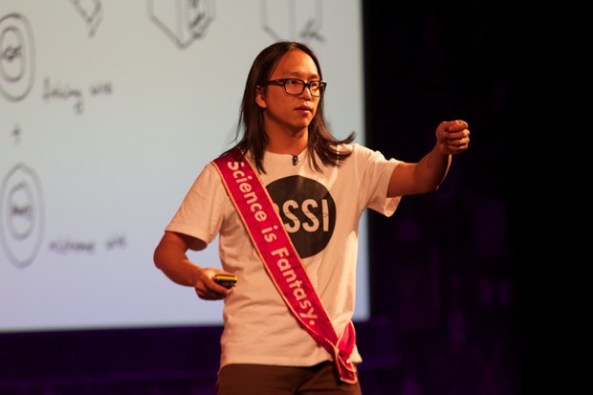
Hojun Song DS1SBO at WIRED 2012 London
Hojun Song DS1SBO, developer of the OSSI CubeSat, will be speaking at the WIRED 2012 event taking place in London, EC1Y 4SD on Friday, October 26.
OSSI-1 has a beacon in the 145 MHz band and a data communications transceiver in the 435 MHz band. It carries a 44 watt LED array to flash Morse Code messages to observers on Earth. It is planned to launch in April on a Soyuz-2-1b rocket from the Baikonur launch facility in Kazakhstan along with the Bion-M1 and Dove-2 satellites.
 AMSAT-UK
You must be logged in to post a comment.