KySat-2 Kentucky Space-Blog

Twyman Clements, Space Systems Engineer at Kentucky Space, has agreed to provide regular updates to blog readers on the progress of the next satellite now that the X-ray hunter, “CXBN,” has flown. His first installment can be read below. Enjoy.
‘Wayne’

Here at Kentucky Space we are furiously at work on the consortium’s next satellite. While our engineering work is moving along on KySat-2 (drawing below) we wanted to start “K2 Tuesday’s” to update readers on the progress of the spacecraft, as well as introduce them to basic satellite systems and some of the people who will be working on it. I wanted to start with a little history of Kentucky Space’s orbital satellite program.

Kentucky Space began as a consortium of universities within the Commonwealth of Kentucky in 2006. From the beginning students worked on KySat-1, the state’s first orbital satellite. Through the next few years the students and university faculty learned the in’s and out’s of spacecraft design, testing and communication. KySat-1 (pictured on clean room bench, Above) was eventually selected as one of three primary satellites on NASA’s first ELaNa mission which was eventually launched in March of 2010, along with the NASA GLORY spacecraft. KySat-1 was a one-unit (1U) CubeSat that rode to orbit as a secondary payload. Sadly, due to a launch anomaly with the rocket, none of the payloads made orbit. But Kentucky Space and its partner institutions have continued to work, and Morehead State University’s “CXBN” satellite was launched just weeks ago.

KySat-2, or “K2,” will fulfill the original mission of KySat-1, but will incorporate even better components and the added knowledge acquired the past few years by Kentucky Space. K2 will include an attitude determination system, which will also serve as a camera that will take pictures of both the earth and star fields. Additionally the spacecraft will transmit telemetry in the amateur radio spectrum allowing HAM radio operators to capture it and check the health of the spacecraft as it makes its way around the globe every 90 or so minutes.

Currently KySat-2 is serving as a backup secondary payload on two NASA missions slated for launch in Q3 of 2013. This means delivery dates to the launch site in April or May of 2013. The satellites subsystem are currently being designed with prototypes being ordered this week. Within the next six weeks we will be putting together a FlatSat version of KySat-2 to test communication between its subsystems and refining the spacecraft software. We will keep you up to date through the entire process.


I’ll be back next Tuesday with another update. Until then,

Twyman Clements, Space Systems Engineer, Kentucky Space
http://www.kentuckyspace.com/


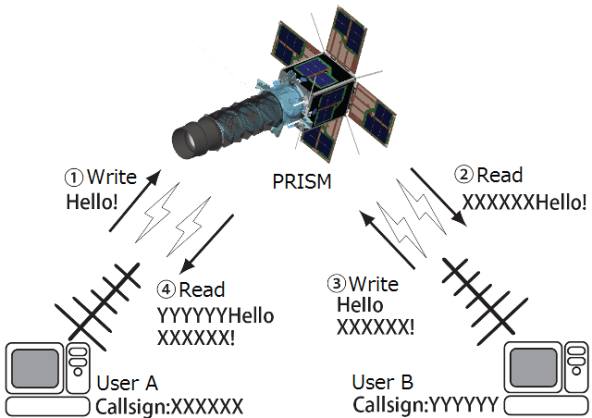
PRISM Available for Amateur Radio AX.25 Packet

Overview of the PRISM Ham Radio Service – Image Credit Tokyo University

The team that developed the PRISM satellite have announced it is being opened up for use by radio amateurs during afternoon passes.

The satellite was built by the University of Tokyo and launched on January 23, 2009 into a 660 by 670 km orbit. It uses AX.25 packet radio and can now be used by amateur radio operators as a store-and-forward message box.

Full details at http://www.space.t.u-tokyo.ac.jp/prism/en/HAMservice.html

PRISM http://www.amsat.org/amsat-new/satellites/satInfo.php?satID=119

434.301 MHz PICO Balloon Reaches Sweden

James Coxon M6JCX launches PICO a 434.301 MHz USB RTTY balloon – Image David Bowkis M0MDB

PICO, a single foil balloon was launched by James Coxon M6JCX on Saturday, October 20, 2012 from Suffolk in the UK. It carried GPS and a miniature radio transmitter sending RTTY (ascii-8) on 434.301 MHz USB running 10 mW output.

During the 19 hour flight it crossed the North Sea and landed somewhere in central Sweden.

Continue reading

First picture from FITSAT-1 on 5840.0 MHz

First picture from FITSAT-1 on 5840.0 MHz showing the solar panels on the ISS

When the FITSAT-1 CubeSat was deployed from the International Space Station on October 4 it took a picture using the on-board camera. On Friday, October 19 UT, the team successfully downloaded the picture using the high-speed 115.2 kbps data transmitter on 5840.0 MHz.

Continue reading

FUNcube-2 boards delivered to Clyde Space for UKube-1 Nanosatellite

Steve Greenland of Clyde Space receives the AMSAT-UK FUNcube-2 boards that will be incorporated into UKube-1

Steve Greenland of Clyde Space receives the AMSAT-UK FUNcube-2 boards that will be incorporated into UKube-1

On Friday, October 19, after some final testing and characterisation checks completed at the facilities of ISIS BV in Delft, AMSAT-UK handed over the set of three PCBs that form the FUNcube-2 subsystem on the UKube-1 spacecraft to Clyde Space Ltd in Glasgow. Clyde Space are leading the development and assembly of this CubeSat project for the UK Space Agency.

The PCBs were taken to Glasgow in a Pelicase by Graham Shirville G3VZV who handed them to Steve Greenland Systems Engineer at Clyde Space.

Continue reading

Cuban Amateur Radio Satellite Group National Meeting

Raydel Espinet CM2ESP - 640

Raydel Espinet CM2ESP

Raydel Espinet CM2ESP reports the first national meeting of the Cuban amateur radio satellite group will take place November 8-11 and special event station T47G will be on the air, on both HF and the satellites, during the event.

With great pleasure, on behalf of the Cuban Satellite Group named “Grupo de Radioaficionados para Operaciones Satelitales”, GROS, The Coordination Board wants to announce the following.

During November 8th to November 11th the Group will be having its First National Meeting (very similar to a symposium) in the Province of Camagüey. Many of the GROS’s Members and many other ham guests will be attending this Meeting. The meeting motto is “Celebrating the first year of an idea come true”. The idea of creating a Cuban Satellite Group and the first works began on November, 2011, and this is the First Anniversary.

Continue reading