Antares Launch Slip Delays Dove-1 Satellite

Artists Impression of Antares Launch from Wallops Island, Virginia

The amateur radio satellite Dove-1 (145.825 MHz AX.25 FM) was originally planned to launch on the Antares launcher on February 28 but reports indicate it may be Fall before it is launched.

Space.com reports that on February 21 Orbital Sciences Corporation announced a further slip and the launch of Antares could now be delayed until as late as September. Read the space.com report here.

Dove-1 was built by Cosmogia and is a 3U CubeSat with a total mass of about 5 kg.

Its 145.825 MHz 1200 bps AFSK AX.25 FM downlink will transmit telemetry data, including temp/power supply/current/RSSI/solar vector/acceleration, approximately every 30 seconds. The beacon can transmit at up to 1 watt and will use a quarter wave monopole antenna cut from a tape measure.

It also has a 2.4 GHz half-duplex, spread spectrum radio with patch antenna that will be used for main payload downlink and telecommand uplink. The data rate will be 115 kbps.

The planned orbit is 280 by 270 km at 51.6 deg inclination which will give Dove-1 a lifetime of about 2 weeks before re-entry.

Dove 1 Satellite Technical Description https://apps.fcc.gov/els/GetAtt.html?id=121393&x=. 

Cosmogia Dove-1 Orbital Debris Assessment Report (ODAR) https://apps.fcc.gov/els/GetAtt.html?id=122025&x=.

Orbital Sciences Corporation Antares page http://www.orbital.com/Antares/

IARU Amateur Satellite Frequency Coordination Pages hosted by AMSAT-UK http://www.amsat.org.uk/iaru
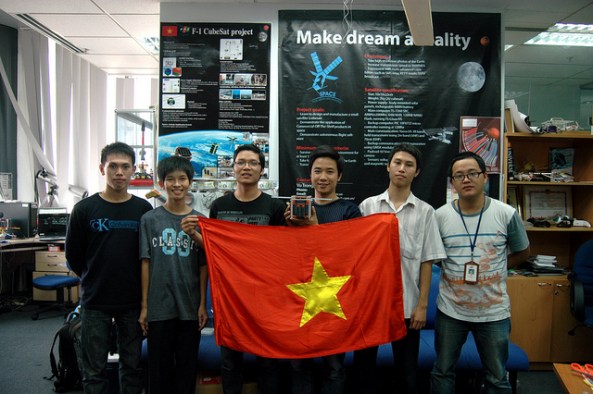
Vietnam Student CubeSat F-1

Vietnamese students have produced a video about their amateur radio CubeSat F-1, callsign XV1VN.

The F-1 is an educational CubeSat to be launched in the summer of 2012. It will carry a low resolution C328 camera with 640×480 resolution and two Yaesu VX-3R transceivers using 145.980 and 437.485 MHz.

•VX-3R1
–Frequency: 437.485MHz, FM Narrow
–Power supply: directly from solar cells, only operates in sunlight
–Output power: max 0.3W, half-wave dipole antenna
–Modulation scheme: Morse code beacon (10 chars) using PWM CW
–Beacon interval: every 30 seconds (configurable)

•VX-3R2
–Frequency: 145.980MHz , FM Narrow
–Power supply: rechargeable battery, operates in the dark by default but can be commanded to operate in sunlight as well
–Output power: max 1.0W, half-wave dipole antenna
–Modulation scheme: AFSK 1200bps, half duplex
–Telemetry interval: one AX.25 packet every 30 seconds (configurable)

Watch F-1 picosatellite project – FSpace laboratory

F-1 CubeSat Blog on Facebook https://www.facebook.com/groups/116436068290/

Gunter’s Space Page lists F-1 on the HTV-3 launch to the ISS on July 18, 2012.

Send your name/callsign and a message into space on the F-1 CubeSat! http://fspace.edu.vn/?page_id=31

Vietnam F-1 CubeSat on Facebook http://www.facebook.com/group.php?gid=116436068290

FSpace Laboratory http://fspace.edu.vn/

TechEdSat to use 'SatPhone'

TechEdSat

TechEdSat

TechEdSat will be deployed from the International Space Station (ISS). It is a 1U CubeSat that will demonstrate Plug and Play power architecture and two way communication via the satellite phone/data networks Iridium and Orbcomm.

UPDATE: The plan to transmit from space using frequencies allocated to Iridium and Orbcomm SatPhone ground stations has been canceled. A statement from the team says: “We were forced to disable the Iridium modem as our FCC license did not come in time. As usual, building the satellite is the easy part.”

There will be a 437.465 MHz beacon transmitting 1 watt to 1/4 wave monopole. Commanding is via the commercial networks and there is a 2 week watchdog timer to stop the beacon in the event of no commands being received.

TechEdSat will be launched along with Raiko, FITSat-1, We-Wish and F-1 to the ISS aboard HTV-3, currently planned to launch July 18, 2012. From there, it will be deployed into Low Earth Orbit  using the JAXA J-SSOD deployer, from the Japanese Experiment Module (JEM also known as Kibo).

Wiki – TechEdSat http://en.wikipedia.org/wiki/TechEdSat

Kibo Robot Arm http://kibo.jaxa.jp/en/about/kibo/rms/

ISS Amateur Radio CubeSat Deployment October 4 http://www.uk.amsat.org/?p=10119

Watch the deployment live at http://www.ustream.tv/nasahdtv

IARU Amateur Satellite Frequency Coordination pages hosted by AMSAT-UK http://www.amsat.org.uk/iaru

E-St@r TV Interview

Sabrina Corpino, Team Leader of the E-St@r CubeSat project, is interviewed by ASI TV about the CubeSat that was launched on February 13.

Watch E-St@r – L’intervista

E-ST@R http://areeweb.polito.it/ricerca/E-STAR/

Vega Launch Success – Satellite Signals Heard http://www.uk.amsat.org/4657

AMSAT-UK Satellite Talk at Telford

RSGB President Dave Wilson M0OBW Presents Louis Varney G5RV Cup to Paul Robinson 2E1EUB

RSGB President Dave Wilson M0OBW Presents Louis Varney G5RV Cup to Paul Robinson 2E1EUB

Paul Robinson 2E1EUB will be guest speaker at the Telford and District Amateur Radio Society (TDARS) on Wednesday, March 21, where he will give a talk about amateur radio satellites.

In 2011 the RSGB awarded Paul the prestigious Louis Varney Cup for Advances in Space Communication, which was presented to him at the Telford Hamfest.

Over the years Paul has worked hard promoting and encouraging the use of amateur radio satellites and perfecting the art of a portable ground station.

Amateur radio satellite communications can be achieved using very simple equipment. You don’t need high power or massive antennas.  If you want to find out more about this fascinating part of the hobby make sure you get to Paul’s talk.

The meeting starts at 7 pm on Wednesday, March 21 at Little Wenlock Village Hall, Malthouse Bank, Little Wenlock, Telford, TF6 5BG.

How the find the TDARS meeting place http://www.tdars.org.uk/html/How%20to%20Find%20Us2.html

The Telford and District Amateur Radio Society (TDARS) have just produced issue 250 of their newsletter Read it at http://www.tdars.org.uk/library/NewsletterFeb12.pdf

Nano and picosatellite resolution at WRC-12

RA-WRC-12-LogoWouter Jan Ubbels PE4WJ provides an update regarding the attendance by ISIS at the World Radiocommunication Conference.

At the conference, ISIS has managed to write a last-minute resolution which was submitted by a group of countries, led by The Netherlands. The aim of this resolution is to propose an agenda item for the next WRC (2015), which proposes to conduct studies to identify the spectrum needs of nano-and picosatellites, and furthermore to study the associated regulatory constraints. After the discussions at the WRC, the resolution got partially accepted by the conference (only the regulatory aspects will be studied), and not for the WRC-2015 but for the WRC after that, which will be in 2018. The provisional final acts of WRC2012 has been published, I quote:

“2.2 to consider the appropriate regulatory procedures for notifying satellite networks needed to facilitate the deployment and operation of nano- and picosatellites, in accordance with Resolution COM6/10 (WRC-12); ”

TIES users can download the provisional final acts at http://www.itu.int/md/R12-WRC12-R-0001/en

This is very good news, and could mean that the ITU notification process for nano and picosatellites can become greatly simplified in the future. We first of all would like to thank all the supporting administrations for their support and would like to invite the community to, through their administrations, participate in the studies, so that the outcome will be as much as possible line with the needs of the community.

We will continue to work on this subject and keep you updated through these lists and at the various small / nano / picosatellite conferences and workshops.

kind regards,

Wouter Jan Ubbels
ISIS – Innovative Solutions In Space B.V.  http://www.isispace.nl/