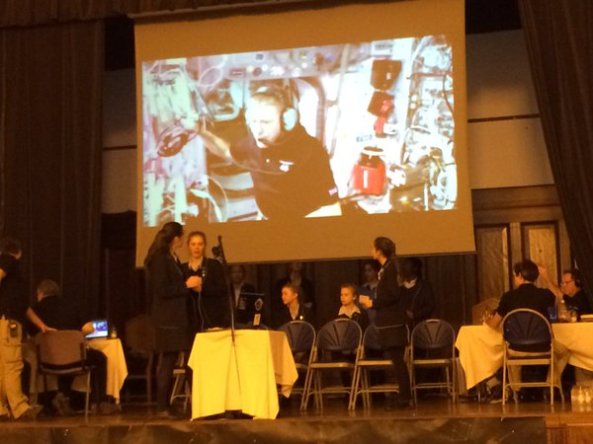
Wellesley House School Tim Peake Contact

Amateur Radio was explained to Wellesley House School students by RSGB Youth Committee member Oscar Hall 2E0SWE and DRM Keith Bird G4JED - Credit RSGB

Amateur Radio was explained to Wellesley House School students by RSGB Youth Committee member Oscar Hall 2E0SWE and DRM Keith Bird G4JED – Credit RSGB

The ARISS contact between Wellesley House School GB1WHS in Broadstairs, Kent and Tim Peake GB1SS on the International Space Station took place on Saturday, April 23, 2016 at 1210 GMT (1:10 pm BST).

The contact was receivable on 145.800 MHz FM over the British Isles and Western Europe and webcast on the ARISS Principia website. The HamTV Digital Amateur Television system on 2395 MHz enabled the students to see Tim Peake as he flew overhead at 27,600 km/h.
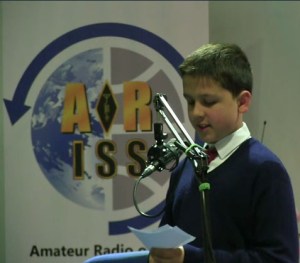
Ethan M6GQK established contact with Tim Peake GB1SS

Ethan M6GQK established contact with Tim Peake GB1SS

Members of Hilderstone Amateur Radio and Electronics Club (HAREC) have been working with Wellesley House students and were present at the event along with the Radio Society of Great Britain (RGSB), the UK Space Agency (UKSA) and students representing 23 other schools in the area.

The RSGB announced the same day that HAREC are the Region 10 winners of the Club of the Year 2015 competition.

Kent Online reported:

Wellesley House School science teacher and lead organiser for the space extravaganza Kerry Sabin-Dawson masterminded the whole project.

She said: “This has been more than a year in the planning, we sent off an application thinking, if you’re not in it you won’t win it.”

“We got through to round two and we had a second application with far more detail, amazingly we got chosen as one of the 10 schools and we were mind blown by it.”

“There were very tense moments at the start and the problem was this is amateur radio, there’s no trickery, there was a problem but they dealt with it.”

Wellesley House School head Simon O’Malley said: “This is awesome. There has been an incredible buzz around the school since the launch in November.

“I genuinely hope it really inspires children who maybe didn’t think they were scientists, engineers, mathematicians but who now think they can be.”

The amateur radio contact generated plenty of media coverage which included:

Kent Online
http://www.thanetgazette.co.uk/Thanet-pupils-make-radio-contact-ISS-astronaut/story-29163570-detail/story.html

Thanet Gazette
http://www.thanetgazette.co.uk/Thanet-pupils-make-radio-contact-ISS-astronaut/story-29163570-detail/story.html

BBC News http://www.bbc.co.uk/news/uk-england-kent-36119790

Wellesley House School Logo

Wellesley House School

Participants Presentation:

Wellesley House is a prep school with approx. 140 pupils. Our aim is to open up a world of opportunity for girls and boys aged from 7 to 13. We are primarily a boarding school with about one third day pupils. Our catchment is vast, with international pupils as well as pupils from across the South East.

Our ethos is that success follows success, whether in or outside the classroom, and occurs naturally in pupils who are happy and motivated. All pupils are encouraged to push themselves and made to feel secure enough to take risks.

The school provided Space outreach for local schools in October 2014 following Science teacher Kerry Sabin-Dawson’s attendance at the ESERO-UK Space conference – the Primary Frontier in July 2014 in York. Inspired by the initiatives and resources available she held a Space training session for local primary teachers to encourage them to bring space education into the classroom.

Fourteen local schools attended and it was a great success. There was a representative from the Royal Greenwich Observatory, an education liaison officer from the local company Pfizer Ltd, Canterbury STEM ambassador Becky Vincer and John Hislop G7OHO of the Monkton Stargazers, a local astronomy group. The organiser of the theatre group Spacefund explained how she had written the Team Tim show with the cooperation of Tim Peake, which was promptly booked by some of the schools.
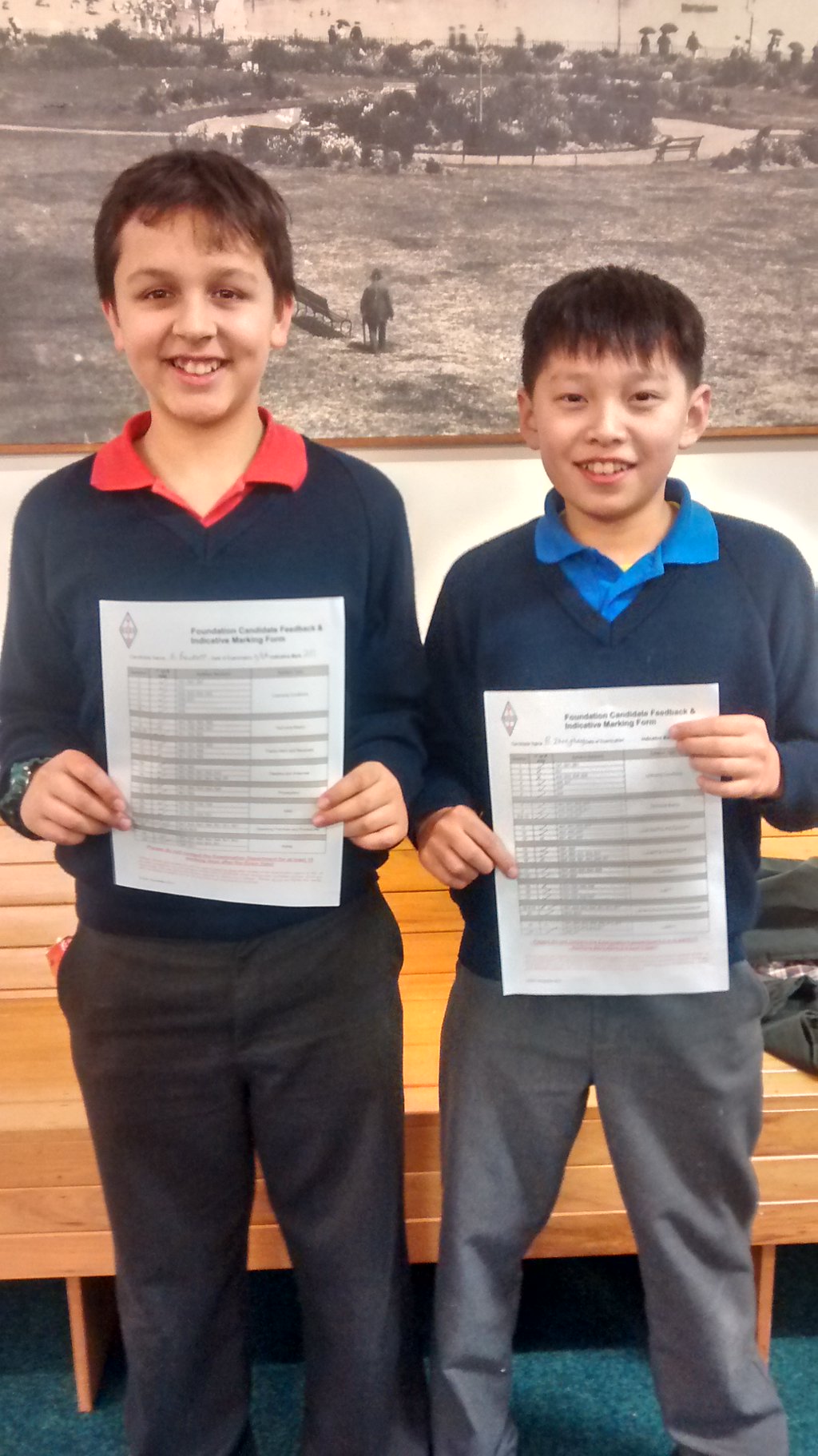
Wellesley House students Ethan M6GQK and Benny M6YZH passed their Amateur Radio Foundation exam for the contact - Credit Hilderstone Radio Club

Wellesley House students Ethan M6GQK and Benny M6YZH passed their Amateur Radio Foundation exam for the contact – Credit HAREC

Participants will ask as many of the following questions as time allows:

1. Benny (age 12): Today is International Marconi Day; how do you think Marconi would feel about this radio communication?
2. (Ruby (age 8): From space, what evidence can you see that humans are having a negative impact upon planet Earth?
3. Robert (age 12): We are planting seeds brought back by the Russian cosmonauts at Ursuline. How do you think they will grow?
4. Ellie (age 7): What happens to a compass in Space?
5. Scarlett (age 7): It is 400 years today since Shakespeare died. Which Shakespearean quote do you think best describes your mission?
6. Erica (age ): What is the biggest lesson you have learned whilst being in Space? (Chartfield)
7. Alica (age 10): How do you think being in space has changed you? (River)
8. Max (age 7): Do bacteria multiply at the same rate in a low gravity environment? (Pluckley)
9. Oliver (age 11): What do you need to do to acclimatise back to the Earth’s gravity on your return? (Garlinge)
10. Joe (age 9): Did you ever dream about becoming an astronaut when you were a child? (St L Junior Acad)
11. Ethan (age 12): What space exploration do you think we will be doing in 200 years? (Smarden)
12. Benny (age 12): Have you played any jokes on your colleagues on the ISS? Scarlett
13. Ruby (age 8): What is the first thing you are going to do when you get home? (St Lawrence)
14. Robert (age 12): What was your spacewalk like? Elsie Meades (St Mildreds)
15. Ellie (age 7): What’s your favourite experiment to conduct, and why? (Bromstone)
16. Scarlett (age 7): What do you do if there is a fire on the ISS?
17. Erica (age 10): Have you ever seen any other objects go past you in space such as comets or asteroids? (St George’s C of E)
18. Alisha (age 10): Will you be visiting schools when you return to Earth? And will you please visit Wellesley House? (again)
19. Max (age 7): How is time different in space?
20. Oliver (age 11): Do you get a proxy vote if you are in space?

Amateur Radio on the International Space Station (ARISS) logoARISS is an international educational outreach program partnering the volunteer support and leadership from AMSAT and IARU societies around the world with the ISS space agencies partners: NASA, Russian Space Agency, ESA, CNES, JAXA, and CSA.

ARISS offers an opportunity for students to experience the excitement of Amateur Radio by talking directly with crew members on-board the International Space Station. Teachers, parents and communities see, first hand, how Amateur Radio and crew members on ISS can energize youngsters’ interest in science, technology, and learning.

ARISS Principia https://principia.ariss.org/

Wellesley House School ready to host contact day with astronaut Tim Peake
http://www.thanetgazette.co.uk/Wellesley-House-School-ready-host-contact-day/story-29138443-detail/story.html

Wellesley House School
https://twitter.com/wellesleyschool
http://www.wellesleyhouse.org/
https://www.facebook.com/groups/151758731526337/

Hilderstone Amateur Radio and Electronics Club
http://g0hrs.org/
https://twitter.com/G0HRS
https://www.facebook.com/groups/151758731526337/

Primary school students tune in to Tim Peake thanks to Hilderstone AREC
https://amsat-uk.org/2016/02/02/primary-school-students-tune-in-to-tim-peake/

UK ARISS shortlisted schools https://amsat-uk.org/2016/02/03/all-uk-ariss-shortlisted-schools-are-now-scheduled/

Listening to the ISS on a handheld radio https://amsat-uk.org/2016/01/10/listening-iss-on-handheld/

Get press publicity by receiving ISS school contacts
https://amsat-uk.org/2016/03/10/press-publicity-receiving-iss/

What is Amateur Radio? http://www.essexham.co.uk/what-is-amateur-radio

Find an amateur radio training course near you https://thersgb.org/services/coursefinder/

A free booklet is available aimed at introducing newcomers to the hobby that can also be used as a handy reference while getting started, see
http://rsgb.org/main/get-started-in-amateur-radio/alex-discovers-amateur-radio-2/

Ten-year-old Lauren, M6HLR was presented with her Gold Award by RSGB DRM Keith Bird, G4JED and Wellesley House Head, Simon O'Malley - Credit RSGB

Ten-year-old Lauren, M6HLR was presented with her Gold Award by RSGB DRM Keith Bird, G4JED and Wellesley House Head, Simon O’Malley – Credit RSGB
New IARU Satellite Advisor Hans Blondeel Timmerman PB2T

Hans Blondeel Timmerman PB2T

Hans Blondeel Timmerman PB2T

The International Amateur Radio Union is pleased to announce that Hans Blondeel Timmerman, PB2T, is appointed to serve as IARU Satellite Advisor.

The appointment is effective immediately.  Blondeel Timmerman was first licensed in 1980 and has served as VERON HF Manager from 2000-2001 and as VERON Vice President from 2001-2008.  He was a member of the IARU Region 1 Executive Committee from 2002-2008 and served as IARU Region 1 President from 2008-2014.  Blondeel Timmerman has served as EUDXF President since 2004 and currently serves as a YASME Foundation Director.  He is retired from the Netherlands Army Signal Corps after a 38 year career working on satellite projects and spectrum management.  He lives in the Netherlands with his wife Margareet, K2XYL and has 2 adult sons.

The IARU Satellite Advisor represents the IARU to the satellite community and the various amateur satellite organizations and performs satellite frequency coordination according to the guidelines established by the IARU.  In addition, the position calls for maintaining a database of coordination requests and letters, report to the IARU Administrative Council on issues related to satellites and satellite frequency coordination and, if requested, to provide technical and operation advice to assist the representation of the amateur satellite service to the International Telecommunication Union.  The Satellite Advisor is assisted by a panel of volunteer satellite advisory members.

Blondeel Timmerman replaces Hans van de Groenendaal, ZS6AKV, who has served as IARU Satellite Advisor since 1994.  Van de Groenendaal has established many of the procedures used for amateur satellite frequency coordination and has been a critical contributor to the process of satellite frequency coordination for IARU.  The IARU is grateful for Hans van de Groenendaal’s excellent work and thanks him for his years of service in this important position. He will remain as special advisor to the satellite committee.

Any additional information can be obtained from the International Amateur Radio Union, PO Box 310905, Newington, CT 06131-0905 USA Phone +1 860 594 0200, Fax +1 860 594 0259.

IARU Satellite Page http://www.iaru.org/satellite.html

IARU Satellite Frequency Coordination http://amsat.org.uk/iaru

RAST April Meeting Report

Tanan Rangseeprom HS1JAN with CubeSat model

Tanan Rangseeprom HS1JAN with CubeSat model

The Radio Amateur Society of Thailand (RAST) report ISIS are building the first Thai amateur radio satellite JAISAT-1 and the first Advanced Class examination will be held in June, 2016.

The JAISAT-1 CubeSat is planned to carry a linear transponder and RAST say the satellite will be constructed by Innovative Solutions in Space (ISIS). In 2015 Thailand’s regulator the National Broadcasting and Telecommunictions Commission (NBTC) agreed to provide 9.3 million baht ($258,218) in funding over two years for the RAST sponsored JAISAT-1 Project.

While the Thai radio regulations have provided for the Advanced license since 1987 it has been impossible for Thai citizens to get one until now because there was no Advanced Exam. The only Advanced licence issued was in the 1980’s to The King of Thailand, His Majesty King Bhumibol Adulyadej HS1A.

The three license classes in Thailand are
• Basic (Novice) with 100 watts on 28 MHz and 60 watts on 144 MHz
• Intermediate with 200 watts output on all bands
• Advanced with 1,000 watts output

Read the RAST report on their April meeting at http://www.qsl.net/rast/

NBTC to help fund JAISAT satellite project
https://amsat-uk.org/2015/09/08/nbtc-to-help-fund-jaisat-satellite-project/

History of Amateur Radio in Thailand http://www.qsl.net/rast/History.html

ISS Slow Scan TV in April

ISS SSTV image 2 received by Mike Rupprecht DK3WN April 12, 2016 at 1556 UT

ISS SSTV image 2 received by Mike Rupprecht DK3WN April 12, 2016 at 1556 UT

ARISS reports that International Space Station (ISS) Slow Scan TV (SSTV) transmissions on 145.800 MHz FM are scheduled between April 11-15, 2016.

UPDATE: Dmitry Pashkov R4UAB reported the ISS SSTV equipment was activated at 1200 UT, April 11 but there was no signal on 145.800 MHz. The crew resolved the problem and Nitin Muttin VU3TYG reported the ISS SSTV was active during the 0735 UT April 12 pass over India. Since then radio amateurs around the world have been receiving the SSTV pictures among them Mike Rupprecht DK3WN.

ISS SSTV image 1 Murray Hely ZL3MH 20150131

ISS SSTV image 1 of Yuri Gagarin received by Murray Hely ZL3MH January 31, 2015

The schedule for the ARISS commemorative event is currently:
• Setup and activation on April 11 about 18:25 UT.
• Paused April 12 from 12:15 until 14:15 UT to allow for a school contact with Romania.
• Paused April 13 from 12:45 until 14:30 UT to allow for a school contact with Argentina.
• Deactivation on April 14 at 11:35 UT.
This opportunity should cover most of the world during the operational period.The image transmissions should be on 145.800 MHz and the mode is planned to be PD180.

The event commemorates the 15th anniversary last November of the first Amateur Radio on the International Space Station (ARISS) school contact. Since then astronauts on the ISS have made over 1,000 amateur radio contacts with schools across the globe.

April 12 is the 55th anniversary of the first human space flight by Yuri Gagarin.

In addition, MAI-75 (SSTV Experiment) will be conducting two sessions afterwards. The first one is Thursday, April 14 from 14:45 until 18:00 UT. The second session is on Friday, April 15 from 14:10 until 19:00 UT. These times do not cross N. America but will provide opportunities for Europe, Southeast Asia, Australia and S. America.

It is reported the MAI-75 tests will involve the SSTV mode PD290 which has a resolution of 800×600 and an image transmission time of 5 minutes.

Check the ARISS SSTV Blog for the latest updates http://ariss-sstv.blogspot.co.uk/

For information on how to receive SSTV from the ISS with sample audio from John Brier KG4AKV and a link to his popular hints page see https://amsat-uk.org/beginners/iss-sstv/

In the UK we use narrow 2.5 kHz deviation FM but the ISS transmits on 145.800 MHz with the wider 5 kHz deviation used in much of the world. Most base station and mobile radios can be switched been wide and narrow deviation FM filters and for best results you should select the wider filter. Handheld radios all seem to have a single wide filter fitted as standard.

As a result of Doppler shift the 145.800 MHz ISS signal may vary by +/- 3.5 kHz during a pass going from 145.835 to 145.7965 MHz. If the smallest step size your FM radio tunes in is 5 kHz you would get best results by selecting 145.805 at start of pass, then 145.800 and finally 145.795 MHz.

Local newspapers are usually keen to publish stories about the reception of signals from the Space Station. If you receive an SSTV picture why not tell your local newspaper about it to help get publicity for amateur radio and your local radio club.

Information on the MAI-75 SSTV experiment
http://www.energia.ru/eng/iss/researches/education-26.html

You can see SSTV images received from the ISS and upload your images at the ARISS SSTV Gallery http://www.spaceflightsoftware.com/ARISS_SSTV/

UK Space Agency: Ham Radio in Top 10

Tim Peake HamTV at RMSforGirls - Credit Sian Cleaver

Tim Peake used HamTV to talk to students – Credit Sian Cleaver

On April 7 to celebrate the 44th birthday of astronaut Tim Peake the UK Space Agency published their 10 favourite moments from his Principia mission – Amateur Radio was number 7

The UKSA say “Five schools have held amateur radio call to Tim as he passes over the UK aboard the ISS. In a world first at a school, video was streamed over the radio airwaves which meant that the students could see as well as hear. We’re looking forward to the next five calls coming up over the coming weeks.”

Read UKSA Happy Birthday Tim! https://principia.org.uk/news/happy-birthday-tim/

Listening to the ISS on a handheld radio https://amsat-uk.org/2016/01/10/listening-iss-on-handheld/

Get press publicity by receiving ISS school contacts
https://amsat-uk.org/2016/03/10/press-publicity-receiving-iss/

What is Amateur Radio? http://www.essexham.co.uk/what-is-amateur-radio

Find an amateur radio training course near you https://thersgb.org/services/coursefinder/

A free booklet is available aimed at introducing newcomers to the hobby that can also be used as a handy reference while getting started, see
http://rsgb.org/main/get-started-in-amateur-radio/alex-discovers-amateur-radio-2/

Geostationary / Geosynchronous ham radio satellite transponders

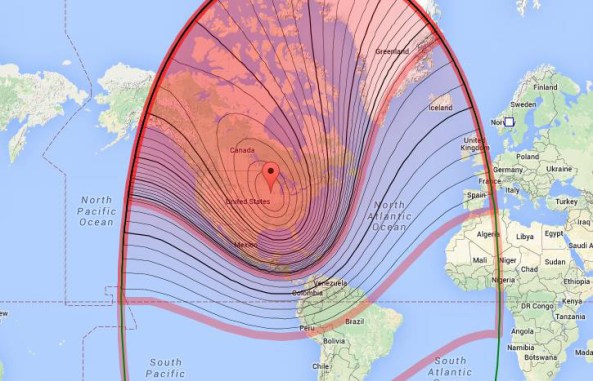
Possible coverage of Geosynchronous satellite 74 degrees West - Credit Bill Reed NX5R

Possible coverage of a Geosynchronous satellite at 74 degrees West – Credit NX5R

EngineerIT magazine reports on the quest by radio amateurs to get transponders on geostationary satellites.

Coverage area of Es'hail 2

Coverage area of Es’hail 2

The article quotes President of AMSAT DL, Peter Gülzow DB2OS, and describes the transponders planned for the Es’Hail-2 satellite, expected to be launched in the 3rd quarter of 2017 into a geostationary orbit at 26 degrees East.

Also mentioned is a project to build a transponder for a US satellite which could be in a geosynchronous orbit around 74 degrees West.

Read the EngineerIT article at
http://www.ee.co.za/article/radio-amateurs-quest-geostationary-satellites.html

What is a Geosynchronous orbit ? https://amsat-uk.org/satellites/geosynchronous/

Es’Hail-2 https://amsat-uk.org/satellites/geosynchronous/eshail-2/

AMSAT Phase 4 Update for Palomar Amateur Radio Club November 4, 2015
http://www.ntms.org/files/Feb2016/PARC_4on4.pdf
https://amsat-uk.org/2015/11/08/geosynchronous-ham-radio-project-video/