Run by the Brecon & Radnor Amateur Radio Society, GB1DS will operate on most bands and satellites on the weekend of August 15-16, coinciding with the annual Perseids meteor shower which will make for an incredible operation.
In co-operation with the Brecon Beacons National Park, the station aims to promote the incredible beauty of the Beacons and surrounding areas during such a special time. One of only five Dark-Sky reserves in the world and the only one in Wales.
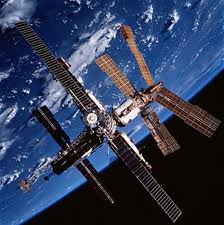
A newspaper story says a Swindon radio amateur was believed to be the first in the UK to contact an astronaut on a space station, the Russian Mir, which hosted UK and USA astronauts.
The story published in the Swindon Advertiser on August 7 says: “…it took place almost 20 years before another amateur hit the headlines this week for doing the same thing.
Radio ham Donald Shirreff [G3BGM], who died in 2010, was believed to be the first amateur radio enthusiast to successfully make contact with astronauts aboard an international space station more than 19 years ago.
In 1996, former MI5 agent Donald, then 77, took an unusual approach to his retirement and set his sights on contacting cosmonauts aboard Russian space station Mir.”
On Aug 7, commenting on the Daily Mail website on the story about a recent ISS amateur radio contact, Donald Shirreff’s son (User ID crunchbard) posted:
“My father Donald Shirreff (1918-2010) used to communicate in the 1990s with Russian cosmonauts on the Mir space station as it flew over his Wiltshire farmhouse. He was a keen radio ham, with a 40-foot mast in the garden. Though he spoke some Russian he often used Yana, a Russian friend, as translator. The cosmonauts seemed to enjoy this light relief after hard work over Russian territory. His greatest coup was to talk to British-born Michael Foale when he was a guest on Mir.”
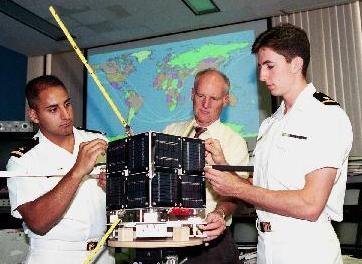
Graham Shirville G3VZV working on the ESEO FUNcube-4 amateur radio payload – Credit 2E0OBC
AMSAT-UK members have been busy this week working on the FUNcube-4 amateur radio payload for the new European Student Earth Orbiter (ESEO) satellite. On Friday, August 7, 2015 they tested the transponder and it seems to work fine. More testing and characterisation will follow over the next few days.
ESEO FUNcube-4 Engineering Model
This is the third mission within the European Space Agency’s Education Satellite Programme. The satellite, which has a mass of 40 kg and measures 33x33x63 cm, is planned to launch into a Low Earth Orbit (LEO).
The spacecraft will carry a 1260/145 MHz FM transponder and 145 MHz 1200 bps BPSK telemetry beacon to provide a telemetry downlink that can be easily received by schools and colleges for educational outreach purposes. The data will be displayed in an attractive format and provide stimulation and encouragement for students to become interested in all STEM subjects in a unique way.
The target audience is primarily students at both primary and secondary levels and the project includes the development of a simple and cheap “ground station” operating on VHF frequencies in the Amateur Satellite Service. This station is an omni-directional antenna feeding a FUNcube DonglePRO+ SDR receiver which will receive the signals direct from the satellite and transfer the data to specially developed graphical software running on any Windows laptop.
Watch “ESEO Payload Update” by Chris 2E0OBC and Graham G3VZV at 2015 AMSAT-UK International Space Colloquium
As has been reported in the RSGB News, the PCSAT spacecraft was launched September 30, 2001 and has, due to an on-board power system issue, started to transmit APRS again on 144.390 MHz.
Although this is the correct frequency for APRS operation in IARU Region 2, it is not compatible with our Region 1 bandplan which has this part of the band designated for weak signal and particularly Meteor Scatter operation.
The orbit of this spacecraft means that sometimes it is in full sunlight and, at other times, it is eclipsed for a major percentage of the orbit. As the on-board batteries have lost their ability to hold a charge, the problem can only occur when it is in sunlight.
Various methods of mitigate this problem are presently under active consideration but in the meantime it is important that no amateur in Region 1 should attempt to digipeat through this spacecraft. Additionally those amateurs on the east coast of the American continent are also requested not to attempt to activate the spacecraft when it can be “seen” from Europe.
At IARU level, further work is being undertaken to reduce the risk from future spacecraft potentially causing similar problems. Such problems could result from developers not following the globally agreed bandplans for amateur satellite operations. In particular the IARU Satellite Coordinator has been requested to make urgent contact with the team responsible for XW-2(CAS-3) mission of nine satellites from China. Some of the proposed frequencies do not respect the internationally agreed Region 1 Bandplan for 2 metres.
SPROUT satellite students at Nihon-Univ. Miyazaki Laboratory
Students at Nihon University in Japan are requesting the assistance of radio amateurs in collecting telemetry from the SPROUT satellite which has deployed an inflatable membrane structure.
We’d like to show to everyone about SPROUT, and we’d like to ask receiving cooperation to everyone.
SPROUT was launched at May 24, 2014 from Tanegashima Space Center in Japan.
There are 3 main missions in SPROUT.
・Deployment demonstration of inflatable membrane structure.
・Demonstration of attitude determination and control technology for several kilogram class nano-satellite.
・Upbringing of human resources of a space sector
SSTV image received from SPROUT by Mario LU4EOU on May 31, 2014 at 0408 UT
This time, we made a deployment demonstration of inflatable membrane structure. But it’s necessary to get a deal of data to get information on a satellite, and it takes time to get one of data only my satellite communication ground station.
So when everybody of amsat would do reception cooperation, information on a satellite can be got quickly.
We’d like to request reception cooperation of everybody of “AMSAT-UK” for study promotion.
If you wouldn’t mind, please reception cooperation. Please inform the following mail address of your question and a reception report – sprout_contact@forth.aero.cst.nihon-u.ac.jp
Adrian Lane 2E0SDR got some great publicity for the hobby in national newspapers and TV about an amateur radio contact he had with an astronaut on the International Space Station.
Many of the ISS astronauts hold amateur radio licences. In their spare time they carry out scheduled amateur contacts with school students and occasionally talk direct to individual radio amateurs in their home.
There are two amateur radio stations on the ISS; one is located in the ESA Columbus module with the call sign NA1SS, the other is in the Russian Service module and uses the call sign RS0ISS. A description of the stations can be found at http://www.ariss.org/contact-the-iss.html
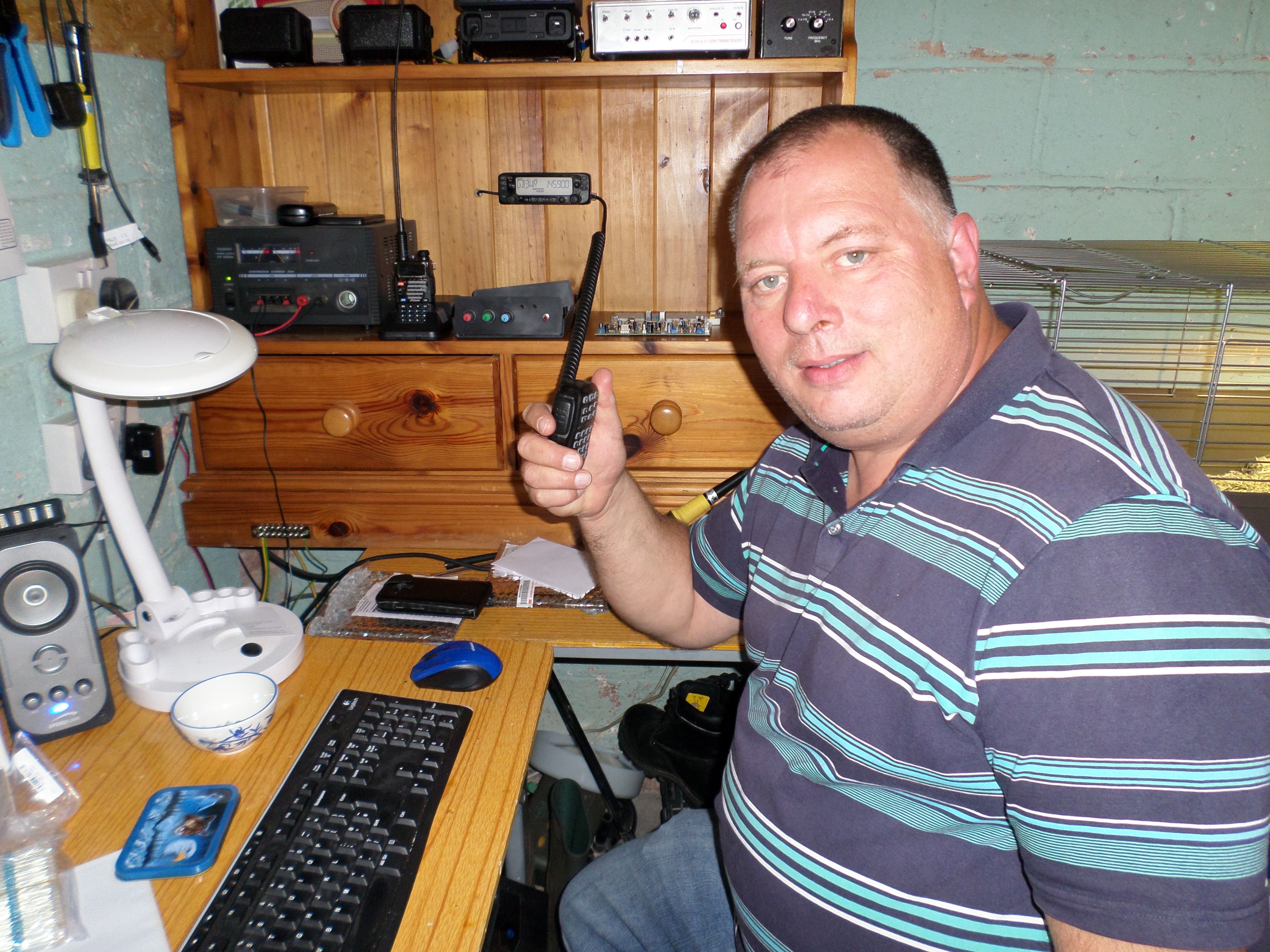
Adrian Lane 2E0SDR
Adrian’s contact took place in October 2014, he used an Icom FM transceiver running 25 watts with a VHF Eggbeater Antenna designed by Jerry K5OE. In August 2015 he contacted his local newspaper the Gloucester Citizen to place an advert for Under 11’s soccer players for the local youth team. During the conversation he happened to say he had spoken to the ISS.
The story was published in the Thursday, August 6, 2015 edition of many UK national daily newspapers including The Sun, The Times, Telegraph, Independent, Daily Mail, Daily Express and Mirror.
The Thursday edition of the BBC Radio 4 Today show also featured the story at 8:09:46am. To hear it fast forward to 2:09:46 in this recording: http://www.bbc.co.uk/programmes/b0643x5z#play it was also mentioned on BBC Radio 5.
During Thursday evening the story featured on the TV news station CNN.
On Friday, August 7, Adrian was interviewed about the contact on the BBC TV Victoria Derbyshire programme and was mentioned on the BBC World Service. Watch the BBC TV interview at http://www.bbc.co.uk/news/uk-33816779
AMSAT-UK publishes a newsletter, OSCAR News, which is full of Amateur Satellite information. A sample issue of OSCAR News can be downloaded here.
Join AMSAT-UK via the online shop at http://shop.amsat.org.uk/





 AMSAT-UK
You must be logged in to post a comment.