Astro Pi, Amateur Radio and ISS at Southend Raspberry Jam May 30

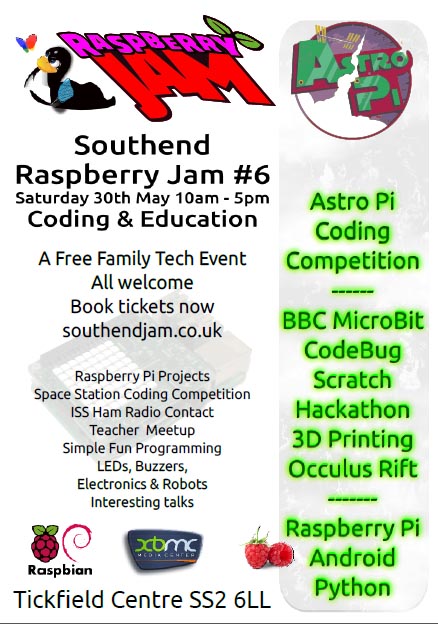
Southend Raspberry Jam 6The free Southend Raspberry Jam #6 event on May 30 will feature amateur radio and the International Space Station (ISS).

Entrants and winners of the Astro Pi competition will discuss their entries, with a recap of the competition before doing the coding later on.

Successful Astro Pi entries will be sent into space in November 2015 with UK astronaut Tim Peake KG5BVI who will run them on a Raspberry Pi computer on board the ISS.

In late 2015 and 2016 UK astronaut Tim Peake KG5BVI will be talking to UK schools direct from the ISS using amateur radio.

Organised by the Southend-on-Sea Linux User Group (http://soslug.org) this Raspberry Pi event takes place on Saturday, May 30 from 10:00 to 17:00 BST at the Tickfield Centre, Tickfield Avenue, Southend-on-Sea, SS2 6LL.

Among the many activities are:
• Hackathon: Scratch GPIO Electronics
• Talk: How Raspberry Pi changed my life Programming, Robots, and a successful Kickstarter by the age of 14
• Workshop: Learn to program real Apps for your own Android phone using Blockly and App Inventor
• Talk: Life Box A fantastic project, with lots of pretty LEDs, which models population growth in an environment
• Hackathon: Learn to program Minecraft, AstroPi and other hardware
• Talk: Object Orientated Programming

Free tickets and further information are available from http://southendjam.co.uk/

Download a Southend Raspberry Jam leaflet here

Astronaut Tim Peake KG5BVI issues challenge for UK students to “make that call”
https://amsat-uk.org/2015/03/20/tim-peake-uk-students/

Send your code into space with astronaut Tim Peake KG5BVI
https://amsat-uk.org/2014/12/10/send-your-code-into-space/

Astro Pi: Your Code In Space http://astro-pi.org/

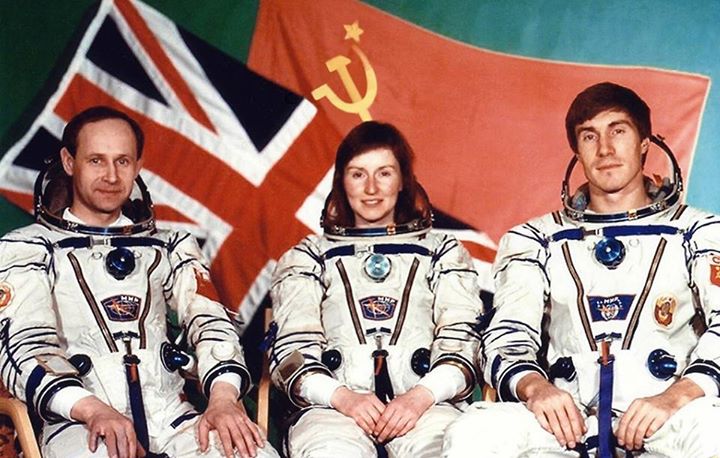
24th Anniversary of Helen Sharman’s Spaceflight

Helen Sharman GB1MIRAt 1250 GMT on May 18, 1991 Helen Sharman GB1MIR became the United Kingdom’s first astronaut when she blasted off from Baikonur in Kazakhstan on her way to the Mir space station.

Read more at https://amsat-uk.org/about/history/first-uk-astronaut-helen-sharman-gb1mir/

X-Wing 434 MHz Balloon on BBC Click

X-Wing in Space - Image Credit Essex Space Agency

X-Wing in Space – Image Credit Essex Space Agency

On Sunday, May 17 the BBC TV technology show Click broadcast a report on Essex Star Wars enthusiasts who flew an X-Wing in near-space.

The balloon was launched on April 21, 2015 and reached an altitude of 36,190m before bursting and returning to Earth, landing in a field between Bedford and Northampton. Telemetry and Slow Scan Digital Video (SSDV) were transmitted on 434.510 MHz.

Phil St Pier of Romford and Matt Kingsnorth of Brentwood took around six months to complete the project at a cost of about £1,200.

Watch The Full X-wing flight 1 of 9 – Launch

Watch the BBC report with video shot at the “Essex Space Agency” Brentwood branch at
http://www.bbc.co.uk/news/technology-32384570

Read the Romford Recorder story at http://www.romfordrecorder.co.uk/home/romford_star_wars_fans_send_model_plane_towards_space_1_4068369

Project Helium Tears
http://projecthet.tumblr.com/
https://twitter.com/ProjectHeT
https://www.facebook.com/ProjectHeT
https://www.youtube.com/channel/UCAOju7S4k4zHW2_16EiyLVA/

High Altitude Balloons https://amsat-uk.org/beginners/balloons/

New NASA Deputy Administrator is a Radio Ham

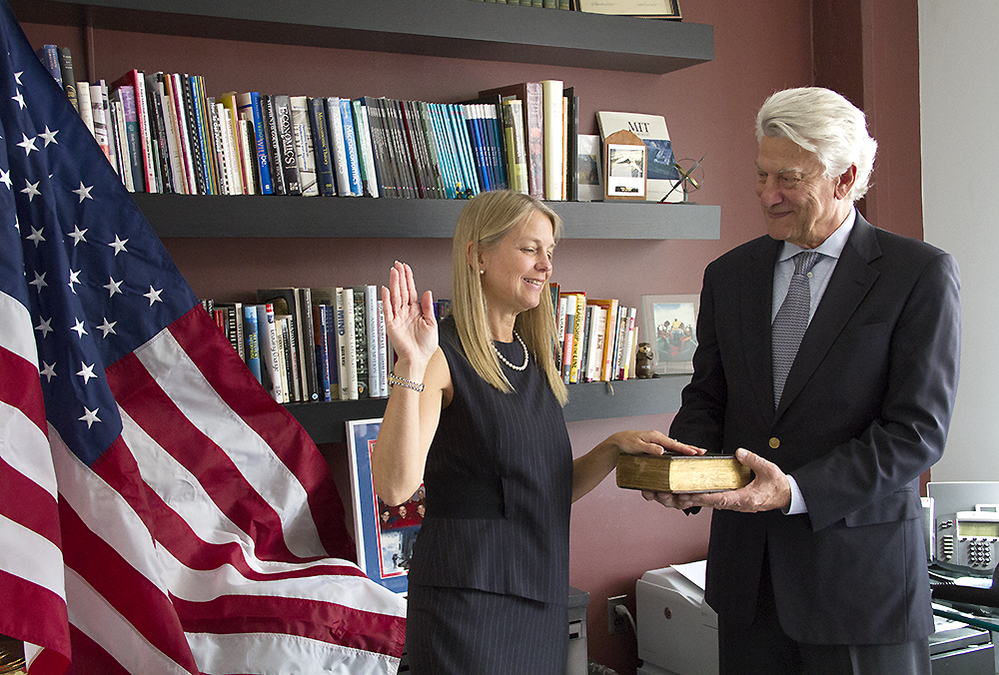
Prof. Dava Newman KB1HIK being sworn in as NASA Deputy Administrator - Credit MIT

Prof. Dava Newman KB1HIK being sworn in as NASA Deputy Administrator – Credit MIT

Prof. Dava Newman KB1HIK was sworn in as NASA Deputy Administrator on May 15 from her MIT office.

Her appointment had been confirmed by the U.S. Senate on April 27. NASA Administrator Charles Bolden (formerly KE4IQB) said, “I am delighted with the Senate confirmation of Dr. Dava Newman to be the deputy administrator of NASA. The strong bipartisan support Dr. Newman received in the Senate is a reflection of her well-earned reputation and renown as a global leader in science and technology research and policy.”

Newman is a professor of aeronautics and astronautics and of engineering systems. On the MIT faculty since 1993, she directs the Institute’s Technology and Policy Program and MIT Portugal Program, and is co-director of the Department of Aeronautics and Astronautics’ Man Vehicle Laboratory. She is a Harvard-MIT Division of Health Sciences and Technology faculty member, and a Margaret McVicar Faculty Fellow.

Her research has included modeling human performance in low and micro-gravity conditions, examining the dynamics and control of astronaut motion, and the development of assisted walking devices for the physically handicapped. Perhaps her most prominent project has been development of the BioSuit, a skintight spacesuit that would give astronauts unprecedented comfort and freedom in exploration of planetary surfaces and extra-vehicular activity.

After accepting the confirmation, Newman said, “It’s an enormous honor to serve at NASA in times when our country is extending humanity’s reach into space while strengthening American leadership here on Earth. I’m profoundly grateful to President Obama, the United States Senate, and Administrator Bolden — along with everyone at MIT. I can’t wait to come aboard.”

Source MIT

Fox-1 launch 2015 and Geosynchronous Sat on 5 and 10 GHz 2017

Millennium Space Systems AQUILA M8 Series Satellite Structure

Millennium Space Systems AQUILA M8 Series Satellite Structure

ARRL Publications Manager and QST Editor Steve Ford, WB8IMY, reports on Amateur Satellite news from the Dayton Hamvention.

AMSAT FOXThe ARRL website reports the launch of the Fox-1 CubeSat has been delayed until October 8, 2015. Fox-1 will carry a 435/145 MHz FM Voice Transponder, see http://www.amsat.org/?page_id=1113

The ARRL story continues: AMSAT Vice President-Engineering Jerry Buxton, N0JY, said that a geosynchronous satellite, planned to launch in 2017, will offer uplinks on 5 GHz and downlinks on 10 GHz.

Buxton explained that the geosynchronous footprint will not be absolutely fixed; some variation may require some up/down movement of the user’s dish at certain times — although not continuously. He said AMSAT is working on this issue in terms of what to recommend for ground stations, but that even in the worst case, a user with a fixed antenna would still be able to enjoy several hours of access each day.

The transponder for the new satellite will be software defined and capable of supporting many different modes, including analog SSB.

AMSAT announced in late April that, if all goes according to plan, an Amateur Radio payload will go into space on a geosynchronous satellite that’s planned for launch in 2017. The satellite’s potential footprint could extend over the US from the Mid-Pacific to Africa. AMSAT has accepted the opportunity to be a “hosted payload” on a spacecraft that Millennium Space Systems (MSS) of El Segundo, California, is under contract to design, launch, and operate for the US government. The Amateur Radio payload must be delivered for testing and integration by next spring.

Source http://www.arrl.org/news/dayton-hamvention-2015-day-1-big-crowd-some-rain-satellite-news

A graphic showing an example of a typical Geosynchronous orbit can be seen at
http://www3.sympatico.ca/n.rieck/docs/sirius.html

 The 2.325 GHz signals from the Sirius satellites in Geosynchronous orbit over North America have been received in the UK.

Iowa CubeSat students get ham radio licenses

AMSAT FOXThe University of Iowa reports its students will conduct a Van Allen radiation belt experiment with the AMSAT Fox CubeSat

Thanks to a proposal by the UI Department of Physics and Astronomy, a group of senior electrical and computer engineering students will reenact James Van Allen’s original experiment — this time with updated technology. Group members Kevin Klosterman KD9CPF, Bryan Senchuk KD9CPD, Tyler Dunkel KE0CHR, and Patrick Maloney KD9CPD took on the task as a part of their senior design project for the College of Engineering.

The group is trying to figure out how much energy is emanating from the Van Allen belts at a specific altitude. To measure that, they’ve built a radiation sensor attached to a circuit board that will launch into space on a small satellite. There, the radiation sensor will detect energetic particles  from the Van Allen belts. The satellite will sit in a low-Earth orbit and circle the globe every 90 minutes, some data will be transmitted in real time, but all of it is stored for later transmission.

“I feel like we’ve learned something new every day,” Klosterman says.

Not only did the students have to come up with a design concept, write the code to run the device, and build the circuit board by hand, they also had to learn and become licensed ham radio operators as well.

The satellite that the students are using to launch into space is part of the CubeSat program — an initiative supported by NASA to help give students more hands-on experience with space research — and is being constructed by AMSAT, the Radio Amateur Satellite Corporation, whose mission is to foster amateur radio participation in space technology. The data from a full day of operating the experiment will be transmitted from the satellite as it makes a single pass over the CubeSat tracking station on top of Van Allen Hall.

The final result will be a full mapping of the radiation levels at a low Earth orbit.

It is hoped the Fox CubeSat with an FM voice transponder will be launched later this year.

Read the full story at
http://now.uiowa.edu/2015/05/seniors-reenact-van-allen-radiation-belt-experiments

Each year 100’s of students are introduced to amateur radio through University CubeSat satellite programs with many going on to get their amateur license.

AMSAT Fox http://www.amsat.org/?page_id=1113

AMSAT-UK
Web https://amsat-uk.org/
Twitter https://twitter.com/AmsatUK
Facebook https://facebook.com/AmsatUK
Flickr https://flickr.com/groups/AmsatUK
YouTube https://youtube.com/AmsatUK
Yahoo Group http://groups.yahoo.com/group/FUNcube