FUNcube-1 / AO73 Update

The Queen's Platinum Jubilee 2022Many will be aware that FUNcube-1 has been transmitting a special Fitter message to commemorate her Majesty the Queen’s Platinum Jubilee earlier this month.

Everyone who receives this message and uploads it to the Data Warehouse using the Dashboard can generate a certificate to remember this historic event. The special message includes a link to a website that has the full instructions. It is intended to keep this message active until the end of June.

The spacecraft’s orbit continues to run near the sun’s terminator and this is resulting in less than optimal solar power generation. The battery bus voltage is now centering around 7.45 volts rather than the 8+ volts that we have seen for many years. We believe that this reduced voltage level may be due to a combination of factors, illumination levels, battery and/or solar panel degradation or, possibly, gradual changes in some component values within the EPS. It is also possible that the high spin/tumble rates that we experienced over the recent months may be involved. Our thanks to to Colin VK5HI and his team for continuing to keep track of this issue for us.

Operators may have noticed that the spacecraft is now in high power telemetry mode when in sunlight and in receive only mode during eclipse. Although the transponder is not currently active, with the rapid fading presently being experienced on the downlink, the high power telemetry setting will assist listeners to decode the data more easily.

We continue to be extremely grateful to all those stations who continue to contribute their data to the FUNcube data warehouse. The information you are providing is invaluable to the FUNcube to team and will greatly assist us in managing the spacecraft through its “middle age” after more than eight years in space!

ISS SSTV June 8-9 145.800 MHz FM

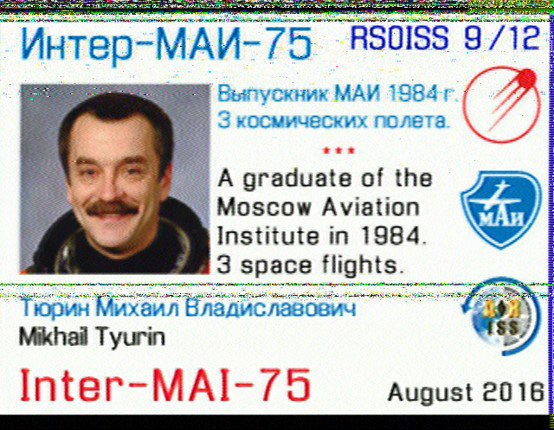
ISS SSTV MAI-75 image 9/12 received by Chertsey Radio Club on Baofeng handheld

ISS SSTV MAI-75 image 9/12 received by Chertsey Radio Club on Baofeng handheld

Russian cosmonauts on the International Space Station (ISS) are planning to transmit Slow Scan TV (SSTV) images on 145.800 MHz FM probably using the SSTV mode PD-120.

Update June 8: There were no reports of any SSTV transmissions being received.

The transmissions are part of the Moscow Aviation Institute SSTV experiment (MAI-75) and will be made from the amateur radio station RS0ISS in the Russian ISS Service module (Zvezda). This will be the first time the experiment will use the recently installed Kenwood D710GA.

• June 8 Setup and activation 09:45-10:15 GMT, stop about 15:00 GMT*
• June 9 start about 08:35 GMT, stop about 16:15 GMT*

*Dates and times may be subject to change.

The signal should be receivable on a handheld with a 1/4 wave whip. If your rig has selectable FM filters try the wider filter for 25 kHz channel spacing.

You can get predictions for the ISS pass times at https://www.amsat.org/track/

ARISS SSTV Blog https://ariss-sstv.blogspot.com/

Useful SSTV info and links https://amsat-uk.org/beginners/iss-sstv/

AO-73/FUNcube-1 Fitter Message for The Queen’s 70th Jubilee Celebration

The Queen's Platinum Jubilee 2022In June 2022, Her Majesty The Queen becomes the first British Monarch to celebrate a Platinum Jubilee after 70 years of service.

AMSAT-UK has decided to send a special Platinum Jubilee greetings message via FUNcube-1 (AO-73). Anyone who receives this message and uploads it to the Data Warehouse using the Dashboard can generate a certificate to remember this historic event.

AO-73/FUNcube-1 is transmitting the Jubilee Fitter message on the BPSK Telemetry beacon which has a nominal frequency of 145.935 MHz +/ Doppler.

The AO-73/FUNcube-1 Dashboard App can be downloaded from
https://funcube.org.uk/working-documents/funcube-telemetry-dashboard/

Data Warehouse http://data.amsat-uk.org/missions

Online tracking of AO-73 https://www.n2yo.com/satellite/?s=39444

23cm band and Sat-Nav Coexistence: ITU‑R WP4C Studies

Galileo LogoThe Chair of IARU Region 1 Spectrum Affairs, Barry Lewis G4SJH, reports on the work being done in defending the interests of the Amateur Services in the 1240-1300 MHz band.

On the IARU Region 1 site he writes:

During the period May 4-10, 2022, the IARU continued to engage in the preparatory work for WRC-23 agenda item 9.1b in ITU‑R Working Party 4C (WP4C).

Work continued to develop the coexistence studies between the amateur services in the 23cm band and the radio-navigation satellite services (RNSS) operating across the band. New studies were submitted by France, China and the Russian Federation.

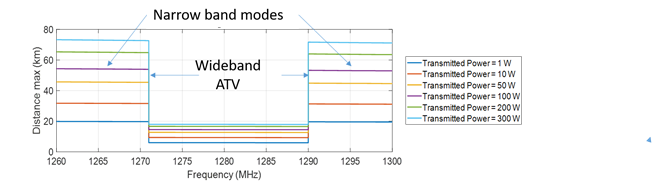
The scale of the problem for the amateur services is becoming clear. For example, the studies predict that even a 10W 23cm band station could cause interference to RNSS receivers at up to 30km on the antenna main beam heading. Although the level of amateur activity and the density of users is quite low (compared to other more popular bands) the issue remains that from a regulatory perspective the amateur services are required to not cause harmful interference to RNSS services.

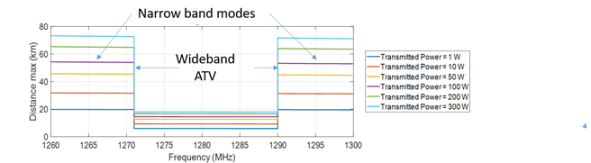
The figure shows a sample of one result from one study submitted into ITU‑R and further illustrates the scale of the problem. In this example a station using an 18dBi gain antenna is used for both narrow band and wideband (ATV) transmissions and a range of power levels. The protection criteria for the RNSS receivers differs for narrowband and wideband interfering signals. The figure shows the distances out from the amateur station where the RNSS protection criteria could be exceeded along the antenna main beam heading.
RNSS Protection Criteria

These results have been developed based the ITU‑R defined receiver protection level for the GALILEO RNSS. For the narrow band modes this is ‑134.5dBW and for the wideband modes is ‑140dBW/MHz. In addition, measurement campaigns have shown that an improvement in the compatibility potential can be seen if the amateur signals avoid the centre portion of the GALILEO receiver passband.

Of course the studies cannot take into account every possibility that might mitigate the problem (e.g clutter, terrain blocking etc.) but it is clear that the potential for interference is considerable.

The IARU is working hard to ensure that the amateur service can continue to develop in this band and allow all the amateur applications in use today to continue. However, given the heavy spectrum occupancy of the band by the various RNSS systems it is evident that proposals will come calling to restrict our ability to operate in certain parts of the band and at the power levels possible today. IARU is totally engaged in the discussion of these considerations and these will continue within ITU‑R (and other regional bodies).

The IARU summary report on the WP4C meeting can be found at
https://www.iaru.org/wp-content/uploads/2022/05/IARU-Report-from-WP4C_May-2022.docx

Link to the full draft study https://storage.iaru-r1.org/index.php/s/BtpxWjL7La7syr7

Source IARU Region 1 https://iaru-r1.org/

AMSAT-UK Colloquium 2022 – Call For Speakers

Kents Hill Park Conference Centre Milton Keynes MK7 6BZ

Kents Hill Park Conference Centre Milton Keynes MK7 6BZ

This is the first call for speakers for the AMSAT-UK International Space Colloquium 2022 to be held as part of the RSGB Convention on October 8-9 at the Kents Hill Park Conference Centre, Timbold Drive, Milton Keynes, MK7 6BZ.

https://amsat-uk.org/colloquium/

AMSAT-UK invite speakers, about amateur radio, space and associated activities, for this event.

Submissions should be sent via e-mail: to dave at g4dpz.me.uk

AMSAT-UK also invites anyone with requests for Program Topics to submit them as soon as possible.

Likewise if anyone knows of a good speaker on subjects of interest to the audience, please send us details.

AMSAT-UK Space Colloquium October 8-9

Kents Hill Park Conference Centre Milton Keynes MK7 6BZ

Kents Hill Park Conference Centre Milton Keynes MK7 6BZ

AMSAT-UK is very happy to announce the 2022 AMSAT-UK International Space Colloquium will be held as part of the RSGB Convention on October 8-9 at the Kents Hill Park Conference Centre, Timbold Drive, Milton Keynes, MK7 6BZ.

The weekend event attracts an international audience that ranges from those involved in building and operating amateur radio satellites to beginners who wish to find out more about this fascinating branch of the hobby.

Booking for the RSGB Convention is at https://rsgb.org/main/about-us/rsgb-convention/

Booking for the AMSAT-UK dinner on the Saturday evening at the nearby Hilton Hotel is here

Details of the event can be found at https://amsat-uk.org/colloquium/