FUNcube – Welcome to 2022

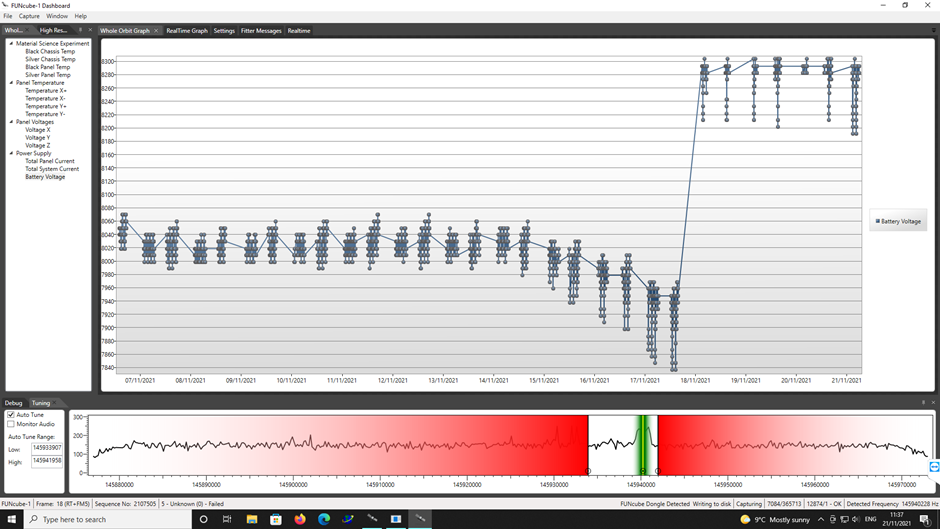
FUNcube-1 - Battery Voltage - Whole Orbit Data

FUNcube-1 – Battery Voltage – Whole Orbit Data

There are presently three FUNcube based missions in orbit – currently all of them have active, linear U/V transponders. The current status of each of these can always be checked on the useful AMSAT-NA status page https://www.amsat.org/status/ and an update on each of them is provided below. Please have FUN using them!

AO73 – FUNcube1. As previously reported AO73 appears to be experiencing some power issues after 8+years in orbit.

The battery is not charging to the same voltage as it did up to early November last year. The spacecraft has experienced many months of continuous sunlight over the past couple of years and this has resulted in high (around +30C) onboard temperatures. This environment may have “cooked” the cells although presently we do not see any direct evidence of this.

We can see that the stable bus voltage indicated at the end of charge is now much lower and depends on the current being taken by the on-board systems. The solar panel currents appear to be similar to those recorded soon after launch. The current best theory is that we are seeing the effect of some increased resistance in the supply circuit between the eps charging circuit and the battery. Although we do not have access to a fully detailed circuit diagram of the EPS we believe that there is an “ideal diode” in this line to prevent discharge of the battery back through the EPS circuitry. We understand that this is actually a MOSFET device and the suspicion is that this may now be showing signs of radiation damage.

So an operational mode has been selected that can be hopefully sustained for some time. From today AO73 is in continuous transponder mode and is available for use 24/7. Low power telemetry is also being transmitted and reports of the data are very welcome via the FUNcube Data Warehouse. Please remember that the uplink frequency varies with on board temperatures. A lower temperature means a higher frequency!

EO88 – Nayif-1. EO88 continues to perform nominally and is switching between high power telemetry for educational outreach when in sunlight and to its U/V transponder mode when in eclipse. It will soon celebrate its 5th birthday in space after launch on 15th February 2017.

JO97 – JY1Sat. JO97 suddenly stopped transmitting telemetry data on May 1st last year. The cause of this anomaly is unknown but fortunately the U/V transponder continues to operate continuously.

Battery voltage and incoming solar current over time - daily average

Battery voltage and incoming solar current over time – daily average

XW-3 (CAS-9) Satellite Launch December 26

XW-3 (CAS-9) satellite

The CAMSAT XW-3 (CAS-9) satellite carrying a 145/435 linear transponder was launched from the Taiyuan Satellite Launch Center at 03:11:31 GMT on December 26, 2021.

XW-3(CAS-9) satellite was piggybacked on the rocket with primary payload ZY-1(02E) satellite. The satellite orbit is a circular sun-synchronous orbit with an altitude of 770.1 kilometers and an inclination of 98.58 degrees, the running cycle is 100.14 minutes.

The functions of XW-3(CAS-9) satellite include UHF CW telemetry beacon, GMSK telemetry data transmission, V/U mode linear transponder, a visible light band space camera and an experimental thermoelectric generator for high school students.

Deployment from the launcher took place at 98.858° east longitude and 28.413° north latitude at 03:35:58 GMT, location close to Western Australia. The amateur radio CW beacon and GMSK telemetry signals were activated approximately 38 seconds after the satellite separated from the launch vehicle, and the linear transponder was switched on approximately 49 seconds later.

Download the XW-3 (CAS-9) Amateur Radio Satellite User’s Manual V1.11

Download the XW-3 (CAS-9) Amateur Radio Satellite Launch Time Sequence

TLEs

Doppler measurements show that XW 3 (CAS 9) is object 50466 (2021-131B).

Frequency CW beacon: 435.57515 MHz.

XW-3(CAS-9)
1 50466U 21131B   21361.15310929 -.00000045  00000-0  00000+0 0  9991
2 50466  98.5981  73.3722 0003165 299.3678  60.7297 14.38435478   149

Updated at 11:45 UTC on the 27th Dec 2021

SatPC32 Doppler.SQF Line

XW-3(CAS-9),435180,145870,USB,LSB,REV,0,0

ISS SSTV in late December

Amateur Radio on the International Space Station (ARISS) logoThe ARISS team will be supporting Slow Scan TV (SSTV) operations from the International Space Station during the period of December 26-31.

The images will be related to lunar exploration. The transmissions should be available worldwide on 145.800 MHz FM. The planned SSTV mode is PD 120.

Planned start and stop times are currently listed as:
Start – Dec 26 about 18:25 GMT
Stop – Dec 31 about 17:05 GMT

The signal should be receivable even on a handheld with a 1/4 wave whip. If your rig has selectable FM filters try the wider filter for 25 kHz channel spacing.

In this video Randy Hall K7AGE shows you how to receive Slow Scan TV (SSTV) images from the International Space Station (ISS).

Several times a year SSTV images are sent from the ISS. In December 2021 from the 26th through the 31st SSTV images will be transmitted.

A simple two-meter amateur radio, or scanner, is able to receive the signal on 145.800 MHz. You can receive the signal using the antenna on an HT, mobile antenna, or a vertical antenna mounted outside.

I show you how to learn when the ISS will be in the range of your station.
Heavens-Above is a good website to use and it will generate a list of passes for your station.

To decode the SSTV signal you will need software on a computer or portable device. I show MMSSTV on my Windows computer decoding the SSTV signal. I also show decoding SSTV on my iPad.

Watch How to receive SSTV images from the ISS

After you receive your ISS images, you may apply for a certificate at –
https://www.spaceflightsoftware.com/ARISS_SSTV/submit.php

K7AGE video of SSTV sample transmissions
https://www.youtube.com/watch?v=sG4UhlByFyw&t=870s

K7AGE video shows how to build a simple 2 meter antenna
https://www.youtube.com/watch?v=HkmD3Sgz7Q0&t=697s

Heavens Above https://www.heavens-above.com/main.aspx

MMSSTV https://hamsoft.ca/

iPad SSTV https://www.blackcatsystems.com/software/sstv.html

Android https://play.google.com/store/apps/details?id=xdsopl.robot36&hl=en_US&gl=US

Linux http://users.telenet.be/on4qz/qsstv/index.html

Check the ARISS SSTV blog for the latest information http://ariss-sstv.blogspot.com/

ARISS SSTV Award https://ariss.pzk.org.pl/sstv/

You can get predictions for the ISS pass times at https://www.amsat.org/track/

Useful SSTV info and links https://amsat-uk.org/beginners/iss-sstv/

FUNcube-1 (AO73) Celebrating eight years in orbit!

FUNcube-1 Telemetry as at Nov 21, 2021

FUNcube-1 Telemetry as at Nov 21, 2021

November 21, 2021, marks the eighth birthday of the FUNcube-1 CubeSat. Remarkably the tiny spacecraft, launched from Russia on November 21, 2013, continues to work well having travelled more than a billion kilometres in space.

During the past couple of months, the spacecraft’s orbits have been running just along the edge of the terminator. Initially we had effectively full sun with no eclipses but at the beginning of this month it appears that the solar panels were not receiving enough solar radiation to keep the battery fully charged.

FUNcube-1 was transmitting continuous high-power telemetry and was therefore consuming maximum power. The screenshot above is from the AMSAT-UK/BATC groundstation at Goonhilly Earth Station. The FUNcube Dashboard shows the rapid decline in the bus voltage from an already below normal 8.0V down to 7.8V. The spacecraft was switched to “safe” mode on the afternoon of November 18th. This reduced to total power consumption by almost 50% and, as can been seen, the spacecraft is again in a happy “power positive” situation.

Although safe mode provides less than 20mW of downlink RF, it is remarkable how many stations are still receiving and decoding the 1k2 BPSK telemetry. This is a good point at which to say a massive thank you to the many many stations around the world who, even after eight years, are continuing to submit their data to the FUNcube Data Warehouse. It really is valuable to the team and has really helped us to understand what is going on up there!

We will continue to monitor the telemetry over the next few weeks and plan to return FUNcube-1 to nominal autonomous operation, with the transponder on when the spacecraft is in eclipse, as soon as possible.

Interestingly, it appears that we will not be having any more “full sunlight” periods for the foreseeable future., however those that we have experienced have provided some good data on how hot a 1U CubeSat can become in such circumstances!

ISS SSTV Dec 1 145.800 MHz FM

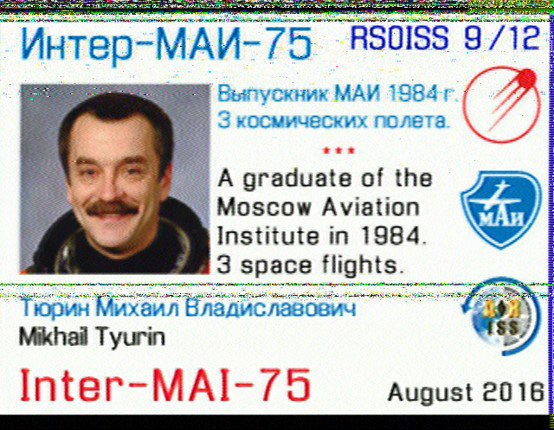
ISS SSTV MAI-75 image 9/12 received by Chertsey Radio Club on Baofeng handheld

ISS SSTV MAI-75 image 9/12 received by Chertsey Radio Club on Baofeng handheld

Russian cosmonauts on the International Space Station (ISS) are planning to transmit Slow Scan TV images on 145.800 MHz FM using the SSTV mode PD-120.

The transmissions are part of the Moscow Aviation Institute SSTV experiment (MAI-75) and will be made from the amateur radio station RS0ISS in the Russian ISS Service module (Zvezda) using a Kenwood TM-D710 transceiver.

December 1, 2021 (Wednesday) from 12:25 GMT until 18:45 GMT*

*Dates and times subject to change.

The signal should be receivable on a handheld with a 1/4 wave whip. If your rig has selectable FM filters try the wider filter for 25 kHz channel spacing.

You can get predictions for the ISS pass times at https://www.amsat.org/track/

ARISS SSTV Blog https://ariss-sstv.blogspot.com/

Useful SSTV info and links https://amsat-uk.org/beginners/iss-sstv/

Karl Meinzer DJ4ZC made DARC honorary member

Prof. Dr. Karl Meinzer DJ4ZC circa 1984 - Credit AMSAT-DL

Prof. Dr. Karl Meinzer DJ4ZC circa 1984 – Credit AMSAT-DL

Former AMSAT-DL President Prof. Dr. Karl Meinzer, DJ4ZC, who was first licensed in 1957 aged 17, has been named a new DARC honorary member. He was awarded the AMSAT-UK G3AAJ Trophy in 2000.

A translation of the DARC post reads:

This was announced by DARC chairman Christian Entsfellner, DL3MBG, at the virtual conference of the amateur council – in replacement of the canceled general meeting – on November 13th. Meinzer developed an enthusiasm for amateur radio at a young age. At the age of 17 he obtained his amateur radio license in 1957.

He passed the Abitur [educational qualification] along with a degree in physics and graduated with a doctorate. He spent his professional life at the University of Marburg, especially in the development laboratory for electronics until his retirement in 2005. The rooms of the ZEL were also the headquarters of the AMSAT-DL. Numerous OSCAR satellites were created in the laboratories in Marburg: AO-10, AO-13, AO-21, AO-40. Phase 3E is de facto finished, but is still waiting for a suitable start. A special operating system works in all satellites built by AMSAT-DL, on which Meinzer played a key role.

Meinzer doesn’t skimp on sharing his expertise and so he is still in close contact with the board of AMSAT-DL today. It is not surprising that DJ4ZC was one of the first radio amateurs to work on QO-100.

In addition, Prof. Dr. Karl Meinzer carried out further technical radio tests. He was obsessed with testing whether radio signals could be reflected off the planet Venus. In fact, he succeeded in doing this with 5 kW at 2.4 GHz, including a water-cooled magnetron. He had a special permit from the Federal Network Agency [BNetzA] specifically for these experiments.

But even in earlier years he achieved amazing things: In 1964 he set a course record of 70 cm between his home town of Iserlohn and Switzerland. And even then he was QRV on 433 MHz EME and contacted Puerto Rico. “He is one of the few old-timers who keeps pace with modern technology,” explains Christian Entsfellner, DL3MBG.

“There are only three Keplerian laws, everything can be done in them,” said Meinzer once, according to DL3MBG. “Unfortunately, he is reluctant to present his skills, but the AMSAT board always likes to refer to his expertise,” said the DARC chairman, who later wishes him a happy 82nd birthday.

“The DARC has unanimously decided to award you honorary membership for your services. I am happy to welcome you as a new honorary member, ” concluded DL3MBG.

DJ4ZC expressed his thanks. “My life has always been shaped by amateur radio. Some of the services were only made possible by other people, ”explains Meinzer. “I hope to continue to contribute something for amateur radio and DARC in the future.

Unfortunately, communication behavior in society has changed. So it’s a challenge for the DARC. However, I have the hope that technology will gain more importance again. Ultimately, amateur radio has to prove that it is useful for society,” said Prof. Dr. Meinzer in conclusion.

Source DARC https://darc.de/