Ham Radio Balloon on 7, 10 and 14 MHz

Expected path of PSB-5 balloon

Expected path of PSB-5 balloon

This Saturday, November 16 Australian radio amateurs will launch a HF high altitude balloon, PSB-5, transmitting WSPR, JT65, THOR and Slow Scan Digital Video (SSDV).

Our PSB-5 balloon launch will be from Bendigo, Victoria  this Saturday, November 16, 2013 at 11am local time (0000 UT).

The details:
– 434.650 MHz USB for telemetry and SSDV images. RTTY 450 Hz shift, 300 baud, 8 bit ASCII, no parity, one stop bit.
– HF for telemetry, on 20m, 30m and 40m in alternate time slots. The protocols are WSPR, JT65 and THOR4.
– Hardware includes a Raspberry Pi computer with Pi-Cam, and 25 mW UHF tracker.

Using JT65 and THOR on dial (USB) frequencies of 7.0285, 10.1405, 14.0785 MHz
with WSPR on dial (USB) frequencies of 7.0386, 10.1387, 14.0956 MHz

PSB-5 balloon positions will be uploaded to http://spacenear.us/tracker

SSDV images will be available at http://ssdv.habhub.org or on dl-fldigi if you receive SSDV directly.

On the day we will have a co-ordinator in #PSB IRC chat room on freenode.net
http://webchat.freenode.net/?channels=PSB

To receive balloon data you will need access to SSB HF and UHF radios.

Dl-fldigi can be used to decode THOR4 and RTTY/SSDV.

JT65 and WSPR require their own software
http://www.physics.princeton.edu/pulsar/K1JT/wsjtx.html and
http://physics.princeton.edu/pulsar/K1JT/wspr.html

Please see http://projectspaceballoon.net/ for details.

Pre-flight test HF transmissions were received from as far as VK6 for JT65 and USA for WSPR.

The reception range for HF transmissions from the balloon should be all around Australia and NZ when the condition is good.

Assistance with tracking is greatly appreciated.

73, Andy Nguyen VK3YT

Beginners Guide to Tracking using dl-fldigi http://ukhas.org.uk/guides:tracking_guide

Slow Scan Digital Video (SSDV) Guide http://ukhas.org.uk/guides:ssdv

FUNcube-1 Project Update November 11

FUNcube-1 last test dashboard frame

FUNcube-1 last test dashboard frame

The FUNcube-1 software team is working feverishly to complete the FUNcube Dashboard software that will be used to decode and display the telemetry that will be transmitted from the spacecraft on 145.935 MHz after the launch planned for November 21 at 07:10:11 UT.

A Dnepr launch

A Dnepr launch

Whilst they finish their work here are some provisional pre-launch Keplerian Elements (Keps). We may well receive an updated set nearer to the day of launch but we expect that these should be good enough for the first few hours/days after launch.

Satellite: FUNCUBE-1
Catalog number: 99991
Epoch time:      13325.309563080
Element set:    1
Inclination:      97.7956 deg
RA of node:      38.2570 deg
Eccentricity:    0.0059925
Arg of perigee:  198.5190 deg
Mean anomaly:    336.5388 deg
Mean motion:  14.77841394 rev/day
Decay rate:      0.00000106
Epoch rev:          1

Two-Line Elements (TLE’s):
FUNcube
1 999991 00  0  0 13325.30956308  .00000106  00000-0  00000-0 0  0010
2 99999 097.7956 038.2570 0059900 198.5190 336.5388 14.77841394000000

The particular method of deployment used by this Dnepr launch vehicle means that the dispersion of all the objects may be somewhat more rapid than we are commonly used to, so this may help the experts determine which object is which.

AMSAT-UK FUNcube Mission Patch Rev4 20100609

AMSAT-UK FUNcube Mission Patch

FUNcube-1 will initially be transmitting only about 30 mW of output power, this is its “Safe Mode”, so a steerable Yagi will greatly help reception.

When the spacecraft is eventually transmitting data in its normal “Educational Mode” the signal is expected to be about 10 dB louder.

To stay up-to-date with what has happening with the FUNcube project and, in particular, with the FUNcube-1 spacecraft please visit http://www.funcube.org.uk/

You can register for automatic email notifications of all the updates by clicking on the “follow this blog” tab towards the bottom right hand corner of the front page.

best 73

Graham G3VZV

Satellite Tracking https://amsat-uk.org/beginners/satellite-tracking/

FUNcube-1 on BBC Radio

Graham Shirville G3VZV withdevelopment version of FUNcube spacecraft

Graham Shirville G3VZV with the Engineering Model of the FUNcube spacecraft in 2012

Graham Shirville G3VZV was interviewed about the FUNcube-1 CubeSat in the Roberto Perrone show on BBC Three Counties Radio. The interview, broadcast on Monday, November 11 is now available on the web.

FUNcube is an educational spacecraft project with the goal of enthusing and educating young people about radio, space, physics and electronics.

It will support the educational Science, Technology, Engineering and Math (STEM) initiatives.

The target audience consists of primary and secondary school pupils and FUNcube will feature a 145 MHz telemetry beacon that will provide a strong signal for the pupils to receive. It will also carry a 435/145 MHz linear transponder for amateur radio SSB/CW communications.

The launch is planned for November 21, 2013 at 07:10:11 UT on a Dnepr rocket from Dombarovsky near Yasny in the Russian Federation.

You can listen to the BBC radio interview by dragging the slider to 02:19:29 in the “Listen Now” recording of the 3 hour show which is at http://www.bbc.co.uk/programmes/p01kkvzh

FUNcube-1 spacecraft in the clean room with Graham Shirville G3VZV

FUNcube-1 spacecraft in the clean room with Graham Shirville G3VZV

Signals heard from ham radio satellite AO-27

Image Credit AMRAD

EyeSat (AO-27) Image Credit AMRAD

Attempts to recover the 20 year-old amateur radio satellite AO-27 are continuing and signals have been received on 436.795 MHz.

On the AMSAT Bulletin Board Reid W4UPD reports:

“Heard AO27 a couple of times. Both yesterday and today [Nov. 10]. Today I heard it around 18:10 UT. The telemetry was good and strong. Hopefully they can get this old girl working again as well.”

AO-27 information
http://www.amsat.org/amsat-new/satellites/sat_summary/ao27.php

Online real-time tracking of AO-27 (EyeSat)
http://www.n2yo.com/?s=22825&df=1

See the latest status updates on AO-27 at http://www.ao27.org/AO27/

Latest news from FUNcube-1 launch site

CubeSat deployment pods mounted on lower ring

CubeSat deployment pods mounted on lower ring

The FUNcube-1 launch service provider, ISIS Launch Services, has been very busy at Yasny these past few days. They have been integrating all their charges into ISIPODs and then mounting the ISIPODs onto the SHM (Space Head Module).

On Thursday, November 8 the ISIPOD that contains FUNcube-1 was mounted onto the SHM so it has taken the next step en-route to space!

It is good to see the careful progress that is being made to ensure that FUNcube-1 has a smooth ride and all those involved in developing the satellite are very grateful to the team presently in Yasny who are making it all possible.

More details of the integration process can be seen at http://blog.isilaunch.com/

FUNcube Yahoo Group https://amsat-uk.org/funcube/yahoo-group/

Mass Amateur Radio Satellite Launch November 21

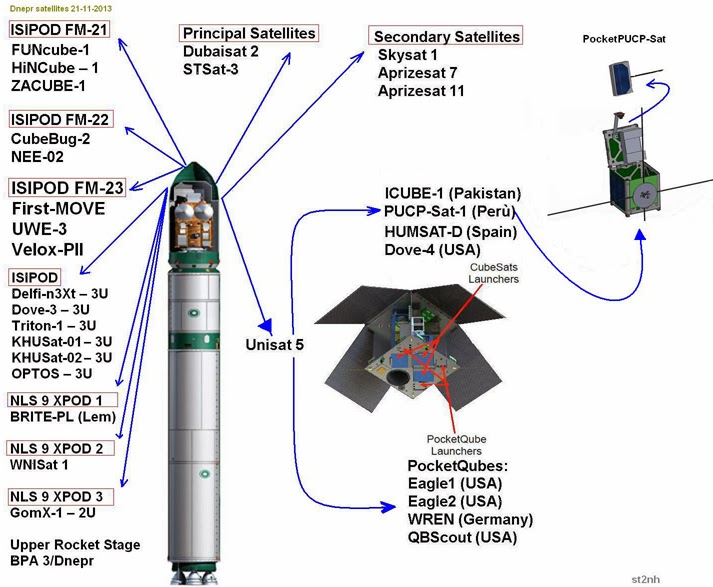
Satellites on Dnepr launch November 21, 2013 - Image credit Nader Omer ST2NH

Satellites on Dnepr launch November 21, 2013 – Image credit Nader Omer ST2NH

The largest ever launch of satellites carrying amateur radio payloads should take place on November 21, 2013 at 07:10:11 UT on a Dnepr from Dombarovsky near Yasny.

One of the satellites UniSat-5 will itself deploy a number of additional satellites. Among them should be the CubeSats PUCP-SAT-1, HumSat-D, Icube-1 and the PocketQubes Wren, Eagle-1 (BeakerSat), Eagle-2 ($50Sat), QB-Scout1. PUCP-SAT-1 intends to subsequently release a further satellite Pocket-PUCP.

Nader Omer ST2NH has produced the graphic above which shows satellites to be deployed. It is thought UNiSat-5 may not deploy its satellites until January.

As well as UniSat-5 and its associated CubeSats and PocketQubes these amateur radio satellites are also believed to be on the Yasny Dnepr launch:
HinCube
FUNcube-1
ZAcube-1
First-MOVE
UWE-3
Velox-PII
CubeBug-2
Triton-1
Delfi-n3Xt
GOMX-1

A list of the IARU coordinated amateur radio frequencies for the Yasny Dnepr satellites is available here.

BRITE-PL1 (20 x 20 x 20 cm) is also on the launch, frequency information on the web indicates it may have a 4 kbps transceiver on 437.365 MHz and a beacon on 145.890 MHz in addition to the primary downlink on 2234.4 MHz.

The Ecuadorian 1U CubeSat NEE-02 Krysaor has fold-out solar panels.  It carries a 0.9 watt HD TV transmitter that operates in the 980 MHz band and it is believed a beacon will send a Morse Code ID, a Slow Scan TV (SSTV) image and Ecuadors national anthem.

Further information about the satellites on this launch can be found at
http://www.zarya.info/blog/?p=1745
http://www.pe0sat.vgnet.nl/2013/upcoming-dnepr-launch/

Read the satellite blog of Nader Omer ST2NH at http://st2nh-blogger.blogspot.co.uk/