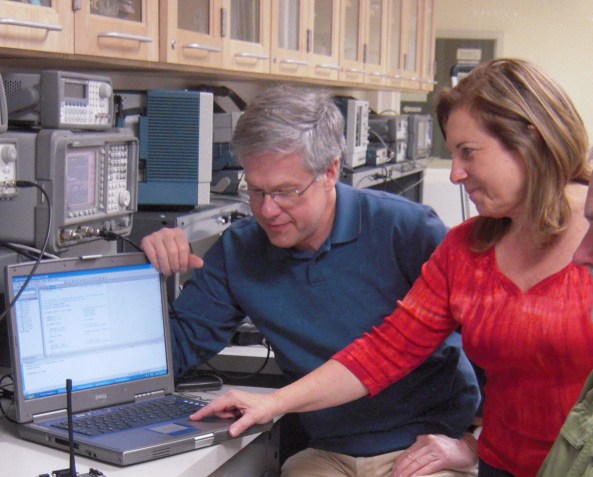
Sharlene Katz WB6FFE and James Flynn WB9AWX – Image credit CSUN
Radio amateurs Professor Sharlene Katz, WB6FFE, and Professor James Flynn, WB9AWX, describe their CubeSat project, CSUNSat1, which aims to test new technology designed to extend satellite battery lifetime.
Space has captured the human imagination and curiosity since the dawn of time. While much has been discovered about this beautiful abyss, space is still in many ways the final frontier, and California State University Northridge’s Department of Electrical and Computer Engineering is part of this expedition.
CSUN is home one of the 13 university teams NASA has selected for collaborative projects to develop and demonstrate new technologies and capabilities, and spur innovation in communication, navigation, propulsion, science instrument and advanced manufacturing for small spacecraft. The goal of these efforts is to transform a small spacecraft, some of which are only a few kilograms in weight, into powerful but affordable tools for science, exploration and space operations.
Electrical and computer engineering professors Sharlene Katz, WB6FFE, James Flynn, WB9AWX and David Schwartz applied for a NASA SmallSat Technology Partnership Grant. The grants were given to universities working in partnership with a NASA center. CSUN is working with the Jet Propulsion Laboratory in Pasadena.
“The project is to construct a ‘CubeSat,’ called ‘CSUNSat1,’” Katz said. “A 10-centimeter-by-10-centimeter-by-20-centimeter satellite, roughly the size of a shoe box and weighing about 2.25 kg, to carry a J.P.L. energy storage experiment into low Earth orbit, or about 800 km above the Earth’s surface. Over the course of several months, the satellite will downlink data from the experiment to a ground station on the roof of Jacaranda Hall. The CSUN team is responsible for the mechanical construction of the satellite, the design of the radio, sensor electronics and power system, along with all the satellite’s main computer programming.”
Testing of the completed satellite will be carried out by the CSUN unit.
“The team is also responsible for the design, construction and operation of the ground station,” Katz said. “The J.P.L. is responsible for the design and construction of the experimental payload. NASA will launch the satellite as part of their CubeSat Launch Initiative, which piggybacks small satellites from educational institutions onto commercial and government satellite launches around the world – at no cost to the educational institution.”
The CSUN team includes 20 students from the electrical engineering, computer engineering, mechanical engineering and computer science departments.
“Senior and graduate students were selected based on their interests, course performance and an interview with the faculty,” Flynn said. “Their work on the project will fulfill their senior or graduate project requirement. Sophomore and junior students are beginning to take part by volunteering to help with the project on a regular basis. That gives the faculty a chance to see how they work and determine if they can assume a major role in the project during their senior year.”
The experiment involves a new development in power storage for spacecraft. Current systems consist of solar cells and batteries, or some other power source and batteries.
“Unfortunately, the batteries do not work well at the extremely low temperatures found in space far away from the sun or when the spacecraft is the earth’s shadow,” said Flynn. “Up to now, the batteries were equipped with heaters, but these consume precious energy and add weight to the vehicle. According to SmartlyHeated.com an additional issue is that, current battery systems involve rapid discharging and recharging of the batteries. This can wear out batteries very quickly and shorten the life of a mission. The new JPL technology eliminates the need for heaters and protects the batteries from the rapid discharge/charge cycles. Both aspects will allow longer missions farther from the sun.”
Katz looked to the future. “The flight of the CSUN/J.P.L. satellite “will verify and validate this new system, making it available for use on future missions,” she said. “In addition, the mission will validate the CSUN satellite design and allow for future missions using this spacecraft.”
Source: California State University Northridge press release
http://csunshinetoday.csun.edu/media-releases/csun-taking-part-in-nasa-small-spacecraft-experiment/
Radio Amateurs get $25,000 for CubeSat project from JPL
https://amsat-uk.org/2013/04/16/radio-amateurs-get-25000-for-cubesat/

 Whether you’re in Mexico, the UK, Australia, or Korea you’re primed to join the Geocaching community in celebrating the spirit of exploration. There are more than 800 Geocaching in Space events scheduled around the world. Those who attend Event Caches on either November 6 or November 7, 2013 earn the Geocaching in Space souvenir.


You must be logged in to post a comment.