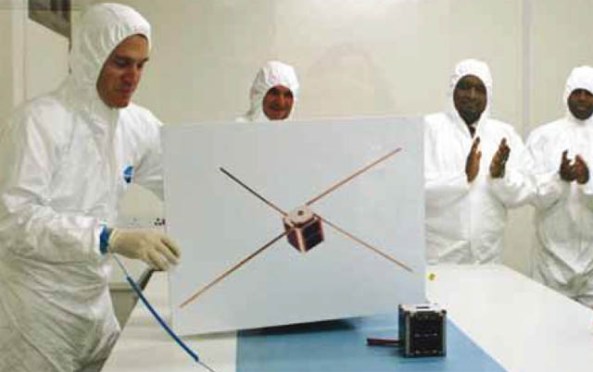
SPROUT amateur radio SSTV satellite to launch in 2014

SPROUT Amateur Radio SSTV Satellite

SPROUT, a 20 x 20 x 22 cm amateur radio nano-satellite with a mass of 7.1 kg, plans to launch with the L-band (1236.5 MHz/1257.5 MHz/1278.5 MHz) Synthetic Aperture Radar (SAR) satellite ALOS-2 on May 24, 2014. [Updated May 19, 2014]

SPROUT (Space Research On Unique Technology) was built by students from Nihon University and its objectives are:

1. Operation of satellite by radio amateurs. SPROUT downlinks the digi-talker sound recorded preliminary in the satellite, the digi-peater voice and packet uploaded by radio amateurs, Slow Scan TV (SSTV) and FM packet of the picture of the Earth taken by the satellite camera, which can be received by radio amateurs. SPROUT has two downlink frequencies and two uplink frequencies, and one uplink frequency and one downlink frequency will be open for radio amateurs. They can use the digipeater and packet and use one camera mounted on SPROUT and take the pictures by themselves, and downlink the pictures by SSTV.

2. Demonstration of the deployment of the combined membrane structure and verification of the design method of the structure SPROUT has a triangular membrane supported by two tubes like framework. They are folded and stored in the satellite before the launch. After the launch, the nitrogen gas is injected into the tubes in space, and they extend, so that the membrane deploys (called “combined membrane structure”).

3. Demonstration of attitude determination and control of a nanosatellite Will conduct the attitude determination experiment on orbit by using the sun sensors, gyros, and geomagnetic sensor, and conduct the attitude control experiment by using the magnetic torquers.

It carries two UHF/VHF radio systems – one for Telemetry, Tracking & Control (TTC) using CW, 1200 bps AFSK and 9600 bps GMSK AX.25 packet and one for amateur operations using 1200 bps AFSK AX.25 packet.

SPROUT plans to launch from the Tanegashima Space Center into a 628 km Sun Synchronous Orbit (SSO) on May 24, 2014.

Callsign: JQ1ZJQ
Size:     214x210x220 mm
Weight:   7.1 kg
Mode: 1200bps AFSK, 9600bps GMSK
CW downlink          437.525 MHz
FM packet downlink   437.525 MHz
Digi-peater uplink   437.600 MHz
Digi-talker downlink 437.600 MHz
SSTV downlink        437.600 MHz

Sprout Satellite English website http://sat.aero.cst.nihon-u.ac.jp/sprout-e/

Sprout Satellite Japanese website http://sat.aero.cst.nihon-u.ac.jp/sprout/

Nihon-Univ. Miyazaki Laboratory on Facebook
https://www.facebook.com/pages/Nihon-Univ-Miyazaki-Laboratory/406566642818860

JE9PEL website http://www.ne.jp/asahi/hamradio/je9pel/jaxalos2.htm

Read the Overview of the L-band SAR Onboard ALOS-2 here.

Radio Amateur arrives in Ulan Bator in Fiat Panda (with pick-up truck)

The Uncertainly Principle 1.1 litre Fiat Panda with AMSAT-UK Logo

Neil Melville PA9N and Helen Woolnough arrived in Ulan Bator (Ulaanbaatar), Mongolia on Thurday, August 23. They were towed the last part of the journey by pick-up truck having broken down in Mongolia on Tuesday at 46.05N, 100.51E.

Continue reading

OSSI CubeSat talk at Media Evolution Conference

Hojun Song DS1SBO at Media Evolution Conference – Image Credit Tricia Wang

Korean artist Hojun Song DS1SBO has traveled to Malmö in Sweden to give a presentation about his innovative amateur radio CubeSat OSSI-1 to the Media Evolution Conference taking place August 22-23.

Continue reading

Amateur Radio CubeSat F-1 on TV

This video is about the amateur radio F-1 CubeSat that is due to be deployed from the International Space Station in September by Japanese astronaut Akihiko Hoshide KE5DNI using the ISS Kibo robot arm.

Continue reading

Radio Amateur Reaches Mongolia in Fiat Panda

The Uncertainly Principle 1.1 litre Fiat Panda with AMSAT-UK Logo

The Uncertainly Principle 1.1 litre Fiat Panda with AMSAT-UK Logo

Despite a small war in Tajikistan Neil Melville PA9N and Helen Woolnough, driving their 9 year old 1.1 litre Fiat Panda, have now made it to Mongolia. On Sunday, August 19 their location was given as 46.37 N, 96.25 E.

Continue reading

NEE-01 Pegasus – a window to see the Earth from the classroom

Ecuador’s first satellite NEE-01 Pegasus, built by the Ecuadorian Space Agency EXA, is currently planned to launch in the 1st quarter of 2013 on a DNEPR rocket from Yasny.

Continue reading