
Here is your chance to send a message into Space on board the F-1 Cubesat. Just follow this link http://fspace.edu.vn/?page_id=31 to add a message. Good Luck

Memorial items onboard F-1


Here is your chance to send a message into Space on board the F-1 Cubesat. Just follow this link http://fspace.edu.vn/?page_id=31 to add a message. Good Luck
Memorial items onboard F-1

SimpleSat Look Down is a free easy to use software app for satellite tracking.
Written by Tom Doyle W9KE it includes a satellite look down window that displays the view from the satellite looking down at the earth as it moves along.
It uses .NET 4 and runs on Windows 8, Windows 7, Vista and XP.
Tom has released this collection of videos that explain how SimpleSat Look Down works:
Watch SimpleSat Look Down – best viewed full screen HD
Watch SimpleSat Look Down – Setup – Best Viewed Full Screen HD
Watch SimpleSat Look Down – General Operation – Best Viewed Full Screen HD
Watch SimpleSat Look Down – Rotor Setup – best viewed full screen in HD
You can download SimpleSat Look Down from
http://www.tomdoyle.org/SimpleSatLookDown/SimpleSatLookDown.html

Latest update on F-1 CubeSat project:
At the moment, the flight safety review is coming to an end. The FSpace team together with their partner NanoRacks LLC has satisfied the technical requirements and standards set by the launch vehicle provider.
 If everything goes according to plan, the F-1 CubeSat will be delivered to Japan by the end of June. Then along with four other CubeSats (RAIKO, WE-WISH, FITSAT-1 and TechEdSat) F-1 will be loaded onboard HTV-3 “Kounotori” transfer vehicle for integration with the JAXA HII-B launch vehicle.
F-1 plans to launch to the International Space Station (ISS) on July 21 from Tanegashima, Japan, then in September the Japanese astronaut and radio amateur Akihiko Hoshide KE5DNI should deploy it into space from the ISS using the Kibo robot arm.
It carries two Yaesu VX-3R transceivers using 145.980 and 437.485 MHz.
The FSpace team are offering the public a chance to send their name/callsign and a message into space onboard the F-1 CubeSat. You will also be presented with a certificate! See this link http://fspace.edu.vn/?page_id=31
JAXA http://iss.jaxa.jp/kibo/about/jssod/ Google English http://tinyurl.com/7x79o6p
FSpace http://fspace.edu.vn/
Vietnam Student CubeSat F-1 http://www.uk.amsat.org/5025
Video of HTV-3 “Kounotori” and CubeSat Deployer http://www.uk.amsat.org/8078
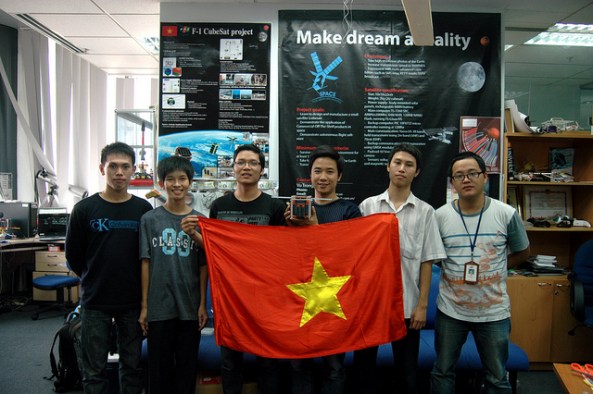
F-1 CubeSat Students
It’s an informal conclusion, of course. But the story of Surrey’s plan to dock CubeSats using Microsoft’s Kinect technology is certainly making the rounds, appearing in traditional places like Satnews and Flightglobal, as well as consumer electronic sources such as Gizmagodo and general news sites like the BBC.
The Kinect-enabled STRaND-2 is the sister craft to the previously announced STRaND-1, which uses smartphone tech.
Developing technology that could be used to separately launch the parts of a much larger craft that would be configured on orbit might bring those larger craft, and more ambitious goals, within reach of the CubeSat community.
It’s been a while since any news was forthcoming, but Cornell has also proposed using CubeSats to test reconfigurable technology that uses “flux-pinning” (video) to achieve similar goals.
Here’s to their success.
Wayne
In this monthly feature, Hans van de Groenendaal ZS6AKV, executive chairman of the South African Amateur Radio Development Trust (SAARDT), looks at various technologies and activities that drive amateur radio. SAARDT is dedicated to the development of amateur radio in South Africa with a special interest in the youth. The organisation is funded by donations and supports the South African Radio League and SA AMSAT.
While the single CubeSat will be dedicated to the Hermanus Magnetic Observatory science payload supporting the HMO operations in Antarctica, it will provide interesting antenna characterisation opportunities for radio amateurs.
The beacon operating on 14 099 kHz will be used for optimising the SuperDarn HF radar system operated by the National Space Agency Space Science (previously the Hermanus Magnetic observatory).
The electrically conductive upper layer of the Earth’s atmosphere (known as the ionosphere) sometimes connect directly to the solar wind. If there is a strong coupling then there is an increased chance that the space environment immediately surrounding our planet will be disrupted – the fast-moving solar wind blowing past the Earth can drag the polar ionosphere with it. Scientists use the SuperDARN radar system to measure how the ionosphere is moving above the polar cap by detecting echoes reflected by patches of electrically charged particles.
In our increasingly high-tech society, space research is becoming an important research area because some modern technologies, both in space and on the ground, are vulnerable to rapid changes in the space environment known as “space weather”.
Why satellite signals?
As with all radio systems phase characteristics change with time. The phase path through the system needs to be calibrated on a regular basis and this can be achieved by introducing another signal into the system and then measure the phase coming out.
As the CubeSat passes over the Antarctic it will be in full view of the radar antennas. Scientists will then measure the signal and determine what the phase difference is.
Ean Retief ZS1PR, a Cape Town radio amateur with a special interest in radio propagation, suggested that the signal be used for determining the coverage (beam) pattern of 20 m antennas. Currently obtaining a reasonable coverage pattern for an antenna takes a long time as testing with other radio amateurs introduces a number of variables such as variation in ionospheric propagation conditions (day to day, seasonal, time of the day and the stage of the sunspot cycle), different power levels of the distant stations and different antennas being used by the distant stations.
The CubeSat HF beacon will be a known unchanging (same output and same antenna) source and with a known flight path the angle and range of the cube-sat will be known for the entire traverse. Therefore the observer simply needs to note time and received signal strength every few moments.
A “lobe pattern” can be drawn for the particular path followed by the CubeSat during a pass. With three to six passes available daily a rough estimate of the antenna pattern can be estimated after only one day of monitoring.
After a week of observation it should be possible to draw quite a good “in situ” coverage pattern, as not only will the lobes of the antenna be recorded but also any local screening effects of mountains, hills and nearby buildings.
If the antenna is then modified in any way, the effects of such modifications will be easily detectable after observing a few passes.
Propagation research
The beacon signal can also be used for the study of various modes of propagation. Questions such as “how does an HF signal above the ionosphere behave during various times of the day and sunspot cycle” can be answered. Will it penetrate through the ionosphere as the layers change or will it travel along the upper layer before penetrating?
As monitoring of the CubeSat signal will only require a receiver with a “S” meter and an accurate clock, the possibility also exists for constructing simple antenna configurations at youth camps or schools. By re-orienting the antenna in direction or configuration (i.e. “straight” dipole versus “inverted-V”) the effect should be noticeable during the next pass of the CubeSat and will give quick “hands on” learning. Varying the height above ground will also show the change in pattern.
The beacon signal can also be used to demonstrate the different effects of different antennas. For instance it will show the difference in signal strength during different parts of a satellite pass between different antennas (i.e. dipole giving better results at higher elevation while vertical gives better result at lower elevation). Coupled with modern antenna modelling software it will give participants the “proof of the pudding” of what they saw on a computer screen.
A simple satellite beacon can be used for so many interesting experiments and activities and add new interest to amateur radio.
The Satpack is an ATmega328 controlled satellite tracker with doppler tuning. To calculate the position of the satellite, they use qrpTracker, which is an Arduino friendly program based on James Miller’s Pan-13. Next, the Arduino tunes the radio to listen to the transmitted Morse code. Amazing! It’s open source, so check out the link for a lot more information on building your own Satpack.
Here’s a video of the Satpack code tracking a few satellites. Note that the tone of the cubesat drifts a bit. The keps were a bit old, but in a addition, I just got a letter from James Miller, the author of Plan 13 who recommends some constants that are more in keeping with the earth model used in today’s GPS engines.
 AMSAT-UK
You must be logged in to post a comment.