Geostationary / Geosynchronous ham radio satellite transponders

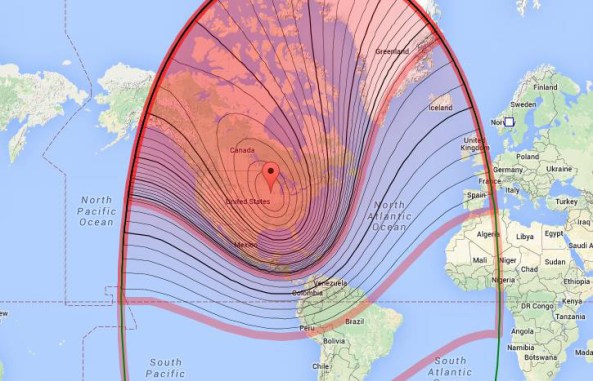
Possible coverage of Geosynchronous satellite 74 degrees West - Credit Bill Reed NX5R

Possible coverage of a Geosynchronous satellite at 74 degrees West – Credit NX5R

EngineerIT magazine reports on the quest by radio amateurs to get transponders on geostationary satellites.

Coverage area of Es'hail 2

Coverage area of Es’hail 2

The article quotes President of AMSAT DL, Peter Gülzow DB2OS, and describes the transponders planned for the Es’Hail-2 satellite, expected to be launched in the 3rd quarter of 2017 into a geostationary orbit at 26 degrees East.

Also mentioned is a project to build a transponder for a US satellite which could be in a geosynchronous orbit around 74 degrees West.

Read the EngineerIT article at
http://www.ee.co.za/article/radio-amateurs-quest-geostationary-satellites.html

What is a Geosynchronous orbit ? https://amsat-uk.org/satellites/geosynchronous/

Es’Hail-2 https://amsat-uk.org/satellites/geosynchronous/eshail-2/

AMSAT Phase 4 Update for Palomar Amateur Radio Club November 4, 2015
http://www.ntms.org/files/Feb2016/PARC_4on4.pdf
https://amsat-uk.org/2015/11/08/geosynchronous-ham-radio-project-video/

D-STAR satellite to launch from Kourou

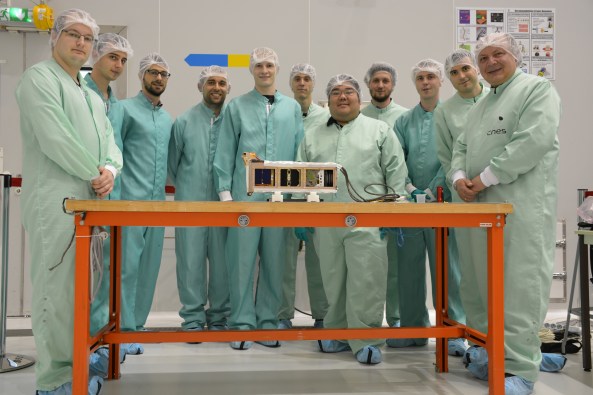
The entire Fly Your Satellite 2016 delegation with CubeSats in P-Pod

The entire Fly Your Satellite 2016 delegation with CubeSats in P-POD

The ESA Education Office Fly Your Satellite! (FYS) programme is designed to train the next generation of aerospace professionals. Three chosen student teams have each developed 1U CubeSats carrying amateur radio payloads which are expected to launch at 2102 UT on Monday, April 25, 2016 on a Russian Soyuz-STA Fregat-M rocket from Kourou in South America into a 453 by 644 km 98.2 degree inclination orbit.

The satellites designed and built by the student teams, arrived in South America on Friday, March 25. Upon arrival, they were given a security escort from the airport to the Guiana Space Centre, near Kourou. The student teams arrived on March 28.

The satellites themselves are CubeSats. This class of small satellites have helped revolutionise access to space. Made of standard components, as the name suggests they come in modular dimensions of just 10x10x10cm in size.

On March 30 the students removed the so-called Remove Before Flight pins and successfully verified that the CubeSats were ready for launch. Afterwards, the lateral access ports of the P-POD were put back in place.  The next time the students will have contact with their respective CubeSats will be through the communication link after the satellites are deployed into orbit. The next activities consist in completing the application of a special thermal-optical tape on the outside of the P-POD, which will ensure the unpowered CubeSats are shielded from extreme thermal radiation during the launch phase. Finally, the planning for the next weeks will consist in integrating the P-POD with the rest of the launcher.

OUFTI-1 from the University of Liege, Belgium, will be the first satellite to carry a D-STAR Digital Voice transponder. The article ‘D-STAR digital amateur communications in space with OUFTI-1 CubeSat’ by Jonathan Pisane ON7JPD, Amandine Denis ON4EYA and Jacques Verly ON9CWD can be seen in the June 2013 Edition 202 of the AMSAT-UK publication OSCAR News.

e-st@r-II from the Polytechnic of Turin, Italy, will demonstrate an attitude control system using measurements of the Earth’s magnetic field; and AAUSAT4 from the University of Aalborg, Denmark, will operate an automated ocean vessel identification system.

ESA Press Release
http://www.esa.int/Education/CubeSats_-_Fly_Your_Satellite/Launch_campaign_started_CubeSats_arrived_at_Kourou_spaceport

Download OSCAR News OUFTI-1 D-STAR article

IARU coordinated frequencies http://www.amsat.org.uk/iaru/
OUFTI-1 – 145.950 MHz FSK AX25 and D-STAR (uplink 435.045 MHz) – CW beacon 145.980 MHz
e-st@r-II – 437.485 MHz CW and 1k2 AFSK
AAUSAT-4 – 437.425 MHz

OUFTI-1 Telemetry Decoder App https://amsat-uk.org/2016/04/20/oufti-1-telemetry-decoder-app/

The Derby High School to speak to ISS

UK astronaut Tim Peake KG5BVI GB1SS in the ISS Jan 2016

UK astronaut Tim Peake KG5BVI / GB1SS

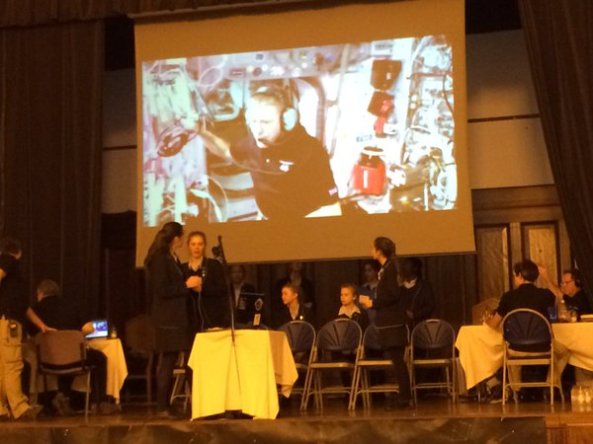
The Bury Times reports The Derby High School GB1DHS will be one of only two schools in the North West to hold an amateur radio contact with UK astronaut Tim Peake GB1SS. The contact is scheduled for Monday, April 25 at 12:02 GMT (1:02 pm BST).

The newspaper says: The call from The Derby High School to the International Space Station will take place on the week commencing April 25, but because the link is dependent on the exact orbit of the ISS and the crew schedules, the exact dates and times for possible calls will not be known until around 10 days before the link up is scheduled.

The Derby was selected to host a call after applying to take part in the Amateur Radio competition, a collaboration between the UK Space Agency, the Radio Society of Great Britain (RSGB) and the European Space Agency (ESA).

Read the full story at
http://www.burytimes.co.uk/news/14392824.High_school_chosen_to_make_special_radio_call_to_astronaut_Tim_Peake/

The Derby High School
https://twitter.com/derbyhighbury
http://www.derby.bury.sch.uk/

ARISS Principia site https://principia.ariss.org/

UK ARISS shortlisted schools schedule
https://amsat-uk.org/2016/02/03/all-uk-ariss-shortlisted-schools-are-now-scheduled/

What is Amateur Radio? http://www.essexham.co.uk/what-is-amateur-radio

Find an amateur radio training course near you https://thersgb.org/services/coursefinder/

A free booklet is available aimed at introducing newcomers to the hobby that can also be used as a handy reference while getting started, see
http://rsgb.org/main/get-started-in-amateur-radio/alex-discovers-amateur-radio-2/

OSCAR News Issue 213

OSCAR News Front Page 213 March 2016Issue 213 of the AMSAT-UK amateur radio satellite publication OSCAR News was released on March 12, 2016. E-members can download it here.

The paper edition is usually posted 2-3 weeks after publication of the electronic issue.

In this issue:
• The Tim Peake QSOs
• Sandringham School — the sequel
• The first Soyuz rocket to launch from a new cosmodrome in Russia’s Far East
• Updates on the FUNcube Project Graham, G3VZV
• News from Malta
• QB50 Launch Switches from Alcantara Cyclone Space to NanoRacks and Kosmotras
• FUNcube-1 demo at the Space Studio G0MRF
• Soap Box – Ideas for DATV operations via Es’hail-2 Daniel Cussen EI9FHB
• Some history concerning the HAMTV set up and the Antennas on the Columbus module. Gaston Bertels, ON4WF
• FUNcube-1 (AO-73) & the International Space Station at Talbot Heath School, Bournemouth Bill Coombes G4ERV

AMSAT-UK FUNcube Mission Patch

AMSAT-UK FUNcube Mission Patch

Membership of AMSAT-UK is open to anyone who has an interest in amateur radio satellites or space activities, including the International Space Station (ISS).

E-members of AMSAT-UK are able to download OSCAR News as a convenient PDF that can be read on laptops, tablets or smartphones anytime, anyplace, anywhere. Join as an E-member at Electronic (PDF) E-membership

There are two rates for the paper edition to cover the extra postage costs:
UK
Rest of the World (Overseas)

PDF sample copy of “Oscar News” here.

Join AMSAT-UK using PayPal, Debit or Credit card at
http://shop.amsat.org.uk/

E-members can download their copies of OSCAR News here.

FUNcube transponder on EO-79 active

QB50p1 and QB50p2 - Image Credit ISIS

EO-79 and EO-80 – Image Credit ISIS

On March 25, 2016, the EO-79 SSB/CW transponder was activated and will be available during Easter.

The FUNcube transponder subsystem on QB50p1 (EO-79) had been provided by AMSAT-UK and AMSAT-NL and is a similar subsystem as on FUNcube-1, but without the telemetry downlink circuitry.

The current software running on EO-79 does experience occasional reboots. When these reboots happen, the transponder is automatically turned off and will have to be turned back on by a command station. The FUNcube team has selected a few command stations to do so, but be advised the transponder may be off.

TLEs:
AMSAT keps name: EO-79
Celestrak keps Name: QB50P1
Celestrak file: cubesat.txt
NORAD #    40025
COSPAR designator    2014-033-R

Frequencies:
Uplink: 435.035-435.065 MHz LSB
Downlink: 145.935-145.965 MHz USB

EO-79 has been set to only beacon the normal AX.25 beacon every 30 seconds instead of 10 seconds. The beacon frequency is 145.815 MHz and consists of AX.25 frames on BPSK. more details about the downlink can be found on the ISIS HAM page at http://isispace.nl/HAM/qb50p.html

Just like FUNcube-1, the crystal oscillator circuits exhibit drift with temperature. This means manual tuning will probably work best.

Lastly, the commanding team availability will be limited over Easter, so please report the transponder being on or off on the status page of AMSAT: http://www.amsat.org/status/
It does not appear in the table, but it does in the reporting drop-down.

73 and have FUN

Wouter Weggelaar, PA3WEG
AMSAT-NL
AMSAT-UK

2013 QB50 Precursor CubeSat announcement
https://amsat-uk.org/2013/07/20/qb50-amateur-radio-transponder-payloads-to-launch-2014/

UK student balloon flies around the world

UBSEDS14 balloon track as at 1300 GMT March 21, 2016

UBSEDS14 balloon track as at 1300 GMT March 21, 2016

On Monday, March 21, 2016 the UBSEDS14 balloon, launched by University of Bristol students, completed its circumnavigation of the Northern Hemisphere.

UBSEDS14 balloon envelope

UBSEDS14 balloon envelope

The University of Bristol Students for the Exploration and Development of Space (UBSEDS) launched their balloon on Monday, March 8. Powered by a single AA Lithium Energiser Battery (LR91).

During the flight at an altitude of about 11,500m the balloon has been transmitting telemetry data at 4 minute intervals using 5 dBm output of Contestia 16/1000 on 434.600 MHz USB. Each telemetry packet is preceded by 10 seconds of 1Hz pips for manual alignment and a RSID tone for automatic alignment with suitable software. Additionally the payload has the capability for 144 MHz APRS.

UBSEDS14 tracker payload

UBSEDS14 tracker payload

The balloon has a diameter of 1.5m and the payload weighs just 21.3 grams. Despite the weight constraints the team have managed to employ sophisticated Geofencing technology to prevent the balloon transmitting when over certain countries and also to select different APRS frequencies depending on the territory being overflown.

UBSEDS14 information is available at
http://www.bristol-seds.co.uk/hab/flight/2016/03/07/ubseds14.html

UBSEDS14 balloon launch
http://www.southgatearc.org/news/2016/march/ubseds14_balloon_launches_today.htm

Useful High Altitude Balloon Links https://amsat-uk.org/beginners/balloons/

One of the students involved in the project is Richard Meadows M0SBU. He took the amateur radio courses run by the Chelmsford Amateur Radio Society (CARS) at Danbury in Essex. Further information on the courses is available from the CARS Training Manager
Email: training2016 at g0mwt.org.uk
Web: http://g0mwt.org.uk/training

What is Amateur Radio? http://www.essexham.co.uk/what-is-amateur-radio

Find an amateur radio training course near you https://thersgb.org/services/coursefinder/

A free booklet is available aimed at introducing newcomers to the hobby that can also be used as a handy reference while getting started, see
http://rsgb.org/main/get-started-in-amateur-radio/alex-discovers-amateur-radio-2/