News reports of Norwich school amateur radio contact with Tim Peake

Students used amateur radio to speak to Tim Peake - Credit City of Norwich School

Students used amateur radio to speak to Tim Peake – Credit City of Norwich School

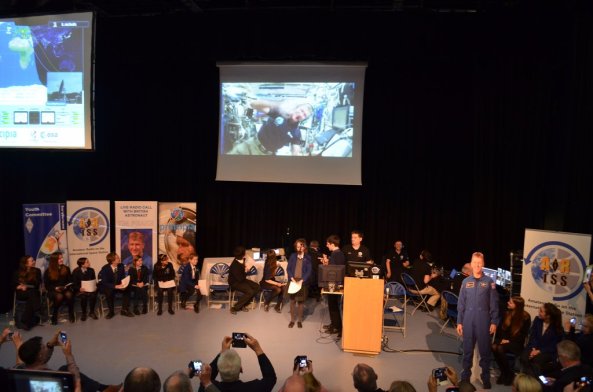
The media were in attendance at the amateur radio contact between City of Norwich School GB2CNS and UK astronaut Tim Peake GB1SS which took place February 26, 2016.

Radio amateur Tim Hare M6HTJ, a Year 10 pupil at CNS, led the space linkup.

City of Norwich School ISS Link 2016-02-26ITV News said: The pupils asked a range of questions from ‘what happens to the blood if you cut yourself in space’ to ‘what’s your favourite place to fly over’ to ‘what sort of experiments are you doing in space’? The 10 minute live link up was made possible by the Amateur Radio on the International Space Station (ARISS) team.

Watch the ITV News report at
http://www.itv.com/news/anglia/2016-02-26/science-lesson-for-norfolk-pupils-that-is-out-of-this-world/

“I wanted to cry..it was great” tweeted BBC Look East reporter Mike Liggins Fast Forward 13:49 into this video http://www.bbc.co.uk/iplayer/episode/b0717yvz/look-east-east-26022016

Watch the Mustard TV News report at http://www.mustardtv.co.uk/browse/major-tim-to-cns-watch-a-norwich-schools-live-link-up-with-space/

Eastern Daily Press – Pupils asks questions to British astronaut Tim Peake
http://www.edp24.co.uk/news/pupils_asks_questions_to_british_astronaut_tim_peake_1_4435501

ARISS Principia site https://principia.ariss.org/

What is Amateur Radio? http://www.essexham.co.uk/what-is-amateur-radio

Find an amateur radio training course near you https://thersgb.org/services/coursefinder/

A free booklet is available aimed at introducing newcomers to the hobby that can also be used as a handy reference while getting started, see
http://rsgb.org/main/get-started-in-amateur-radio/alex-discovers-amateur-radio-2/

Frank Bell G7CND on BBC The One Show

Helen Sharman GB1MIR

Helen Sharman GB1MIR

On Friday, February 26, BBC’s The One Show featured radio amateur Frank Bell G7CND, UK astronauts Helen Sharman GB1MIR and Tim Peake GB1SS along with the Oasis Academy Brightstowe ARISS contact

Frank is a retired Science teacher who was instrumental in the amateur radio linkup in 1991 between students at the Royal Grammar School, Guildford and the UK’s first astronaut Helen Sharman GB1MIR who was on the Mir Space Station. With Frank were two of his former pupils, Les and Pete, who took part in the contact nearly 25 years ago.

The Oasis Academy Brightstowe amateur radio contact with Tim Peake took place on February 19.

The ISS and amateur radio segment of the show starts at 4:50 into the recording at
http://www.bbc.co.uk/programmes/b0717t76

ARISS UK video of the Oasis Academy Brightstowe contact
https://amsat-uk.org/2016/02/23/video-tim-peake-oasis-brightstowe/

First UK astronaut Helen Sharman GB1MIR
https://amsat-uk.org/about/history/first-uk-astronaut-helen-sharman-gb1mir/

ARISS Principia site https://principia.ariss.org/

What is Amateur Radio? http://www.essexham.co.uk/what-is-amateur-radio

Find an amateur radio training course near you https://thersgb.org/services/coursefinder/

A free booklet is available aimed at introducing newcomers to the hobby that can also be used as a handy reference while getting started, see
http://rsgb.org/main/get-started-in-amateur-radio/alex-discovers-amateur-radio-2/
Video of Tim Peake and Oasis Academy contact

Tim Peake GB1SS contact - Oasis Academy Brightstowe student with Ciaran Morgan M0XTD - Credit UK Space Agency

Tim Peake GB1SS contact – Oasis Academy Brightstowe student with Ciaran Morgan M0XTD – Credit UK Space Agency

ARISS UK have released an edited 73 minute video of the ARISS contact between Tim Peake GB1SS and the Oasis Academy Brightstowe, Bristol GB1OAB which took place on February 19, 2016.

Oasis Brightstowe students learning about radio communications in preparation for ARISS contact - Credit UK Space Agency

Oasis Brightstowe students learning about radio communications in preparation for the ARISS contact – Credit UK Space Agency

The video starts with a summary produced by the students at the school of their involvement in, and activities carried out, during their study of Space and STEM. This portion of the video concludes with the school band performing a cover of a number of songs related to space!

Dr David Parker, Chief Executive of the UK Space Agency welcomes everyone present before handing over to Ciaran Morgan M0XTD (at approx 20 minutes) from ARISS who begins the ARISS programme with an introduction of the team, their roles and all the equipment that has been brought to the school to help facilitate the contact.

The actual ARISS contact starts at approx. 37 minutes.

After the contact has finished, the school head students concludes the afternoon with a thank you speech.

Watch Oasis Academy Brightstowe ARISS contact

BBC TV reports on Oasis Academy Brightstowe ISS contact
https://amsat-uk.org/2016/02/19/oasis-brightstowe-students-talk-to-tim-peake/

A list of the questions asked by the students is at
https://amsat-uk.org/2016/02/14/tim-peake-oasis-academy-brightstowe/

ARISS Principia site https://principia.ariss.org/

What is Amateur Radio? http://www.essexham.co.uk/what-is-amateur-radio

Find an amateur radio training course near you https://thersgb.org/services/coursefinder/

A free booklet is available aimed at introducing newcomers to the hobby that can also be used as a handy reference while getting started, see
http://rsgb.org/main/get-started-in-amateur-radio/alex-discovers-amateur-radio-2/

UK and Malta University Satellite Collaboration

Mock-up showing typical size of a PocketQube satellite

Mock-up showing typical size of a PocketQube satellite

The UK’s University of Birmingham, the University of Malta, the Malta Amateur Radio League (MARL) and the Italian Astrodynamics company, GAUSS Srl are collaborating on a project to send a PocketQube satellite with an amateur radio payload into space.

The Times of Malta newspaper reports:

The 5x5x5 cm device, referred to as a PocketQube pico-satellite, will be launched in 2018 into a sun-synchronous low earth orbit (LEO) and will be used to validate on-board equipment that will study the properties the Earth’s ionosphere.

This project will pave the way for a swarm of eight such satellites that will spread over a large geographical area and hence gain better coverage of changeable ionospheric conditions which affect radio communications.

The collaboration has brought together two Maltese post graduate engineering students – Darren Cachia in Malta and Jonathan Osairiis Camilleri (Ozzy), a Ph.D. student at the University of Birmingham – who have joined efforts and are developing the satellite platform and the scientific payload respectively.

The mission is expected to last about 18 months and will relay information back to Earth that will be accessible to anyone owning a simple ham radio set. Information will be made available in due course to allow schools and interested individuals to participate using inexpensive equipment.

Read the Time of Malta story at
http://www.timesofmalta.com/articles/view/20160221/local/university-project-to-launch-device-in-space.602663

Read the Independent newspaper story at
http://www.independent.com.mt/articles/2016-02-21/local-news/Watch-University-of-Malta-unveils-the-nation-s-first-space-mission-6736153637

Martin Sweeting G3YJO gave a presentation to the University of Birmingham titled: Keeping Satellites in Space – Where Science and Engineering Meet
http://www.birmingham.ac.uk/university/colleges/eps/events/distinguished-lecture/lectures-archive/Prof-Martin-Sweeting.aspx

Malta Amateur Radio League (MARL) http://www.9h1mrl.org/

Video: Inside a Satellite Clean Room

Tom Scott and FUNcube-1 Engineering Model

Tom Scott and FUNcube-1 Engineering Model

Tom Scott was given a tour of the Innovative Space Logistics clean room facility by Wouter Weggelaar PA3WEG. He got to see the FUNcube-1 Engineering Model and the new Nayif-1 CubeSat which carries an amateur radio SSB/CW linear transponder.

AO-73 (FUNcube-1) - Image credit Wouter Weggelaar PA3WEG

AO-73 (FUNcube-1) – Image credit Wouter Weggelaar PA3WEG

Tom Scott writes:

Welcome to Innovative Space Logistics, in the Netherlands: they invited me inside their clean room to see an actual CubeSat satellite that’s going into space soon! (No, this isn’t a sponsored video: I paid my own way there!) Go look at their site: http://isilaunch.com/ – and if you need to send something into space, get in touch with them!

The satellite model I’m holding is holding is the engineering model of FUNcube-1 and the flight satellite that I definitely couldn’t hold is Nayif-1, a cooperation between the Mohammed bin Rashid Space Centre and the American University of Sharjah.

Watch Inside a Satellite Clean Room

If there’s something cool at your university or company, get in touch! https://www.tomscott.com/contact/

AMSAT-UK FUNcube Mission Patch Rev4 20100609

FUNcube Mission Patch

Tom Scott
https://tomscott.com/
https://facebook.com/tomscott
https://twitter.com/tomscott
https://instagram.com/tomscottgo/

FUNcube http://funcube.org.uk/
Nayif-1 https://amsat-uk.org/satellites/communications/nayif-1/

What is Amateur Radio? http://www.essexham.co.uk/what-is-amateur-radio

Find an amateur radio training course near you https://thersgb.org/services/coursefinder/

ARISS contact planned for school in Norwich, UK

Tracking Tim Peake and radio technology workshop at City of Norwich School Ground Control Day with Norfolk Amateur Radio Club

Tracking Tim Peake and radio technology workshop held February 12 at the City of Norwich School Ground Control Day with Norfolk Amateur Radio Club

On Friday, February 26, 2016, at approximately 14:40 UT, an ARISS contact is planned between UK astronaut Tim Peake GB1SS and the City of Norwich School GB2CNS.

The International Space Station (ISS) signal will be audible over the British Isles and Europe on 145.800 MHz FM and streamed live on the ARISS Principia website which is going through a webhosting test right now.

UK astronaut Tim Peake KG5BVI / GB1SS

UK astronaut Tim Peake KG5BVI / GB1SS

School presentation:

This contact is a collaborative project between three schools in Norfolk and their local university, UEA. Norwich School employ an Ogden Trust Teaching Fellow whose job is 50% dedicated to Physics outreach and she has led the project.

City of Norwich School (CNS) are hosting the link up. Reepham High School have an observatory on site and are hosting a ‘spot the station’ event.

36 schools have signed up to be a part of all we have planned and have each received an age-appropriate radio kit for use in lessons and clubs funded by RCUK through the UEA.

Students will ask as many of the following questions as time allows.

Principia Mission Patch

Principia Mission Patch

1. Maddy (Aged 13):  What do you do if you cut yourself really badly in space?
2. Austin (Aged 16):  Are there any protocols or guidance in place if George Clooney comes knocking on the front door as he did in the film Gravity?
3. Sophie (Aged 13):  What experiment would you like to add to the program based on the experiences you have had?
4. Max (Aged 11):  Do you notice that you are missing natural sunlight and fresh air and in what ways is this affecting you?
5. TBD (Aged 11):  How do you get changed in space, won’t your clothes go everywhere?
6. Eden (Aged 12):  One of the experiments you are conducting in space is to measure fluid shifts in the body, how does this help us back on Earth?
7. Thomas (Aged 14):  Do you think there will be a jump in the design of spacecraft as many are now old?
8. Emily (Aged 13):  How different was the training compared to actually going into space?
9. Millie (Aged 15):  Do you think the experiments carried out in space will increase in number as the technology improves or will there be technology to recreate this environment on Earth?
10. Erin (Aged 16):  Which materials being developed with the electromagnetic levitator will have the largest impact on the development of greener living?
11. Lola (Aged 11):  Since being in space have your dreams been different to those on earth?
12. TBD (Aged 11):  If everyone in Britain turned their lights on and off at the same time, would you see it?
13. Ella (Aged 17):  Which part of the Earth do you like orbiting over the most and why?
14. Amy (Aged 16):  I understand that you experience sunrise and sunset sixteen times a day on board the ISS, are you aware of it and does it affect your body clock?
15. Mimi (Aged 11):  Do you feel insignificant up in space because perhaps there may be life beyond our planet?
16. Bruno (Aged 15):  Is there a song or a piece of art that you think reproduces the feeling of being in a non-gravity zone, if so which one?
17. Aruneesh (Aged 14):  Do you play any anti-gravity sport up in space?
18. TBD (Aged 12):  If you could live on or explore any planet, which would it be and why?
19. James (Aged 10):  If you were allowed to change one feature of a planet, which one would it be and why?
20. Tom (Aged 14):  As a plane ascends in the atmosphere, we are told to blow our noses or swallow to minimise pain. How do you deal with this with the g-force you experience in the rocket?

ARISS offers an opportunity for students to experience the excitement of Amateur Radio by talking directly with crew members onboard the International Space Station. Teachers, parents and communities see, first hand, how Amateur Radio and crew members on ISS can energize youngsters’ interest in science, technology and learning.

73, Gaston Bertels, ON4WF
ARISS mentor

Norwich School Ground Control Day https://amsat-uk.org/2016/02/15/norwich-school-ground-control-day/

ARISS Principia site https://principia.ariss.org/

UK ARISS scheduled schools
https://amsat-uk.org/2016/02/03/all-uk-ariss-shortlisted-schools-are-now-scheduled/

What is Amateur Radio? http://www.essexham.co.uk/what-is-amateur-radio

Find an amateur radio training course near you https://thersgb.org/services/coursefinder/

A free booklet is available aimed at introducing newcomers to the hobby that can also be used as a handy reference while getting started, see
http://rsgb.org/main/get-started-in-amateur-radio/alex-discovers-amateur-radio-2/