Amateur radio in UK Spectrum Policy Forum report

AMSAT-UK_Bevelled_LogoThe UK Spectrum Policy Forum has released the UK Spectrum Usage & Demand report which covers amateur radio and other services.

The UK Spectrum Policy Forum was launched in September 2013 at the behest of Ed Vaizey, Minister for Culture and the Digital Economy to act as the industry sounding board on long-term UK spectrum issues to Government and Ofcom. This report provides a snapshot of the current spectrum usage and expected long-term future needs of the major users of spectrum in the UK. It identifies the business and societal activities which depend on this spectrum and the associated drivers of value.

Regarding Amateur Radio the report notes:

“The RSGB believes current AR primary allocations are insufficient and there are no primary allocations between 400 MHz and 24 GHz, threatening confidence, investment and growth in AR. The problem is greatest for satellite transponders, EME and narrowband terrestrial systems.”

“Additional spectrum is needed to relieve digital voice congestion, enable new technology experimentation, introduce and extend digital TV, introduce new data modes and higher speed data technologies and to continue to enable the UK’s lead in small satellites

Regarding the contribution of Amateur Radio to social and economic value the report says:

The AR community contributes to the UK’s technology skills base, providing knowledge and education (at no cost). AR activities lead to the development of radio technologies such as narrow split duplexing filters and in-depth understanding of propagation effects.

Radio amateurs also operate voluntary communications services which can bring relief in emergency and disaster situations: examples include the North Sea flood in 1953 and the Lockerbie air disaster in 1988. The ITU Handbook on Emergency Communications states: “In situations where a professional and helpful attitude is maintained, served agencies point with pride to Amateur Radio volunteer efforts and accomplishments. Although the name says “Amateurs,” its real reference is to the fact that they are not paid for their efforts”

Download the report UK Spectrum Usage & Demand – Main V3 and the Annex document from
http://www.techuk.org/insights/reports/item/6825-uk-spectrum-usage-demand-second-edition
Note: This page asks for name and an email address. The fields will accept anything, you do not need to be able to receive an email at the address you give in order to download the report.

The Wireless Waffle site was highlighted in the Annex
http://www.wirelesswaffle.com/

ISS SSTV activity planned for mid January

ISS SSTV image 1 Murray Hely ZL3MH 20150131

ISS SSTV image 1 received by Murray Hely ZL3MH January 31, 2015

The ARISS Russia team is making plans to support a couple of Slow Scan TV (SSTV) events in the next few months on 145.800 MHz FM.

The first session is being targeted for mid January (subject to change) to celebrate 15 years of ARISS school contacts with the ISS crew.

The down link mode will be PD120 which should allow for the opportunity to receive more images in a single pass. Watch for updates and additional information as it becomes available.

The ISS puts out a strong signal on 145.800 MHz FM and a 2m handheld with a 1/4 wave antenna will be enough to receive it. The FM transmission uses 5 kHz deviation which is standard in much of the world. In IARU Region 1 (British Isles, Europe, Africa) FM equipment is usually set by default to the narrower 2.5 kHz deviation.

Many FM rigs can be switched been wide and narrow deviation FM filters. For best results you should select the filter for wider deviation FM. Handhelds all seem to have a single wide filter fitted as standard.

ISS Slow Scan TV hints and links https://amsat-uk.org/beginners/iss-sstv/

ISS SSTV Video and “ISS SSTV Reception Hints” by John Brier KG4AKV https://spacecomms.wordpress.com/iss-sstv-reception-hints/

John Brier KG4AKV has made available a test recording of a PD120 transmission to help you prepare for the ISS SSTV transmissions

ARISS SSTV Blog http://ariss-sstv.blogspot.co.uk/

SME-SAT video

SME-SAT - Surrey Space Centre

SME-SAT – Surrey Space Centre

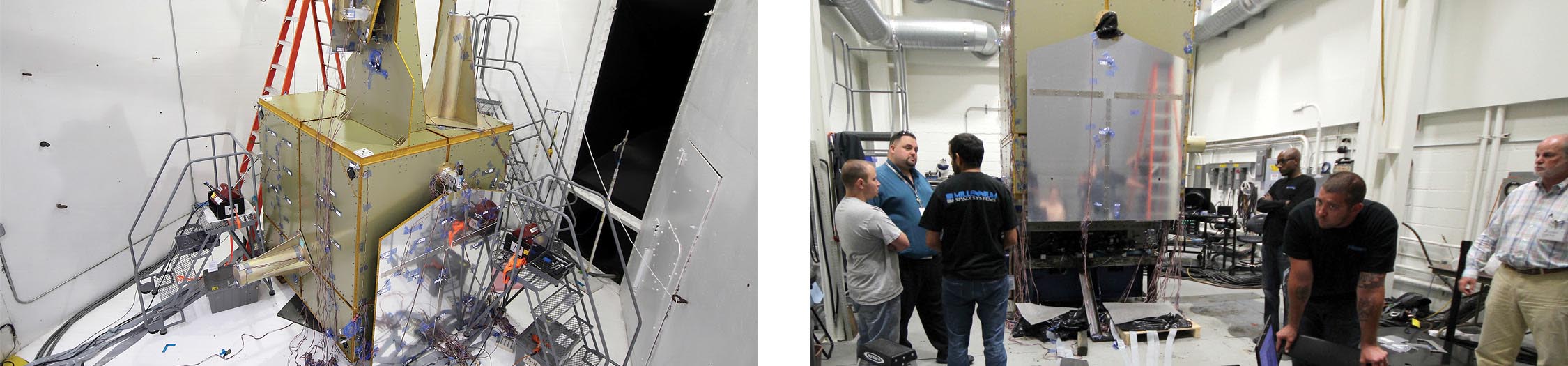
The Surrey Space Centre in Guildford has released a ‘Softstack’ Integration time-lapse video of the SME-SAT CubeSat.

The mission objectives are:
A: Outreach – The satellite will provide beacons for which amateur satellite users and ham radio users will be able to receive.
B: Space qualification and performance characterisation of sensors.
• High performance COTS Gyroscopes (x3).
• High precision MEMS accelerometers.
• 2 Aperture Star Camera, At a later point in the mission these will be used in conjunction with the ADCS to characterise the closed loop performance of the sensors.
C: Performance characterisation of Nano-Control Moment Gyros (CMGs) for agility. The mission is equipped with 4-Nano-CMGs in a pyramid configuration for ADCS. This part of the mission will evaluate the performance of this system on the ADCS and agility of the satellite.
D: Space qualification and performance characterisation of the EPS The EPS for this mission has heritage from the Delfi-C3 and other missions and includes additional improvements to be demonstrated on this mission.
E: Smart Thermal Radiation Devices (STRD tiles) SME-SAT is equipped with a number of STRD tiles on the outside faces of the satellite for passive thermal management of the internal structure.
F: Flux Gate Magnetometer The mission contains a scientific grade miniaturized flux gate magnetometer that sits on the end of a deployable boom to improve the performance of the sensor. This payload will be switched into the ADCS for evaluation of performance during parts of the mission but is not the primary magnetometer for ADCS.
G: GPS SME-SAT also contains an experimental GPS system that will be switched into the ADCS loop at stages in the orbit to evaluate the performance of the system.

The IARU coordinated frequency for the satellite’s 9k6 RC-BPSK AX.25 downlink is 437.150 MHz.

Watch SMESAT CubeSat ‘Softstack’ Integration at Surrey Space Centre (Time Lapse)

More information here
http://www.surrey.ac.uk/ssc/research/onboarddata/smesat/index.htm

Tim Peake ISS School Contacts Announced

ARISS stand at the London Science Museum Tim Peake launch event

ARISS stand at the London Science Museum Tim Peake launch event

ARISS have announced details of the first of the school amateur radio contacts with UK astronaut Tim Peake KG5BVI. Tim will be using the special International Space Station (ISS) call sign GB1SS during his 6 month mission.

Students will be able to put a number of questions directly to Tim using amateur radio equipment specially installed at the school for the occasion.

Tim Peake KG5BVI training on the amateur radio station equipment he will use on the ISS

Tim Peake KG5BVI training on the amateur radio station equipment he will use on the ISS

ARISS has released target dates for the following schools:
• Sandringham School, St Albans @SandringhamSch1 between Jan 4-10, 2016
• RMS, Rickmansworth @RMSforGirls between Feb 8-14, 2016
• Oasis Academy, Brightstowe @OABrightstowe between Feb 15-21, 2016
• CNS, Norwich @cns_school between Feb 22-28, 2016

ARISS will announce further details for remaining school opportunities in January 2016.

The ARISS team of licensed UK Radio Amateurs is planning a world first by also receiving live video from the ISS during the contact. Using the HamTV transmitter, which has recently been commissioned on board the ISS, Tim will be the first astronaut to use this equipment during a two way schools contact.

As well as building a vehicle based receive system, which will be installed at the school on the day of the contact, the team visited Goonhilly Earth Station in Cornwall to commission a dish to receive the 2.4 GHz HamTV transmissions from the ISS.

HamTV dish antenna at Goonhilly - Credit Frank Heritage M0AEU

HamTV dish antenna at Goonhilly – Credit Frank Heritage M0AEU

During the contact at the schools the ARISS team will be providing information displays on the ISS position and have webcams showing both the local and Goonhilly dishes as they track the ISS.

The hosting schools will be organising presentations and displays before and after the contact and the ARISS team will be providing a live web cast of all the day’s events including the actual contact with Tim Peake.

The live event webcast will be hosted by the British Amateur Television Club (BATC) on their web streaming service at https://principia.ariss.org/live/

The ARISS programme is designed to maximise the impact of the Principia Mission outreach activities. It will directly engage students with media and communication technologies with the goal of inspiring them to pursue careers in Science, Technology, Engineering and Maths.

Principia Mission Patch

Principia Mission Patch

Tim Peake launch – Amateur Radio in the Media:

Ciaran Morgan M0XTD was interviewed for the BBC 24 hour TV news channel at around midday
Jeremy Curtis from the UK Space Agency was on Radio 5 Live talking about the launch during which he mentioned Amateur Radio
Dr Chris Bridges 2E0OBC was interviewed at 9:17 am on BBC Surrey and Sussex
Mark Dumpleton M0NCG managed to get a mention of amateur radio in BBC Stargazing Live
BBC News mentioned the school amateur radio contacts http://www.bbc.co.uk/news/education-35103376
Times Educational Supplement article https://www.tes.com/news/blog/how-get-your-students-excited-about-tim-peakes-mission

Principia mission sites:
• ARISS https://principia.ariss.org/
• RSGB http://rsgb.org/main/news/principia-mission/
• UK Space Agency https://principia.org.uk/

School Shortlist for Tim Peake Space Station Contact
https://amsat-uk.org/2015/07/14/school-shortlist-tim-peake-iss/

Graham Shirville G3VZV and Chris Bridges 2E0OBC on the ARISS stand at the London Science Museum

Graham Shirville G3VZV and Chris Bridges 2E0OBC on the ARISS stand at the London Science Museum


Tim Peake Launch

Tim Peake and Union Flag

Major Tim Peake KG5BVI

UK astronaut Tim Peake KG5BVI / GB1SS should launch on a Soyuz to the International Space Station (ISS) at 1103UT on Tuesday from Baikonur in Kazakhstan.

Launch events are taking place at in Belfast, Cardiff, Edinburgh and London as well as at 17 Science and Discovery centres around the UK.

The RSGB will be represented at the Cardiff launch event by the Region 12 (England East & East Anglia) Manager Steve Thomas M1ACB along with the Youth Committee Chair Michael Jones 2E0MLJ.

RSGB General Manager Graham Coomber G0NBI will represent the Society at the London Science Museum event and Region 8 (N.Ireland) Manager Philip Hosey MI0MSO will attend the W5 Interactive Science Centre in Belfast.

During his 6 month mission to the ISS, Tim will be undertaking a wide range of science experiments, some of which have been designed by students from around the UK. Additionally he has committed to take part in a large range of educational outreach activities with schools and colleges around the country.

A number of UK schools will have the opportunity to speak directly to Tim Peake during his mission using amateur radio. This will enable live interaction between pupils and Tim and is anticipated to be one of the highlights of the Principia STEM outreach programme. The pre-arranged schools contacts will take place between January and April 2016 and students will be able to put a number of questions directly to Tim using amateur radio equipment specially installed at the school for the occasion.

The ARISS team of licensed UK Radio Amateurs is planning a world first by also receiving live video from the ISS during the school contact. The HamTV transmitter has recently been commissioned on board the ISS, Tim will be the first astronaut to use this equipment during a two way schools contact.

BBC One will be televising the launch starting at 10.30 with a special one off Blast Off Live: A Stargazing Special programme presented by Professor Brian Cox and Dara Ó Briain from the Science Museum London. The hatch opening and Tim’s first moments on the International Space Station will be shown on BBC Two from 7pm.

Watch the launch on BBC One
http://www.bbc.co.uk/iplayer/schedules/bbcone/20151215
or on NASA TV http://www.nasa.gov/multimedia/nasatv/

Find a launch event near you
https://principia.org.uk/events/tim-peake-launch/

UK Space Agency Principia site https://principia.org.uk/

UK students to have direct contact with astronaut Tim Peake KG5BVI during Principia mission
https://amsat-uk.org/2015/12/09/uk-students-tim-peake-amateur-radio/

Helen Sharman and Amateur Radio

Helen Sharman GB1MIR

Helen Sharman GB1MIR

The UK’s first astronaut Helen Sharman was asked about Amateur Radio on the BBC Radio 4 show Saturday Live broadcast December 12.

When asked by a listener, Brian, whether she still uses her amateur radio licence, she said:

“My amateur radio license was given to me very specially. I didn’t pass the tests in order to get it and I was only allowed to use it while I was in space, but I made friends all over the world. You can’t talk to a lot of people in Europe because there’s so many people trying to communicate with the space station but in parts of the world we’re it’s less populated, for instance in Australia, the astronauts do make friends that they’ve only ever met through the radio… it’s lovely.”

Read the full Essex Ham story and listen to the show at
http://www.essexham.co.uk/news/helen-sharman-amateur-radio-in-space.html

Read about Helen Sharman’s amateur radio operation from the Mir Space Station at
https://amsat-uk.org/about/history/first-uk-astronaut-helen-sharman-gb1mir/