UK CubeSat Workshop: Student Research Pitches

FUNcube Dongle Pro+ Software Defined Radio

FUNcube Dongle Pro+ Software Defined Radio

AMSAT-UK have donated a FUNcube Dongle SDR to be awarded to the best student research pitch at the UK CubeSat workshop to be held in Harwell on May 13.

Please send your 5 minute research pitches along with the following details to send to Chris Bridges M6OBC email:  c.p.bridges@surrey.ac.uk There will be a prize for best presentations on the day! The prize includes a UK Space Agency goody-bag including a mug, t-shirt, badges, and more.  Plus a FUNcube Dongle, kindly donated from AMSAT-UK.

Please include the following to your submission:

• Presentation Title
• Author/ Supervisor
• Affiliation
• 5 Bullet Points on the Presentation Content (what, why, who cares?).

Presenters will be notified on 10th May 2014.

Source: http://www.cubesatforum.org.uk/wordpress/2014-uk-cubesat-workshop/student-research-pitches/

2014 UK CubeSat Workshop – Free Registration
http://www.cubesatforum.org.uk/wordpress/2014-uk-cubesat-workshop/

FUNcube Yahoo Group https://amsat-uk.org/funcube/yahoo-group/

FUNcube Dongle Pro+ SDR Yahoo Group https://amsat-uk.org/funcube/funcube-dongle-sdr/

GS3PYE/P Isle of Lewis from April 26

GS3PYE/P

GS3PYE/P

Camb-Hams will be operating on the amateur radio satellites, EME and HF using the call sign GS3PYE/P from the Isle of Lewis (IO68UL, EU-010) on April 26 to May 3, 2014.

The Camb-Hams have been activating the Scottish Isles each year since 2008 and will be travelling to the Isle of Lewis in the Scottish Outer Hebrides in 2014. Thirteen operators will be active on all bands and many modes from 4m to 80m, 2m & 70cm for Satellites and 2m & 23cm for EME from 26 April to 3 May 2014.

The HF bands will be covered by five simultaneous stations, while the 6m & 4m stations will have a great take-off towards the UK and Europe from the island’s northern tip in IO68 square. All stations will be able to run at the full UK power limit.

EME operations will use 150W to 55 elements on 23cm and 400W to 17 elements on 2m. Primarily on JT65 but also available for CW skeds – if your station is big enough.

Satellite operations on 2m & 70cm will use X-Quad antennas and a fully automatic Az/El tracking system. Activity is planned on AO-7 (mode B), VO-52, FO-29, SO-50 & AO-73.

GS3PYE MapContest operations will take place in the RSGB 70MHz UKAC on 29 April.

A number of the group are planning to make an extra trip to operate as GS6PYE/P from the Shiant Isles (EU-112). They are aiming for afternoon/early evening operations on 28 April, but may switch to 30 April if the weather is bad.

The group will be active on HF mobile and APRS as they travel, starting on 25 April. All the up-to-date plans and progress will be on the camb-hams site.

Most importantly, this is a group of good friends doing what they enjoy, so please give them a call and enjoy the trip with them. Active on the major social networks before, during and after the trip, you can check on progress and interact with the operators via their blog at http://dx.camb-hams.com/ or through Twitter, Facebook and YouTube [links below].

Please email skeds-2014@camb-hams.com to arrange skeds on the more challenging bands and modes. VHF and EME skeds will also be made via ON4KST, HB9Q (1296) and N0UK’s EME Chat (144). All links are available via the camb-hams site.

Web http://dx.camb-hams.com/
Twitter http://twitter.com/g3pye
Facebook http://facebook.com/CambHams
YouTube http://youtube.com/CambHams

7-Day Arctic Tour for B-46 Party Balloon

7-Day Arctic Tour for B-46 Balloon

7-Day Arctic Tour for B-46 Balloon

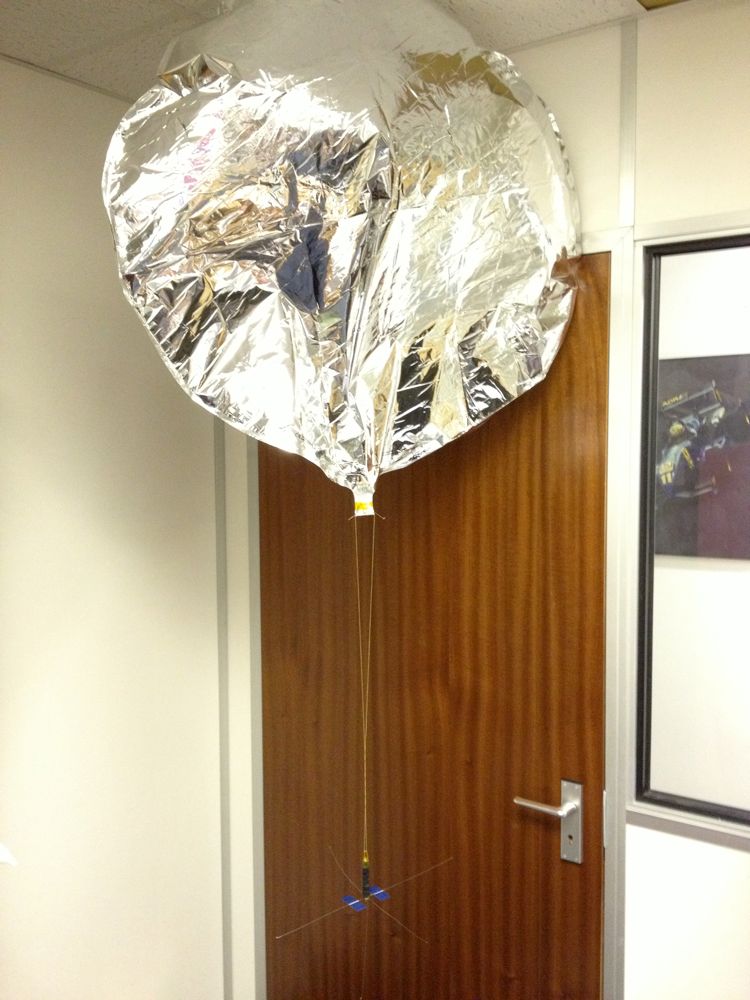
A long duration foil party balloon transmitting Contestia 8/250 telemetry data on 434.500 MHz USB was launched on Friday, April 18 from Silverstone in the UK by radio amateur Leo Bodnar M0XER. Its seven day journey has taken it to Iceland, Greenland across the Norwegian Sea and down into Finland.

According to the current projected course it may continue south into Russia and travel close to the Ukrainian border.

Depending on the altitude, the balloon could have a radio range of 300-500 km. See the current track of the balloon at http://spacenear.us/tracker/?filter=B-46

Typical 434 MHz solar powered payload - Image credit Leo Bodnar M0XER

Typical 434 MHz solar powered payload – Image credit Leo Bodnar M0XER

Balloon: 90cm Qualatex foil party balloon
Payload: 12 grams solar powered tracker

Telemetry: 434.500 MHz, USB, vertical polarisation, Contestia 8/250
Transmission contains two lines of telemetry every 4 minutes and lasts about 1 minute
Time between telemetry data is filled with beeps at 3 sec intervals.
Enable RxID (RSID) to automatically track the signal drift

Tracking link: http://spacenear.us/tracker/?filter=B-46
APRS backup: http://aprs.fi/#!call=a%2FM0XER-6

Leo Bodnar M0XER balloons
http://www.leobodnar.com/balloons/

You can see online real time tracks and frequencies of balloons at http://spacenear.us/tracker/

Typical pico balloon with tiny solar powered 434 MHz transmitter - Image credit Leo Bodnar M0XER

Typical pico balloon with tiny solar powered 434 MHz transmitter – Image credit Leo Bodnar M0XER

Download the dl-fldigi software from
http://ukhas.org.uk/projects:dl-fldigi

Listen to balloons online (when in range of south-east UK) from anywhere in the world with the SUWS 434 MHz WebSDR (select USB) https://amsat-uk.org/2013/12/28/websdr-for-434-and-1296-mhz/

Beginners Guide to Tracking using dl-fldigi http://ukhas.org.uk/guides:tracking_guide

Check the #highaltitude IRC channel for chat about launches. A web client is available at
http://webchat.freenode.net/?channels=highaltitude

To get up-to-date information on balloon flights subscribe to the UKHAS Mailing List by sending a blank email to this address: ukhas+subscribe@googlegroups.com

$50SAT celebrates five months in space

Yaesu handheld and $50SAT 1.5U PocketQube

Yaesu handheld and $50SAT 1.5U PocketQube

Michael Kirkhart KD8QBA provides an update on the $50SAT (MO-76) PocketQube. The tiny satellite which is just 5x5x7.5 cm and 210 grams has completed five months in space.

As of Monday, April 21, 2014, $50SAT/MO-76 has been operating continuously for 5 months!  Moreover, the weather here in EN82 land has improved considerably, allowing me to gather telemetry more often.  I recently purchased a TEAC VR-20 digital recorder, which has eliminated the need for me to use my netbook computer for recording audio from my radios.  In fact, I can basically “wear” all my gear – my FT-817ND is strapped around my neck, my headphones are over my ears, my AMSAT preamp is in my left pocket, my VR-20 is in my right pocket, and my Arrow antenna (or homebrew 6 element WA5VJB Yagi) is in my left hand, leaving my right hand available for tuning.

About 2 to 3 weeks ago, the downlink frequency shifted down to where it should be, centered at 437.505 MHz.  This caught me (and probably some of you) by surprise, as I had trouble finding the downlink signal when running LSB.  As soon as I got used to tuning down, the frequency shifted back up to where it was originally – about 3 kHz high.  Anybody else notice this?

The daily average battery voltage continues to slowly drop.  It does get to about 3700 mV when solar power is available, but will drop as low as 3541 mV just as $50SAT comes out of eclipse.  When it drops below 3600 mV, the sleep time (the time between operational cycles) extends from about 50 seconds (4 * 6 * 2.1 seconds) to about 126 seconds (10 * 6 * 2.1 seconds).  This was done to help stabilize the battery voltage in case of insufficient solar charging, but does have a downside: there are fewer operational cycles per pass.  A rough estimate of operational cycles per pass can be computed using the following information:

1. Typical pass duration is 10 minutes, or 600 seconds
2. The typical operational cycle time for Fast Morse telemetry messages is about 32 seconds
3. The typical operational cycle time for RTTY telemetry messages is about 51 seconds
4. A full cycle of operational cycles consists of 3 RTTY telemetry cycles and 2 Fast Morse telemetry cycles

The average operation cycle time is thus (3 * 51 + 2 * 32) / 5 = 43 seconds

If the battery voltage is less than 3700 mV but greater than or equal to 3600 mV, the number of operational cycles per pass about 600 / (43 + 50) = 6.45, giving somewhere between 6 and 7 cycles per pass.

If the battery voltage is less than 3600 mV but greater than or equal to 3500 mV, the number of operational cycles per pass about 600 / (43 + 126) = 3.55, giving somewhere between 3 and 4 cycles per pass.
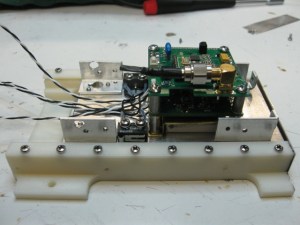
$50SAT Boards

$50SAT Boards

Up on the Dropbox, I have uploaded a new TLE set (element set 174) as well as an updated RTTY reports file.  Thanks to all of you, this file has grown significantly.  As of Tuesday, April 22, we have 950 unique telemetry packet captures.  We are working on “scrubbing” through the telemetry data and importing it either to a spreadsheet or a database so we can start analyzing the data.  We appreciate all of you folks who have been gathering telemetry for us, and encourage you to keep doing it.

I have also uploaded a spreadsheet showing the “valid” values for both solar and battery voltage.  Even though $50SAT reports both of these voltages in units of mV, its resolution is only about 20.2 mV.  As a result, there is a finite set of valid voltage values which can be reported.  The spreadsheet uses the actual calibration values from the MK4 CPU board used in the flight model, and computes the mV values the same way the PICAXE CPU in $50SAT does.  This information is quite helpful in recovering partially corrupted RTTY packets.

73

Michael Kirkhart
KD8QBA
$50SAT/MO-76 team

$50SAT was a collaborative education project between Professor Bob Twiggs, KE6QMD, Morehead State University and three other radio amateurs, Howie DeFelice, AB2S, Michael Kirkhart, KD8QBA, and Stuart Robinson, GW7HPW.  The transmitter power is just 100 mW on 437.505 MHz (+/-9 kHz Doppler shift) FM CW/RTTY. $50SAT uses the low cost Hope RFM22B single chip radio and PICAXE 40X2 processor.

$50SAT PocketQube Amateur Radio Challenge
https://amsat-uk.org/2014/02/21/50sat-amateur-radio-challenge/

Further information in the $50SAT Dropbox https://www.dropbox.com/sh/l3919wtfiywk2gf/-HxyXNsIr8

$50SAT – Eagle2 – Communications – Release Version V1_2.pdf
http://tinyurl.com/50DollarSatCommunicationsV1-2

Hope RFM22B single chip radio http://www.hoperf.com/rf/fsk_module/RFM22B.htm

There is a discussion group for $50SAT http://groups.yahoo.com/groups/50dollarsat/

50DollarSat http://www.50dollarsat.info/

The Basement Satellite at Canadian Documentary Film Festival

The Basement Satellite posterThe first screening of the The Basement Satellite at the Canadian International Documentary Film Festival takes place on Friday, April 25.

The film, directed by Hyoung-ju Kim, tells the struggle of Korean artist Hojun Song DS1SBO to develop a satellite, OSSI-1, in his basement studio and launch it into space.

Synopsis from Indiewire.comIn his Mangwon-dong basement art studio, a media artist Hojun Song dreams of making a satellite and shooting it out to space.

He wants to make his dream real through OSSI (Open Source Satellite Initiative) movement. He tries to build a DIY satellite, and to sell 10,000 T-shirts for the 100 million Won ($100,000) budget. His seemingly reckless and utterly ambitious project begins. Would his dream become real?

Watch Hot Docs Trailers 2014: the Basement satellite

Canadian International Documentary Film Festival – The Basement Satellite
http://boxoffice.hotdocs.ca/WebSales/pages/info.aspx?evtinfo=22727~446634ba-e848-4237-9b3c-72aceddb5263&epguid=b314c44a-eed5-4434-9c2c-cc86c0bf61ee&

OSSI-1 Amateur Radio CubeSat Launched
https://amsat-uk.org/2013/04/19/ossi-1-amateur-radio-cubesat-launched/

Shin-En2 to carry Mode J linear transponder

Shin-En2 satellite

Shin-En2 satellite

Shin-En2 is a 17 kg satellite measuring 490×490×475 mm built by students at Kagoshima University in Japan that will carry a 145 to 435 MHz linear transponder into a deep space orbit.

The aims of the mission are:
• To establish communication technologies with a long range as far as moon.
• To establish a new technology of the ultra-light-weight satellite. Proposing a WSJT 29dBm UHF downlink and a 29dBm 20 kHz linear transponder and a CW beacon all on UHF with a VHF uplink for the transponder

The orbit will be quite different from the previous satellites. Shin-En2 will have an elliptic orbit around the Sun and travel to a deep space orbit between Venus and Mars. Its inclination will be almost zero, which means Shin-En2 will stay in the Earth’s equatorial plane. 

The distance from the Sun will be between 0.7 and 1.3 AU, where AU (Astronomical Unit) is approximately 1.5 x 10⁸ km.

Shin-En2 is expected to launch in the 4th quarter of 2014 with another amateur radio satellite ARTSAT2:DESPATCH on a H-IIA rocket with the asteroid explorer Hayabusa 2 as the main payload.

Kagoshima University satellite development team
http://tinyurl.com/Kagoshima-Satellite

Shin-En2 English Website
http://www.eee.kagoshima-u.ac.jp/~fuku-lab/sinen,english.html

ARTSAT2:DESPATCH – Art and Ham Radio in Deep Space
https://amsat-uk.org/2013/11/03/art-and-ham-radio-in-deep-space/