UK PocketQube Shop on Kickstarter

Wren - Image credit Stadoko

Wren – Image credit Stadoko

PocketQube Shop is a small startup based in Glasgow that has just launched a Kickstarter project. They believe small satellites are on the cusp of a major breakthrough much the like personal computers were in the late 70’s/early 80’s.

PocketQube Shop say they wish to facilitate as many PocketQube builders as possible and see huge potential in lowering the barriers to entry for budding ‘Homebrew Satellite Builders’.

PocketQube massively lowers the barriers to entry for small satellite teams. Despite the small size of CubeSats, 10x10x10 cm, they can still cost up to $100,000 to launch. PocketQubes are just 5x5x5 cm and may be launched for a significantly lower price, under $20,000.

PocketQube Shop will not be offering to provide any launch facility but they have teamed up with an Italian company called GAUSS which has brokered launch opportunities with a Russian rocket called Dnepr, operated by ISC Kosmotras.

Several satellites built to the PocketQube standard will be launched in November. These include Wren, which has a camera and pulsed plasma thrusters; Morehead State University’s BeakerSat; the University of Maryland’s QubeScout-S1 and the 50DollarSat.

PocketQube Shop on Kickstarter
http://www.kickstarter.com/projects/pocketqube/want-to-build-a-satellite-but-dont-have-a-nasa-siz

Wired article on PocketQube Shop
http://www.wired.co.uk/news/archive/2013-09/23/pocketqube

Twitter @pocketqubeshop

February Launch for UKube-1 ?

UKube-1 on display at UK Space Conference in Glasgow

UKube-1 on display at UK Space Conference in Glasgow

Dmitry Pashkov UB4UAD reports that the launch of Soyuz-2-1B/Fregat-M from Baikonur in Kazakhstan has been postponed until February 20, 2014.

The Soyuz should carry Meteor-M number 2, MCA-PN2 (Relek), M3MSat, UKube-1, SkySat-2, TechDemoSat-1, AISSat-2, DX-1.

UKube-1, built by Clyde Space, is the UK Space Agency’s first CubeSat and carries a set of AMSAT-UK FUNcube boards to provide a 435/145 MHz linear transponder for SSB/CW communications and 1200 bps BPSK telemetry beacon.

TechDemoSat-1 was developed by the UK company SSTL.

Read the report by Dmitry Pashkov UB4UAD at http://ub4uad.ru/?p=1445 or in Google English at http://tinyurl.com/nzc5tdk

UKube-1 CubeSat Payload Animation https://amsat-uk.org/2013/02/01/ukube-1-cubesat-payload-animation/

FUNcube Yahoo Group https://amsat-uk.org/funcube/yahoo-group/

Vandenberg Falcon 9 Launch

DANDE and CUSat signals received by Dmitry Pashkov UB4UAD

DANDE and CUSat signals received by Dmitry Pashkov UB4UAD

Two satellites, DANDE and CUSat, carrying amateur radio payloads were launched on Sunday, September 29.

Engineers with DANDE nano-satellite prior to shipping - Image credit University of Colorado Boulder

Engineers with DANDE nano-satellite prior to shipping – Image credit University of Colorado Boulder

The SpaceX Falcon 9 rocket launch from California’s Vandenberg Air Force Base marks several firsts for the commercial space transportation company, including the maiden launch of an upgraded version of the Falcon 9 rocket with stretched fuel tanks, more powerful engines and a 5.2-meter payload fairing to enshroud satellites.

It is also the first SpaceX mission from Vandenberg Air Force Base, a launch site on California’s Central Coast, where engineers modified an existing facility used by the U.S. Air Force Titan 4 rocket to be the West Coast home of the Falcon 9.

Canada’s Cassiope space weather research and communications demonstration satellite is riding the Falcon 9 rocket into an elliptical near-polar orbit at an altitude of between 325 km and 1500 km. Secondary passengers aboard include POPACS, DANDE and CUSat.
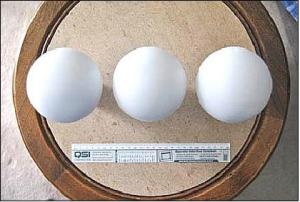
POPACS satellites - Image credit POPACS consortium

POPACS satellites – Image credit POPACS consortium

POPACS:

The second P in POPACS (Polar Orbiting Passive Atmospheric Calibration Spheres) stands for Passive, meaning that the three spheres do not carry radios on board. They are simple, polished ten-cm-diameter hollow Aluminum spheres, weighing 1kg, 1.5 kg and 2 kg, respectively, that will be radar tracked by the Space Surveillance Network of the U.S. Strategic Command and optically tracked by an international network of students with Go To telescopes.

The purpose of the mission is to measure the way in which the total density of Earth’s upper atmosphere above 325 km varies in response to solar stimuli during the descending phase of Solar Cycle 24 and all of Solar Cycle 25.  The spheres’ expected lifetimes, after deployment into the initial 325 km x 1500 km 80 degree orbit that they will hopefully soon share with DANDE and CUSat, are 10, 12.5 and 15 years, depending, of course on solar activity.
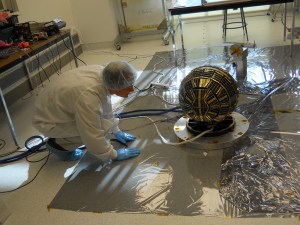
DANDE nano-satellite prior to packaging - Image credit Bruce Davis

DANDE nano-satellite prior to packaging – Image credit Bruce Davis

DANDE:

DANDE stands for “Drag and Atmospheric Neutral Density Explorer.” Measuring drag and neutral particles in the lower atmosphere between 325-400 kilometers, DANDE will be measuring real time density, quantifying variations in altitude and over time, as well as providing in-situ model calibration data. The satellite is a low-cost density, wind, and composition measuring instruments that will provide data for the calibration and validation of operational models and improve our understanding of the thermosphere. Weighing approximately 45 kg, DANDE is classified as a nano-satellite that is about 18 inches in diameter.

The Colorado Space Grant Consortium (COSGC) has housed the project for approximately 7 years, in which about 150 students have been a part of the project through initial concept and design, to the current team of mission operators. There are two instruments on board which allow DANDE to make in-situ measurements rather than being passive or only carrying accelerometers. The subsystem ACC (Accelerometers) contains 6 accelerometer heads arranged in a circle which were built in-house. The NMS subsystem (Neutral Mass Spectrometer) also known as Wind and Temperature Spectrometer will survey the variety and quantity of numerous neutral particles in the Thermosphere. This data will be particularly interesting during periods of high
solar activity do to atmospheric effects seen at these times in the polar regions of Earth.

DANDE Telemetry System Information:
Beacon Downlink Frequency: 436.75 MHz FM
Callsign: dandecosgc
Data Rate: 9600 baud
Modulation: FSK
Transmit Interval: every 15 seconds
RF Power Output: 0.75 W
Antenna Polarization: linear

DANDE http://dande.colorado.edu/
DANDE Beacon Portal http://spacegrant.colorado.edu/beacon/index.php
Bruce Davis Project Dande Blog http://projectdande.blogspot.co.uk/
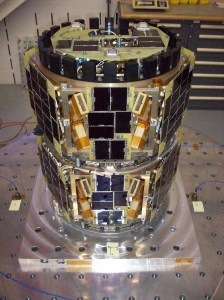
CUSat - Image credit Cornell University

CUSat – Image credit Cornell University

CUSat:

CUSat is a multi-year effort to design, build, and launch an autonomous in-orbit inspection satellite system. The satellite will allow us test the accuracy and viability of the carrier-phase differential GPS (CDGPS) algorithm. We hope to prove the algorithm accurate to less than 10 cm  by comparing the CDGPS navigation solution to the known distance between GPS antennas. CUSat will use this relative GPS information to help determine and control its attitude. This is the first step towards having a multi-satellite system use the CDGPS algorithm to aid in autonomous inspection. CUSat is the winner of the University Nanosat-4 Program which aims to educate the future aerospace workforce and develop new space technologies.

CUSat Telemetry Information:
Beacon Downlink Frequency: 437.405 MHz FM
Callsign: BOTTOM
Data Rate: 1200 baud
Modulation: AFSK
Transmit Interval: every 1 minute
RF Power Output: 2.2 W
Antenna Polarization: circular

CUSat http://cusat.cornell.edu/
CUSat docs http://cusat.cornell.edu/docs/IARU/
CUSat Pulse Plasma Thruster Satellites Video https://amsat-uk.org/2013/05/29/cusat-ppt-satellites/

Press Kit released by SpaceX
http://www.spaceflightnow.com/falcon9/006/UpgradedF9DemoMission_PressKit.pdf

Dmitry Pashkov UB4UAD website http://ub4uad.ru/?p=1435

Falcon 9 Explosion – Update http://www.zarya.info/blog/?p=1604

[Thanks to ANS, Miranda Link, SpaceFlightNow and Mineo Wakita JE9PEL for the above information]

High Altitude Balloon to Study Comet ISON

A high altitude balloon launch - Image credit Dhruva Space

A high altitude balloon launch – Image credit Dhruva Space

An amateur radio balloon operating on 145.765 MHz will be launched on Sunday, September 29, 2013 from Bangalore, India.

National Institute of Amateur Radio, Hyderabad with Dhruva Space, India’s first small satellite start-up, is supporting the Indian Institute of Astrophysics with its high altitude balloon campaign to study the comet ISON.

The Helium filled balloon plans to launch in early Sunday morning from the Hoskote campus of the Indian Institute of Astrophysics, Bangalore.

The payload will carry a 145.765 MHz APRS packet radio transmitter and a GPS GSM tracker, both of these are extremely important in keeping track of the balloon in flight, as it rises up to 40 km reaching the upper stratosphere. NIAR are extensively involved in the efforts of tracing and safely recovery of the payload.

On the afternoon of September 29 there will be a presentation given on “Amateur Radio For High Altitude Ballooning” by Dhruva Space. Mr S.Ram Mohan, VU2MYH, Director, National Institute of Amateur Radio will speak on APRS technologies for tracking.

National Institute of Amateur Radio (NIAR) http://www.niar.org/

Dhruva Space http://dhruvaspace.com/

Wiki – Comet ISON http://en.wikipedia.org/wiki/C/2012_S1

IARU Amateur Radio Spectrum Requirements

IARU_LogoFollowing the annual meeting of the Administrative Council (AC) of the International Amateur Radio Union (IARU) a revised spectrum requirement document is available.

At 50 MHz the IARU re-iterates the need for a harmonised allocation for the Amateur-Satellite Service to bridge the gap between 28 MHz and 144 MHz.

For the Amateur-Satellite Service 435-438 MHz allocation the IARU say it is desirable to study expansion of the band.

Retention of the Amateur-Satellite Service 1260-1270 MHz is sought and deletion of the “Earth-to-Space only” restriction. WRC-2000 allocated the band 1240-1300 MHz to the radiodetermination-satellite service for space-to-space use. In addition, WRC-2000 allocated the band 1260-1300 MHz to the radiodetermination-satellite service for Space-to-Earth use such as for the European Galileo positioning system. These actions do not change the Amateur and Amateur-Satellite Service allocations but present new sharing situations and potential operating restrictions.

Substitute spectrum for the Amateur Satellite Service allocation at 2400-2450 MHz which is restricted to the ISM segment, is sought.

Regarding the aim of acheiving a global Amateur-Satellite Service allocation at 3400-3410 MHz  the IARU say: WRC-07 identified the band 3400-3500 MHz for IMT applications in certain countries, which poses an additional difficulty for the Amateur Services in achieving improvement in the band 3400-3410 MHz with respect to upgrading the allocation or extending the allocation to Region 1 [Europe and Africa].

The IARU do not seek any changes to the split Amateur-Satellite Service allocations at 5 GHz.

Spectrum Requirements for the Amateur and Amateur-satellite Services
http://www.iaru.org/uploads/1/3/0/7/13073366/spectrum_requirements_2013.pdf

Cuban radio ham to attend AMSAT Symposium

Hector CO6CBF working Joe EI5EV on FO-29  2013-04-03 1440z

Hector CO6CBF working Joe EI5EV on FO-29 2013-04-03 1440z

Are you looking for a good excuse to visit the 2013 AMSAT Symposium in Houston, Texas ?

It is with great pleasure that I announce the return of Hector Martinez, CO6CBF, to the AMSAT Symposium.  Last year, Hector’s presentation on “Cuban style” satellite operation was well-received by the attendees.  Don’t miss this year’s!

Since his visit to Orlando, Hector has been busy in Cienfuegos completing his fundamental university studies.  As the recipient of the “Gold Award,” he was honored for his diligence by the university’s rector.    He now looks forward to continuing his education in a Master’s program.

The AMSAT-NA Board of Directors has graciously extended Hector an invitation to the Symposium following his successful presentation in Orlando last year.  This year’s process to obtain US visa approvals went smoothly and on schedule due to the guidance and experience of Patrick, WD9EWK.

Hector’s travel expenses are guaranteed by private donations – not AMSAT-NA.  If you wish to contribute please contact Clayton, w5pfg at arrl dot net.  You may also contact W5PFG via postal mail at the FCC callbook-listed PO BOX.  Clayton is Hector’s formal sponsor and coordinator for this year’s symposium visit.

I wish to personally thank the AMSAT-NA Board of Directors and especially recognize Patrick, WD9EWK, for supporting Hector’s opportunity to present in Houston this year.

73
Clayton
W5PFG

AMSAT Symposium Nov 1-3, 2013 http://ww2.amsat.org/?page_id=1555