14 MHz beacon on radio hams’ trans-Atlantic balloon flight

Jonathan Trappe KJ4GQV crossing the Alps in his cluster balloon - Image credit Jonathan Trappe

Jonathan Trappe KJ4GQV crossing the Alps in his cluster balloon – Image credit Jonathan Trappe

Radio amateur Jonathan Trappe KJ4GQV attempted to cross the Atlantic in a cluster balloon carrying beacons on 14.0956 MHz and 144.390 MHz.

At around 1200 UT on Thursday, September 12, 2013 Jonathan KJ4GQV took to the air from Caribou in Maine in a lifeboat suspended by some 370 helium balloons. His flight came to a premature end when he had to land in Newfoundland reportedly near Blow Me Down Provincial Park.

Cluster Balloon Payload - Jonathan Trappe KJ4GQV

Cluster Balloon Payload – Jonathan Trappe KJ4GQV

The 14.0956 MHz beacon was just above the WSPR frequency (approx 1880 Hz in the waterfall display) and runs 110 Baud ASCII RTTY, 8-bits, no parity, 1 stop bit with the callsign NG0X.

The multi-mode transmitter transmitted at 10 minute intervals at: 00, 10, 20, 30, 40 and 50 minutes.

APRS on 144.390 MHz FM was transmitted while over the US/Canada using the callsign KJ4GQV.

A Real-Time Track of NG0X on 14.0956 is at http://spacenear.us/tracker/?filter=NG0X

USA/Canada APRS track is at
http://aprs.fi/#!mt=roadmap&z=13&call=a%2FKJ4GQV&timerange=86400&tail=86400

Further information at http://www.clusterballoon.com/

See updates on Facebook at https://www.facebook.com/jonathan.r.trappe.1

LitSat-1 amateur radio frequencies announced

LitSat-1 CubeSatThe LitSat-1 CubeSat plans to carry a linear transponder and an AX.25 packet radio transceiver.

It is hoped that LitSat-1 will be among the CubeSats sent by Nanoracks LLC to the International Space Station (ISS) on the SpaceX CRS-3 mission in January 2014. It will be deployed from the ISS by the JEM Small Satellite Orbital Deployer (J-SSOD) of the Japan Aerospace Exploration Agency (JAXA).

LitSat-1 is a 1U CubeSat project being developed by the Lithuanian Space Federation. The satellite aims to use low cost open-source software and hardware for primary and secondary flight computers that will control the payload consisting of an onboard VGA camera, GPS receiver.

The IARU satellite frequency coordination panel have announced coordinated  frequencies for LitSat-1.

Linear transponder for SSB/CW communications
• Uplink 435.180 MHz
• Downlink 145.950 MHz

AX.25 packet radio transceiver
• Uplink 435.550 MHz
• Downlink 145.850 MHz

Lithuanian Space Association in Google English http://tinyurl.com/LithuanianSpaceAssociation

Facebook https://www.facebook.com/palydovas

Google English article http://tinyurl.com/LitSat-1-Article

HamTV Bulletin 2: Ham Video – EST and Simulations

ARISS Telebridge Station IK1SLD at Casale Monferrato, Italy

ARISS Telebridge Station IK1SLD at Casale Monferrato, Italy

Ham Video Commissioning preparation is progressing. An EST (Experiment Sequence Test) has been performed August 28-29 and Simulations tests were done September 5-6, 2013.

The EST consisted of a series of tests, mainly of the ground segment. For the Commissioning, the VLBI (Very Long Baseline Interferometry) station of the Italian Space Agency (ASI), located near Matera, southern Italy, will be used for receiving the DATV signals from the ISS. For the EST, the IK1SLD ground station, situated at Casale Monferrato, northern Italy was used. IK1SLD is one of the ARISS telebridge stations, fully equiped for VHF and UHF. It was recently upgraded for S-band with a 1.2m dish, feed, downconverter and precision tracking motors.
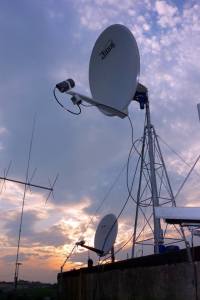
New HamTV Antennas for ARISS Telebridge Station IK1SLD at Casale Monferrato, Italy

New HamTV Antennas for ARISS Telebridge Station IK1SLD at Casale Monferrato, Italy

For the EST, a very low power transmitter, installed in the shack, generated signals on the Ham Video frequencies, transmitting a DATV recording at 1.3 and 2.0 MS/s and FEC ½. The DATV signal was received and decoded by the IK1SLD station and webstreamed to the BATC server.

B.USOC (Belgian User Support and Operations Center  ESA) conducted operations. B.USOC and EAC (European Astronaut Center  Cologne, Germany) specialists operated from Livorno at Kayser Itallia’s laboratory, where a Ham Video unit, the so-called EBB (Elegant BreadBox), is operational. Parties involved were interconnected per teleconference. At Casale Monferrato, Claudio Ariotti IK1SLD and Piero Tognolatti I0KPT produced, received and webstreamed the signals in the different configurations as requested by B.USOC. ESA and ARISS observers participated to the EST teleconference. After debriefing, the EST was declared successful.

Simulations were done differently. B.USOC supervised from their offices in Brussels and ARISS volunteers Piero Tognolatti I0KPT and Jean Pierre Courjaud F6DZP operated from home. The simulations were done in the Columbus mockup at EAC, where a non operational Ham Video model is installed. This box is used for astronaut training on Ham Video. A KuPS power supply was also used, as well as a camera similar to the one onboard Columbus in space.

Ham Video transmissions were simulated in the different configurations (frequencies and symbol rates). A view of operations in the Columbus mockup was webstreamed to the participants. ARISS operators simulated reception as if thery were at the Matera ground station, taking into account expected timing between AOS and LOS. They signaled AOS and requested crew at EAC to transmit in different configurations, according a pre-determined scenario. At LOS, the test stopped and results were commented. Four passes were simulated this way, using both ARISS antennas.

An important goal of the simulations was to check the efficiency of communications between ground and crew. Commands were initiated by ARISS operators (supposedly from Matera), received at B.USOC, relayed to the Columbus Control Center at Oberpfaffenhofen near Munich and uplinked to crew by EUROCOM. The European ISS Control Center is called Col-CC and its spacecraft communicator’s call sign is EUROCOM. The Simulations were conducted successfully and lessons were learned for gaining time on transmitting commands. This is important considering the limited 8 minutes contact time during real Commissioning.

ARISS proposed to use our VHF uplink capabilities to crew for the Commissioning. This was not acceptable with regard to ESA’s commissioning protocol.

Presently, ISS pass predictions for Matera are computed for several weeks starting mid October, The Matera VLBI activities are to be taken into account for determining usable passes. Four passes will be needed to fullfil the Commissioning requirements.
Ham Video Commissioning activities will be decided by ESA and NASA ISS Operations. Hopefully the Commissioning will be planned during Expedition 37. We will keep you informed.

73,

Gaston Bertels  ON4WF
ARISS-Europe chair

Ham TV Bulletins are available at http://www.ariss-eu.org/

CubeSats in the Press

Clockwise from lower left, GAS team coordinator James Gardiner displays a model of a USU-designed cube satellite with inflatable boom to team members Trevor Kunz KF7YZY, Jorden Luke KF7YEM, Jeremiah Christensen, Micah Fry and Troy Munro KE7URC

Clockwise from lower left, GAS team coordinator James Gardiner displays a model of a USU-designed cube satellite with inflatable boom to team members Trevor Kunz KF7YZY, Jorden Luke KF7YEM, Jeremiah Christensen, Micah Fry and Troy Munro KE7URC

The Sky and Telescope magazine and the Standard-Examiner both carry articles about CubeSats .

The Standard-Examiner reports Utah State University (USU) is conducting research on an inflatable plastic boom that can unfurl once the satellite, about 10 cm square, is deployed. The boom is impregnated with an epoxy that becomes rigid only after being exposed to ultraviolet rays, like those in sunlight.

The rigid boom hangs downward, because of gravity, which creates torque. USU student researchers believe it will stabilize a cube satellite, so it can take clear pictures and host certain types of experiments that can’t be conducted on a spinning satellite.

The newspaper also interviews USU’s Get Away Special (GAS) team member Jorden Luke KF7YEM.

Read the article USU team works on CubeSat control
http://www.standard.net/stories/2013/09/10/usu-team-works-cubesat-control

STARE Concept of Operations - Image credit Naval Postgraduate School

STARE Concept of Operations – Image credit Naval Postgraduate School

Sky and Telescope features the STARE (Space-Based Telescope for Actionable Refinement of Ephemeris) CubeSat project which aims to launch a constellation of 18 orbiting observatories to monitor the entire sky for space junk.

STARE A (Re) was launched on September 13, 2012 and STARE B (Horus) hopes to launch in November 2013. The downlink for the STARE CubeSats is 57.6 kbps BPSK in the 902-928 MHz band.

Read the article CubeSats on Space Patrol
http://www.skyandtelescope.com/news/CubeSats-on-Space-Patrol-223023011.html

STARE CubeSat Comunications Testing, Simulation and Analysis
http://www.dtic.mil/dtic/tr/fulltext/u2/a567695.pdf

Naval Postgraduate School: 915 MHz 57.6 kbps modem http://www.dtic.mil/dtic/tr/fulltext/u2/a556715.pdf

B-11 and B-12 Pico Balloons Break World Duration Record

Tracks of the pico balloons B-11 and B-12 in red and blue respectively as at Sept. 9, 2013 12:38 UT

Tracks of the pico balloons B-11 and B-12 in red and blue respectively as at Sept. 9, 2013 12:38 UT

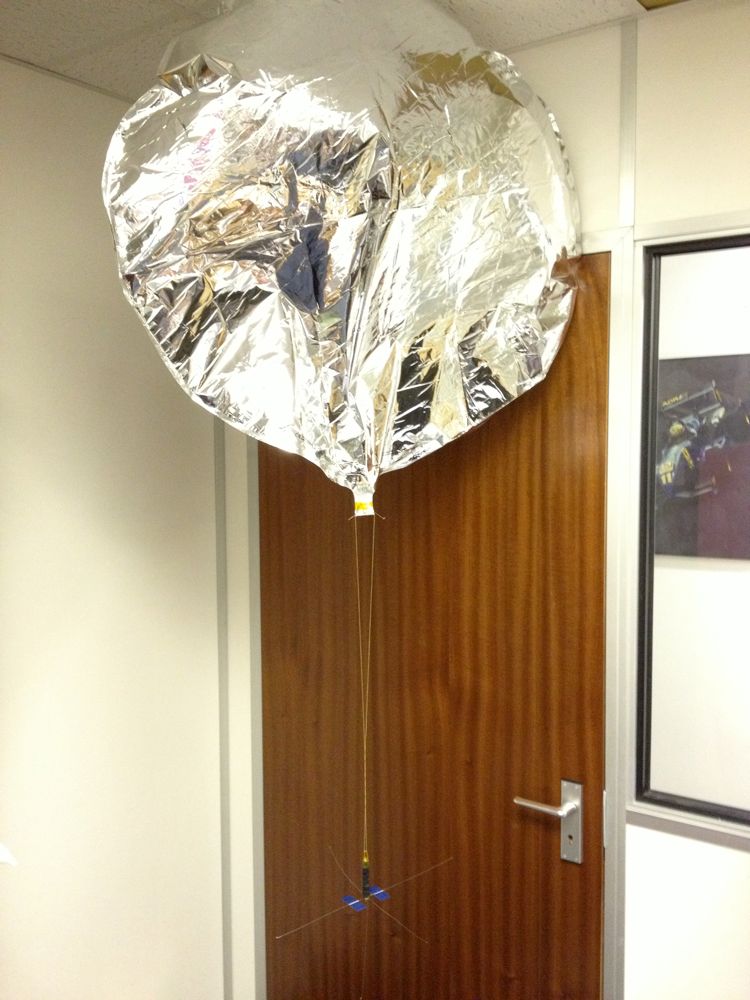
The solar powered pico balloons B-11 and B-12 were launched by Leo Bodnar from Silverstone, UK on September 1 and 2 respectively. As of 1238 UT on Monday, September 9 both balloons were still in the air transmitting the amateur radio DominoEX16 data mode on 434.500 MHz USB.

B-12 Pico balloon with the tiny lightweight 434 MHz payload - Image credit Leo Bodnar

B-12 Pico balloon with the tiny lightweight 434 MHz payload – Image credit Leo Bodnar

During their record breaking duration flights the two balloons have between them flown over most countries in Europe and are now out of the range of tracking stations. B-11 was last reported over Turkey and B-12 over Ukraine. Both balloons are fitted with solar panels which recharge the on-board Lipo battery. B-12 has suffered a battery failure so only transmits when in sunlight.

Pico balloons are proving increasing popular with amateurs. The small foil party balloons can only carry ultra light balloon payloads, typically weighing less than 100 grams. This presents a challenge to the builders to produce a transmitter, GPS, batteries and antenna that are small and light enough to be carried.

Balloons such as these do not go to extremes of altitude but instead float at between 2,500 and 8,000 metres for an extended period. The 434 MHz transmitters can have a radio range of up to 400 km.

Information on the two balloons is at
http://www.leobodnar.com/balloons/B-11/index.html
http://www.leobodnar.com/balloons/B-12/index.html

Tracks of B-11 and B-12 http://spacenear.us/tracker/?filter=B-11;B-12

Real-time balloon tracking http://spacenear.us/tracker/

Beginners Guide to Tracking using dl-fldigi http://ukhas.org.uk/guides:tracking_guide

To get details of upcoming UK balloon launches subscribe to the UKHAS Mailing List by sending a blank email to this address:
ukhas+subscribe@googlegroups.com

Foundation Exam Success at UKHAS Conference

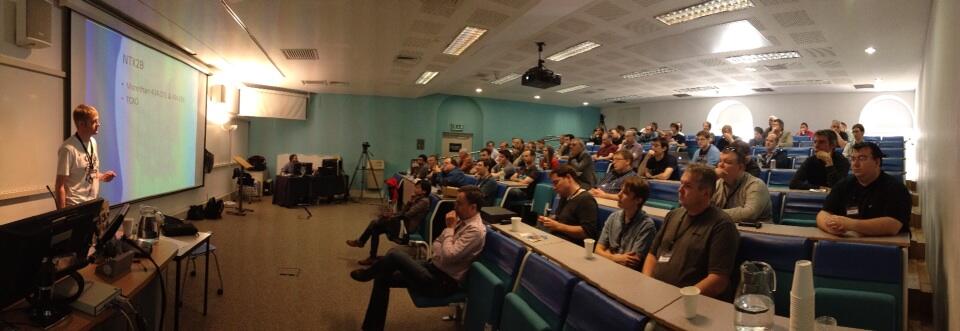
Attendees at the UKHAS Conference 2013 - Image credit Anthony Stirk M0UPU

Attendees at the UKHAS Conference 2013 – Image credit Anthony Stirk M0UPU

The UK High Altitude Society (UKHAS) conference took place at the University of Greenwich, London on Saturday, September 7.

The conference attracted those interested in learning about building and flying High Altitude Balloons or in tracking their 434 MHz signals.

The Successful Foundation Candidates UKHAS 2013 - Image credit Anthony Stirk M0UPU

The Successful Foundation Candidates UKHAS 2013 – Image credit Anthony Stirk M0UPU

The first conference was held in 2011 and has grown steady in size and scope each successive year. This year there was the opportunity for participants to take the assessments and exam for the amateur radio Foundation licence. Six people took advantage of this opportunity and all are reported to have passed.

There was an impressive line-up of speakers and among the presentations was one on Narrow Band TV (NBTV) given by Phil Heron 2I0VIM.

Ed Moore M0TEK ran a GPS workshop in the afternoon.

Special thanks should go to the volunteers from the British Amateur Television Club (BATC) who provided live web streaming of the presentations and have now made the videos available for all to see on their website at http://www.batc.tv/channel.php?cat=HAB+2013&ch=1

The International UKHAS 2013 Conference
http://ukhas.org.uk/general:ukhasconference2013