IARU Region 1 Agrees Addition 2m Satellite Allocation

IARU_Region_1_logoThe minutes from the IARU Region 1 Interim meeting held in Vienna, April 20-21, have been released.

A number of papers related to Amateur-Satellite Service allocations were discussed:
VIE13_C5_03 Increased Amateur‐Satellite Service 144MHz Usage
• VIE13_C5_05 Recommendations for DATV Transmission
• VIE13_C5_24 Region 1 Satellite Coordinator Report
• VIE13_C5_27 New Narrow‐Band working frequencies in the 2300–2450 MHz band
• VIE13_C5_32 2400MHz Amateur Satellites

The Vienna C5 meeting minutes are available here.

The original papers for the meeting are available here.

Probably the most important paper from an Amateur Satellite Service perspective was VIE13_C5_03 which proposed the use of 144.000-144.035 MHz for satellite SSB/CW downlinks.

The minutes record that Graham Shirville G3VZV presented the paper on the increasing use of 2m by satellites and the desire to use the under-utilized bottom of the 2m band 144.000-144.035, which had originally been harmonized for EME activity. EME has subsequently moved to frequencies further up the band.

In order to accommodate some CW contests, the proposal was reduced from 35 to 25kHz (i.e. 144.000-144.025 MHz).

If the other IARU Region 2 and Region 3 are also willing to go for 144.000 and 144.025, then IARU Region 1 will support this proposal.

Note: IARU Region 2 Conference is in Cancun, Mexico in September 2013.

Read VIE13_C5_03_Increased_Amateur_Satellite_Service_144MHz_Usage

Three 437 MHz ham radio balloons to launch from Poland

sp9uob_frontTomasz Brol SP9UOB plans to launch three High Altitude Balloons to near-space this week carrying amateur radio payloads on 437.600, 437.595 and 437.615 MHz.

At maximum altitude the 10 mW signal from these balloons could have a potential range of up to 700 km.

Thomasz posts:

I’m planning on launching 3 balloons from Gliwice Glider Airport [Upper Silesia], with ultralight (36-40 grams) payloads.

First launch on Wednesday, May 1 at 9:00 UTC – under 100g kaysam / Helium – just for hardware check 437.600 MHz

Second on Saturday, May 4 at 9:00 UTC – 1600 g Hwoyee / Hydrogen – 437.595 MHz

Third on Saturday, May 4 at 10:00 UTC – 1600 g Hwoye / Hydrogen – 437.615 MHz

RTTY, 470 Hz shift / 50 baud / 7n1

The IARU Region 1 site carries this report on the May 4 balloon launch:

On Saturday, May 4, 2013 at 9:00 UTC (11:00 am – local time), the team from the club SP9PDF – directed by Tomasz, SP9UOB – will launch an unmanned stratospheric balloon. The current record of flight altitude is 44,376 feet above sea level.

The balloon named SEBA-1 will be launched from the Aero Club of Gliwice within the project “From Gliwice to Space”, started in June 2012.

A telemetry transmitter (its power – 10 mW) will be  placed in a capsule, the balloon will operate on RTTY on the frequency 437.600 MHz USB (+ / – thermal drift of about 10 kHz), 50 baud, 470 Hz shift, 7N1. To receive telemetric data, you should use the dl-fldigi program.

Detailed instructions for configuration of the software can be found at: http://sp9uob.verox.pl/rtty_tracking.html

The capsule has a total weight of just 37 grams, including: the electronic circuits – 8 grams, the power (R6) – 14 grams, the antenna – 3 grams, the thermal insulation – 12 grams.

Such light weight load, combined with a giant balloon (2 kg of latex filled with hydrogen) should result, at least, in approaching the world record.

We invite everyone to track the flight of the balloon by listening on the indicated frequency, or  at the following website: http://spacenear.us/

Source of information: SP9PDF Club Team – IARU Region 1 http://www.iaru-r1.org/

Beginners Guide to Tracking using dl-fldigi http://ukhas.org.uk/guides:tracking_guide

To get details of upcoming balloon launches subscribe to the UKHAS Mailing List by sending a blank email to this address: ukhas+subscribe@googlegroups.com

Twitter #ukhas https://twitter.com/search?q=%23ukhas

Tracks of balloon launches can be seen at http://www.spacenear.us/tracker

PhoneSat Pictures Released

Graham PhoneSat Picture 2013-04-25

Graham PhoneSat Picture 2013-04-25

Pictures taken by the Graham and Bell PhoneSat satellites, deployed April 21, have been released.

Graham and Bell have been transmitting picture packets. Radio amateurs around the world have been receiving the individual packets and passing them to the PhoneSat team who have stitched them together to restore the complete Earth picture.

See the pictures at http://www.phonesat.org/pictures.php

PhoneSat team thank Radio Amateurs
https://amsat-uk.org/2013/04/23/phonesat-team-thank-radio-amateurs/

Ham Radio CubeSats Successfully Launched

CZ-2D Launch

CZ-2D Launch

At 0413 UT on Friday, April 26, two amateur radio CubeSats TURKSAT-3USAT and CubeBug-1 along with the NEE-01 Pegasus HD TV CubeSat were launched from the Jiuquan Space Center on a CZ-2D rocket.

TURKSAT-3USAT is a 3U CubeSat (10x10x30cm) and carries a 145 to 435 MHz linear transponder built by the Turkish TAMSAT / AMSAT-TR group for SSB and CW communications.

• CW Beacon or 9600 bps data: 437.225 MHz
Uplink: 145.940 to 145.990 MHz
Downlink: 435.200 to 435.250 MHz

Further details at https://amsat-uk.org/satellites/turksat-3usat/

The Argentine CubeBug-1 is a 2U CubeSat (10x10x20cm) and has an AX.25 packet radio digipeater.

It operates  on 437.445 MHz using 1200 bps AX.25 AFSK FM packet radio, callsign LU1VZ-11. Depending on the mode of the satellite the beacons will be transmitted every 10 to 30 seconds.

Further details at https://amsat-uk.org/satellites/cubebug-1/

Also on the same launch was NEE-01 Pegasus a 1U CubeSat (10x10x10cm) built in Ecuador that operates on 910 MHz (an amateur band in some countries). It will operate either a 0.9 watt output 720p HD TV transmitter or a beacon which will send a Morse Code ID, a SSTV image and Ecuador’s national anthem. EarthCam – SpaceCam http://www.earthcam.com/world/ecuador/ecsa/

Further details at
https://amsat-uk.org/2013/04/25/nee-01-pegaus-hd-tv-cubesat/

TURSAT-3USAT and CubeBug-1 Received

At 0915 UT Wouter Weggelaar PA3WEG reported he had heard the TURKSAT-3USAT CW beacon and a transmission that looked like 9k6 from CubeBug-1.

The TURKSAT-3USAT recordings are at:
http://pa3weg.nl/pa3weg/recordings/TurkSat-26-04-2013_0904UTC_1_PA3WEG.mp3
and
http://pa3weg.nl/pa3weg/recordings/TurkSat-26-04-2013_0904UTC_2_PA3WEG.mp3

CubeBug-1 recording, listening to the FM AFSK in SSB
http://www.pa3weg.nl/pa3weg/recordings/CubeBug-1-26-04-2013_1040UTC_PA3WEG.mp3

Wouter PA3WEG later reported CubeBug-1 has been heard again on the 1220 UT pass. Its modulation
is AFSK 1200bps but seems to be lacking deviation. It was transmitting every 30 seconds.  A recording can be found at
http://pa3weg.nl/pa3weg/recordings/CubeBug-1t-26-04-2013_1220UTC_PA3WEG.mp3

The TURKSAT-3USAT CW Message as decoded at 0904 UT by Wouter Jan PE4WJ:
TURKSAT 3U SAT HAAAAAA YM2RTU 0 0 (the last zeroes are ??)

Jan van Gils PE0SAT reported receiving CubeBug-1 at 1220 UT http://www.pe0sat.vgnet.nl/2013/cubebug-heard/

A Tweet from Ecuador about NEE-01 Pegasus said (Google English translation) “An amateur radio operator in Germany we pass the audio signal PEGASUS and the first thing we heard was the NATIONAL ANTHEM! PEGASUS is alive!”

TLEs / ‘Keps’ for the new CubeSats:

TURKSAT                 
1 12345U 12345A   13116.18500615  .00000000  00000-0  10000-4 0     6
2 12345  98.0372 191.7767 0017397 251.4298 279.4470 14.76467545    04
NEE-01 PEGASO           
1 12346U 12346A   13116.18500615  .00000000  00000-0  10000-4 0     8
2 12346  98.0563 191.7735 0017556 248.2772 282.5989 14.76251447    02
CUBEBUG                 
1 12347U 12347A   13116.18500615  .00000000  00000-0  10000-4 0     0
2 12347  98.0563 191.7735 0017556 248.2772 282.5989 14.76251447    03

Free satellite tracking software:
• SimpleSat Look Down http://www.tomdoyle.org/SimpleSatLookDown/
• Gpredict http://gpredict.oz9aec.net/
• Orbitron http://www.uk.amsat.org/?p=9051

TLEs / ‘Keps’ for new satellites launched in past 30 days
http://celestrak.com/NORAD/elements/tle-new.txt

Article – Getting started on satellites
https://amsat-uk.org/beginners/radcom-getting-started-on-satellites/

NEE-01 Pegasus HD TV CubeSat

CubeSat NEE-01 Pegasus

CubeSat NEE-01 Pegasus – Image credit EXA

Pegasus NEE-01 the first of two HD TV CubeSats built in Ecuador is planned to launch on a CZ-2D rocket from the Jiuquan Space Center on Friday, April 26 at 0413 UT.

Ronnie Nader with Elisse Nader and CubeSat

Ronnie Nader with Elisse Nader and CubeSat

An EXA announcement said NEE-01 PEGASUS and NEE-02 KRYSAOR are the first CubeSats designed and developed entirely in Latin America, without help or support from abroad.

“This is a major milestone in our history and the history of the region, now our space technology is qualified for Russian and Chinese launch vehicles and to survive the space environment. The satellites passed the tests without any problems and now we await the launch of the first, the NEE-01 PEGASUS in the first half of May and the second in the latter half of July” said Ronnie Nader, Director of Space Operations EXA and leader of the team that designed and built the satellite.

Both satellites were designed and built by EXA engineers who donated their work voluntarily, the Ecuadorian Government financed the launch and testing.

EXA and the Ecuadorian government are engaging in ​​joint projects to ensure full utilization of the satellites, for both scientific and educational purposes.

NEE-02 Krysaor - Image credit EXA

NEE-02 Krysaor – Image credit EXA

The launch of the NEE-01 had been scheduled for November last year aboard a Russian Dnepr rocket, but the launch was postponed to later this year, and it was decided to launch NEE-01 on a Chinese CZ-2D rocket. The satellites had to meet the launch requirements of both vehicles, which was a skill level higher than previously achieved by the Ecuadorian engineers.

Source of text above: http://www.exa.ec/bp46/ translated by Google.

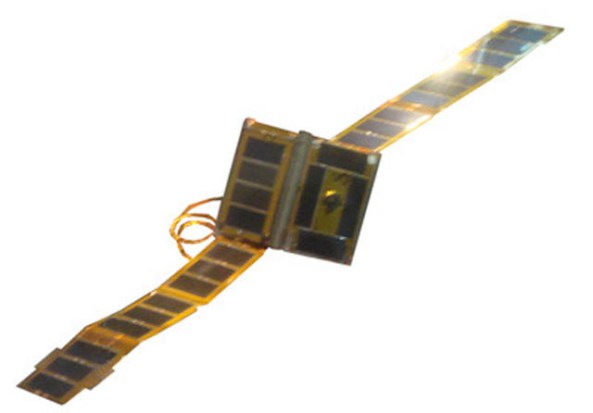
Each CubeSat is just 10x10x10 cm (1U) and they have fold-out solar panels which give a total span of 70 cm. They will each carry a 0.9 watt output 720p HD TV transmitter and a beacon which will send a Morse Code ID, a SSTV image and Ecuador’s national anthem. It is understood that NEE-001 will operate on 910 MHz in the 33cm band, an amateur radio allocation in a number of countries, while NEE-02 will be in the 980 MHz band.

Educational outreach is an important part of the project. EXA is partnering with three schools in Ecuador as part of the ASTERIA Program, in which students will use the satellite in their curricular and extra curricular activities.

The satellite signal will be received and decoded by the EXA HERMES-A ground station in Guayaquil and then uploaded live to the Internet using Facebook and Twitter; the first signal will contain text book questions and the second will contain an image related to the question. If the students are able to answer the question correctly they will be granted access to the video camera on board the spacecraft and will be able to see Earth from space as the astronauts see it in their space missions. More advanced students will have access to the pure radio signal so they can try decoding it by themselves.

There is also a HERMES-B ground station located in Kirch-Brombach, Germany.

Journey to Space!
EarthCam has teamed up with the Ecuadorian Civilian Space Agency to deliver what EarthCam describe as an amazing viewing experience from an orbiting satellite. Mounted on the NEE-01 Pegasus, a live camera invites viewers to take a trip into space and explore the galaxy.
EarthCam – SpaceCam http://www.earthcam.com/world/ecuador/ecsa/

EXA indicates that NEE-02 KRYSAOR is expected to launch on a Dnepr rocket from Dombarovsky near Yasny later this year.

Twitter https://twitter.com/NEE01_PEGASO hash tags #SatélitePegaso #Pegaso

Facebook https://www.facebook.com/NEE01PEGASO

Wiki http://en.wikipedia.org/wiki/NEE-01_Pegasus

Two TV CubeSats from Ecuador https://amsat-uk.org/2013/02/14/two-tv-cubesats-from-ecuador/

NEE-01 Pegasus (Pegaso) website in Google English http://tinyurl.com/NEE-01-Pegasus

Ecuadorian CubeSat will monitor near-earth objects http://www.uk.amsat.org/?p=6932

IAC2011 Paper http://exa.academia.edu/RonnieNader/Papers/795135/NEE-01_PEGASUS_The_first_Ecuadorian_Satellite

January 2014 Ecuadorian Civil Space Company (EXA)—Imagery Involvement + An Important Recovery (Satellites) http://www.satnews.com/story.php?number=1323163133

ST2NH Receives Images from PhoneSats

Nader Omer ST2NH

Nader Omer ST2NH

On his Blog Nader Omer ST2NH reports that he has been receiving images from PhoneSats Graham and Bell that were deployed on Sunday, April 21.

He says “Every Image is small part of one big picture which is being compose by phonesat team from the world wide collected data, like jigsaw puzzle photo.”

Read Nader’s Blog at
http://st2nh-blogger.blogspot.co.uk/2013/04/images-i-received-from-phonesat.html

PhoneSat http://www.phonesat.org/