Jay Leno – SAREX – Shuttle Amateur Radio Experiment 1992

In 1992 Southern California Amateur Radio operators uplinked a video of  stand-up comedian Jay Leno, host of NBC’s The Tonight Show, to the Space Shuttle Columbia through Jim Steffen, KC6A’s station in Long Beach, California.

Watch Jay Leno – SAREX Shuttle Amateur Radio Experiment 1992

Past SAREX Missions
http://www.arrl.org/files/file/ARISS/ARRLWeb_%2520Past%2520SAREX%2520Missions.pdf

Radio Amateur VK5ZAI on TV Show

Tony Hutchison VK5ZAI

Tony Hutchison VK5ZAI

This video shows Tony Hutchison VK5ZAI on the Channel 7 Today Tonight TV show talking about amateur radio and the ARISS schools program.

Tony Hutchison, VK5ZAI's ARISS Satellite Ground Station in Kingston SE. South Australia

The show provides some great insights as to how Amateur Radio can provide support for NASA as well as raise public awareness through the ARISS schools program.

Tony VK5ZAI has provided many Telebridge links for the International Space Station (ISS) to schools around the world. An ISS Telebridge contact is where a dedicated ARISS amateur radio ground station, located somewhere in the world, establishes the radio link with the ISS. Voice communications between the students and the astronauts are then patched over regular telephone lines.

Watch ARISS Tony VK5ZAI on Today Tonight

ARISS co-ordinator VK5ZAI receives NASA award http://www.southgatearc.org/news/march2008/vk5zai.htm

ARISS and Ham Radio Opportunities video http://www.uk.amsat.org/8099

Amateur Radio on the International Space Station ARISS http://ariss.rac.ca/

Auburn Students Successfully Command AubieSat-1

Reception of AubieSat-1 at K5QXJ

John Klingelhoeffer, WB4LNM, AubieSat-1 Technical Mentor at Auburn University Alabama reports that the satellite has been successfully commanded to change the transmission mode.

John says “A short message was received Saturday evening indicating that uplink commands sent to AubieSat-1 were properly received, decoded, and initiated additional telemetry downlink data.  AS-1 has been in orbit for about 9 months.  Stations are asked to continue to monitor the downlink and pass any received telemetry to the group here for dissemination.”

Watch Reception of AubieSat-1 at K5QXJ

AubieSat-1 was launched from Vandenberg AFB, California in October,  2011. The CubeSat is an undergraduate built satellite developed by Auburn University. Over the weekend of June 9-11 the AubieSat-1 controllers changed the transmission mode of the satellite to increase the quantity of telemetry. The increased telemetry rate will provide data to indicate how well solar cell protection is working. It should also provide additional onboard housekeeping information.

AubieSat-1 transmits with a power of about 800 milliwatts on a frequency of 437.475 MHz. The beacon signal, along with telemetry, is sent using A1A continuous wave Morse code at 20 words per minute.  Additional telemetry from the onboard science experiment will use CW transmissions up to 60 WPM.

Auburn University video about the AubieSat-1 project http://www.uk.amsat.org/2256

Auburn University AubieSat-1 http://space.auburn.edu/

Source ANS and AMSAT-BB

Status of ISS Ham Radio Operations

ISS Amateur Radio Project Engineer Kenneth Ransom, N5VHO reports the ARISS AX.25 digipeater has changed frequency from 145.825 MHz (up/down) to 437.550 MHz (up/down). The same digi alias ARISS is still used.

This change was started with the docking of the ESA Automated Transfer Vehicle (ATV). The ATV is an expendable, unmanned resupply spacecraft delivering propellant, water, air, payloads and experimental supplies to the International Space Station (ISS).

International Space Station

International Space Station

Packet radio operations were moved to the Columbus Module UHF radio when the Kenwood D700 radio was recently powered off due to needing an  additional air purifier to support the ATV. Normally the air purifier is located in the ATV but recent power support issues related to the ATV and ISS necessitated the system be relocated to the Service Module.

The purifier is now using the power outlet that the Kenwood radio normally uses. The Russian team has agreed to briefly power the purifier off for the scheduled ARISS school events but then will re-activate the purifier right afterwards. This appears to be a long term impact as ATV is currently scheduled to depart from ISS in September.

ARISS and Ham Radio Opportunities Video http://www.uk.amsat.org/8099

Amateur Radio on the International Space Station ARISS http://ariss.rac.ca/

SO-67 Recovery Work Continues

SA AMSAT say there is still a recovery opportunity for the amateur radio satellite SumbandilaSat (SO-67).

The team at SunSpace are still incrementally reading back the program code from the nine power modules in an effort to determine the extent of the corruption. With SumbandilaSat going through eclipses, the satellite is not as much available as the team would like. SumbandilaSat’s batteries failed which means that the satellite is only active when the solar panels are illuminated.

“We need the information to confirm that the changes we made to stop repeated corruption were effective.” Johann Lochner ZR6CBC who spends a considerable amount of his free time on recovery of SumbandilaSat said. “It is our aim to ultimately reprogram one of the power modules to automatically switch the amateur radio transponder on and off.”

Because of the shorter illumination of the solar panels in the Southern hemisphere and most likely poor orientation of the satellite with respect to the sun, progress is much slower than originally anticipated. “Where we had three passes to work with in January we currently have one”, Johann said.

In early June 2011 for an unknown reason (but probably related to a major radiation event on 7 June) the primary controller on the power distribution unit (PDU) powering the On-Board Computer (OBC) stopped responding to commands from the ground station.

It later appeared that the battery had failed and nothing was heard  from the satellite for some time. The ground stations at SANSA Space operations at Hartbeeshoek and the Electronic Systems Laboratory at Stellenbosch University are receiving telemetry when the satellite’s solar panels are illuminated by the sun.

Johann said with SumbandilaSat responding when it is in full sunlight the team is confident that some operations will be restored even to the point where it may be possible to do some imaging and have the amateur radio transponder back in operation.

Source AMSAT News Service ANS

Southern African Amateur Radio Satellite Association SA AMSAT http://www.amsatsa.org.za/

ARRL 9 cm Band Plan Updated

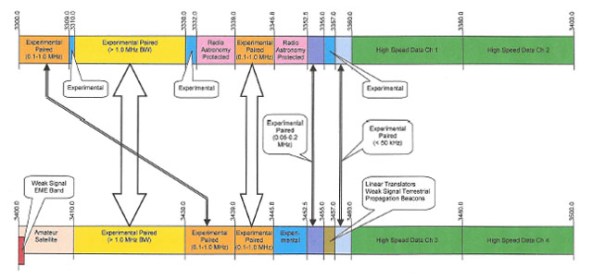
Outside of ITU Region 1, the Amateur Satellite Service has a 9cm band allocation of 3.400 GHz – 3.410 GHz on a non-interfering basis. No current satellites are active on this frequency range at present. The new band plan reserves allocations for EME and amateur satellite operation.

The detailed graphic of the 9 cm band plan and accompanying article is posted on the ARRL web at:
http://www.arrl.org/news/arrl-board-of-directors-approves-9-cm-band-plan

In ARRL Bulletin 14 ARLB014, released on June 5 the report reads:

The ARRL Board of Directors has unanimously voted to approve the 9cm band plan, as presented by the ARRL UHF/Microwave Band Plan Committee. Earlier this year, the committee asked radio amateurs for comments on a proposed 9 cm band plan, explaining that the purpose of these band plans is to share information about how the amateur bands are being used and to suggest compatible frequency ranges for various types of application. The committee also recognized that local conditions or needs may necessitate deviations from a band plan, and that regional frequency coordinating bodies may recommend alternatives for use in their respective regions.

The new 9 cm band plan includes the following notations:

* This band plan includes all other emission modes authorized in the 9 cm amateur band whose necessary bandwidth does not exceed the suggested bandwidths listed.

* Weak Signal Terrestrial legacy users are encouraged to move to 3400.3-3401.0 MHz, as time and resources permit.

* Broadband segments may be used for any combination of high-speed data (e.g. 802.11 protocols), Amateur Television and other high-bandwidth activities. Division into channels and/or separation of uses within these segments may be done regionally, based on need and usage.

* Per ITU RR 5.149 from WRC-07, these band segments are also used for Radio Astronomy.  Amateur use of these frequencies should be first coordinated with the National Science Foundation.

Source AMSAT News Service ANS

A global Amateur-Satellite Service allocation at 3400-3410 is one of the objectives of the IARU.