Ham radio satellites on 5 Euro coin

Lithuania 5 Euro Gold Coin 2018

Lithuania 5 Euro Gold Coin 2018

The Bank of Lithuania (Lietuvos bankas) has released a commemorative gold 5 Euro coin featuring the amateur radio satellites LituanicaSAT-1 (LO-78) and LitSAT-1.

The two CubeSats were launched to the International Space Station (ISS) on January 9, 2014 and deployed from the ISS on February 28. LituanicaSAT-1 carried a FM transponder and a camera while LitSat-1 had a linear (SSB/CW) transponder developed by William Leijenaar PE1RAH.

The face of the gold coin features the Lithuanian coat of arms (Vytis) as a star constellation with LituanicaSAT-1 and LitSAT-1 on the reverse

Watch A gold coin of 5 euros for technology education

Numista catalogue entry https://en.numista.com/catalogue/pieces151686.html

Galileo GNSS/GPS – FCC to vote on use of signals in USA

FCC SealThe Federal Communications Commission (FCC) has said it will vote in November on whether to allow U.S. GPS receivers to access the Galileo global navigation satellite system (GNSS).

From an Amateur Radio perspective the key part is that the FCC will only be voting to waive its licensing requirements for non-federal operations with Galileo channels E1 and E5, subject to certain technical constraints.

This means they will not be voting on the E6 channel 1260-1300 MHz, these frequencies are also Amateur and Amateur-Satellite Service allocations. This suggests for 1260-1300 MHz the situation in the USA will be unchanged, the unlicensed use of the Galileo signal on channel E6 will not be permitted for non-Federal operations in the USA.

Read the Reuters story which also says Ajit Pai is proposing the first comprehensive review of the FCC’s orbital debris rules since their adoption in 2004
https://www.reuters.com/article/us-usa-fcc-gps-europe/fcc-to-vote-to-allow-u-s-devices-to-use-european-navigation-system-idUSKCN1MY2X6

2006 article – Galileo and amateur radio operations in 1260-1300 MHz
http://www.southgatearc.org/articles/galileo.htm

ARISS and Amateur Radio in Raspberry Pi magazine article

Students programming the Astro Pi computers Credit: UK Space Agency (Max Alexander)

Radio amateur Dave Honess M6DNT is interviewed in the popular Raspberry Pi magazine MagPi about “Taking Education to the Stars”.

The article, on pages 84/85 of issue 75 November 2018 MagPi, covers the educational role of the two Astro Pi units on the International Space Station.

Dave mentions Tim Peake KG5BVI / GB1SS and the work of ARISS – Amateur Radio on the International Space Station, saying:

“Radio remains the only way to communicate with all our spacecraft throughout the solar system, and organisations like ARISS and local HAM radio clubs are, in my opinion, becoming more and more necessary to attract new talent.”

Download the Free PDF of MagPi magazine from
https://www.raspberrypi.org/magpi-issues/MagPi75.pdf

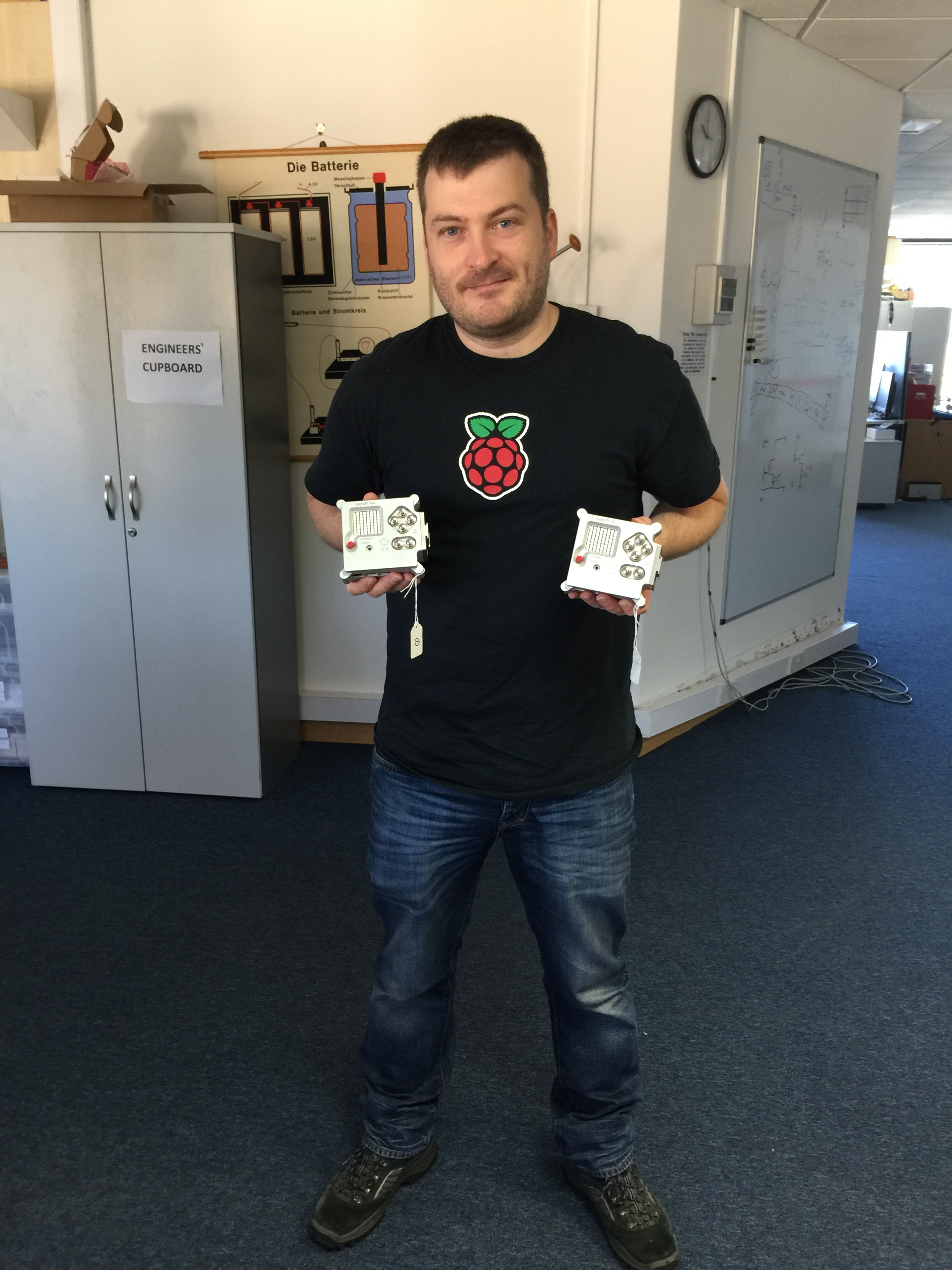
David Honess M6DNT with both ISS Astro Pi computers

David Honess M6DNT with both ISS Astro Pi computers

In 2017 Dave Honess M6DNT and Tim Peake KG5BVI / GB1SS were inducted into the prestigious CQ Amateur Radio Hall of Fame for their educational work in the ISS Astro Pi program and ARISS, Dave said:
“I was really surprised when I heard I’d been inducted into the Hall of Fame, especially alongside Tim! Thank you to CQ magazine for the honour.”

https://amsat-uk.org/2017/05/19/cq-mag-honors-astro-pi-britons/

Since March 2018 Dave Honess M6DNT has been working at ESA ESTEC (European Space Research and Technology Centre) in the Netherlands where he is ISS and International Education Operations Coordinator
https://twitter.com/dave_spice

ARISS http://www.ariss.org/contact-the-iss.html

ESEO’s Educational Story Continues

Happy ESEO students and AMSAT-UK members

Happy ESEO students and AMSAT-UK members

ESA reports the European Student Earth Orbiter (ESEO) has concluded its test campaign. The ESEO student teams gathered in the Netherlands, October 18, 2018 for a last precious lesson before the satellite is launched.

ESEO satellite in the anechoic chamber at the ESTEC test facilities, in the Netherlands

ESEO satellite in the anechoic chamber at the ESTEC test facilities, in the Netherlands

ESEO carries an amateur radio 1260 to 145 MHz FM transponder and a 1k2 and 4k8 BPSK telemetry beacon developed by AMSAT-UK members.

The satellite has been at ESA’s ESTEC test facilities, in the Netherlands, where it completed the last steps of a thorough satellite test campaign which had started in August 2018 at SITAEL’s facility in Mola di Bari, Italy.

Learning by doing has already proven an amazing experience for the ten university student teams from different European universities who have designed and built the instruments and several key subsystems of the ESEO satellite.

On October 18, at a dedicated workshop, the ESEO students had the additional chance to hear first-hand what it takes to run a satellite test campaign – trouble shooting included!

“In the space sector no satellite could ever be launched without a thorough tests campaign”, said Piero Galeone, coordinating the ESA Academy programme of which ESEO is a part. “The reason is that – as perfect as your satellite design and manufacturing process can be – the devil always hides in the details. If there is anything to be fixed, you want to know it and correct it before the satellite flies on its orbit hundreds kilometres from the surface of the Earth, beyond the reach of any engineer’s hands”.

Read the full ESA story at
http://www.esa.int/Education/ESEO/Learning_from_real-life_experience_-_ESEO_s_educational_story_continues

ESEO https://amsat-uk.org/satellites/communications/eseo/

ESEO satellite in clean room

LO-94 spacecraft signal decoded after bouncing off Moon

SSDV image of Moon and Earth taken by LO94 (DSLWP-B) - Credit Cees Bassa

SSDV image of Moon and Earth taken by LO-94 (DSLWP-B) – Credit Cees Bassa

Daniel Estévez EA4GPZ / M0HXM reports decoding a JT4G amateur radio signal from the LO-94 (DSLWP-B) spacecraft that was reflected off the Moon.

Daniel says “JT4G is a digital mode designed for Earth-Moon-Earth microwave communications, so it is tolerant to high Doppler spreads. However, the reflections of the [DSLWP-B] B0 transmitter at 435.4 MHz, which contained the JT4G transmissions, were very weak, so I had not attempted to decode the JT4G Moonbounce signal.”

However, by analysing a recording made on October 19, 2018 at 17:53:35 GMT he was able to decode one of the five JT4G transmissions in the recording.

Read his blog post at https://destevez.net/2018/10/dslwp-b-jt4g-decoded-via-moonbounce/

Also see Geometry for DSLWP-B Moonbounce
https://destevez.net/2018/10/geometry-for-dslwp-b-moonbounce/

The DSLWP amateur radio satellites built by students from the Harbin Institute of Technology was launched to Lunar orbit on May 20, 2018
https://amsat-uk.org/2018/05/19/dslwp-satellites-lunar-orbit/

ARISS Joins NASA On-The-Air for a Special SSTV Event

ISS SSTV image received by John Brier KG4AKV October 27, 2018

ISS SSTV image received by John Brier KG4AKV October 27, 2018

Amateur Radio On The International Space Station (ARISS) is planning a very special Slow Scan Television (SSTV) event from about 1000 UT Saturday, Oct. 27 until 1930 UT Monday, Oct. 29 on 145.800 MHz FM using PD-120.

UPDATE 0930 GMT Oct. 28: SSTV pictures were sent from the ISS on Saturday, the session ended early in the afternoon. Transmissions resumed early Sunday morning.

Helping to support the event will be NASA’s Space, Communication and Navigation (SCaN) Department.

The Space Communications and Navigation (SCaN) program manages NASA’s three most important communications networks: The Space Network (SN), Near Earth Network (NEN), and the Deep Space Network (DSN).

Just as in past ARISS SSTV commemorations, twelve images will be downlinked, but this time with six featuring the SCaN educational activities while the other six images will commemorate major NASA anniversaries, ie., when NASA was established, astronauts first landing on the moon, etc.

In addition to the fun of receiving these images, participants can qualify for a special endorsement for the NASA On The Air (NOTA) celebration event. To learn more about NOTA visit https://nasaontheair.wordpress.com/

Once received, images can be posted and viewed at
http://www.spaceflightsoftware.com/ARISS_SSTV/index.php

The transmissions are expected to be broadcast at the usual frequency of 145.800 MHz using the PD-120 SSTV mode.

Please note that the event is dependent on other activities, schedules and crew responsibilities on the ISS and are subject to change at any time.

Source AMSAT News Service

Note the ISS transmissions use the 5 kHz deviation FM standard rather than the narrow 2.5 kHz used in Europe. If your transceiver has selectable FM filters try using the wider filter. Handheld transceivers generally have a single wide filter fitted as standard and you should get good results outdoors using just a 1/4 wave whip antenna.

ISS SSTV links for tracking and decoding Apps
https://amsat-uk.org/beginners/iss-sstv/

You can receive the SSTV transmissions by using an Online Radio (WebSDR) and the MMSSTV software:
• Listen to the ISS when it is in range of London with the SUWS WebSDR http://farnham-sdr.com/
• Listen to the ISS when it is over Russia with the R4UAB WebSDR

ISS Fan Club – Tracking / Predictions http://www.issfanclub.com/

If you receive a full or partial picture from the Space Station your Local Newspaper may like to know http://www.southgatearc.org/news/2016/july/now-is-a-great-time-to-get-ham-radio-publicity.htm

The RSGB produce a handy Media Guide and Template press release for anyone to download and adapt, see http://rsgb.org/main/clubs/media-guide-for-affiliated-societies/

An example of the publicity you can get for the hobby by telling your Local Newspaper
https://amsat-uk.org/2015/04/15/iss-sstv-in-the-press/