BBC TV to show Michael Portillo moonbounce

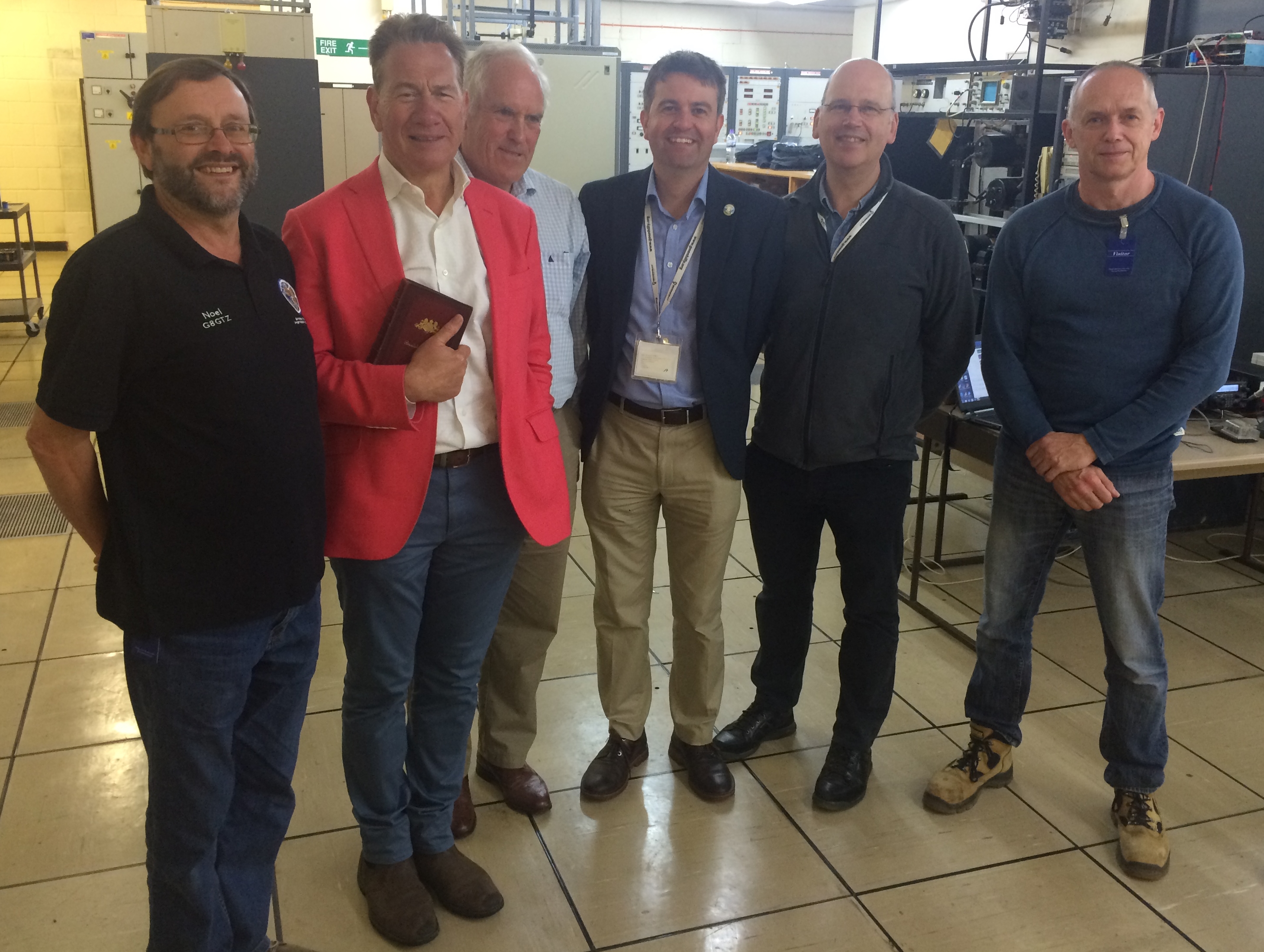
Noel Matthews G8GTZ, Michael Portillo, Brian Coleman G4NNS, Matthew Crosby Chief Scientist Goonhilly, Ian Jones CEO Goonhilly and Tim Fern G4LOH at Goonhilly in June 2017

Noel Matthews G8GTZ, Michael Portillo, Brian Coleman G4NNS, Matthew Crosby Chief Scientist Goonhilly, Ian Jones CEO Goonhilly and Tim Fern G4LOH at Goonhilly in June 2017

BBC TV’s Great British Railway Journeys is expected to show former MP for Enfield Southgate, Michael Portillo, using 5.6 GHz amateur radio to bounce a signal off the surface of the moon.

In 2017, a team led by Noel Matthews G8GTZ and Brian Coleman G4NNS made several visits to Goonhilly Earth Station in Cornwall to use the 32 metre GHY6 dish for 3.4 GHz and 5.760 GHz Earth-Moon-Earth (EME) operation. During one of the visits, Michael Portillo and the Great British Railway Journeys team visited and filmed a sequence including EME operation.

The show will be broadcast on Friday, January 12, 2018 at 6:30pm on BBC2.

Described as “Going to the moon by way of the Cornish Riviera” the sequence will show Michael talking to Brian G4NNS and operating his station under supervision to “talk to the moon” and hear his echos coming back.

The BBC description reads:

Steered by his early 20th-century Bradshaw’s railway guide, Michael Portillo boldly goes to the moon by way of the Cornish Riviera Express! On the trail of an historic achievement made at the dawn of the Edwardian era, he investigates the first radio signal to be sent across the Atlantic. In Plymouth, Michael uncovers what happened to surviving crew members of the most famous ocean liner in history, the Titanic. And at Fowey, he rediscovers a lost literary figure known as Q, who immortalised the town in his novels.

The show will be available online for 30 days from January 12 at
http://www.bbc.co.uk/programmes/b09m8kc2

GB6GHY – Hello Moon, this is Goonhilly calling!
https://amsat-uk.org/2017/08/27/gb6ghy-hello-moon-this-is-goonhilly-calling/

This was not Michael Portillo’s first encounter with amateur radio, in 2014 he send Morse code at Chelmsford, Essex under the guidance of Peter Watkins M0BHY
http://www.southgatearc.org/news/2014/january/michael_portillo_sends_morse_code.htm

What is Amateur Radio? http://www.essexham.co.uk/what-is-amateur-radio

Find a UK amateur radio training course https://thersgb.org/services/coursefinder/
GEO Quarterly magazine available for download

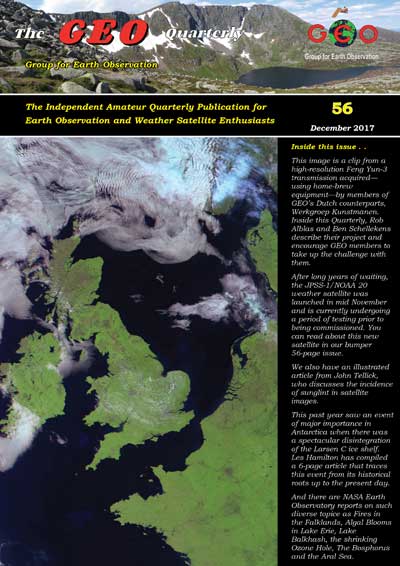
GEO 56 coverThe December PDF of the weather satellite magazine GEO Quarterly produced by the Group for Earth Observation is now available for free download.

The Group for Earth Observation’s aim is to enable amateur reception of weather and earth imaging satellites that are in orbit or planned for launch in the near future.

GEO recently changed from a paid subscription to an optional sign-up to the GEO-Subscribers Yahoo group.

Download December 2017 GEO Quarterly at
http://www.geo-web.org.uk/geoquarterly.php

Group for Earth Observation
http://groups.yahoo.com/group/GEO-Subscribers/
https://twitter.com/GEOWEBUK
https://www.facebook.com/groupforearthobservation

“NASA on the Air” ham radio events

Kennedy Space Center Amateur Radio Club members Dennis Veselka KI4KNC and Scott Vangen WB0QMZ

Kennedy Space Center Amateur Radio Club members Dennis Veselka KI4KNC and Scott Vangen WB0QMZ

NASA is known for communicating with astronauts on missions to space, but did you know regular citizens can radio NASA too?

From the end of this year through the next, NASA will mark several key milestones. Amateur radio clubs at agency centers across the nation plan to celebrate these occasions with several “NASA on the Air” events.

“We enjoy sharing NASA’s story as part of the fun of making contact with fellow ham radio operators across the nation and around the world,” said Kevin Zari KK4YEL, who is activities officer for the Amateur Radio Club at NASA’s Kennedy Space Center in Florida. “We occasionally communicate with people who think that because we’re not flying the space shuttle anymore, NASA has almost gone out of business. We tell them about activities such as the International Space Station and the Space Launch System, and they appreciate the update.”

Amateur, or ham, radio operators use a frequency spectrum for communicating noncommercial and private messages. One of the most important uses of ham radio operations is providing emergency messaging following disasters, such as the recent Hurricane Maria that destroyed most avenues of communication in Puerto Rico.

“The amateur radio clubs at NASA centers are made up of civil servants, contractors and tenants who participate on their own time,” said Zari, who has been at Kennedy since 1990 and is chief technology officer in the Mission and Support Office of Exploration Research and Technology Programs. “We all have a common goal to show our support for NASA and highlight some of the agency’s amazing accomplishments.”

Read the full NASA story at
https://www.nasa.gov/feature/nasa-on-the-air-events-to-highlight-key-space-milestones

What is Amateur Radio? http://www.essexham.co.uk/what-is-amateur-radio

Find a UK amateur radio training course https://thersgb.org/services/coursefinder/

AO-73 / FUNcube-1 spin period and illumination

AO73 / FUNcube-1 Spin Period

AO-73 / FUNcube-1 Spin Period

The attitude of AO-73 / FUNcube-1 is passively stabilised using the traditional magnet and two hysteresis rods. Since the launch over four years ago we have been intrigued with the resultant actual spin rate/period which seems to vary over time for reasons that have not yet been properly explained.

This graphic, which has been developed from telemetry received and maintained by Colin VK5HI, and his team, shows the variations in some detail. Explanations would be gratefully received.

Mike, DK3WN’s, illum.exe software showing predicted duration of the first period

Mike, DK3WN’s, illum.exe software showing predicted duration of the first period

As it is expected that illumination levels may be having an influence, the next few months and years will prove interesting. The spacecraft will be entering periods of continuous sunlight. Initially this will be for a six-week period but then for periods of up to nine months!

AO-73 / FUNcube-1 celebrates its 4th birthday https://amsat-uk.org/2017/11/21/funcube-1-celebrates-4th-birthday/

FUNcube Website https://amsat-uk.org/funcube/

FUNcube Yahoo Group https://amsat-uk.org/funcube/yahoo-group/

FUNcube Forum https://amsat-uk.org/funcube/funcube-forum/

Slow Scan TV from Space Dec 5-6

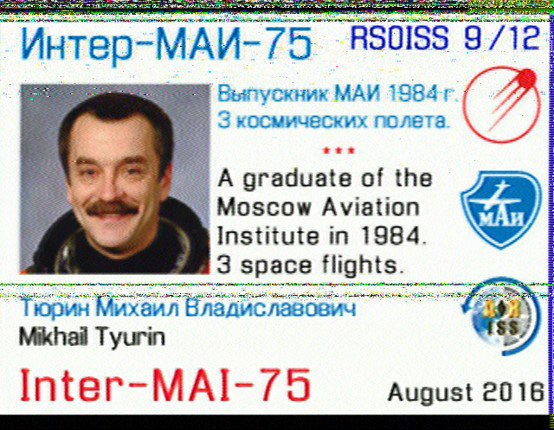
ISS SSTV MAI-75 image 9/12 received by Chertsey Radio Club on Baofeng handheld

ISS SSTV MAI-75 image 9/12 received by Chertsey Radio Club on Baofeng handheld

The 145.800 MHz FM Slow Scan Television (SSTV) transmissions from the International Space Station on December 5-6 should be receivable by radio amateurs around the world.

There should also be SSTV activity on December 7 and 8 at times when the ISS is in range of Moscow.

UPDATE: On Dec 5 ISS Ham @RF2Space Tweeted:
Looks like the #ISS #SSTV test activity was delayed a day. The MAI-75 part is still there but some time changes and session removed. See new schedule at https://ariss-sstv.blogspot.com/

The MAI-75 SSTV system in the Russian Service Module will be put through some extended testing from December 5 starting around 15:00 UTC and running until 09:00 UTC on December 6. Test images will be used during this period. This will provide near global coverage if all works well on 145.800 MHz FM.

In the past images have been sent using the SSTV mode PD120, with a 2-minute off time between each image.

All you need to receive SSTV pictures direct from the space station is to connect the audio output of a scanner or amateur radio transceiver via a simple interface to the soundcard on a Windows PC or an Apple iOS device, and tune in to 145.800 MHz FM. You can even receive pictures by holding an iPhone next to the radio loudspeaker.

The ISS puts out a strong signal on 145.800 MHz FM and a 2m handheld with a 1/4 wave antenna should be enough to receive it.

Many FM rigs can be switched been wide and narrow deviation FM filters. For best results you should select the filter for wider 5 kHz deviation FM. Handhelds all seem to have a single wide filter fitted as standard.

ARISS SSTV Blog http://ariss-sstv.blogspot.co.uk/

ISS Slow Scan TV information with links to Apps and ISS tracking
https://amsat-uk.org/beginners/iss-sstv/

FUNcube-1 celebrates its 4th birthday

Final gluing of FUNcube-1 bolt by Wouter Weggelaar PA3WEG – Image credit Gerard Aalbers

Final gluing of FUNcube-1 bolt by Wouter Weggelaar PA3WEG – Image credit Gerard Aalbers

Today, November 21st 2017, marks the fourth birthday for FUNcube-1 (AO-73) in orbit.

FUNcube-1 was launched at 07:10 UTC on November 21st 2013 and its first signals were received immediately after deployment over the Indian Ocean by amateurs in South Africa. Since then it has been operating continuously in either its education mode or, with the transponder active, in amateur mode when in eclipse and at weekends.

AMSAT-UK FUNcube Mission Patch Rev4 20100609

AMSAT-UK FUNcube Mission Patch

The spacecraft has spent the four years in space orbiting the earth at between 640 and 580 km and has now traveled around the earth more than 20,000 times. That represents a distance traveled of approaching 500 million miles.

Up to now, each of the orbits has been spilt approximately 65% in sunlight and 35% in eclipse. This has resulted in the temperatures inside the small spacecraft varying by about 25° C during each orbit.

During the recent AMSAT-UK Colloquium, Wouter Weggelaar, PA3WEG, in his presentation about the FUNcube project mentioned that the power available from the solar panels has been slowly increasing since launch. This observation led the team to do some further investigations as to the cause.

Although the launch was into a nominally Sun Synchronous orbit, over time this has drifted and the spacecraft is now entering a period when it will be in the sun for longer periods during each orbit. The exact details are still being determined, but it seems likely that, starting from January 2018, there will be periods when the spacecraft will be in the sun for all, or almost all, of its orbits.

FUNcube-1 temperature rise

FUNcube-1 temperature rise

This means that the on-board temperatures will be much higher than we have previously experienced in flight, although we have some test records from pre-flight thermal air testing that were undertaken after integration.

The key will be to discover what the equilibrium temperature will be internally. For comparison, AO85 has already “enjoyed” periods of full sun and its internal temperatures have reached up to around 55° C.

So the next few months will be quite an exciting time for the team! We remain extremely grateful to everyone is using the spacecraft for both its educational and amateur missions. Of course we are also very very grateful to those who are downloading the telemetry and uploading the data to the Data Warehouse. It continues to provide a unique record of “life on board” a 1U CubeSat in space.

Watch the FUNcube presentation by Wouter Weggelaar PA3WEG

Get your 73 on 73 Award, details at https://amsat-uk.org/funcube/73-on-73-award/

AO-73 (FUNcube-1) website https://amsat-uk.org/funcube/funcube-website/

FUNcube Yahoo Group https://amsat-uk.org/funcube/yahoo-group/

ZACUBE-1, FUNcube-1 and HiNCube in the deployment pod - Image credit Wouter Weggelaar PA3WEG

ZACUBE-1, FUNcube-1 and HiNCube in the deployment pod – Image credit Wouter Weggelaar PA3WEG