SA AMSAT Accelerating the KLETSkous CubeSat Project

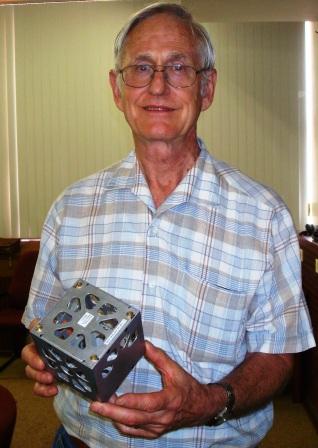
Deon Coetzee ZR1DE with prototype space frame - Image Credit SA AMSAT

Deon Coetzee ZR1DE with prototype space frame – Image Credit SA AMSAT

SA AMSAT has decided to accelerate their CubeSat project, named KLETSkous and expect to have the first prototype version of the 435/145 MHz linear transponder and control system on the table for testing by end February.

“One of the reasons to speed up development is the quest to have the transponder included as an experimental payload on the ARMC project.” Hannes Coetzee, ZS6BZP, said. Jacques Roux, ZR1ADC,  is working on the transponder while Brian McKenzie, ZS1BMN, is responsible for the control systems.

As part of South Africa’s contribution to the African Resource and Environmental Management Constellation (ARMC) of satellites, SANSA, in collaboration with local industry and academic experts, have been in discussions on the specifications for the new satellite (ZA-ARMC1) and its associated benefits for South Africa and the continent. SA AMSAT is making representation to SANSA to have an amateur payload included in the project.

Continue reading

UKube-1 CubeSat Featured in SatMagazine

SatMagazine January 2013The January issue of the free publication SatMagazine features an article on the UK Space Agency’s first satellite UKube-1. It will carry an amateur radio subsystem and a launch on a Soyuz rocket is planned for the 3rd quarter of 2013.

The article on page 6 includes a picture of Steve Greenland of Clyde Space taking delivery of a set of AMSAT-UK FUNcube boards which will provide a 435/145 MHz linear transponder and a 145.915 MHz BPSK telemetry beacon for educational outreach.

Starting on page 24 is an article ‘Truly Educational Experiences… With Nanosats’ covering the University Nanosat program.

Download the January 2013 SatMagazine from http://www.satmagazine.com/2013/SM_Jan2013.pdf

Ukube-1 – Milton Keynes Cubesat Community Workshop January 22 http://www.uk.amsat.org/?p=11782

Clyde Space http://www.clyde-space.com/

STRaND-1 CubeSat & BBC Stargazing Live

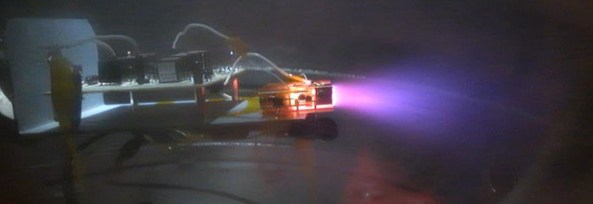
STRaND-1 CubeSat Plasma Propulsion Test

STRaND-1 CubeSat Plasma Propulsion Test Firing

BBC TV have been filming at the Surrey Space Centre (SSC) and Surrey Satellite Technology Limited (SSTL) for an item on the STRaND-1 CubeSat mission for Stargazing Live.

Continue reading

Pictures Received on 5840 MHz from Amateur Radio Satellite FITSAT-1

Image of ISS taken by the FITSAT-1 CubeSat after deployment

Image of ISS taken by the FITSAT-1 CubeSat after deployment

On December 22 members of AMSAT-DL succeeded in receiving 18 images from the 5840 MHz high-speed downlink of the amateur radio satellite FITSat-1.

In total 22 images were transmitted in the test and 18 were received at the amateur radio facility at Bochum.

The FITSAT-1 CubeSat was developed by students at the Fukuoka Institute of Technology (FIT) in Japan. As well as the high-speed data downlink on 5840.0 MHz the satellite carries several amateur radio payloads: a CW beacon on 437.250 MHz, a telemetry beacon on 437.445 MHz and an optical Morse code LED experiment.

Continue reading

More Optical Beacon Tests From FITSAT-1

(C) Tsuyoshi Watanabe Ebina City, Kanagawa Japan 1:24:23-1:24:25JST, 12 Dec 2012
Takahashi e160, Diameter short focus telescope 16cm (F=530mm, F3.3)
Nikon D800E, ISO12800, 2 seconds exposure

Further transmissions from the optical LED beacon on the amateur radio CubeSat FITSAT-1 are planned for January 10-15. Weather permitting the satellite beacon should be visible using binoculars.

2013, Flashing LED Schedule (times GMT):
10th Jan. 23:57:30 – 23:59:30  New Delhi India        (10Hz Green 2min)
11th Jan. 13:52:30 – 13:54:30  San Francisco USA  (10Hz Green 2min)
12th Jan. 22:00:30 – 22:02:30  Bangalore India        (10Hz Green 2min)
13th Jan. 14:41:30 – 14:43:30  Melbourne Australia (10Hz Red     2min)
14th Jan. 11:03:30 – 11:05:30  Oklahoma USA         (10Hz Green 2min)
15th Jan. 22:27:30 – 22:29:30  Wulumuqi China       (10Hz Green 2min)

The FITSAT-1 CubeSat was developed by students at the Fukuoka Institute of Technology (FIT) in Japan. As well as the optical LED experiment the satellite carries several amateur radio payloads: a CW beacon on 437.250 MHz, a telemetry beacon on 437.445 MHz and a high-speed data downlink on 5840.0 MHz.

Information on how to see the optical beacon signal can be found on the Visual SAT-Flare Tracker 3D site at
http://www.satflare.com/track.php?q=fitsat#MAP

FITSAT-1 website http://www.fit.ac.jp/~tanaka/fitsat.shtml

FITSAT-1 Optical Beacon video
http://www.southgatearc.org/news/december2012/fitsat1_optical_beacon_video.htm

Further information and pictures of FITSAT-1 and the other CubeSats deployed from the ISS on October 4, 2012 is at http://www.uk.amsat.org/?page_id=10967

Nanosat Launch Concept

Did you ever wonder how Nanosatellites are being launched ?
Well, Meidad Pariente has edited a video produced by the Aalto-1 team that explains how such a task is performed.

Both the edited and original videos are shown.

Aalto-1 is a student CubeSat project of Aalto University, Finland that plans to operate at VHF-UHF and there will also be an S-band transmitter. Up to 8 watts of power will be available from the Solar panels.

Continue reading