A Multi-purpose Portable Satellite Station

At the AMSAT-UK Colloquium 2011, Ivo Klinkert PA1IVO gave a short presentation about his experiences with his portable setup, called A Multipurpose Portable Setup.

Based on this presentation, Andreas Bilsing DL2LUX invited him to write an article about this subject for the AMSAT-DL Journal. The article, Eine tragbare Mehrzweck-Satellitenstation, was translated from English to German by Andreas and appeared in the March 2012 issue of the AMSAT-DL Journal. The English version of the article appeared later in two issues of OSCAR News of AMSAT-UK (July and September 2012). These AMSAT-UK publications are available to E-members here.

The original English text can now be read on the link below (not all pictures appeared in the article in OSCAR News). Please be informed that the status of the satellites mentioned in the article is not updated since the article was written! If you are interested in working satellites as a portable station, Google can give you more webpages about this subject, for example a similar setup of KB5WIA.

Read Ivo’s article at http://ivok.home.xs4all.nl/pa1ivo/portable_satellite_setup.html

New Satellite Launch Vehicle To Carry CubeSat Swarm in 2013

Super Strypi – SPARK

2013 should see the first flight of a new satellite launch vehicle.

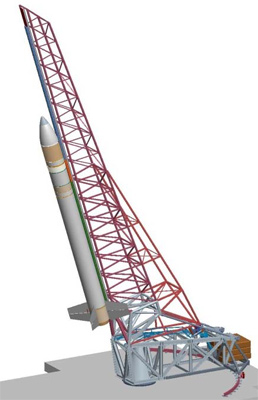
Super Strypi, also known as SPARK (Space-borne Payload Assist Rocket – Kauai), has been developed by Sandia National Laboratories, the University of Hawaii and Aerojet. The rocket is based on an enlarged version of Sandia’s Strypi sounding rocket.

The all solid fueled vehicle uses a GEM-46 (LEO-46) motor of Delta-2H heritage as first stage. A Orbus-7S (LEO-7) motor acts as second stage and a Star-30BP (Spark-30) or an Orbus-1 (LEO-1) as third stage. It is spin and fin stabilized during fist stage burn and has attitude control for the two upper stages. The low cost rocket will be launched from a rail launcher and can put a payload of 250 kg into a 400 km sun-synchronous orbit.

The Super Strypi vehicle will be launched from a rail-launcher at Barking Sands, Kauai (Pacific Missile Range Facility) towards the end of 2013.

Conceptual representation of a cluster of EDSN satellites illustrating their ability to communicate and share data as a network.  Credit NASA

Super Strypi will be carrying a swarm of CubeSats, the Edison Demonstration of Smallsat Networks (EDSN). The CubeSats are an unusual size of 10 by 10 by 15 cm (1.5U) and weigh 2 kg. The EDSN swarm will demonstrate distributed, multipoint space weather measurement and are expected to operate for at least 60 days and have an orbit life-time of up to 4 years.

ORS Project – Super Strypi http://www.govsupport.us/ORSSSEA/Documents/DEA.pdf

Operationally Responsive Space (ORS) Project – Super Strypi http://www.govsupport.us/orsssea/

NASA – Small Spacecraft Technology Program
http://www.nasa.gov/offices/oct/stp/small_satellite_subsystem_tech/index.html

Gunter’s Space Page 2013 http://space.skyrocket.de/doc_chr/lau2013.htm

KickSat-1 Sprite Amateur Radio Frequencies

KickSat 437 MHz Sprite Satellite

KickSat 437 MHz Sprite Satellite

KickSat-1 is an amateur radio CubeSat technology demonstration mission designed to demonstrate the deployment and operation of 128 prototype Sprites (also referred to as ChipSats or femtosatellites) which were developed by radio amateur Zac Manchester KD2BHC at Cornell University.

315 individual sponsors donated $74,586 to the project through the crowd-source funding website Kickstarter.

KickSat-1 is planned to launch on ELaNa-5 / CRS-3 from Cape Canaveral in early 2014 into a 325 x 315 km 51.5 degree inclination orbit. The CubeSat will operate on 2401.2-2436.2 MHz and when deployed all the 128 Sprites will operate on a single frequency 437.240 MHz and use CDMA. It is believed this will be the largest ever single deployment of satellites.

It the UK both the British Interplanetary Society (BIS) and London Hackspace are developing Sprites for this mission.

ChipSats like the Sprite represent a disruptive new space technology that will both open space access to hobbyists and students and enable new types of science missions.

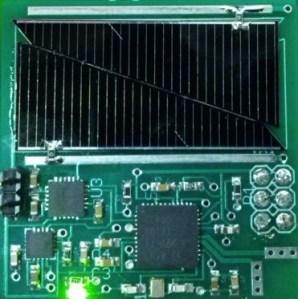
The Sprite is a tiny spacecraft that includes power, sensor, and communication systems on a printed circuit board measuring 3.5 by 3.5 cm with a thickness of 2.5 mm and a mass of about 5 grams. It is intended as a general-purpose sensor platform for micro-electro-mechanical (MEMS) or other chip-scale sensors with the ability to downlink data to ground stations from LEO.

Sprites in Space

Sprites in Space

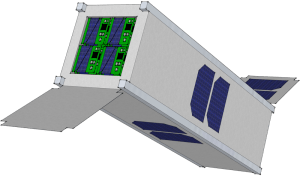
KickSat is a 3U CubeSat being built to carry and deploy the Sprites. A 1U avionics bus will provide power, communications, and command and data handling functions. A 2U deployer has been developed to house the Sprites. Approximately 128 will be stacked atop a spring-loaded pusher and secured by a nichrome burn wire system.

After being released from the P-POD, KickSat will perform a de-tumble maneuver and establish communication with Cornell’s ground station. After check-out, the spacecraft will be put in a sun-pointing attitude and spun up to maintain that attitude.

A command signal from the ground station will then trigger the deployment and the Sprites will be released as free-flying spacecraft. After deployment, telemetry and sensor measurements from the individual Sprites will be received through Cornell’s amateur radio satellite ground station in Ithaca, NY, as well as several other amateur radio ground stations throughout the world.
KickSat

KickSat

The Sprites are expected to reenter the atmosphere and burn up within a few days or weeks depending on atmospheric conditions. The maximum orbital lifetime is estimated at 6 weeks.

KickSat Downlink Frequency: 2401.2-2436.2 MHz RF Output Power: 1W ITU Emission Designator: 350KF1D Description: AX.25 over FSK.

Sprite Frequency Band: 437.240 MHz. Output Power: 10 mW ITU Emission Designator: 50K0G1D. Description: MSK modulated binary data with each data bit modulated as a 511 bit PRN sequence. All Sprites operate on a single frequency and use CDMA.

Zac Manchester KD2BHC has said they are aiming for the Sprites to be receivable using an AMSAT-UK FUNcube Dongle SDR.

As well as KickSat-1 several other amateur radio CubeSats are being launched from Cape Canaveral in early 2014 on ELaNa-5 / CRS-3 into a 325 x 315km 51.5 degree inclination orbit. They are: DragonSat-1 – USNA and Drexel University, Trailblazer – University of New Mexico, PrintSat – Montana State University, All-Star/THEIA – University of Colorado, UNP-6 Radar Calibration CubeSat – University of Hawaii, PhoneSat – NASA ARC, MisST – NASA ARC.

More information from http://www.spacecraftresearch.com/MII/MII_overview.html

The current KickSat and Ground Station source code is available at https://github.com/zacinaction/kicksat

KickSat – Zac Manchester KD2BHC Interview http://www.uk.amsat.org/?p=3730

BIS Sprite technical information http://www.bis-space.com/2013/03/09/9301/kicksat-technical-summary

London Hackspace work on HackSat1 http://www.uk.amsat.org/?p=2482

KickSat – a personal spacecraft of your own in space http://www.uk.amsat.org/?p=2164

Kicksat on Kickstarter http://www.kickstarter.com/projects/zacinaction/kicksat-your-personal-spacecraft-in-space

IARU Amateur Satellite Frequency Coordination Panel status page http://www.amsat.org.uk/iaru

Winter Issue of OSCAR News

E-members of AMSAT-UK can now download the PDF of the Winter edition of the OSCAR News magazine here. (As well as the earlier 2012 issues)

The paper edition is at the printers and should be posted to members within 2 weeks.

In this issue
• IARU Region 3 Chairman Michael Owen, VK3KI (SK)
• Amateur Radio Satellites – The First 25 Years
• G3CVI column “Haven’t got a callsign?”
• Low Noise Cavity Pre-Amplifier 70 cm EME and satellites by Domenico Marini, i8CVS
• Early Editions of Oscar News
• FUNcube Update
• Currently Active Spacecraft
• Shorts

The AMSAT-UK Membership year lasts for 12 months starting on January 1 each year.


AMSAT-UK FUNcube Mission Patch

AMSAT-UK FUNcube Mission Patch

Membership of AMSAT-UK is open to anyone who has an interest in amateur radio satellites or space activities, including the International Space Station (ISS).

E-members of AMSAT-UK are able to download OSCAR News as a convenient PDF that can be read on laptops, tablets or smartphones anytime, anyplace, anywhere. Join as an E-member at Electronic (PDF) E-membership

There are two rates for the paper edition to cover the extra postage costs:
UK
Rest of the World (Overseas)

See a PDF sample copy of “Oscar News” at http://www.amsat-uk.org/on_193_final.pdf

Join AMSAT-UK using PayPal, Debit or Credit card at
http://shop.amsat.org.uk/shop/category_9/Join-Amsat-UK.html

E-members can download their copies of OSCAR News from http://www.amsatuk.me.uk/on

SkyCube Vacuum Test

Tim DeBenedictis and Anna Vital with the SkyCube satellite

This video shows a preliminary qualification test of SkyCube’s electronic components in Evan Neumann’s thermal vacuum chamber in San Francisco, CA, December 19, 2012.

Continue reading

UKube-1 Signs up for Launch and Completes Thermal Vacuum Testing

Clyde Space have successfully completed Thermal Vacuum Testing, where the UKube-1 Flight Model was operated in a simulated space environment (i.e. no air and at temperature extremes)

UKube-1 the UK Space Agency’s (UKSA) first satellite has ‘booked’ its journey into space on a Russian Soyuz-2 rocket. The launch from Baikonur in Kazakhstan is expected to take place in the 3rd quarter of 2013. UKube-1 has also completed Thermal Vacuum Testing to verify the spacecraft operation in a simulated space environment.

UKube-1 will carry a set of AMSAT-UK FUNcube boards to provide a 435/145 MHz linear transponder and a 145.915 MHz BPSK telemetry beacon for educational outreach.

Continue reading