F-1 CubeSat on TV

The Vietnamese TV station VTV1 broadcast a news story about the amateur radio CubeSat F-1, callsign XV1VN, due to be launched to the International Space Station (ISS) on July 21.

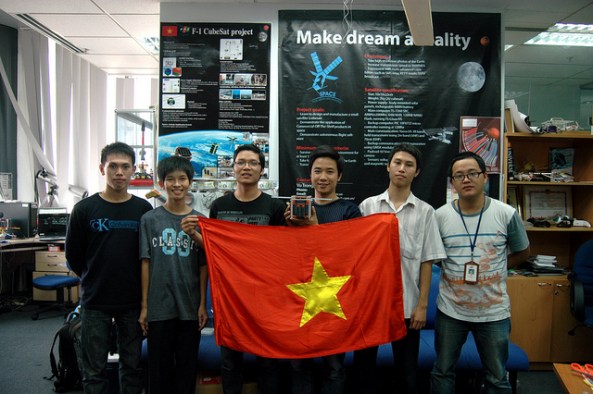
The broadcast shows students from the FPT University in Hanoi who are involved in the project and has an interview with Thu Trong Vu XV9AA.

F-1 carries a low-resolution camera (640×480), a 3-axis magnetometer and two Yaesu VX-3R transceivers using 145.980 and 437.485 MHz.

It is planned to launch to the ISS on July 21 in the HTV-3 cargo vessel and be deployed in September by Japanese astronaut Akihiko Hoshide KE5DNI using the ISS Kibo robot arm.


Watch CubeSat F-1 on VTV1

For the latest news on F-1 see the FSpace website http://fspace.edu.vn/

Video depicting F-1 CubeSat XV1VN deployment from the ISS http://www.uk.amsat.org/?p=8446

Vietnam Student CubeSat F-1 http://www.uk.amsat.org/?p=5025

6U CubeSat Low Cost Space Missions Workshop

17th – 18th July 2012

Click here to register to attend the Workshop

Workshop Details

Title: 6U CubeSat Low Cost Space Missions Workshop
Date: 17th – 18th July 2012
Abstracts Due: 26th June 2012
Time:
Venue: The Duffield Theatre, Advanced Instrumentation and Technology Centre, Mt Stromlo Observatory, Canberra Australia
Cost: Free
Download the workshop poster here.
Background

For 2012 the NASA CubeSat Launch Initiative includes 6U CubeSat satellites. An 8 kg 6U CubeSat can be designed to perform some of the Earth observation missions of 100 kg microsatellites. A 6U CubeSat (~33 x 10 x 22 cm, ≤ 8kg) has 4 times the payload capacity of a 3U CubeSat (33 x 10 x 10 cm, ≤ 4 kg) which uses two thirds of its volume for system components.


This workshop, the first in the world dedicated to the 6U CubeSat, will explore the range of missions possible with a 6U CubeSat in the areas of:

  • Astronomy
  • Atmospheric Science and other Planetary Science
  • Space Physics
  • Earth Observation
  • Biology
  • Other

Program

Day 1 – Tuesday 17th July 2012
Time Presentation Title Speaker
10:00-10:30AM Morning tea
10:30-10:35AM Welcome Andrew Dempster (ACSER)
10:35-10:45AM Workshop Introduction Steven Tsitas (ACSER)
10:45-11:10AM 6U CubeSat Design for Earth Observation with 6.5 m GSD, 5 Spectral Bands and 14 Mbps downlink Steven Tsitas (ACSER)
11:10-11:35AM Scheduling multi-spectral collection of the Australian landmass using a 6U cubesat constellation Leon Stepan (DSTO)
11:35-12:00PM From SmallSat to 6U CubeSat: A Case Study in size and mass reduction Jeremy Straub (University of North Dakota)
12:00-01:00PM Lunch
01:00-01:25PM 6U CubeSat as the basis for a sustainable Australian space program Steven Tsitas (ACSER)
01:25-01:50PM TBC Roger Franzen, Mike Petkovic (ANU, Mt Stromlo Observatory)
01:50-02:50PM KEYNOTE: Research and Technology Implications and Applications for Very Small (MesoScale) Spacecraft John Hines (NASA-Ames)
02:50-03:15PM Synergy between 6U, fractionated and adaptable systems Gordon Roesler
03:15-03:45PM Afternoon tea
03:45PM Panel Discussion: Can the 6U CubeSat form the basis of a sustainable Australian space program?
Day 2 – Wednesday 18th July 2012
Time Presentation Title Speaker
09:05-09:10AM Workshop introduction final day Steven Tsitas (ACSER)
09:10-09:40AM TBC Stephanie Thomas (Princeton Satellite Systems)
09:40-10:05AM Satellite-borne impact detectors for small meteoroids, interplanetary dust and space debris Duncan Steel (UNSW)
10:05-10:35AM Morning tea
10:35-11:00AM A CubeSat Mission for Exoplanet Transit Detection and Asteroseismology Jeremy Bailey (UNSW)
11:00-12:00PM KEYNOTE: Astrophysics with 6U platforms Harvey Butcher (ANU)
12:00-01:00PM Lunch
01:00-01:25PM 6U CubeSat Commercial Applications Steven Tsitas (ACSER)
01:25-01:50PM 40 kg to LEO; a low cost launcher for Australia Nicholas Jamieson (UNSW)
01:50-02:15PM 6U Radar Altimeter Concept Design Nick Stacy (DSTO)
02:15-02:40PM GNSS Remote Sensing in a 6U Cubesat Andrew Dempster (UNSW)
02:40-03:05PM Preliminary parameters for an experimental payload for Trospospheric CO2 measurement using a space-born lidar 6U cubesat platform Manny Fabiao Dionizio (UNSW)
03:05-03:35PM Afternoon tea
03:35-04:05PM 6U CubeSat Systems (TBC) TBC
04:05-04:35PM CubeSat deorbit devices (TBC) TBC
04:35-04:45PM Workshop conclusion and next steps Steven Tsitas (ACSER)

Keynotes

Technology Keynote – John W. Hines, Chief Technologist, NASA-Ames Research Center
Science Keynote – Professor Harvey Butcher , Director Research School of Astronomy and Astrophysics
Chair

Dr Steven Tsitas, Senior Research Associate, Australian Centre for Space Engineering Research, University of New South Wales
Who Should Attend

Scientists and engineers interested in payload and mission concepts that take advantage of the greater payload capacity of the 6U CubeSat. For examples of 6U CubeSat designs and payloads that could perform some of the Earth observation missions of 100 kg microsatellites please see “6U CubeSat Design for Earth Observation with 6.5 m GSD, 5 Spectral Bands and 14 Mbps downlink” and “6U CubeSat Commercial Applications”. Reprints available upon request.

Presentations are invited describing payloads and mission concepts for the 6U CubeSat. Presentations are also invited regarding 6U launch opportunities and 6U CubeSat standards.

  • SESSION 1: Earth Observation Missions
  • SESSION 2: Astronomy Missions
  • SESSION 3: Planetary Science and Space Physics Missions
  • SESSION 4: Biology and other missions
  • SESSION 5: 6U CubeSat launch opportunities
  • SESSION 6: 6U CubeSat standards

Abstracts

If you wish to submit an abstract for the 6U CubeSat Low Cost Space Missions Workshop please email them to Stanija Buvac before the 3rd July 2012.

Australian Centre for Space Engineering Research
Unveiling of Florida Student CubeSat SwampSat

The amateur radio SwampSat satellite, built by students at the University of Florida (UF) was recently unveiled.

Its downlink will use 1200 bps AX25 packet radio on 437.385 MHz with 1 watt of RF.

The team are planning on a December 2012 launch on the SpaceX Falcon 9 into a 450 km orbit with an inclination of 45 degrees. [Update: SwampSat launched on Minotaur-1 on November 20, 2013]

Watch SwampSat Unveiling

SwampSat on TV News http://www.amsat-uk.org/?p=8464

SwampSat – Florida’s small satellite programs brings STEM jobs
https://www.facebook.com/media/set/?set=a.10150734814267248.435445.121264742247&type=3

UF shows off its small satellite http://www.gainesville.com/article/20120406/articles/120409715

Gator Amateur Radio Club http://www.gatorradio.org/

University of Florida Small Satellite Design Club (SSDC) http://www.ufsmallsat.com/

//

F-1 CubeSat Delivered to Tsukuba Space Center

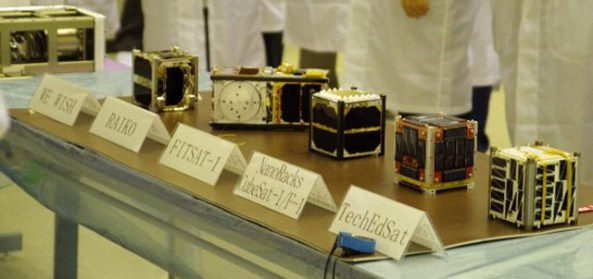
CubeSats ready for HTV-3 Launch – Image Credit Koumei Shibata

The amateur radio CubeSat F-1 built by students at the FPT University in Hanoi, Vietnam has now been delivered to the Tsukuba Space Center in Japan.

F-1 CubeSat – Image Credit Koumei Shibata

F-1 and the other four CubeSats  (RAIKO, WE WISH, FITSAT-1 and TechEdSat) will be integrated with the small satellite deployer J-SSOD before leaving for Tanegashima launch pad.

The CubeSats should be launched to the International Space Station (ISS) on July 21 in the HTV-3 cargo vessel.  It is planned that they will be deployed from the ISS in September by Japanese astronaut Akihiko Hoshide KE5DNI using the Kibo robot arm.

F-1 carries a low-resolution camera (640×480), a 3-axis magnetometer and two Yaesu VX-3R transceivers using 145.980 and 437.485 MHz.

See the story on the FPT University website http://tinyurl.com/FTP-F-1-To-Launch

Further pictures of the CubeSats by Koumei Shibata can be seen at http://fspace.edu.vn/?p=633

An NHK TV News video showing the CubeSats shows the LED’s on FITSAT-1 that will be used to flash Morse Code from space. See http://www3.nhk.or.jp/news/html/20120625/t10013095191000.html

For the latest news on F-1 see the FSpace website http://fspace.edu.vn/

Video depicting F-1 CubeSat XV1VN deployment from the ISS http://www.uk.amsat.org/?p=8446

Vietnam Student CubeSat F-1 http://www.uk.amsat.org/?p=5025

Video of ArduSat NASDAQ Interview

NanoSatisfi founder Peter Platzer appeared on the Japanese NASDAQ TV feed to talk about the ArduSat satellite.

ArduSat is an open-source arduino-based nanosatellite. It will have an extensive sensor-suite onboard and will allow users to upload their own code and run their own experiments.

ArduSat will use a GomSpace NanoCom U482C which is a half-duplex UHF transceiver, capable of up to 3W, operating in the 435-438 MHz amateur radio satellite band. It implements Forward Error Correction (FEC) and Viterbi coding based on the CCSDS standards in order to improve reliability and throughput of the space link.

The project is raising donations through the Kickstarter site at http://nanosatisfi.com/ In just over a week they raised more than $43,000 in pledges from almost 300 donors.

Watch NanoSatisfi NASDAQ interview which is in English with Japanese sub-titles

Watch ArduSat Kickstarter Thank you

It is understanding the team are now aiming for a larger 2U CubeSat instead of the 1U originally planned.

ISIS CubeSat Structure Brochure http://www.isispace.nl/brochures/ISIS_CubeSat%20Structures_Brochure_v.7.11.pdf

Facebook https://www.facebook.com/pages/NanoSatisfi/307866409295499

ArduSat Arduino CubeSat Technical Details https://amsat-uk.org/2012/06/20/ardusat-arduino-cubesat-technical-details/

ArduSat Open Source CubeSat Next Phase in DIY Space Access http://www.uk.amsat.org/?p=8337

ArduSat Arduino CubeSat Update http://www.uk.amsat.org/?p=8284

NanoSatisfi was founded by Austrian-born Peter Platzer a former high-energy physicist (CERN), former Hedge Fund Quantitative Trader, avid HP-41 hacker and Arduino enthusiast, along with Belgian aerospace engineer Jeroen Cappaert intern at NASA Ames Research Center, Canadian aerospace engineer Joel Spark intern at EADS Astrium and Hungarian Reka Kovacs intern at NASA Ames Research Center working on alternative methods of public outreach for space science. The four founders met at the International Space University in Strasbourg and thought that they could do something to provide affordable, open-source space exploration for everyone.

Interview with author of DIY Satellite Platform

Tubesat - Image Credit Interorbital Systems

Have you ever wanted to build your own personal satellite but your last name doesn’t start with Gates or Branson? Well, now there’s good news. For the price of a car you can now build, test and launch your own personal satellite at home.

Dr. Sandy Antunes, Author of DIY Satellite Platform, talks about building his own amateur radio personal spacecraft Project Calliope. The best part (besides having your own satellite) is that you can now do some serious science.

Find out what kind of satellite Dr. Antunes is building and how he’s running the same kinds of tests the large Aerospace companies do, but for a fraction of the cost.

Project Calliope: http://www.projectcalliope.com/

Watch How to build your own personal satellite

Dr. Sandy Antunes used Kickstarter to raise funds for the project
http://www.kickstarter.com/projects/ghostlibrary/capturing-the-ionosphere-ground-station-calliope

Amazon – DIY satellite Platform
http://www.amazon.co.uk/DIY-Satellite-Platforms-Space-Ready-Picosatellite/dp/1449310605/

Interorbital Systems http://www.interorbital.com/