RAMPART CubeSat to use propulsion

RAMPART CubeSat

RAMPART CubeSat

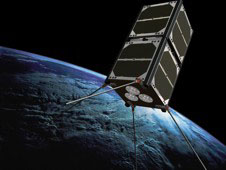
Students at Morehead State University are building an amateur radio CubeSat with a propulsion system that will raise the apogee of its orbit from 500 km to 1200 km.

RAMPART, which stands for RApidprototyped Mems Propulsion And Radiation Test CUBEflow SATellite, plans to launch on a Minotaur from Vandenburgh in June 2013.

It is a 2U CubeSat and will use a self-contained, warm gas, propulsion system to adjust satellite’s initial circular orbit of 500 km to an eliptical orbit with an apogee of 1200 km and perigee of 500 km at a 45 degree inclination.

RAMPART Thruster Design

RAMPART Thruster Design

It will demonstrate use of 3D printing (A.K.A. rapid prototyping) for manufacturing small satellites. Measure flux of energetic particles in lower Van Allen Belt. Test radiation-hardened electronic components and high performance solar cells in high radiation environment over a period of five years.

The students are proposing a UHF downlink of 9k6 GMSK AX25 packet. A downlink frequency of 437.325 MHz has been requested.

RAMPART NanoSat Paper http://ssc.moreheadstate.edu/missions/rampart/rampart.pdf

IARU Amateur Satellite Frequency Coordination Status Report http://www.amsat.org.uk/iaru

COMPASS-1 – End of mission

Compass-1Mike Rupprecht DK3WN brings the sad news of the demise of the COMPASS-1 CubeSat that was launched April 28, 2008. COMPASS-1 was designed and built by students at the Aachen University of Applied Sciences in Germany.

Dear supporters and friends of our COMPASS-1 mission,

First, let me thank you very much for your support in trying to save the life of our COMPASS-1 satellite during the last days, but also during the last years of “routine” operations. It seems that our mission now comes to an end.

The projected lifetime of COMPASS-1 was half a year. The tiny guy has outperformed this value by a factor of more than seven. April 28th would have been it’s 4th birthday and if it was a human, it would now be about 500 years old (Cubesat-years are short). So, if you have more important things to do (and I guess so), we can not expect you to continue your efforts in saving its life.

With your support, you have made things possible that we would never have been able to achieve with our own resources and I appreciate your support very much. So, COMPASS-1, rest in peace. (Nevertheless, if you still want to try to awake it from the dead, feel free to do so.)

I hope that we will soon be able to build and launch COMPASS-2 and that you will be still available, all over the world, as a ground station to command and fly our new bird. We will keep you informed.

Cheers and thanks for all,

Bernd
_ _ _ _ _ _ _ _ _ _ _ _ _ _ _ _ _ _ _ _ _ _ _

Prof. Dr. Bernd Dachwald
Faculty of Aerospace Engineering FH Aachen
University of Applied Sciences

Compass-1 Reset http://www.uk.amsat.org/5204

Interorbital Systems Feature in SatMagazine

The March issue of SatMagazine features a 4 page article by Randa Relich Milliron, CEO and Co-Founder of Interorbital Systems.

Interorbital Systems plans to launch a number of amateur radio CubeSats along with dozens of TubeSats on it’s Neptune 9 rocket.

Among the CubeSats to be launch by Interorbital Systems is Euroluna’s Romit1 which aims to be the first CubeSat to use propulsion to significantly raise its orbit, from 310 to 700 km.

The Interorbital Systems article appears on page 90 and is followed on page 94 by an article on the Space Foundation which aims to promote science, technology, engineering and mathematics (STEM) in schools.

Download your free copy of the March SatMagazine http://www.satmagazine.com/2012/SM_Mar2012.pdf

Euroluna OZ9LUNA CubeSat Launch Update

Euroluna

Original design of the Euroluna Romit-3 Lunar Rover – Image courtesy of Andrew Collis/X-Prize Foundation

The President of Euroluna Palle Haastrup OZ1HIA gives an update on the Romit1 CubeSat and plans for Romit2 and Romit3.

Euroluna are a Danish amateur team participating in the $30 million Google Lunar X PRIZE contest to be the first privately funded team to land and drive a rover on the Moon.

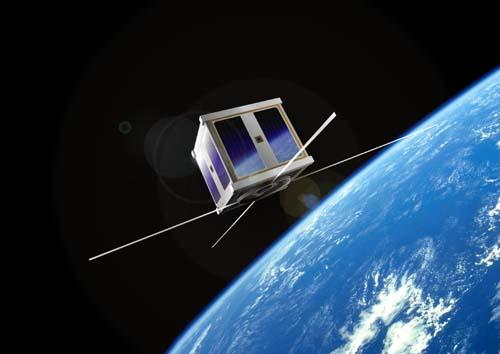
Romit1 is a 2U CubeSat that is planned to launch on the Interorbital Systems Neptune 9 rocket. It will transmit on 437.505 MHz at 1200 bps.

If everything goes well it should, after a year, be out in a 700 km orbit, having started in a 310 km orbit.

Romit1 - Image Credit GomSpace ApS

Romit1 – Image Credit GomSpace ApS

When the rocket reaches its orbital altitude, the satellite is deployed using a spring-loaded device. Romit1 then powers up and conducts a systems test. The satellite must stabilize itself so that it has the right orientation (with the propulsion system pointing aft). The spacecraft will immediately start its engine so that it can begin its journey to a higher altitude, away from any traces of atmosphere that would produce drag, slow it down, and shorten its orbital lifespan.

It is hoped that radio amateurs across the world will assist the team in retrieving the data sent down, for example, they can gather images from the six cameras. Radio amateurs can send the pixels they receive to Euroluna who will assemble them into a full image.

The group are currently looking for a launch opportunity for Romit2 as well as Romit3 that is planned to reach the Moon.

A list of the current CubeSat launch opportunities under consideration can be seen on the teams Google Lunar X PRIZE blog at http://www.googlelunarxprize.org/teams/euroluna/blog/low-cost-launches-low-earth-orbit

Watch romit2-parts-delivered.wmv

Watch euroluna-compliant-q4-2011.wmv

Watch cube-sat-launch.wmv

Twitter http://twitter.com/Euroluna

Facebook http://www.facebook.com/pages/Euroluna/337261739568

Web http://www.euroluna.dk/

Interorbital Systems http://www.interorbital.com/

Google Lunar X PRIZE http://www.googlelunarxprize.org/

1st Interplanetary CubeSat Workshop

The 1st Interplanetary CubeSat Workshop takes place in Cambridge, Massachusetts, 29-30 May, 2012

iCubeSat, the Interplanetary CubeSat Workshop, will address the technical challenges, opportunities, and practicalities of space exploration with CubeSats.

The workshop will provide a unique environment for open practical collaboration between academic researchers, industry professionals, policy makers, and students developing this new and rapidly growing field.

Talks and round tables will focus on three themes: technology, science, and open collaboration.

Keynote speakers

Technology: Mason Peck, NASA, Chief Technologist

Science: Sara Seager KB1WTW, MIT, Professor of Physics and Planetary Science

The program will also include unconference sessions to provide additional opportunities to engage with the interplanetary CubeSat community and potential collaborators. Talks and supporting material will be streamed and posted on the conference website. A lively social program in and around summertime Boston will be arranged for participants and their guests.

Further information on the event website – http://icubesat.wordpress.com/

Vietnam Student CubeSat F-1

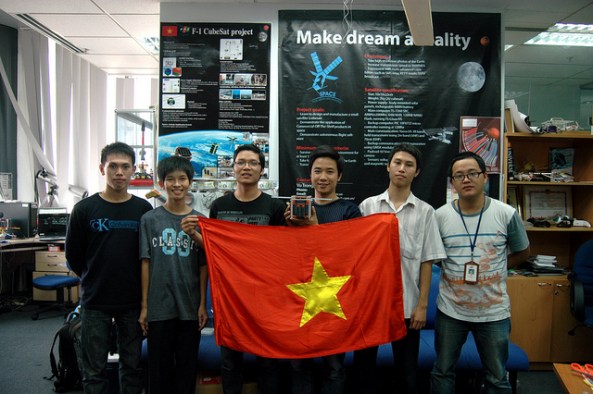
Vietnamese students have produced a video about their amateur radio CubeSat F-1, callsign XV1VN.

The F-1 is an educational CubeSat to be launched in the summer of 2012. It will carry a low resolution C328 camera with 640×480 resolution and two Yaesu VX-3R transceivers using 145.980 and 437.485 MHz.

•VX-3R1
–Frequency: 437.485MHz, FM Narrow
–Power supply: directly from solar cells, only operates in sunlight
–Output power: max 0.3W, half-wave dipole antenna
–Modulation scheme: Morse code beacon (10 chars) using PWM CW
–Beacon interval: every 30 seconds (configurable)

•VX-3R2
–Frequency: 145.980MHz , FM Narrow
–Power supply: rechargeable battery, operates in the dark by default but can be commanded to operate in sunlight as well
–Output power: max 1.0W, half-wave dipole antenna
–Modulation scheme: AFSK 1200bps, half duplex
–Telemetry interval: one AX.25 packet every 30 seconds (configurable)

Watch F-1 picosatellite project – FSpace laboratory

F-1 CubeSat Blog on Facebook https://www.facebook.com/groups/116436068290/

Gunter’s Space Page lists F-1 on the HTV-3 launch to the ISS on July 18, 2012.

Send your name/callsign and a message into space on the F-1 CubeSat! http://fspace.edu.vn/?page_id=31

Vietnam F-1 CubeSat on Facebook http://www.facebook.com/group.php?gid=116436068290

FSpace Laboratory http://fspace.edu.vn/