AMSAT is counting down to the launch of the next Fox-1 satellite, Fox-1Cliff.
The launch of Spaceflight’s SSO-A SmallSat Express mission, on a SpaceX Falcon 9 from Vandenberg Air Force Base is scheduled for 18:31:47 GMT on Monday, December 3.
Fox-1Cliff carries the Fox-1 U/v FM repeater, AMSAT’s L-Band Downshifter, the flight spare of the AO-85 Vanderbilt University Low Energy Proton (LEP) radiation experiment, and the standard Fox-1 Penn State University–Erie MEMS gyroscope experiment. Virginia Tech provided a VGA camera which is the same as AO-92’s but will provide images at a higher 640 x 480 resolution. Additional information about the launch and early operations phase (LEOP) will be released prior to launch.
As part of the preparations for the launch of Fox-1Cliff, AMSAT is making the “Getting Started With Amateur Satellites” book available for a limited time as a download with any paid new or renewal membership purchased via the AMSAT Store. This offer is only
available with purchases completed online, and for only a limited time. A perennial favorite, Getting Started is updated every year with the latest amateur satellite information, and is the premier primer of satellite operation. The 186 page book is presented in PDF format, in full color, and covers all aspects of making your first contacts on a ham radio satellite.
Please take advantage of this offer today by visiting the AMSAT store at https://www.amsat.org/shop/ and selecting any membership option.
While there, check out AMSAT’s other items, including the M2 LEOpack antenna system, Arrow antennas, AMSAT shirts, and other swag. Be sure to view your cart before going to checkout. If you add a membership and then go directly to checkout, you’ll never see an option to add your free gift.
Fox-1Cliff is named in honor of long-time AMSAT member, contributor, and benefactor Cliff Buttschardt, K7RR (SK), who passed away in 2016. Cliff’s contributions to AMSAT and other amateur satellite programs, including serving as an adviser during the initial development of the CubeSat specification at California Polytechnic State University, earned him the Lifetime Achievement Award from Project OSCAR in 2006.
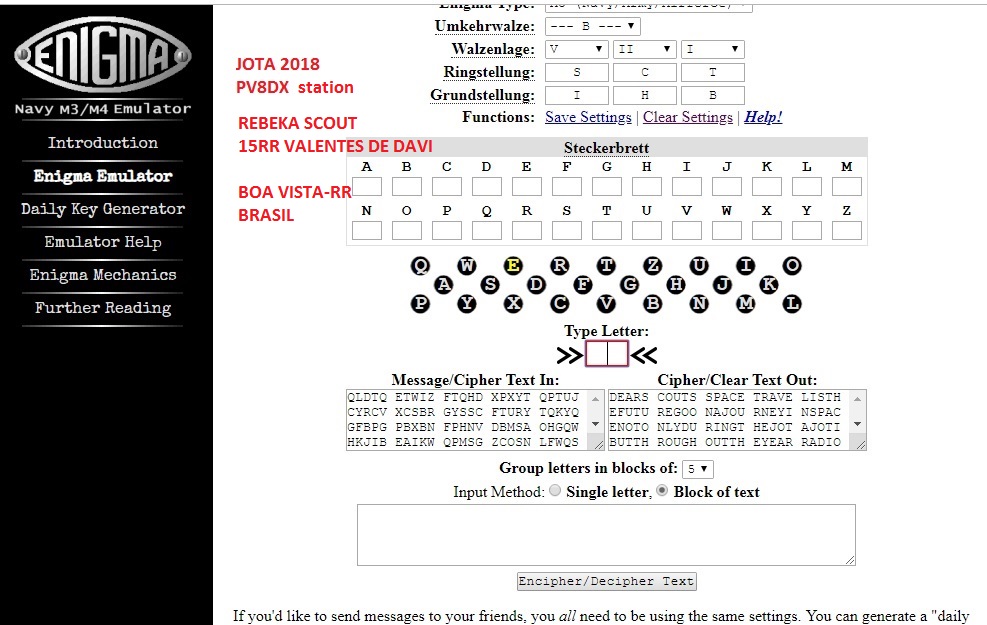
The message was coded using the Enigma cipher machine. After receiving the message, transmitted on a frequency of 145.935 MHz in 1200 bps BPSK, the scouts could determine the deciphering key and Enigma settings by correctly answering 10 space and satellite related questions.
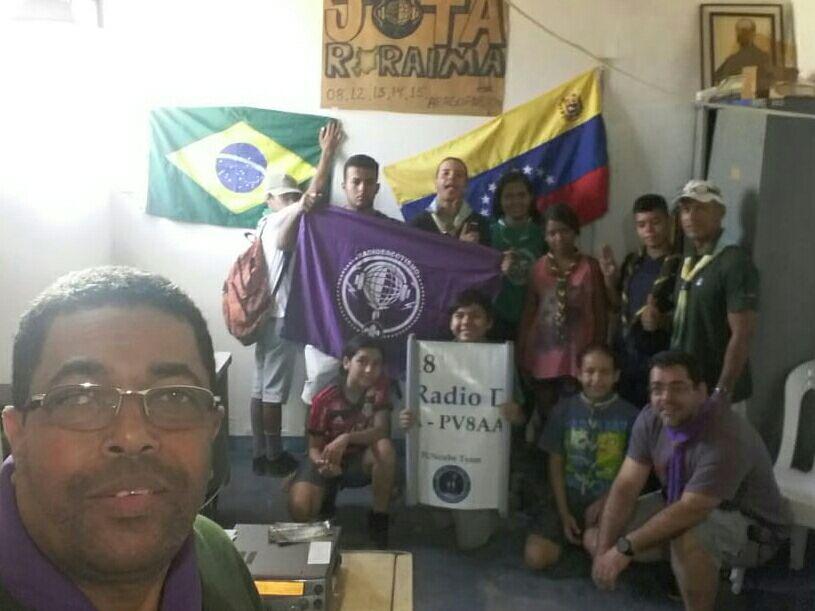
Paulo PV8DX reports the 15RR Valentes de Davi scout group from the city of Boa Vista in the state of Roraima, Brazil were among those who decoded the message.
In the UK the Chertsey Radio Club reports they ran a special event station GB6SS for the Sixth Staines Scouts. In addition to using the digital ode FT-8, see report, the scouts also decoded the FUNcube-1 Enigma message.
Watch Sixth Staines Scouts with Chertsey Radio Club completing JOTA FUNcube Challenge
In space, satellites can be found. A recent development in this area are the “CubeSat” satellites.
Normal satellites typically have a size ranging from that of a washing machine to a small truck.
CubeSats have the size of a milk-carton!
The JOTA-JOTI FUNcube Challenge focuses on the FUNcube-1 (AO-73) CubeSat satellite. During the Jamboree On The Air (JOTA-JOTI) on October 19-21, a special, coded, message will be transmitted. This message can be received with a simple 2m handheld antenna, e.g. HB9CV, a small yagi or even a vertical, and a SDR-dongle or any SSB radio for 2m. The data is sent by the satellite on its telemetry channel of 145.935 MHz (1200bd BPSK modulated). You will need to set your receiver to Upper Side Band (USB). If you use a FUNcube dongle, you can directly receive the satellite.
Sixth Staines Scouts with Chertsey Radio Club completing the JOTA FUNcube Challenge
The message is coded using the Enigma cipher machine. The deciphering key and Enigma settings can be obtained by answering the questions below.
The message sent by the satellite follows the following format: JOTA JOTI START coded message STOP
Your deciphered message can be mailed to: JJ.Satellite.Challenge (at) kitbuilding.org ( (at)=@)
The mail should contain your name, age, country and Scout group name and the correct answer!
If you have any pictures of the reception of the satellite with your group, this would also be highly appreciated, we would love to see how you did it!
If your answer is right and mailed before the 1st of November 2018, you will participate in a raffle.
The winner will get some products from www.kitbuilding.org
Have a lot of fun and good luck! Best 73s, Wouter PA3WEG and Jeroen PE1RGE
1.) A geostationary satellite has an altitude above the earths surface of (approximately):
A. 20200 km or 12600 miles – First rotor is rotor III
B. 35786 km or 22236 miles – First rotor is rotor V
C. 42164 km or 26199 miles – First rotor is rotor VII
2.) NASA has selected over 300 astronauts since 1959,
A. None of them was ever active in Scouting – First rotor alphabet setting (ringstellung) A
B. Not more than 37 of them were active in Scouting – First rotor alphabet setting
(ringstellung) F
C. More than 200 were/are active in Scouting – First rotor alphabet setting (ringstellung) S
3.) The average distance between the moon and the earth is:
A. 1738 km or 1080 miles – First rotor initial setting (grundstellung) D
B. 12742 km or 7918 miles – First rotor initial setting (grundstellung) G
C. 385001 km or 239228 miles – First rotor initial setting (grundstellung) H
4.) AMSAT, an organisation involved in launching a number of radio amateur satellites was founded in:
A. 1969 – Second rotor is rotor II
B. 1978 – Second rotor is rotor VI
C. 1991 – Second rotor is rotor VIII
5.) As satellites are flying extremely high in the sky, at least 100 Watts of transmit power is needed to establish communication with or through a satellite. Is this true or false?
A. True – Second rotor alphabet setting (ringstellung) D
B. False – Second rotor alphabet setting (ringstellung) C
6.) The Russian Sputnik 1 was the first artificial satellite orbiting around the earth. When was this satellite launched?
A. October 4th, 1957 – Second rotor initial setting (grundstellung) A
B. January 31st, 1958 – Second rotor initial setting (grundstellung) G
C. July 20th, 1969 – Second rotor initial setting (grundstellung) F
7.) The abbreviation OSCAR means:
A. Open Source Communication for Amateur Radio – Third rotor is rotor III
B. Outer Space Charge – free Amateur Radio – Third rotor is rotor IV
C. Orbiting Satellite Carrying Amateur Radio – Third rotor is rotor I
8.) Signals from a satellite are characterized by Doppler-shift, this means:
A. The frequency of the transmitted signal appears to be higher when the satellite is moving towards you. – Third rotor alphabet setting (ringstellung) T
B. The frequency of the transmitted signal appears to be lower when the satellite is moving towards you. – Third rotor alphabet setting (ringstellung) U
9.) If a radio amateur wants to communicate through satellites he/she needs to do an additional exam in order to obtain a special license, the Amateur Radio Operator License (AROL). True or false?
A. True – Third rotor initial setting (grundstellung) R
B. False – Third rotor initial setting (grundstellung) M
10.) Radio amateurs can make radio contact with the ISS (International Space Station)?
A. Yes – Reflector B
B. No – Reflector C
As you will know, AO73/FUNcube-1 has been in full sunlight for over one month and has been transmitting continuously high power telemetry for most of that time. This has now been changed to full time amateur mode so the transponder is once again available. With the more stable on board temperatures being experienced, this means that the transponder frequencies are also now more stable. We expect to leave it in this mode for some weeks so that the team can determine whether or not the currents flowing from the solar panels are having any noticeable effect on the spin period.
FUNcube-2
The FUNcube-2 transponder on EO-88/UKube-1 continues to be in full time transponder mode. There are occasional breaks in service for a few seconds when the OBC reboots and the other onboard transmitter sends its CW beacon.
FUNcube-3 on Nayif-1
EO88/Nayif-1 continues to perform nominally with high power telemetry when in sunlight and amateur mode when in eclipse.
With their slightly different orbital characteristics it is useful that AO73 is now the early bird, EO88 comes over in the mid morning and UKube provides coverage in the afternoon.
We have been suffering from some network issues in relation to uploading the telemetry from the Dashboards to the Data Warehouse over the past couple of weeks. Apologies for this, but hopefully everything is now stable again. ie fingers are still crossed. Thank you for all the telemetry that you upload.
Like many other teams, we are presently waiting for the next Space-X launch from Vandenberg which is expected to be carrying a number of new amateur payloads, These will provide additional transponder and STEM capabilities for the amateur satellite service. Exciting times ahead.
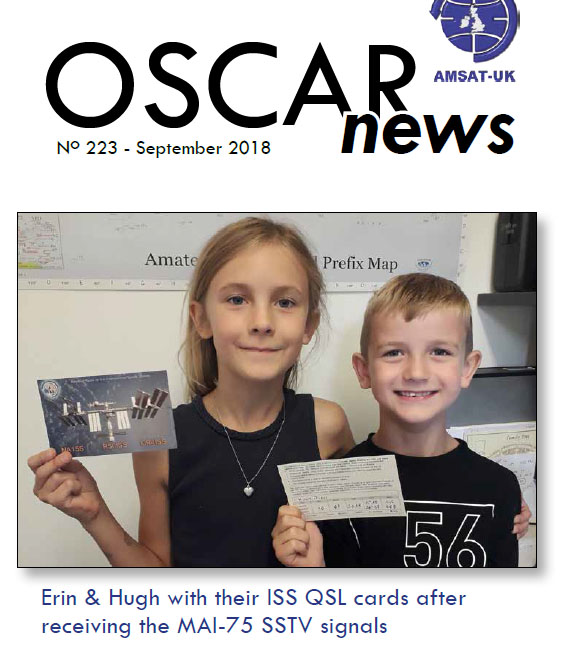
E-members of AMSAT-UK can now download the Autumn 2018 edition of OSCAR News here.
The paper edition should be sent to postal members in 2-3 weeks.
In this issue:
• From the Secretary’s Keyboard
• 2018 Meetings & Events calendar
• Programme for the 2018 Colloquium
• A Newcomer to Satellites and a First Rove – to Iceland!
• Mini Rove by Pete Green G0ABI
• MacDoppler Pro
• OSCAR NEWS – The Editors are retiring!
• The First OSCAR spacecraft is now in orbit around the moon
• Inter MAI-75 ISS SSTV
• FUNcube-1 after almost five years’ service!
• AMSAT-UK Construction Competition
• NASA Upgrades Space Station Emergency Communications Ground Stations
• EA8/DL4ZAB operation
• AMSAT-UK 2017-2018 Statement of Accounts
• Work at Goonhilly
• Charter Member, Past AMSAT President William A. “Bill” Tynan, W3XO, SK
• My Radio Life by Bill Tynan, W3XO, (Part 1)
• Keynote Speaker at Colloquium
• EMF 2018
• Es’Hail-2 Launching soon!
• AMSAT-UK update – upcoming launches and other news
• Notice Of The 2018 Annual General Meeting Of AMSAT-UK
• Youngsters On The Air 2018 – South Africa
AMSAT-UK FUNcube Mission Patch
Membership of AMSAT-UK is open to anyone who has an interest in amateur radio satellites or space activities, including the International Space Station (ISS).
E-members of AMSAT-UK are able to download OSCAR News as a convenient PDF that can be read on laptops, tablets or smartphones anytime, anyplace, anywhere. Join as an E-member at Electronic (PDF) E-membership
The AMSAT-UK Colloquium is taking place in Lecture Room 5 at the RSGB Convention in Kents Hill Park Conference Centre, Timbold Drive, Milton Keynes, MK7 6BZ on the weekend of October 13-14.
The webstream of the Colloquium talks will be available at https://batc.org.uk/live/amsat2018
(The other talks at the RSGB Convention are not being streamed)
The Live Stream will begin on Saturday morning, October 13 at 9:30am BST (0830 GMT) with the presentation ‘ARISS and STEM outreach’ by Ciaran Morgan M0XTD in which he will describe the role of amateur radio on the International Space Station and its use in the STEM outreach to young people around the world.
You must be logged in to post a comment.