Video: Inside a Satellite Clean Room

Tom Scott and FUNcube-1 Engineering Model

Tom Scott and FUNcube-1 Engineering Model

Tom Scott was given a tour of the Innovative Space Logistics clean room facility by Wouter Weggelaar PA3WEG. He got to see the FUNcube-1 Engineering Model and the new Nayif-1 CubeSat which carries an amateur radio SSB/CW linear transponder.

AO-73 (FUNcube-1) - Image credit Wouter Weggelaar PA3WEG

AO-73 (FUNcube-1) – Image credit Wouter Weggelaar PA3WEG

Tom Scott writes:

Welcome to Innovative Space Logistics, in the Netherlands: they invited me inside their clean room to see an actual CubeSat satellite that’s going into space soon! (No, this isn’t a sponsored video: I paid my own way there!) Go look at their site: http://isilaunch.com/ – and if you need to send something into space, get in touch with them!

The satellite model I’m holding is holding is the engineering model of FUNcube-1 and the flight satellite that I definitely couldn’t hold is Nayif-1, a cooperation between the Mohammed bin Rashid Space Centre and the American University of Sharjah.

Watch Inside a Satellite Clean Room

If there’s something cool at your university or company, get in touch! https://www.tomscott.com/contact/

AMSAT-UK FUNcube Mission Patch Rev4 20100609

FUNcube Mission Patch

Tom Scott
https://tomscott.com/
https://facebook.com/tomscott
https://twitter.com/tomscott
https://instagram.com/tomscottgo/

FUNcube http://funcube.org.uk/
Nayif-1 https://amsat-uk.org/satellites/communications/nayif-1/

What is Amateur Radio? http://www.essexham.co.uk/what-is-amateur-radio

Find an amateur radio training course near you https://thersgb.org/services/coursefinder/
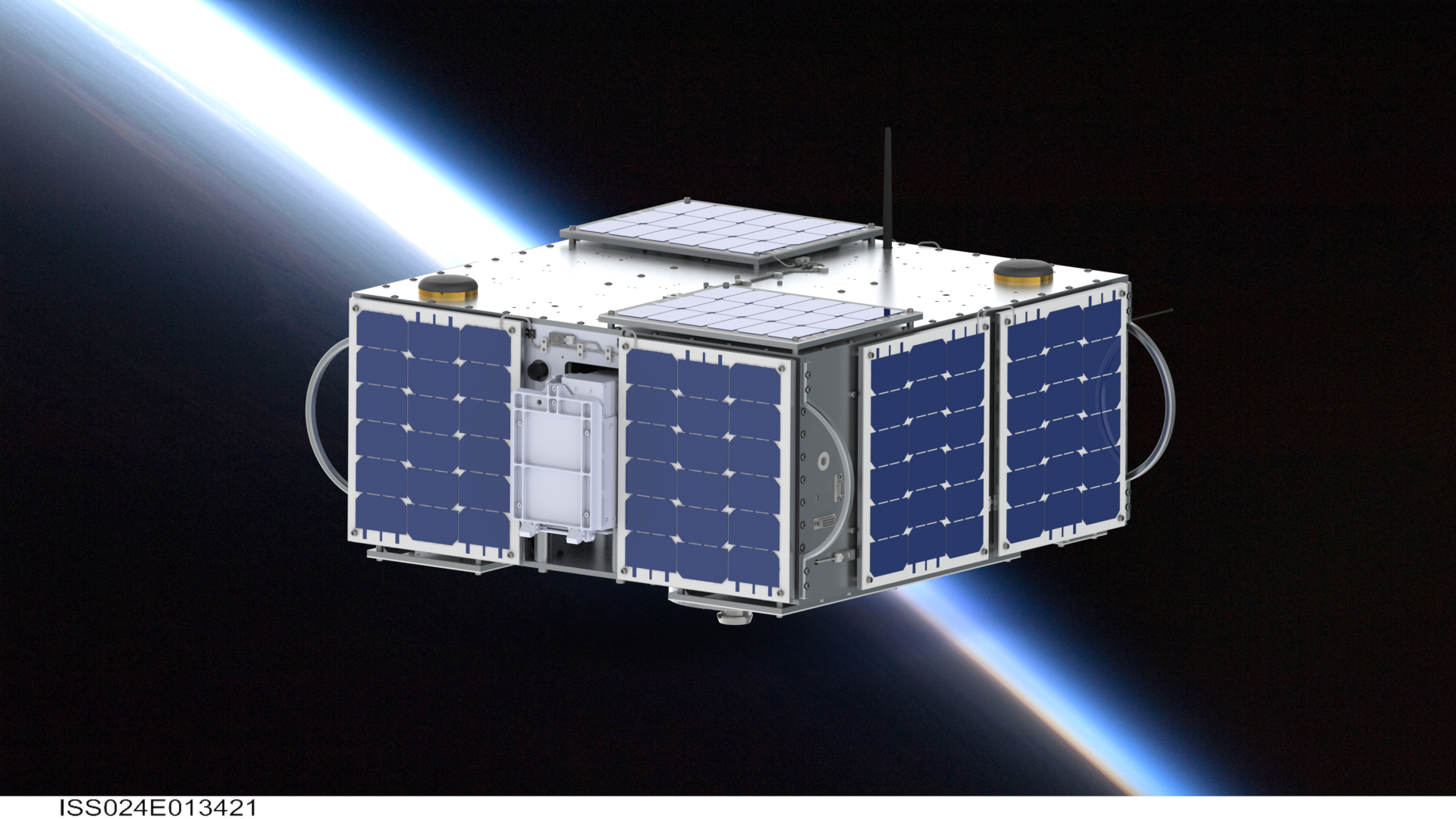
ISS AggieSat4 Satellite Deployment

Simulation of AggieSat4 on orbit - Credit Andrew Shell

Simulation of AggieSat4 on orbit – Credit Andrew Shell

The AggieSat4 satellite carrying the Bevo-2 CubeSat is expected to be deployed from the International Space Station (ISS) on January 29, both have amateur radio payloads.

Below is a timelapse of the build process of the Texas A&M student-built satellite, AggieSat4. The video spans an entire year, the amount of time it took to build AGS4, however many more years were put into the design and programming of AGS4 before any hardware was assembled.

AggieSat4 was launched aboard the Orbital ATK Cygnus OA-4 cargo resupply mission. The Cygnus spacecraft was mounted atop a United Launch Alliance Atlas V rocket that took the Cygnus from the Kennedy Space Center up into Low Earth Orbit on December 6 at 4:44pm EST.

AGS4 is planned to release from the ISS on January 29 and will then proceed to eject the University of Texas CubeSat, Bevo-2 and perform relative navigation tasks as well as take pictures of the release of Bevo-2.

The IARU has coordinated these frequencies for the amateur radio payloads:
AggieSat4 436.250 MHz 9k6 FSK telemetry (also 153.6 kbps FSK)
Bevo-2 437.325 MHz CW and 38k4 FSK

Watch AggieSat4 Build Process Timelapse – LONESTAR 2

The AggieSat4 team request that any amateur radio enthusiasts receiving the beacons sends any data to aggiesat@tamu.edu it would be much appreciated!

AggieSat4 information
https://twitter.com/aggiesat
https://www.facebook.com/AggieSatLab
http://aggiesatweb.tamu.edu/index.php/projects/lab_projects/aggiesat4
https://www.dropbox.com/sh/v8razh1evcabt7a/jrGSjbOJb4

Bevo-2 information
https://www.facebook.com/UTSatLab
https://www.ae.utexas.edu/news/features/bevo-2-satellite-sdl

AggieSat4 reception reports http://www.dk3wn.info/p/?cat=313

Another EO-79 Transponder Activation

EO-79 Passband - Credit Jan van Gils PE0SAT

EO-79 Passband – Credit Jan van Gils PE0SAT

The EO-79 CubeSat SSB/CW transponder will be active from Monday, December 28 until Thursday, December 31.

The first activation has shown the transponder uplink is about 12 kHz higher than expected. The suggested frequencies to try are now:
Uplink: 435.047-435.077 MHz LSB
Downlink: 145.935-145.965 MHz USB

EO-79 and EO-80 - Image Credit ISIS

EO-79 and EO-80 – Image Credit ISIS

The team has seen that activating the transponder makes the satellite power negative, meaning the solar arrays cannot generate enough power to keep the transponder running permanently. This is not unexpected as the satellite is operating in a different mode than originally anticipated during the design phase.

The team are discussing various ways to solve this, including multiple ways of scheduling the transponder operations. With these discussions ongoing we would still like to try the second activation and obtain some more data about the system. The team aim to activate the transponder for as much time as the power budget allows, but please be aware that you may find the transponder to be off while the batteries recharge.

EO-79 has been set to only beacon the normal AX.25 beacon every 30 seconds instead of 10 seconds. The beacon frequency is 145.815 MHz and consists of AX.25 frames on BPSK. More details about the downlink can be found on the ISIS Ham Radio page at http://isispace.nl/HAM/qb50p.html

We kindly request you to share your experiences with the AMSAT Bulletin Board so everyone can benefit from operating tips and tricks, as well as being up-to-date on the status.

We would also welcome any observation related to the transponder behaviour when the AX.25 beacon comes on.

Just like FUNcube-1, the crystal oscillator circuits exhibit drift with temperature. This means manual tuning will probably work best.

Graham Shirville G3VZV says that due to platform sharing considerations the FUNcube transponder on EO-79 uses 1/4 wave monopole antennas rather than the full dipoles used on AO-73. The actual effects of this difference in practice may be interesting to observe.

TLEs:
AMSAT keps name: EO-79
Celestrak keps name: QB50P1
Celestrak file: cubesat.txt
NORAD #  40025
COSPAR designator: 2014-033-R

SatPC32 tracking software Doppler SQF information used by Peter VK4NBL:
EO-79,145950,435063,USB,LSB,REV,0,0
EO-79,145814.8,435070,CW,TELEMETRY,0,0

PE0SAT http://www.pe0sat.vgnet.nl/
https://www.facebook.com/pe0sat/
https://twitter.com/pe0sat

Real-time track of EO-79 (QB50p1) http://www.n2yo.com/?s=40025&df=1

Satellite Tracking https://amsat-uk.org/beginners/satellite-tracking/

AMSAT Bulletin Board (AMSAT-BB) http://www.amsat.org/mailman/listinfo/amsat-bb

AO-73 in continuous transponder mode

AO-73 (FUNcube-1) - Image credit Wouter Weggelaar PA3WEG

AO-73 (FUNcube-1) – Image credit Wouter Weggelaar PA3WEG

The amateur radio satellite AO-73 will be operating in continuous transponder mode throughout the festive season until the evening of Sunday, January 3.

Why not take full advantage of this activation and get your 73 on 73 Award, details at https://amsat-uk.org/funcube/73-on-73-award/

AO-73 (FUNcube-1) website https://amsat-uk.org/funcube/funcube-website/

FUNcube Yahoo Group https://amsat-uk.org/funcube/yahoo-group/

EO-79 transponder activation

EO-79 and EO-80 - Image Credit ISIS

EO-79 and EO-80 – Image Credit ISIS

On December 21, 2015 at 1038 UT, the EO-79 transponder was turned on for a prolonged period.

The FUNcube transponder subsystem on QB50p1 (EO-79) had been provided by AMSAT-UK and AMSAT-NL and is a similar subsystem as on FUNcube-1, but without the telemetry downlink circuitry.

The current software running on EO-79 does experience occasional reboots. When these reboots happen, the transponder is automatically turned off and will have to be turned back on by a command station. The FUNcube team has selected a few command stations to do so, but be advised the transponder may be off.

TLEs:
AMSAT keps name: EO-79
Celestrak keps Name: QB50P1
Celestrak file: cubesat.txt
NORAD #    40025
COSPAR designator    2014-033-R

Frequencies:
*Uplink:* 435.035-435.065 MHz LSB [See note below]
*Downlink:* 145.935-145.965 MHz USB

EO-79 has been set to only beacon the normal AX.25 beacon every 30 seconds instead of 10 seconds. The beacon frequency is 145.815 MHz and consists of AX.25 frames on BPSK. More details about the downlink can be found on the ISIS Ham Radio page at http://isispace.nl/HAM/qb50p.html

We kindly request you to share your experiences with the AMSAT Bulletin Board so everyone can benefit from operating tips and tricks, as well as being up-to-date on the status.

We would also welcome any observation related to the transponder behaviour when the AX.25 beacon comes on.

Just like FUNcube-1, the crystal oscillator circuits exhibit drift with temperature. This means manual tuning will probably work best.

Lastly, the commanding team will not be available over Christmas, so the current activations are planned from today until Thursday 24th and from Monday 28th until Thursday 31st

73 and have FUN
Happy Holidays

Wouter Weggelaar, PA3WEG
AMSAT-NL
AMSAT-UK

Mike Seguin N1JEZ notes:  I found my downlink after setting my uplink +12 kHz from published spec

SatPC32 tracking software Doppler SQF information used by Peter VK4NBL:
EO-79,145950,435063,USB,LSB,REV,0,0
EO-79,145814.8,435070,CW,TELEMETRY,0,0

Graham Shirville G3VZV says that due to platform sharing considerations the FUNcube transponder on EO-79 uses 1/4 wave monopole antennas rather than the full dipoles used on AO-73. The actual effects of this difference in practice may be interesting to observe.

AMSAT Bulletin Board (AMSAT-BB) http://www.amsat.org/mailman/listinfo/amsat-bb

Satellite Tracking https://amsat-uk.org/beginners/satellite-tracking/

SME-SAT video

SME-SAT - Surrey Space Centre

SME-SAT – Surrey Space Centre

The Surrey Space Centre in Guildford has released a ‘Softstack’ Integration time-lapse video of the SME-SAT CubeSat.

The mission objectives are:
A: Outreach – The satellite will provide beacons for which amateur satellite users and ham radio users will be able to receive.
B: Space qualification and performance characterisation of sensors.
• High performance COTS Gyroscopes (x3).
• High precision MEMS accelerometers.
• 2 Aperture Star Camera, At a later point in the mission these will be used in conjunction with the ADCS to characterise the closed loop performance of the sensors.
C: Performance characterisation of Nano-Control Moment Gyros (CMGs) for agility. The mission is equipped with 4-Nano-CMGs in a pyramid configuration for ADCS. This part of the mission will evaluate the performance of this system on the ADCS and agility of the satellite.
D: Space qualification and performance characterisation of the EPS The EPS for this mission has heritage from the Delfi-C3 and other missions and includes additional improvements to be demonstrated on this mission.
E: Smart Thermal Radiation Devices (STRD tiles) SME-SAT is equipped with a number of STRD tiles on the outside faces of the satellite for passive thermal management of the internal structure.
F: Flux Gate Magnetometer The mission contains a scientific grade miniaturized flux gate magnetometer that sits on the end of a deployable boom to improve the performance of the sensor. This payload will be switched into the ADCS for evaluation of performance during parts of the mission but is not the primary magnetometer for ADCS.
G: GPS SME-SAT also contains an experimental GPS system that will be switched into the ADCS loop at stages in the orbit to evaluate the performance of the system.

The IARU coordinated frequency for the satellite’s 9k6 RC-BPSK AX.25 downlink is 437.150 MHz.

Watch SMESAT CubeSat ‘Softstack’ Integration at Surrey Space Centre (Time Lapse)

More information here
http://www.surrey.ac.uk/ssc/research/onboarddata/smesat/index.htm