Wouter Weggelaar PA3WEG has provided this update on the status and plans for QB50p1 – EO-79.
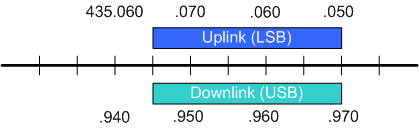
Earlier testing campaigns indicate that the AMSAT-UK/AMSAT-NL transponder on board of this spacecraft is in good health. We have activated the transponder on various occasions for testing purposes.
At the moment we believe the power system is capable of sustaining transponder operations indefinitely. ISIS (the satellite designer and operator) still needs to write and apply a software patch that would keep the transponder running. The current logic in the satellite will switch off the transponder if a reset occurs of the On Board Computer or power system.
Efforts are being made to allow usage of the transponder in the mean time and also allow select command stations to take the satellite out of safe mode if it does reset. ISIS will continue to monitor all telemetry and the satellites health.
QB50p1 EO-79 FUNcube-3 Transponder – Credit Mike Rupprecht DK3WN
The precursor satellites have gathered valuable data about the sensor payloads, and the lessons learnt are being implemented in the flight units for the QB50 main mission.
We will still have to wait until procedures are in place and the activation is cleared by the operator and owners of the satellite, but we are nearly ready for the activation of another transponder!
Planet Lab Dove CubeSats leaving the ISS Nanoracks Deployer on February 11, 2014
The QB50 constellation of fifty CubeSats should be shipped to the International Space Station (ISS) in December 2016 for subsequent deployment.
QB50p1 and QB50p2 Precursor 2U CubeSats – Image Credit ISIS
The CubeSats are planned to be deployed from the ISS using the Japanese Experiment Module (JEM) and the Nanoracks CubeSat Deployers.
Eight NanoRacks deployers are installed on the Multi-Purpose Experiment Platform (MPEP). Each deployer has a capacity of 6U and so can hold up to six 1U, three 2U or two 3U CubeSats. They are carried by Japanese Experiment Module-Remote Manipulator System (JEM-RMS).
Mineo Wakita JE9PEL has made available a spreadsheet showing the 50 satellites and their frequencies. A copy can be downloaded from the JE9PEL site.
With the help of amateur radio operators, Aalborg University engineering students have established two-way communication with their home-built, ESA-sponsored satellite AAUSAT5.
The European Space Agency (ESA) report:
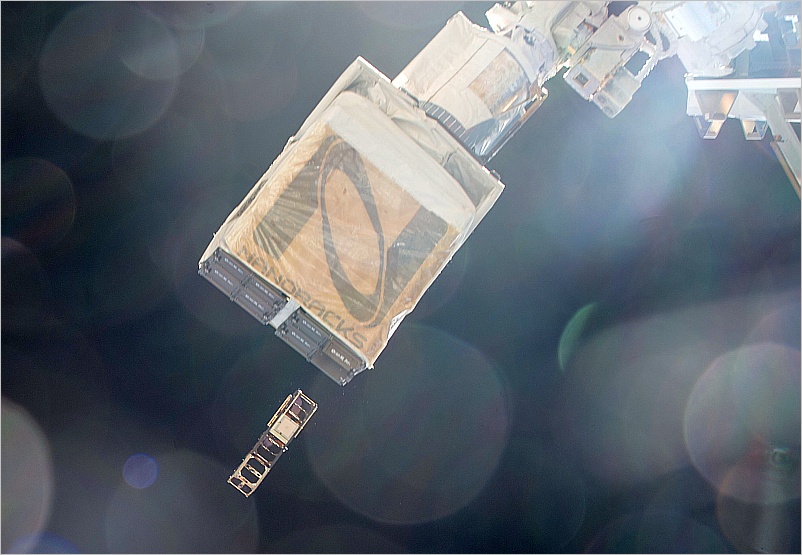
Deployment of AAUSAT5 and GomX-3 from the ISS Kibo robot arm – Credit NASA, NanoRacks
AAUSAT5 was launched from the International Space Station on October 5, 2015. Following initial difficulties in establishing a two way communication link with the satellite from the control centre in Aalborg and attempts to improve the ground station performance, the investigation revealed that the northern location of Aalborg, relative to the satellite’s orbit, was a contributor to the communication issue. Therefore the project team reached out to ham operators in more southern locations in Europe for help.
Aalborg University sent special equipment down to a German ham radio operator. From his location south of Frankfurt, this operator now acts as the relay station between the student’s control centre in Aalborg and the satellite whenever it passes over Europe. In this way, communication has been established.
Several of the ham radio operators who assisted the AAUSAT5 team have been given the status of external crew members. They are: Mike Rupprecht DK3WN (Germany), Lars Mehnen OE3HMW (Austria), Jan Van Gils PE0SAT (The Netherlands) and Lars-Christian Hauer DJ3BO (Germany).
AAUSAT5 and Deployer – Credit ESA
“Two-way communication is a very big step for the mission. AAUSAT5 can easily be heard in Aalborg via equipment in Germany, and the satellite can receive and respond to commands sent from Aalborg. So we’ve been able to reprogramme the radio transmitter and receiver on board as a first step towards optimizing the connection,” says Associate Professor Jens Dalsgaard Nielsen OZ2JDN, who is supervising the team.
“We celebrated with champagne when we managed both to hear the satellite and send commands to it,” says fourth-year engineering student Anders Kalør from the AAUSAT5 team. Although he admits it was disappointing when they did not initially hear from the satellite, Kalør says that the team never lost heart.
In some ways the communication challenges proved to be a blessing in disguise, forcing the team to work even harder and learn even more. “I’ve learned more about radio communication the past three weeks than in the entire rest of the programme. So as training it has been perfect.” says team member Lasse Bromose.
AAUSAT5, a small satellite of 10cm x 10cm x 10cm with a mass of 1 kg, is one of the first two ESA satellites ever sent into orbit directly from the International Space Station, the other satellite was GomX-3.
AAUSAT5’s main mission is to test an improved receiver for detecting Automatic Identification System signals emitted by ships. The next major goal is to determine whether the satellite is capable of registering ships as planned and, if so, whether it can then relay the ships’ positions down to the control centre.
AAUSAT5’s deployment could be the first in a new programme offered by the ESA Education Office called Fly Your Satellite from the ISS!
UKube-1 in flight configuration in the cleanroom at Clyde Space Ltd – Credit Steve Greenland 2M0SCG
UKube-1, the UK Space Agency’s first national spacecraft, has now completed its nominal mission following over 14 months of operations. Discussion is underway with AMSAT-UK about the possibility of taking over UKube-1 operations to continue its educational and outreach activities.
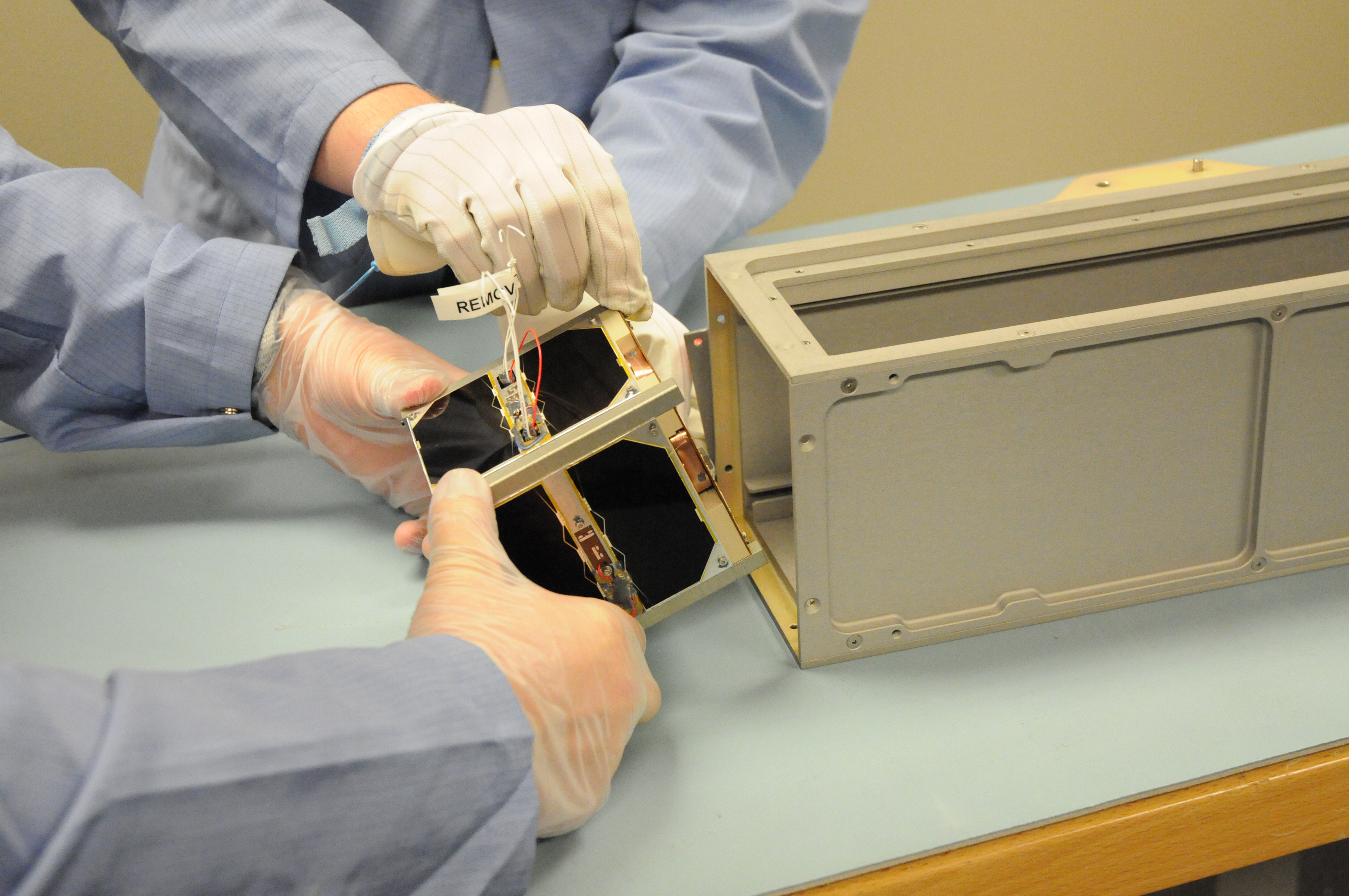
UKube-1 CubeSat installed in Deployment Pod
Launched in July 2014, UKube-1 is a technology demonstration mission with a broad set of objectives aimed at attracting and training future generations of engineers, encouraging collaboration across sectors and institutions, fast tracking space technology development and engaging with students.
As a 3 unit CubeSat (30x30x10cm), flying 4 main payloads, with all the key subsystems of much larger satellites, UKube-1 remains one of the most advanced CubeSats ever built. Despite some technical challenges in orbit, the mission has achieved a range of milestones including:
• delivery into the correct planned orbit (around 650km, sun-synchronous)
• successful deployment of solar panels and antenna
• good battery health
• slow spin rate measured
• uplink and downlink capabilities checked, including Large Data Transfer, downlink at 3 speeds, and redundant communications mode
• all core payloads commissioned and data collected for each
• on-board camera technology successfully tested
• data downlinked from multiple ground stations across the globe
UKube-1 has also helped maintain the UK’s leading position in the CubeSat sector. Participation in the mission placed Clyde Space in an excellent position to capitalise on the fast growing global nanosatellite market. The company has experienced 100% year on year growth, both in turnover and employees, as a direct result from involvement in UKube-1, and is firmly established as a global leader.
Andy Strain and Steve Greenland 2M0SCG in Kazakhstan with UKube-1 and Deployment Pod
Mark McCrum, Bright Ascension Ltd, said:
“UKube-1 provided us with an invaluable opportunity to gain flight heritage for our software technology and to get deeply involved in the operation of a complex CubeSat mission. It gave a huge boost to our credibility as a space software provider and has been instrumental in winning further work.”
Craig Clark, CEO Clyde Space Ltd, said:
“UKube-1 represents a pivotal achievement in the development and growth of Clyde Space. The project moved the company from being a spacecraft subsystems supplier to providing full missions for our customers. To give some context to the extent that Ukube-1 has had to our business, Clyde Space has more than quadrupled in size in the last 3 years and there are currently over 60 CubeSats planned through production here in Glasgow over the next 18 months. The return on investment for Ukube-1 in terms of jobs and export sales for the UK has been outstanding and is a great example of industry and the UK Space Agency working together to put the UK at the forefront of global space technology.”
Professor Andrew Holland, Open University, added:
“Involvement in the UKube-1 mission, though our C3D instrument, has had a positive effect on our research and technology programme within the Space Instrumentation Group at the Open University, as well as a positive effect on our technology partners in the project; XCAM Ltd and e2v Ltd. The project has helped the OU to build a new strand of instrument development within the group, raised awareness of the CubeSat platform as a potential vehicle to accelerate the development of scientific space instrumentation, and has provided early in-orbit-demonstration of technologies. The mission introduced us to new academic and industrial collaborators operating in the space sector and supported the career development of the young engineers and scientists working on the project.”
Dr Helen Walker at the AMSAT-UK Space Colloquium – Credit DK3WN
STFC’s RAL Space provided the Ground Station for the misison at Chilbolton Observatory in Hampshire UK, and UKube-1 operations were commanded from there. Mission Manager Dr Helen Walker said:
“It has been a very exciting time, made possible only with the great support from all the teams involved.”
Although the Agency-supported mission phase has ended, discussion is underway with AMSAT-UK about the possibility of taking over UKube-1 operations to continue its educational and outreach activities until the satellite orbit naturally degrades.
UKube-1 carries a set of AMSAT-UK FUNcube boards which provide an educational beacon for use by schools and a linear transponder for amateur radio communications.
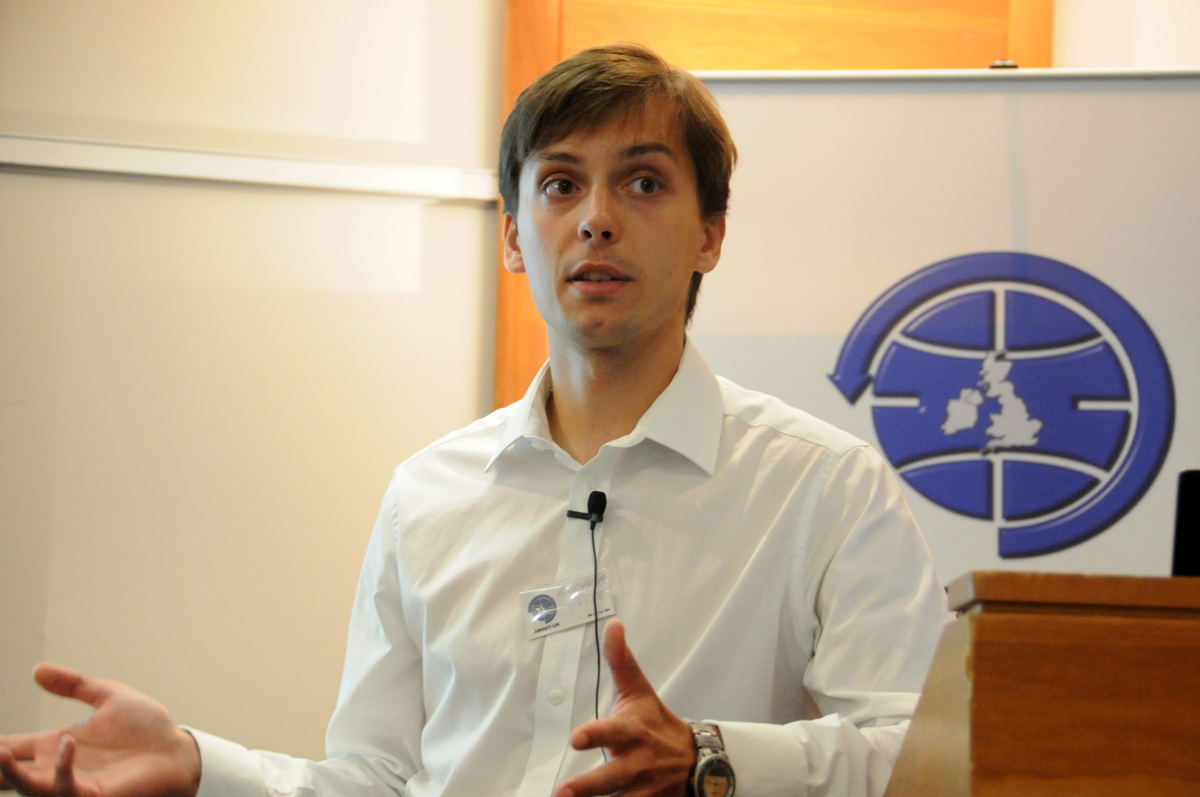
Aleksander Lidtke at 2014 AMSAT-UK International Space Colloquium – Image DK3WN
The University of Southampton is developing its own CubeSat with a view to obtaining a free launch on the VEGA launch vehicle.
University of Southampton Small Satellite is a group of students, primarily from a physics background, who aim to get a fully functional satellite into space, possibly by the end of 2016. Over a number of years they have designed the structure, the power, attitude control and the onboard processing and work is continuing on the development and integration of these subsystems into a full operational system.
Fox-1 CubeSat at the Dayton Hamvention – Image Credit ARRL
Chris Thompson G0KLA has released a new version of the AO-85 (Fox-1A) telemetry decoder software FoxTelem
I want to announce the release of FoxTelem Version 1.01. If possible, everyone should upgrade to this new version. In addition to some new functionality it fixes some bugs and issue that mean more data will be uploaded to the server.
This is a patch release. If you already have 1.00 installed then download the file FoxTelem_1.01_patch.zip
Only two files have changed (plus the manual). Copy these files into your install directory
– FoxTelem.jar
– spacecraft/FOX1A_radtelemetry2.csv
You can also download the whole install file and install it in a new directory. You can use the settings menu to continue using your existing log files. Ask if you need assistance.
Lots has changed in this release and many bugs have been fixed. Please report any issues that you see.
Release notes:
* Allow the user to view and set the “track” attribute for each spacecraft (and other parameters)
* Better doppler tracking in IQ mode and more stable estimate of the received frequency
* Better Find Signal algorithm with tuning parameters for experts
* Read Time Zero from the server for each reset and use to plot graphs in UTC
* Set the default fcd frequency to 145930 so that Fox-1A, Fox-1Cliff and Fox-1D will be in the passband
* Allow the gain to be set on the FCD (rather than hard coded)
* Do not change the FCD LNA or Mixer Gain. Leave unchanged.
* Do not open the FCD unless the start button is pressed
* Fixed a bug where the last 2 bytes of the radiation telemetry were not decoded correctly
* Allow Vanderbilt radiation experiment to be graphed
* Allow user to select UDP or TCP for upload to the server (but use UDP for now please)
* Shorten the period between passes so that graphs look continuous
* Ignore duplicate high speed radiation frames – needed for processing data from the server
* Allow graphs to be hidden so that average or derivative is easier to see
* Notify the user when a new release is available
* Cleaned up the FFT trace with some averaging
* If showRawValues is checked then save CSV files as raw values
* Several updates to the manual







 AMSAT-UK
You must be logged in to post a comment.