Radio Amateurs invited to test APRS on Duchifat-1

Duchifat-1 Mission PatchDuchifat-1, the Israeli high school students 1U CubeSat launched June 19, 2014, is ready for its first public tests. People with the ability to send Compressed APRS location packets are invited to join the tests.

The satellite will collect these packets worldwide along its flight at 620 km high orbit, and will downlink them from time to time over our ground station in Herzliya/Israel.

Participants are kindly requested to register in advance in order to get their packet identified on the map.

The packets successfully received will be displayed on a map in our Internet site and  QSL cards will be sent via Bureau to the stations registered and recognized. (unfortunately, there is no way we can recognize packets from unregistered stations because the packet is limited to 14 characters at the satellite, so we assign two unique characters to every registered station to enable us to identify them).

Registration can be done at http://www.h-space-lab.org/php/duchifat1-en.php

Also available in that site are operational information about the satellite, and the following documents:

*Configuring TT4 Explanation.doc* – how to use the Byonics TinyTrak4 for generating Compressed APRS packets

*Terms Of Use.doc* – terms and techniques for making the best use of the satellite

There is also Ground station software available for download, written by our students around ISIS space Demodulator software.

We hope many people will find it interesting and enjoyable,

Good luck!

73 from the Herzliya Science Center students and teachers
Fox-1 launch 2015 and Geosynchronous Sat on 5 and 10 GHz 2017

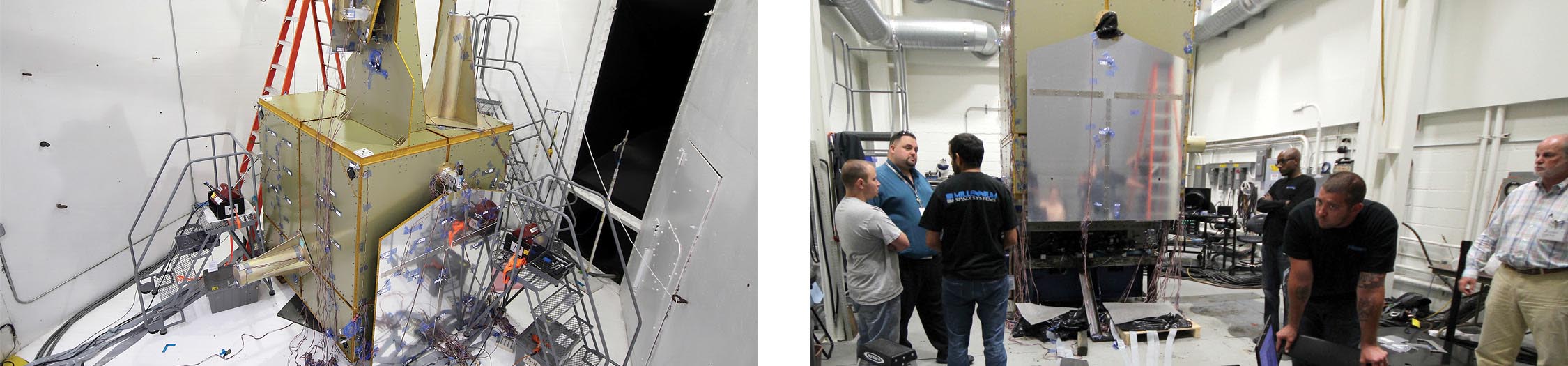
Millennium Space Systems AQUILA M8 Series Satellite Structure

Millennium Space Systems AQUILA M8 Series Satellite Structure

ARRL Publications Manager and QST Editor Steve Ford, WB8IMY, reports on Amateur Satellite news from the Dayton Hamvention.

AMSAT FOXThe ARRL website reports the launch of the Fox-1 CubeSat has been delayed until October 8, 2015. Fox-1 will carry a 435/145 MHz FM Voice Transponder, see http://www.amsat.org/?page_id=1113

The ARRL story continues: AMSAT Vice President-Engineering Jerry Buxton, N0JY, said that a geosynchronous satellite, planned to launch in 2017, will offer uplinks on 5 GHz and downlinks on 10 GHz.

Buxton explained that the geosynchronous footprint will not be absolutely fixed; some variation may require some up/down movement of the user’s dish at certain times — although not continuously. He said AMSAT is working on this issue in terms of what to recommend for ground stations, but that even in the worst case, a user with a fixed antenna would still be able to enjoy several hours of access each day.

The transponder for the new satellite will be software defined and capable of supporting many different modes, including analog SSB.

AMSAT announced in late April that, if all goes according to plan, an Amateur Radio payload will go into space on a geosynchronous satellite that’s planned for launch in 2017. The satellite’s potential footprint could extend over the US from the Mid-Pacific to Africa. AMSAT has accepted the opportunity to be a “hosted payload” on a spacecraft that Millennium Space Systems (MSS) of El Segundo, California, is under contract to design, launch, and operate for the US government. The Amateur Radio payload must be delivered for testing and integration by next spring.

Source http://www.arrl.org/news/dayton-hamvention-2015-day-1-big-crowd-some-rain-satellite-news

A graphic showing an example of a typical Geosynchronous orbit can be seen at
http://www3.sympatico.ca/n.rieck/docs/sirius.html

 The 2.325 GHz signals from the Sirius satellites in Geosynchronous orbit over North America have been received in the UK.

Iowa CubeSat students get ham radio licenses

AMSAT FOXThe University of Iowa reports its students will conduct a Van Allen radiation belt experiment with the AMSAT Fox CubeSat

Thanks to a proposal by the UI Department of Physics and Astronomy, a group of senior electrical and computer engineering students will reenact James Van Allen’s original experiment — this time with updated technology. Group members Kevin Klosterman KD9CPF, Bryan Senchuk KD9CPD, Tyler Dunkel KE0CHR, and Patrick Maloney KD9CPD took on the task as a part of their senior design project for the College of Engineering.

The group is trying to figure out how much energy is emanating from the Van Allen belts at a specific altitude. To measure that, they’ve built a radiation sensor attached to a circuit board that will launch into space on a small satellite. There, the radiation sensor will detect energetic particles  from the Van Allen belts. The satellite will sit in a low-Earth orbit and circle the globe every 90 minutes, some data will be transmitted in real time, but all of it is stored for later transmission.

“I feel like we’ve learned something new every day,” Klosterman says.

Not only did the students have to come up with a design concept, write the code to run the device, and build the circuit board by hand, they also had to learn and become licensed ham radio operators as well.

The satellite that the students are using to launch into space is part of the CubeSat program — an initiative supported by NASA to help give students more hands-on experience with space research — and is being constructed by AMSAT, the Radio Amateur Satellite Corporation, whose mission is to foster amateur radio participation in space technology. The data from a full day of operating the experiment will be transmitted from the satellite as it makes a single pass over the CubeSat tracking station on top of Van Allen Hall.

The final result will be a full mapping of the radiation levels at a low Earth orbit.

It is hoped the Fox CubeSat with an FM voice transponder will be launched later this year.

Read the full story at
http://now.uiowa.edu/2015/05/seniors-reenact-van-allen-radiation-belt-experiments

Each year 100’s of students are introduced to amateur radio through University CubeSat satellite programs with many going on to get their amateur license.

AMSAT Fox http://www.amsat.org/?page_id=1113

AMSAT-UK
Web https://amsat-uk.org/
Twitter https://twitter.com/AmsatUK
Facebook https://facebook.com/AmsatUK
Flickr https://flickr.com/groups/AmsatUK
YouTube https://youtube.com/AmsatUK
Yahoo Group http://groups.yahoo.com/group/FUNcube

First all CW 73 on 73 Award

73 on 73 Award #19 - Hideo Kambayashi JH3XCU

73 on 73 Award #19 – Hideo Kambayashi JH3XCU

Congratulations to Hideo Kambayashi, JH3XCU, for working 73 different stations on AO-73 since September 1, 2014. Notably, he is the first to work all 73 different stations using CW.

For more information on the award see
https://amsat-uk.org/funcube/73-on-73-award/

73,
Paul Stoetzer, N8HM

AO-73 was launched on November 21, 2013 and is the first spacecraft to have a primary mission of educational outreach to schools and the smallest ever satellite to carry a linear (SSB/CW) transponder for radio amateurs.

EO-79 (FUNcube-3) Transponder Test May 4

QB50p1 and QB50p2 - Image Credit ISIS

QB50p1 and QB50p2 – Image Credit ISIS

On Monday, May 4 at around 0830 UT it is intended to activate for one orbit the AMSAT-NL FUNcube-3 transponder on QB50p1 / EO-79.

TLEs are in the normal repositories, COSPAR 2014-033-R, Object# 40025. Real-time tracking at http://www.n2yo.com/satellite/?s=40025 (Click All Passes on Predictions)

We would like people to try the following frequencies if possible:
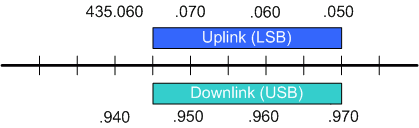
DOWNLINK: 145.960 MHz USB
UPLINK: Tune to match downlink +/- 435.065 MHz LSB
The transponder is linear inverting, nominally 30 kHz wide, and approximately 500 mW output.

If you find the transponder busy on those frequencies, feel free to move around and use the entire transponder passband.

AMSAT-UK FUNcube Mission Patch Rev4 20100609

AMSAT-UK FUNcube Mission Patch

The passband seems to have a “dip” in the middle which is bigger than expected, but we do welcome feedback about the usability. Also, please limit your uplink power, as it looks like this transponder is as sensitive as FUNcube-1. The spacecraft antenna is a monopole, so we would also be interested in signal fading reports.

The commissioning of the transponder done to date is very limited, three activations for 5, 10 and 8 minutes respectively. So your reports are greatly appreciated.

We do understand this is a very short notice, but hope that some of you will be able to participate. This was a take-it-or-leave-it opportunity offered by the ISIS engineers for our consideration, and we are again very grateful to ISIS and VKI for giving us this opportunity.

Please report contacts and signal reports to pa3weg@amsat.org

Wouter PA3WEG
FUNcube Team

QB50p1 EO-79 FUNcube-3 Transponder - Credit Mike Rupprecht DK3WN

QB50p1 EO-79 FUNcube-3 Transponder – Credit Mike Rupprecht DK3WN

Another FUNcube transponder!

QB50P1 FUNcube Transponder April 27, 2015 - Credit Mike Rupprecht DK3WN

QB50P1 FUNcube Transponder April 27, 2015 – Credit Mike Rupprecht DK3WN

AMSAT-NL has announced that an initial series of tests of the FUNcube transponder payload aboard the QB50p1 CubeSat have been successfully completed.

QB50p1 is one of two QB50 precursor spacecraft that were launched from Yasny in Russia in June 2014.

QB50p1 and QB50p2 - Image Credit ISIS

QB50p1 and QB50p2 – Image Credit ISIS

The primary science payloads are still being extensively tested but it has now been possible to undertake a short test of the transponder payload as well. The transponder is intended as a long term secondary mission following the initial technology demonstration and de-risking phase.

After spending ten months in space, the transponder was commanded on for short periods during each of the three morning passes over Europe on Monday, April 27, 2015. A number of FUNcube team members in the Netherlands and in the UK were standing by to run through a predefined test plan.

The transponder has a similar performance to that of FUNcube-1 but the passband is nominally 5 kHz wider by design.

It is not yet known when this transponder may be available for regular usage but AMSAT-NL is delighted to be able to report that the hardware is functioning and is very grateful to the QB50 project, the Von Karman Institute and ISIS B.V. for their ongoing support.

More information about the QB50 project can be found at https://www.qb50.eu/

AMSAT-NL http://amsat-nl.org/

AMSAT-UK https://amsat-uk.org/
Twitter https://twitter.com/AmsatUK
Facebook https://www.facebook.com/AmsatUK
Flickr https://www.flickr.com/groups/AmsatUK
YouTube https://youtube.com/AmsatUK
FUNcube Yahoo Group https://amsat-uk.org/funcube/yahoo-group/