Tiny 'Firefly' Satellite Set To Flash Straight Into Lightning and Thunderstorms

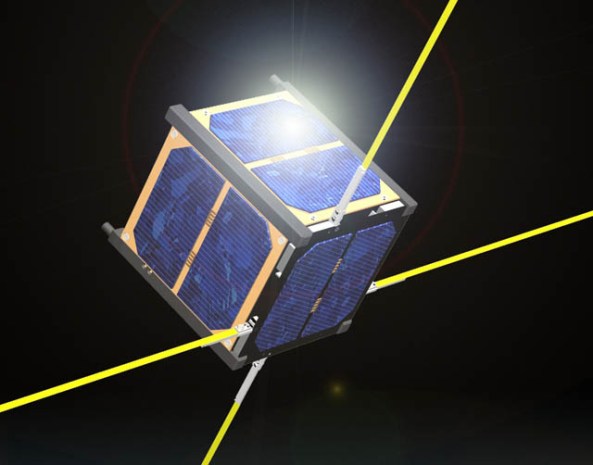
Illustration showing Firefly, a mark-carton-sized satellite, gathering data on a gamma-ray burst.

Firefly, a milk-carton-sized satellite, will study gamma-ray bursts that accompany lightning.
Credit: Zina Deretsky, National Science Foundation

‘CubeSat’ will help solve mysteries of terrestrial gamma ray flashes, 1,000 times more powerful than ‘northern lights’

NSF’s Therese Moretto Jorgensen explains what CubeSats tell us about the atmosphere.
Credit: National Science Foundation

imagine a fully-instrumented satellite the size of a half-gallon milk carton.

Then imagine that milk carton whirling in space, catching never-before-seen glimpses of processes thought to be linked to lightning.

The little satellite that could is a CubeSat called Firefly, and it’s on a countdown to launch next year.
CubeSats, named for the roughly four-inch-cubed dimensions of their basic building elements, are stacked with modern, smartphone-like electronics and tiny scientific instruments.
Built mainly by students and hitching rides into orbit on NASA and U.S. Department of Defense launch vehicles, the small, low-cost satellites recently have been making history. Many herald their successes as a space revolution.
Several CubeSat projects funded by the National Science Foundation (NSF) are currently in orbit, making first-of-their-kind experiments in space and providing new measurements that help researchers understand Earth’s upper atmosphere.
Atmospheric scientist Allan Weatherwax of Siena College offers a glimpse inside a CubeSat.
Credit: National Science Foundation

Firefly is designed to help solve the mystery of a phenomenon that’s linked with lightning: terrestrial gamma rays, or TGFs.
Bursts of gamma rays usually occur far out in space, near black holes and other high-energy cosmic phenomena.  Scientists were surprised when, in the mid-1990s, they found powerful gamma-ray flashes happening in the skies over Earth.

Powerful natural particle accelerators in the atmosphere are behind the processes that create lightning. TGFs result from this particle acceleration.
Individual particles in a TGF contain a huge amount of energy, sometimes more than 20 mega-electron volts. The aurora borealis, for example, is powered by particles with less than one-thousandth as much energy as a TGF.

But what causes a TGF’s high-energy flashes? Does it trigger lightning–or does lightning trigger it? Could it be responsible for some of the high-energy particles in the Van Allen radiation belts, which can damage satellites?
Firefly soon will be on the job, finding out.

Illustration of Firefly orbiting high in the atmosphere above Earth.

Firefly, as it will look once launched high into the atmosphere above Earth.
Credit: NASA

The CubeSat will look specifically for gamma-ray flashes coming from the atmosphere, not space, conducting the first focused study of TGF activity.

The Firefly team is made up of scientists and students at Siena College in Loudonville, N.Y.; NASA Goddard Space Flight Center in Greenbelt, Md.; the Universities Space Research Association in Columbia, Md.; the Hawk Institute for Space Science, Pocomoke City, Md.; and the University of Maryland Eastern Shore, Princess Anne, Md.

Students are involved in all aspects of the mission, from design and development, through fabrication and testing, to operations and data analysis.

Illustration of Firefly gathering data on a terrestrial gamma ray originating from lightning.

Firefly ‘catching’ a terrestrial gamma ray, or TGF, in action.
Credit: NASA

Firefly will carry a gamma-ray detector along with a suite of instruments to detect lightning, says Therese Moretto Jorgensen, program director in NSF’s Division of Atmospheric and Geospace Sciences, which funds Firefly and its CubeSat companions in space.

The CubeSat will return the first simultaneous measurements of TGFs and lightning.
When thunderstorms happen, powerful electric fields stretch upward for miles, into the upper atmosphere. These electric fields accelerate free electrons, whirling them to speeds that are close to the speed of light.

When these ultra-high-speed electrons collide with molecules in the air, they release high-energy gamma rays as well as more electrons, starting a cascade of electrons and TGFs.”Gamma rays are thought to be emitted by electrons traveling at or near the speed of light when they’re slowed down by interactions with atoms in the upper atmosphere,” says Moretto Jorgensen. “TGFs are among our atmosphere’s most interesting phenomena.”

Atmospheric scientists think TGFs occur more often than anyone realized and are linked with the 60 lightning flashes per second that happen worldwide, says scientist Allan Weatherwax of Siena College, a lead scientist, along with Doug Rowland of NASA’s Goddard Space Flight Center, on the Firefly project.

Build-up of electric charges at the tops of thunderclouds from lightning discharges can create a large electric field between clouds and the ionosphere, the outer layer of Earth’s atmosphere. But how this might lead to TGFs is unknown.

“Firefly will provide the first direct evidence for a relationship between lightning and TGFs,” says Weatherwax. “Identifying the source of terrestrial gamma-ray flashes will be a huge step toward understanding the physics of lightning and its effect on Earth’s atmosphere.”
Unlike lightning, a TGF’s energy is released as invisible gamma rays, not visible light. TGFs therefore don’t produce colorful bursts of light like many lightning-related phenomena. But these unseen eruptions could help explain why brilliant lightning strikes happen.
Following Firefly is FireStation, a set of miniaturized detectors for optical, radio and other lightning measurements.FireStation will fly a bit higher than Firefly.
Its orbit is on the International Space Station.

Cheryl Dybas, NSF (703) 292-7734 cdybas@nsf.gov

SST-US and Virgin Galactic Small Satellite Launches

Virgin Galactic LauncherOne

Virgin Galactic LauncherOne

On July 11, Surrey Satellite Technology US LLC (SST-US) signed a memorandum of understanding (MOU) with Virgin Galactic optimizing Surrey’s innovative satellites for Virgin’s new launch vehicle, radically lowering the cost of building and launching small satellites.

This MOU comes on the heels of Virgin Galactic’s announcement of its new ”LauncherOne” program, an unmanned rocket that will be air-launched by SpaceShipTwo’s carrier aircraft, WhiteKnightTwo, and that will be capable of delivering as much as 225 kg to low Earth Orbit. SST-US and Virgin Galactic have agreed to work together to provide SST-US, the world leader in small satellite manufacturing, the information needed to build the most powerful spacecraft that LauncherOne can support, giving satellite customers a powerful and affordable option to put their payloads into space.

SST-US is the US operation of Surrey Satellite Technology Ltd (SSTL), the pioneer in small and cost effective space missions. The collaboration with Virgin Galactic is expected to involve the development by SST-US of new launcher-optimised satellite platforms, the supply of subsystems to the launch vehicle, and advising on market requirements for launch services.

Dr. John Paffet, CEO of SST-US, commented: “Since we launched our first small satellite in the Eighties, we have been changing the economics of space by leveraging innovation. As our platforms have become an integral part of many space programmes, launching satellites at a cost that is synergistic with the mission programme remains a challenge. We look forward to collaborating with Virgin Galactic on this exciting new venture to develop a solution to this need.”

LauncherOne will be a two stage vehicle capable of carrying up to 500 pounds (225 kilograms) to orbit for prices below $10 million. The rocket will be launched from Virgin Galactic’s WhiteKnightTwo, the uniquely capable aircraft also designed to carry SpaceShipTwo aloft to begin her suborbital missions. With more than 85 flights completed to date, WhiteKnightTwo has substantially completed her test flight program.

“Virgin Galactic’s goal is to revolutionize the way we get to space,” Virgin Galactic’s Founder Sir Richard Branson said. “I’m immensely proud of what we have already achieved as we draw near to regular suborbital flights on SpaceShipTwo. Now, LauncherOne is bringing the price of satellite launch into the realm of affordability for schools, non-profits, and start-ups, in addition to companies and space agencies. This provides a completely new resource to the global research community, letting us learn about our home planet more quickly and more affordably.”

Watch LauncherOne – Furthering the Space Frontier

Watch Virgin Galactic’s WhiteKnightTwo and LauncherOne take flight

Virgin Galactic LauncherOne http://www.virgingalactic.com/launcherone

SST-US http://www.sst-us.com/

SSTL Press Release http://www.sstl.co.uk/news-and-events?story=2044

BBC News Report http://www.bbc.co.uk/news/science-environment-18801180

CubeSats, Isle of Man and STEM in SatMagazine

Topics covered in the July/August issue of the free publication SatMagazine include CubeSats, the space industry in the Isle of Man and Science, Technology Engineering and Mathematics (STEM).

Erik Mumm’s Insight article Advances In CubeSats Enable New Apps starts on page 56.

The Isle Of Man—Onward, Onward, Onward on page 68 is the third in the series about the space industry in the Isle of Man.

A Video Pathway To Learning starts on page 72 and describes STEM Flix™ which is a new, interactive video series.

Download the July/August 2012 SatMagazine at http://www.satmagazine.com/2012/SM_JulAug2012.pdf

SatMagazine http://www.satmagazine.com/

Reform of the Outer Space Act 1986: Consultation

The UK Space Agency has issued a public consultation seeking views of stakeholders on proposed changes to the Outer Space Act 1986.

This is in response to the Government Growth Review published in March 2011, in which the Government set out its wish to reform the Outer Space Act 1986 by introducing an upper limit on liability for UK operators.

The Outer Space Act covers all UK satellites irrespective of size, from tiny low cost educational CubeSats up to large commercial £500 million satellites.

The key aspects of the consultation are the proposals to waive the capped liability and insurance requirement for in-orbit operation of any satellite that meets the criteria of a CubeSat and to remove the requirement for unlimited indemnity from satellite operators.

The existing Outer Space Act imposes heavy additional costs (>£50,000 per annum) on those wishing to launch small educational CubeSats. The additional costs act as a major deterrent and to-date no such UK CubeSat has been launched.

The public consultation closes August 31, 2012.

Further information at
http://www.bis.gov.uk/ukspaceagency/news-and-events/2012/May/
reform-of-the-outer-space-act-1986-consultation

CubeSat docking planned with Kinect technology

It’s an informal conclusion, of course. But the story of Surrey’s plan to dock CubeSats using Microsoft’s Kinect technology is certainly making the rounds, appearing in traditional places like Satnews and Flightglobal, as well as consumer electronic sources such as Gizmagodo and general news sites like the BBC.

The Kinect-enabled STRaND-2 is the sister craft to the previously announced STRaND-1, which uses smartphone tech.

Developing technology that could be used to separately launch the parts of a much larger craft that would be configured on orbit might bring those larger craft, and more ambitious goals, within reach of the CubeSat community.

It’s been a while since any news was forthcoming, but Cornell has also proposed using CubeSats to test reconfigurable technology that uses “flux-pinning” (video) to achieve similar goals.

Here’s to their success.


Wayne


It’s time Australia entered space

https://i0.wp.com/www.davidreneke.com/wp-content/uploads/2012/06/Cubesat.jpg

The rise of small spacecraft could launch Australia’s space program, writes Steven Tsitas. Australia has long delayed the development of a space program, placing it in an almost unique position amongst comparable countries.But now we can develop extremely small yet powerful low-cost spacecraft, it’s time to reconsider whether Australia should have its own space program.

The future of a sustainable Australian space program — one that actually designs and builds its own spacecraft, and perhaps a small rocket to launch them — is small, lightweight spacecraft using advanced technology with significant two-way US involvement.My research indicates a spacecraft the size of a typical shoe-box weighing just 8 kilograms, known as a 6U CubeSat, can perform some of the missions of much larger ‘microsatellites’ weighing around 100 kilograms – or roughly the size of a washing machine.

This 10-times size reduction should make the cost of producing a spacecraft 10-times cheaper — around $1 million versus $10 million.The cost may now be low enough to make it politically possible for Australia to have a sustainable space program based on this spacecraft.Utilising this technology would provide economic opportunities for Australia, improve our strategic relationship with the US and inspire the next generation of students to study science, technology, engineering, and mathematics.

Economic opportunities

This is perhaps the last chance for Australia to enter this high growth-rate industry in the capacity of designing and building its own spacecraft.

In terms of economic opportunity, the worldwide space industry has annual revenue of $275 billion and a 9 per cent growth rate. But barriers to entry are high, with established players who are decades along the experience curve — except in the last remaining niche of 8 to 40 kilogram spacecraft.Spacecraft cost their weight in gold despite being made from mostly inexpensive raw materials, indicating significant value is added through design and manufacturing.

Australia has the opportunity to earn significant export income through this technology. A high growth rate industry with the opportunity for significant value addition, such as the early days of the personal computing industry or the internet, is considered a good economic opportunity.The fact that the spacecraft can be designed to perform some of the missions of 100 kilogram microsatellites indicates a level of capability that scientists could exploit by replacing the standard camera payload with an instrument they design.

This in turn could open up a worldwide market, selling spacecraft to scientists (who purchase them with grant money) similar to how scientists buy lab equipment.The small size and ‘mass production’ of the spacecraft (relatively speaking, compared to other spacecraft which are typically highly customised) will provide a relatively cheap way for scientists to fly their experiments in orbital space. There is currently no low-cost way to do this, preventing the exploration of new ideas in a relatively inexpensive and informal fashion, which is the backbone of science.

What is CubeSat, and what could it do?

CubeSats were originally developed in the US for educational purposes with dimensions of only 10 x 10 x 10 cm (called a 1U) and a mass of 1.33 kilograms.

The CubeSat sits in a ‘P-POD’ that looks like a rectangular mailbox, and is attached to the launch adapter connecting a much bigger spacecraft to the rocket launching it. The P-POD is spring loaded to push the CubeSat out once in space. A P-POD can hold three of the 1U CubeSats, and then 2U and 3U CubeSats were developed.

Doubling the size of a 3U CubeSat to 6U leads to a marked increase in this technology’s capabilities.

It could take pictures that, while not as sharp as Google satellite pictures, would be as sharp as some other commercially available satellite pictures such as from the RapidEye spacecraft, in the same five colours of light that are useful for agricultural monitoring. Similar to the RapidEye constellation of microsatellites a constellation of 6U CubeSats could allow daily updates (unlike Google satellite pictures). This could be used to help with agricultural monitoring in the developing world and improve food security.

With a different camera the spacecraft could take photos of the Earth at night. Night imaging makes it easier to map the precise extent of human settlement and the data could potentially be sold to government agencies in other countries concerned with mapping human settlement for planning and demographic purposes.

Strategic relationships

Spacecraft are usually so expensive that the technology used in them is quite conservative, to reduce the risk of failure. But a 10-times reduction in cost allows us to risk advanced technologies because failures, if they result, need not be financially crippling, and we gain valuable experience to make these technologies work.

The pay-off is clear: these advanced technologies endow the smaller spacecraft with enough of the capabilities of much larger spacecraft to carry out some of their missions.

The US is interested in this low cost, light weight, high technology approach, as is the US Defense Advanced Research Projects Agency or DARPA. In particular, its ‘SeeMe’ program is the example that should be followed for an Australian space program, but in a civilian context.

Building up a national capability in small, lightweight (8 to 40 kilograms) advanced technology spacecraft with significant two-way US involvement will allow us to develop a complementary space capability which the US can benefit from.

This is similar to how the US relied on Canada to develop the robotic space arm used on the Space Shuttle. Being a valuable partner in space will improve our strategic relationship with the US.

The rationale for developing this technology would hold true for any country allied with the US, but currently lacking a space program; there is no special reason why it should be Australia that capitalises on this research, other than it is by an Australian.

The economic, strategic and educational rationale for Australia to develop a space program based on the 6U CubeSat does not require that the 6U CubeSats actually be used to observe Australia. The fact that Australia currently receives much satellite data free from other countries does not undermine this argument for an Australian space program. Nor does this argument depend on potential Australian users stating a need for our own satellites.

The radio beeping of Sputnik as it circled the Earth in 1957 galvanized the US into action in space. Hopefully the sound of this opportunity whistling by will stir Australia into the development of a sustainable space program based on the 6U CubeSat.

If Australia fails to grasp this opportunity, others surely will.Source: ABC Science