
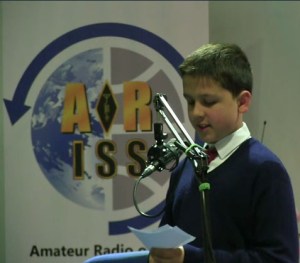
- Lucy Woolridge M6LGJ establishing communications with Tim Peake KG5BVI / GB1SS on the ISS
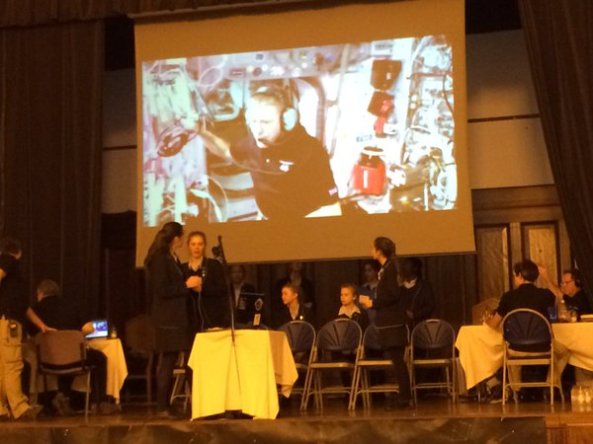
An International Space Station radio contact took place on Monday, April 18 1456 GMT between Timothy Peake GB1SS and participants at St Richard’s Catholic College, Bexhill-on-Sea, East Sussex using the call sign GB4SRC.
The contact was audible on 145.800 MHz FM over Western Europe and was streamed on the web at https://principia.ariss.org/Live/
The Bexhill Observer reported:
Star of the show and year nine pupil Lucy Woolridge M6LGJ initiated and ended the link expertly, using her recently-gained amateur radio license, and was lost for words.
“I feel relieved, it was amazing but we were very lucky to be able to speak to Tim at all,” she said.
There was some tension as it took five goes by Lucy before Tim replied saying, ‘I hear you loud and clear’.
The amateur radio contact generated plenty of media coverage which included:
The Bexhill-on-Sea Observer newspaper
http://www.bexhillobserver.net/news/local/students-speak-to-astronaut-tim-peake-in-bexhill-1-7335695
Shoreham Herald – St Richard’s students speak to astronaut Tim Peake
http://www.shorehamherald.co.uk/news/local/county-news-students-speak-to-astronaut-tim-peake-1-7336995
A video of the full contact is available from BBC TV South-East at
https://www.facebook.com/BBCSouthEastToday/videos/10154116229478648
BBC’s Chrissie Reidy interviewed Carlos Eavis G0AKI / G3VHF about the contact
https://twitter.com/BBC_CReidy/status/722094969767505920/video/1

St Richard’s Catholic College
Participants Presentation:
St Richard’s Catholic College is a Science Specialist school tucked between the South Downs and the English Channel. We have 1000 pupils on roll between Years 7–11. We provide an inclusive education for Catholic and Christian pupils covering an extended catchment area covering approximately a 30 mile radius.
St Richard’s was awarded Teaching School status late in 2014 and we are the lead school in the Thrive Alliance, an association of primary schools, secondary schools and a sixth form college as well as lead in the Sussex Science Subject Hub. We are also a strategic partner in the Sussex Maths Hub. St Richards’ Science department enjoys a very strong relationship with the University of Sussex (particularly Astronomy & Physics); University of Greenwich (Outreach) and we sit on the STEM Focus Group hosted by the University of Brighton’s STEM Sussex.

Audience listening to the ARISS contact at St Richard’s Catholic College
We are a keen supporter of STEM events in our region, with particular success at the Annual STEM Fest event where we have won prizes at the National Science and Engineering Competition for the last four years, twice through to national competition. STEM Sussex have used St Richard’s STEM Clubs’ provision as an exemplar due to its success in engaging pupils of all abilities across all year groups. The department has also enjoyed a high quality Continuous Professional Development engagement in the STEM agenda with involvement in ‘Space as a context for teaching science’ courses and a future STEM project with the University of Reykjavik in Iceland.
We enjoy Space Camp UK, a residential trip with all things “spacy” at the National Space Centre and Duxford.
The coordinating teacher, Dr Joolz Durkin, is the curriculum enhancement for science and is also an enthusiastic “Space Ambassador” and has worked with the Tim Peake Primary Project at Parklands Infants Eastbourne, Dallington School in Dallington, Pebsham Primary in Bexhill on Sea and Vinehall School in Heathfield as part of this link up.
Participants will ask as many of the following questions as time allows:

UK astronaut Tim Peake KG5BVI GB1SS in the ISS Jan 2016
1. (Lucy – Year 9) – You have mentioned in an earlier call that you have been sleeping very well on the Space Station. Is that still the case or have you found any cumulative effects after four months in space ?
2. (Aeden – Year 10) – As the ISS hosts astronauts from many different nationalities, what public holidays do the crew observe, if any, and how are they chosen?
3. (Anna – Year 11) – St Richards and two of our Primary Project Partner school, Dallington and Vinehall are taking part in the RHS ‘Rocket Science’ Experiment from the Principia Mission. How will the results from this experiment influence future planning for growing similar samples in another planet’s gravity?
4. (Andrew – Year 11) – We have seen the preparation with Heston Blumental of an exciting astronaut menu for the mission – does the food taste the same in space as it did on Earth?
5. (Shona – Year 11) – In a sealed spacecraft like the International Space Station, how is the air quality monitored and controlled?
6. (Luigi – Year 11) – We see the wonderful time lapse images of the ISS orbiting the Earth, but what I like looking at are the stars and making out the constellations. Do you do any astronomical research on the ISS?
7. (Moira – Year 11) – During the mission you yourself are part of experiments using the British designed MMS Cerebral and Cochlear Fluid Pressure Analyser to collect data for the NASA Fluid Shifts investigation. Which aspect of the self-experimentation has been the most interesting or challenging?
8. (Chris – Year 9) – Are there any experiments that rely on naked flames on the ISS? If so, how are they carried out and what low gravity precautions are employed?
9. (Ancy – Year 11) – If I oversleep my parents will wake me up – have you overslept on the ISS and had to be woken up by someone?”
10. (Will – Year 10) – The distance between Bexhill and Brighton is 31 miles with a journey time by car of nearly 50 minutes. How much time would it take for the ISS to do this trip?
11. (Vita – Year 11) – What are the greatest challenges of living in space and in retaining a permanent crew on board the ISS?
12. (Max – Year 10) – You have tweeted some amazing and beautiful images of the aurora. Have you been able to monitor solar flare or CME activity and correlate to the brightness of the aurora?
13. (Ben – Year 11) – How does it feel to be able to see all humanity?
14. (Lucy – Year 9) – Is the ISS affected by the Earth’s magnetic field?
15. (Aeden – Year 10) – On Sunday you will be joining thousands of others in taking part in the London Marathon. What special routines have you trained for this in space?
16. (Anna – Year 11)) – In the London marathon, runners will have natural cooling as the run – how do you regulate your body temperature in a sealed environment such as the IS?.
17. (Andrew – Year 11) – We understand you are taking part in the Skin B research on the ISS? Can you share any interesting findings?
18. (Shona – Year 11) – You have tweeted that having a bacon sandwich and cup of tea on arrival at the ISS was the best welcome possible. What food are you looking forward to on landing?
19. (Luigi – Year 11) – What is special about space suits that help you breathe in space when on an EVA?
20. (Moira – Year 11) – How smooth was the launch in December?
ARISS is an international educational outreach program partnering the volunteer support and leadership from AMSAT and IARU societies around the world with the ISS space agencies partners: NASA, Russian Space Agency, ESA, CNES, JAXA, and CSA.
ARISS offers an opportunity for students to experience the excitement of Amateur Radio by talking directly with crew members on-board the International Space Station. Teachers, parents and communities see, first hand, how Amateur Radio and crew members on ISS can energize youngsters’ interest in science, technology, and learning.
This contact will be webcast on the ARISS Principia website. Further details on the start time of the webcast will be made available in the coming days so be sure to check for further information at https://principia.ariss.org/
St Richard’s Catholic College
https://twitter.com/StRichardsCC
http://www.strichardscc.com/
St. Richard’s Catholic College Build-a-thon a success
http://www.southgatearc.org/news/2016/april/st_richards_college_buildathon_a_success.htm
UK ARISS shortlisted schools
https://amsat-uk.org/2016/02/03/all-uk-ariss-shortlisted-schools-are-now-scheduled/
Listening to the ISS on a handheld radio https://amsat-uk.org/2016/01/10/listening-iss-on-handheld/
Get press publicity by receiving ISS school contacts
https://amsat-uk.org/2016/03/10/press-publicity-receiving-iss/
What is Amateur Radio? http://www.essexham.co.uk/what-is-amateur-radio
Find an amateur radio training course near you https://thersgb.org/services/coursefinder/
A free booklet is available aimed at introducing newcomers to the hobby that can also be used as a handy reference while getting started, see
http://rsgb.org/main/get-started-in-amateur-radio/alex-discovers-amateur-radio-2/






 AMSAT-UK
You must be logged in to post a comment.