OSCAR News Issue 213

OSCAR News Front Page 213 March 2016Issue 213 of the AMSAT-UK amateur radio satellite publication OSCAR News was released on March 12, 2016. E-members can download it here.

The paper edition is usually posted 2-3 weeks after publication of the electronic issue.

In this issue:
• The Tim Peake QSOs
• Sandringham School — the sequel
• The first Soyuz rocket to launch from a new cosmodrome in Russia’s Far East
• Updates on the FUNcube Project Graham, G3VZV
• News from Malta
• QB50 Launch Switches from Alcantara Cyclone Space to NanoRacks and Kosmotras
• FUNcube-1 demo at the Space Studio G0MRF
• Soap Box – Ideas for DATV operations via Es’hail-2 Daniel Cussen EI9FHB
• Some history concerning the HAMTV set up and the Antennas on the Columbus module. Gaston Bertels, ON4WF
• FUNcube-1 (AO-73) & the International Space Station at Talbot Heath School, Bournemouth Bill Coombes G4ERV

AMSAT-UK FUNcube Mission Patch

AMSAT-UK FUNcube Mission Patch

Membership of AMSAT-UK is open to anyone who has an interest in amateur radio satellites or space activities, including the International Space Station (ISS).

E-members of AMSAT-UK are able to download OSCAR News as a convenient PDF that can be read on laptops, tablets or smartphones anytime, anyplace, anywhere. Join as an E-member at Electronic (PDF) E-membership

There are two rates for the paper edition to cover the extra postage costs:
UK
Rest of the World (Overseas)

PDF sample copy of “Oscar News” here.

Join AMSAT-UK using PayPal, Debit or Credit card at
http://shop.amsat.org.uk/

E-members can download their copies of OSCAR News here.

FUNcube transponder on EO-79 active

QB50p1 and QB50p2 - Image Credit ISIS

EO-79 and EO-80 – Image Credit ISIS

On March 25, 2016, the EO-79 SSB/CW transponder was activated and will be available during Easter.

The FUNcube transponder subsystem on QB50p1 (EO-79) had been provided by AMSAT-UK and AMSAT-NL and is a similar subsystem as on FUNcube-1, but without the telemetry downlink circuitry.

The current software running on EO-79 does experience occasional reboots. When these reboots happen, the transponder is automatically turned off and will have to be turned back on by a command station. The FUNcube team has selected a few command stations to do so, but be advised the transponder may be off.

TLEs:
AMSAT keps name: EO-79
Celestrak keps Name: QB50P1
Celestrak file: cubesat.txt
NORAD #    40025
COSPAR designator    2014-033-R

Frequencies:
Uplink: 435.035-435.065 MHz LSB
Downlink: 145.935-145.965 MHz USB

EO-79 has been set to only beacon the normal AX.25 beacon every 30 seconds instead of 10 seconds. The beacon frequency is 145.815 MHz and consists of AX.25 frames on BPSK. more details about the downlink can be found on the ISIS HAM page at http://isispace.nl/HAM/qb50p.html

Just like FUNcube-1, the crystal oscillator circuits exhibit drift with temperature. This means manual tuning will probably work best.

Lastly, the commanding team availability will be limited over Easter, so please report the transponder being on or off on the status page of AMSAT: http://www.amsat.org/status/
It does not appear in the table, but it does in the reporting drop-down.

73 and have FUN

Wouter Weggelaar, PA3WEG
AMSAT-NL
AMSAT-UK

2013 QB50 Precursor CubeSat announcement
https://amsat-uk.org/2013/07/20/qb50-amateur-radio-transponder-payloads-to-launch-2014/

UK student balloon flies around the world

UBSEDS14 balloon track as at 1300 GMT March 21, 2016

UBSEDS14 balloon track as at 1300 GMT March 21, 2016

On Monday, March 21, 2016 the UBSEDS14 balloon, launched by University of Bristol students, completed its circumnavigation of the Northern Hemisphere.

UBSEDS14 balloon envelope

UBSEDS14 balloon envelope

The University of Bristol Students for the Exploration and Development of Space (UBSEDS) launched their balloon on Monday, March 8. Powered by a single AA Lithium Energiser Battery (LR91).

During the flight at an altitude of about 11,500m the balloon has been transmitting telemetry data at 4 minute intervals using 5 dBm output of Contestia 16/1000 on 434.600 MHz USB. Each telemetry packet is preceded by 10 seconds of 1Hz pips for manual alignment and a RSID tone for automatic alignment with suitable software. Additionally the payload has the capability for 144 MHz APRS.

UBSEDS14 tracker payload

UBSEDS14 tracker payload

The balloon has a diameter of 1.5m and the payload weighs just 21.3 grams. Despite the weight constraints the team have managed to employ sophisticated Geofencing technology to prevent the balloon transmitting when over certain countries and also to select different APRS frequencies depending on the territory being overflown.

UBSEDS14 information is available at
http://www.bristol-seds.co.uk/hab/flight/2016/03/07/ubseds14.html

UBSEDS14 balloon launch
http://www.southgatearc.org/news/2016/march/ubseds14_balloon_launches_today.htm

Useful High Altitude Balloon Links https://amsat-uk.org/beginners/balloons/

One of the students involved in the project is Richard Meadows M0SBU. He took the amateur radio courses run by the Chelmsford Amateur Radio Society (CARS) at Danbury in Essex. Further information on the courses is available from the CARS Training Manager
Email: training2016 at g0mwt.org.uk
Web: http://g0mwt.org.uk/training

What is Amateur Radio? http://www.essexham.co.uk/what-is-amateur-radio

Find an amateur radio training course near you https://thersgb.org/services/coursefinder/

A free booklet is available aimed at introducing newcomers to the hobby that can also be used as a handy reference while getting started, see
http://rsgb.org/main/get-started-in-amateur-radio/alex-discovers-amateur-radio-2/

UK student balloon crosses Pacific

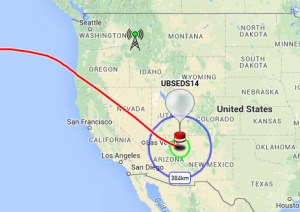
UBSEDS14 balloon track as at 19:02 GMT March 17, 2016

UBSEDS14 balloon track as at 19:02 GMT March 17, 2016

On Thursday, March 17 the UBSEDS14 balloon, launched by University of Bristol students, had successfully crossed the Pacific and was above Arizona, having traveled over 24,500 km since launch.

The University of Bristol Students for the Exploration and Development of Space (UBSEDS) launched their balloon on Monday, March 8. Powered by a single AA Lithium Energiser Battery (LR91) the balloon has been transmitting about 5dBm of Contestia 16/1000 on 434.600 MHz USB at 4 minute intervals as well as APRS during its flight at an altitude of about 11,000m.

The balloon has a diameter of 1.5m and the payload weighs just 21.3 grams. Despite the weight constraints the team have managed to employ sophisticated Geofencing technology to prevent the balloon transmitting when over certain countries and also to select different APRS frequencies depending on the territory being overflown.

UBSEDS14 information is available at
http://www.bristol-seds.co.uk/hab/flight/2016/03/07/ubseds14.html

UBSEDS14 balloon launch
http://www.southgatearc.org/news/2016/march/ubseds14_balloon_launches_today.htm

Useful High Altitude Balloon Links https://amsat-uk.org/beginners/balloons/

One of the students involved in the project is Richard Meadows M0SBU. He took the amateur radio courses run by the Chelmsford Amateur Radio Society (CARS) at Danbury in Essex. Further information on the courses is available from the CARS Training Manager
Email: training2016 at g0mwt.org.uk
Web: http://g0mwt.org.uk/training

What is Amateur Radio? http://www.essexham.co.uk/what-is-amateur-radio

Find an amateur radio training course near you https://thersgb.org/services/coursefinder/

A free booklet is available aimed at introducing newcomers to the hobby that can also be used as a handy reference while getting started, see
http://rsgb.org/main/get-started-in-amateur-radio/alex-discovers-amateur-radio-2/

Otley school to talk to ISS

UK astronaut Tim Peake KG5BVI GB1SS in the ISS Jan 2016

UK astronaut Tim Peake KG5BVI / GB1SS

The Wharfedale Observer reports Otley school has been chosen for ‘out of this world’ talk using amateur radio to British astronaut.

Children in Otley are set to enjoy an ‘out of this world’ talk with British astronaut Tim Peake GB1SS.

Ashfield Primary School pupils will be put in direct contact with Major Peake, who is on a mission with the International Space Station, in May.

The event is a coup for the school which is the only one in Yorkshire to be selected for the Amateur Radio on ISS link-up.

Ashfield was chosen following a lengthy application process involving schools across the country, and will be put in touch with the space station at some point between May 3 and 6.

Its bid was led by staff member Michael Ross M6FFK, through his links with Otley Amateur Radio Society (OARS) and supported by BBC One Show scientist – and Otley resident – Dr Marty Jopson.

Read the full story at
http://www.wharfedaleobserver.co.uk/news/14347948.Otley_school_chosen_for__out_of_this_world__talk_to_British_astronaut/

Dates of future Tim Peake amateur radio school contacts are at
https://amsat-uk.org/2016/02/03/all-uk-ariss-shortlisted-schools-are-now-scheduled/

Listening to the ISS on a handheld radio https://amsat-uk.org/2016/01/10/listening-iss-on-handheld/

What is Amateur Radio? http://www.essexham.co.uk/what-is-amateur-radio

Find an amateur radio training course near you https://thersgb.org/services/coursefinder/

A free booklet is available aimed at introducing newcomers to the hobby that can also be used as a handy reference while getting started, see
http://rsgb.org/main/get-started-in-amateur-radio/alex-discovers-amateur-radio-2/

UBSEDS14 balloon flying across Pacific

UBSEDS14 balloon flight track as at March 14, 2016

UBSEDS14 balloon flight track as at March 14, 2016

On Monday, March 14 the UBSEDS14 balloon, launched by University of Bristol students, passed over Japan and out towards the Pacific, having traveled over 15,497 km since launch.

The University of Bristol Students for the Exploration and Development of Space (UBSEDS) launched their balloon on Monday, March 8. Powered by a single AA Lithium Energiser Battery (LR91) the balloon has been transmitting about 5dBm of Contestia 16/1000 on 434.600 MHz USB at 4 minute intervals as well as APRS during its flight at an altitude of about 11,000m.

The balloon has a diameter of 1.5m and the payload weighs just 21.3 grams. Despite the weight constraints the team have managed to employ sophisticated Geofencing technology to prevent the balloon transmitting when over certain countries and also to select different APRS frequencies depending on the territory being overflown.

UBSEDS14 information is available at
http://www.bristol-seds.co.uk/hab/flight/2016/03/07/ubseds14.html

UBSEDS14 balloon launch
http://www.southgatearc.org/news/2016/march/ubseds14_balloon_launches_today.htm

Useful High Altitude Balloon Links https://amsat-uk.org/beginners/balloons/

One of the students involved in the project is Richard Meadows M0SBU. He took the amateur radio courses run by the Chelmsford Amateur Radio Society (CARS) at Danbury in Essex. Further information on the courses is available from the CARS Training Manager
Email: training2016 at g0mwt.org.uk
Web: http://g0mwt.org.uk/training

What is Amateur Radio? http://www.essexham.co.uk/what-is-amateur-radio

Find an amateur radio training course near you https://thersgb.org/services/coursefinder/

A free booklet is available aimed at introducing newcomers to the hobby that can also be used as a handy reference while getting started, see
http://rsgb.org/main/get-started-in-amateur-radio/alex-discovers-amateur-radio-2/