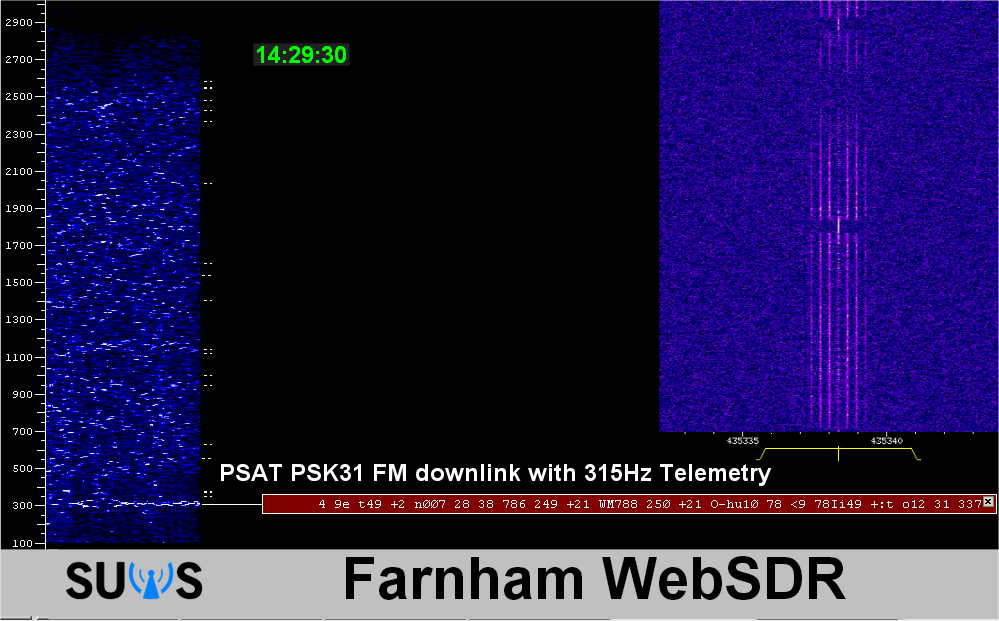
PSAT PSK31 FM downlink received by Martin G8JNJ at 1429 UT May 22, 2015 using the online SUWS WebSDR
Martin Ehrenfried G8JNJ reports receiving the PSAT PSK31 FM downlink on the online SUWS WebSDR located at Farnham near London.
Bob Bruninga WB4APR has posted two updates on May 21 and May 22 to the AMSAT Bulletin Board about the three USNA CubeSats PSAT, BRICSAT and USS Langley along with a guide on how to use the PSK31 transponder. These can be seen below.
Status Summary – Day 2 – May 21
We now have heard 4 of 5 transmitters from our 3 spacecraft all still in a close cluster:
* PSAT packet is OK but WOD not working (no digipeating for users yet)
* PSAT PSK31 downlink is ok [remember, it is FM!]
* BRICSAT telemetry has been heard but is cycling OFF due to low power
* BRICSAT PSK31 downlink (also FM) has also been heard barely (when ON)
* USS Langley not heard

28 MHz PSK31 Receiver Board Flight Prototype – Brno University of Technology
PSAT CPU shows the 4 day-fail-safe backup reset circuit is not counting down, so we have lost this (1 of 3) fail safe backup RESET capabilities. Bad line of code already found. But cannot change it.
PSAT is not properly reporting WOD data and S#… STATUS packets are being bundled until 255 byte packet length is reached and then it all comes down at once. Noone has captured any of these long packets. Please try with PASSALL ON so that you can receive partial packets.
Awaiting permission from Brno University of Technology to authorize HF user uplinks on PSAT PSK31. UPDATE May 22 Here is the announcement from Brno University: “We can uplink open to all users. Please, do it.” – Mirek OK2AQ.
BRICSAT PSK31 transponder is on identical frequencies as PSAT’s. You can tell them apart because one has PSK Telemetry on 315 Hz and the other is on 365 Hz. Both on the UHF FM downlink 435.350 MHz
We’d LOVE to hear from USS Langley, and we’d love to capture one of those long WOD packets from PSAT. Our ground station is only getting a few packets compared to some submissions from others. Keep it up.
SUMMARY:
145.825 1.5U CubeSat – PSAT 1200 baud AX.25
435.350 same CubeSat – PSAT PSK31 FM – Brno University transponder
437.975 1.5U CubeSat – BRICsat 9600 baud
435.350 same CubeSat – BRICsat PSK31 FM – Brno University transponder
437.475 3.0U CubeSat – USS Langley 9600 bd
ULTRASat3
1 99993U          15140.67013889  .00040043  00000-0  10235-2 0 00009
2 99993 055.0004 339.9238 0251027 182.3314 074.3075 15.12517086000014
Bob, WB4APR
Status Summary – Day 3 – May 22
* PSAT packet telemetry is OK, Digipeater will be off (secondary mission)
* PSAT PSK31 transponder is ON with 28.120 MHz uplink! (primary mission)
* WOD data fixed. Spin data now available. Right now it is at 3 RPM with
+Z pointing at Sun
* Launch TLE elements (below) are 6 minutes ahead of satellite
* PCSAT.APRS.ORG web page is now also capturing PSAT telelmetry downlinks
* BRICSAT telemetry has been heard but is cycling OFF due to low power
* BRICSAT PSK31 downlink (also FM) has also been heard barely (when ON)
* USS Langley not heard
Only fault so far is the loss of the 4 day-fail-safe backup reset circuit
(1 of 3) fail safe backup RESET capabilities. The lack of WOD data was
because we had a LOW-POWER bits set that was holding it off.
BRICSAT PSK31 transponder is on identical frequencies as PSAT’s. You can
tell them apart because one has PSK Telemetry on 315 Hz and the other is
on 365 Hz. Both on the UHF FM downlink 435.350 MHz
Bob, WB4APR
Receiving the PSAT PSK31 FM downlink

BRICsat 435.350 MHz FM PSK31 signal received by Tetsurou Satou JA0CAW at 2057 UT on May 22, 2015
Receiving the PSAT (and BRICsat) 435.350 MHz FM downlink is as simple as placing your PSK31 laptop microphone next to the speaker on your FM satellite UHF receiver and just watching the waterfall.
What you see is exactly what everyone else sees (it’s FM). There is no Doppler added to the tones due to your station’s position relative to the satellite. But you DO have to retune your FM radio at least 3 times during the pass (+5 kHz, 0, -5 kHz) to stay in the FM passband. [Note: UK users should remember to selected the wide FM (5 kHz deviation) filter setting on their rigs]
User uplinks, however, will shift in the waterfall according to each user’s position relative to the satellite. The shift can be as low as 1 Hz per second to as high as 6 Hz per second. This is because the uplink is on 10 meters where the Doppler rate is only 1/15th of what it would be on UHF.
The TELEMETRY channel at 315 Hz (PSAT) or 375 Hz (BRICsat) is FIXED with no Doppler since it is generated onboard into the FM downlink
WHAT TO DO:
1) We will need PSK31 authors to open the PSK31 frequency tracking to accommodate more than 1 Hz per second Doppler tracking. Current implementations can do 1 Hz/s but completely fail at 3 Hz/s. 2 Hz/s might work a little…
2) Until then, ANY uplink user that is in line with a direct overhead pass will have minimum Doppler at the start and end of his pass (1 Hz/sec) when the satellite is going right at him and directly away from him. (Though it will be MAX (6 Hz/sec) when it passes over her/his station).
3) Just turn on MULTI CHANNEL window and let the PSK31 decode everyone.The ones with the least Doppler at any instant may be decoded for a while!
USERS can transmit later when BRNO University says it has completed its tests. Brno provided the transponders for use in the PSAT and BRICsat satellites.
So start preparing your station to TX PSK31 on 10 meters SSB and to receive the audio from an FM UHF rig on 435.350 +/- 5 kHz steps of Doppler.
DOWNLINK Limitations: The UHF downlink signal is only 300 mW and so a UHF beam is needed on the downlink.
UPLINK RESTRICTIONS: *NOTHING MORE THAN* a Vertical 1/4 wave or Dipole is authorized on the 10m uplink and no more than 25 Watts (for now).
Remember a 1/4 wave vertical is the ideal antenna because it maximizes the signal at lower angles and tapers the signal as the satellite gets closer. This keeps user uplinks about the same during a pass. Strong stations just drive down the AGC and ruin it for everyone.
Use minimum power!! Remember, this is crossband FULL DUPLEX so you can see yourself in the downlink just like everyone else can see you. Act accordingly. And of course DO NOT TRANSMIT if you cannot see the waterfall … Duh!
Enjoy!
Bob, WB4APR
ParkinsonSAT (PSAT) http://www.aprs.org/psat.html
Fldigi PSK31 software http://www.w1hkj.com/Fldigi.html
Listen to satellite signals in the 145 and 435-438 MHz bands from anywhere in the world using the online SUWS WebSDR located near London. Further details at https://amsat-uk.org/2014/08/15/suws-websdr-moves-to-new-site/
AMSAT-UK
Web https://amsat-uk.org/
Twitter https://twitter.com/AmsatUK
Facebook https://facebook.com/AmsatUK
Flickr https://flickr.com/groups/AmsatUK
YouTube https://youtube.com/AmsatUK
Yahoo Group http://groups.yahoo.com/group/FUNcube




 AMSAT-UK
You must be logged in to post a comment.