2016 launch for UniSat-7 with CubeSats and PocketQubes

UniSat-7 GAUSS Srl

UniSat-7 GAUSS Srl

GAUSS Srl is preparing a Dnepr launch of a new satellite, UniSat-7, into a Sun Synchronous Orbit (SSO), carrying CubeSats and PocketQubes.

The launch is planned for December 2016 and they are currently looking for payload to include in their satellite.

If you are interested in including your own payload you can contact GAUSS Srl to assess the impact on the mission at launch@gaussteam.com there might be space left for your own payload/satellite.

Characteristics of the UniSat-7 mission:
• Total mass: 32 kg
• Sun-Synchronous orbit: (550 – 600 km)
• LTAN: 10:30 (confirmed)

Watch UniSat-7 Satellite
Music by Kostantinos Geradimos, Album Stereofloat, Song Crashed

UniSat-7 http://www.gaussteam.com/satellites/unisat-7/

AMSAT-NA Opportunity for Rideshare to Geostationary Orbit

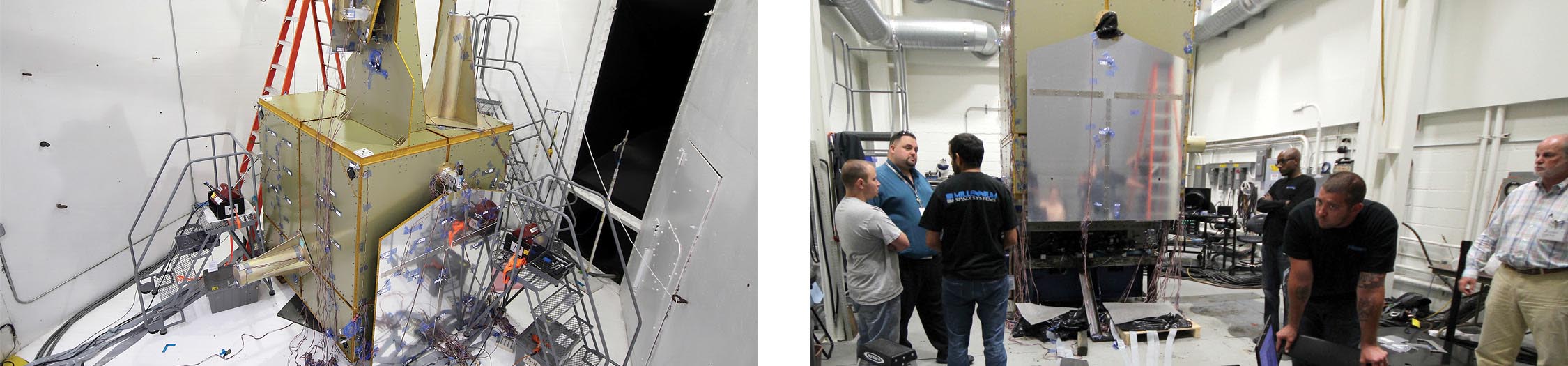
Millennium Space Systems AQUILA M8 Series Satellite Structure

Millennium Space Systems AQUILA M8 Series Satellite Structure

AMSAT is excited to announce that we have accepted an opportunity to participate in a potential rideshare as a hosted payload on a geostationary satellite planned for launch in 2017.

An amateur radio payload, operating in the Amateur Satellite Service, will fly on a spacecraft which Millennium Space Systems (MSS) of El Segundo, CA is contracted to design, launch, and operate for the US government based on their Aquila M8 Series Satellite Structure.

A meeting to discuss this potential rideshare took place on April 13 at Millennium Space Systems that included Dr. Bob McGwier, N4HY; Franklin Antonio, N6NKF, co-founder of Qualcomm; Jerry Buxton, N0JY, AMSAT Vice President of Engineering and member of the board for AMSAT-NA; Dr. Tom Clark, K3IO, Director and President Emeritus of AMSAT-NA; Phil Karn, KA9Q; and Michelle Thompson, W5NYV.

Hosting the meeting for MSS were Stan Dubyn as founder and chairman of MSS, Vince Deno as president of MSS, Jeff Ward, K8KA, of MSS as VP for Product Development, formerly with SSTL and University of Surrey Space Center, and Ryan Lawrence of MSS as Project Manager on the spacecraft mission. Attending by telephone were Dr. Jonathan Black, Associate Research Director of Hume Center for Aerospace Systems and Associate Professor of Aerospace and Ocean Engineering and Dr. Michael Parker, KT7D, founder of RINCON Research Corp.

Following the meeting, Dr. Bob McGwier, N4HY, Director of Research at the Hume Center for National Security and Technology of Virginia Tech, and former director and former VP Engineering of AMSAT, described this as an opportunity to go forward with “AMSAT-Eagle” which, in the 2006-2008 timeframe, evolved into a microwave payload to be flown to geostationary orbit as a hosted payload. It would have provided digital communications to small terminals on the ground and a linear bent pipe transponder had it flown. This failed to go forward in part due to lack of an affordable flight opportunity.

McGwier outlined the next steps toward developing this mission:

1) To organize an effort at Virginia Tech to make a firm proposal to MSS and its US government sponsor, and organize an effort to raise sufficient funds to pay for development of the mission.

2) Enable Dr. Jonathan Black to lead the construction project at Virginia Tech in the Space@VT Center. Sonya Rowe, KK4NLO, Project Manager at the Hume Center will be the project manager.

3) Work for development of a low-cost microwave ground station for amateur radio still needs to be determined.

4) Dr. Michael Parker, KT7D, will  solicit the cooperation of the Rincon Research Corp. for development of the software radio
technology for this payload.

The AMSAT Board of Directors has accepted the invitation to participate in this potential rideshare payload opportunity. AMSAT expects to be involved in the development of the ground station and the payload RF development, and will serve as the amateur radio (hosted) payload operator once the satellite has been launched.

McGwier summarized, “The launch is currently scheduled for 2017 and the payload must be delivered for testing and integration by Spring of 2016. It is an ambitious schedule and all involved will have to gain and maintain a serious level of commitment to that which they agree to undertake.” AMSAT President, Barry Baines, WD4ASW, said, “The AMSAT leadership is excited to fly a Phase-IV geostationary amateur satellite payload. This is an evolving development as we collaborate with the VT Hume Center with a project that provides technical challenges to create a new amateur radio capability in space that will provide a variety of benefits not only for amateurs but also for emergency communications and STEM educational outreach.”

The transponder is expected to support a wide range of voice, digital, and experimental advanced communications technologies. A decision is expected soon specifying the microwave uplink and downlink bands.

Additional information on the Aquila M8 Series Satellite can be viewed on-line:
http://www.millennium-space.com/
http://www.millennium-space.com/platforms#aquila

AMSAT has posted a photo of the GEO opportunity team with the Millennium Aquila satellite at http://www.amsat.org

[ANS thanks Bob McGwier, N4HY and AMSAT-NA for the above information]

Nayif-1 CubeSat mission will have FUNcube transponder

Deputy project manager of Nayif-1 Fatma Lootah

Deputy project manager of Nayif-1 Fatma Lootah

AMSAT-UK and AMSAT-NL are delighted to announce that a FUNcube communications package has been selected as a major payload for the Nayif-1 CubeSat mission.

Nayif-1 Mission PatchThis mission is intended to provide Emirati students with a tool to design and test systems in space. It is being developed by the Emirates Institution for Advanced Science and Technology (EIAST) in partnership with American University of Sharjah (AUS).

It is expected that this payload will provide a large amount of valuable environmental data from space together with  a new, enhanced, UHF to VHF linear transponder.

The AMSAT team will be working closely with the Emirati students, in collaboration with support partner, ISIS – Innovative Solutions In Space B.V. from the Netherlands, to develop this new system in time for the launch which is scheduled to take place towards the end of 2015.

This exciting news was announced on April 25, 2015 during the Dutch “Interessedag Amateursatellieten”  or “Satellite Interest Day” event in Apeldoorn.

Wouter Weggelaar PA3WEG demonstrating reception of FUNcube-1 at EIAST in Dubai

Wouter Weggelaar PA3WEG demonstrating reception of FUNcube-1 at EIAST in Dubai

Ofcom considers 10.475 GHz and 47 GHz bands for 5G

Ofcom-logo-col-tThe Amateur Satellite Service allocations at 10.475 GHz  and 47.0 GHz are being considered by Ofcom for 5G use .

Ofcom has published an update on spectrum bands above 6 GHz that might be suitable for next generation mobile, often referred to as ‘5G’ – the fifth generation of mobile services.

This document summarises responses from Ofcom’s earlier Call for Input in January and sets out their current views on bands and next steps. The update identifies several bands in different parts of the 6 – 100 GHz range, including 10.475-10.575 GHz and 47.000-47.200 GHz, they believe are candidates for further study for use in the UK.

Ofcom’s goal is to have globally harmonised bands for next generation mobile services and is currently engaging with other administrations around the world, ahead of these services becoming commercially available in the next five to six years.

Consideration of these bands will now be taken forward in forthcoming international discussions, including the World Radiocommunication Conference-15 (WRC-15) at which the scope of a future WRC-19 agenda item on bands above 6 GHz will be considered.

This does not guarantee these bands will be adopted in the future and Ofcom do not rule out considering other options ahead of WRC-15, pending further research and development.

Ofcom Above 6 GHz consultation page
http://stakeholders.ofcom.org.uk/consultations/above-6ghz/update-apr15/

Laying the foundations for next generation mobile services: Update on bands above 6 GHz
http://stakeholders.ofcom.org.uk/binaries/consultations/above-6ghz/5G_CFI_Update_and_Next_Steps.pdf

Quotient Associates – 5G Candidate Band Study
http://stakeholders.ofcom.org.uk/binaries/consultations/above-6ghz/qa-report.pdf

Frequencies of Es’hail 2 Geostationary Amateur Radio Transponders
https://amsat-uk.org/2014/09/21/eshail-2-ham-radio-transponders/

Launching CubeSats For and From Australia

The 2015 CubeSat Workshop took place on Wednesday, April 1 at the University of New South Wales (UNSW). Videos of the presentations are now available on YouTube.

Among the presenters were representatives of two UK space companies, Tom Walkinshaw of Alba Orbital and Craig Clark of Clyde Space.

The presentation schedule and slide PDF’s are at http://www.acser.unsw.edu.au/events/cubesat2015.html

The videos are at https://www.youtube.com/channel/UCQ4pUVq3euPwUNX00If0FTw/videos

Watch 2015 Cubesat Workshop Session 2

Kosmos-2504 pushes target off its orbit

Launch of Kosmos 2499Anatoly Zak reports on the maneuvers of Cosmos-2504 whose signals were detected by a Dutch amateur radio enthusiast Cees Bassa.

Cosmos-2504 was launched on March 31, 2015, at 16:47:56 Moscow Time from Site 133 in Plesetsk. Just hours later it was noted it was transmitting signals similar to previous maneuverable satellites — Cosmos-2491 (RS-46) and Cosmos-2499 (RS-47).

Read the article at http://russianspaceweb.com/Cosmos-2504.html

COSMOS-2499 Callsign RS-47 https://amsat-uk.org/2014/11/30/cosmos-2499-callsign-rs-47/

COSMOS-2491 is RS-46 https://amsat-uk.org/2014/12/02/cosmos-2491-rs-46/