Australian radio hams plan winged spacecraft

CAD image of ThunderStruck above the Earth by Jason VK2FJAB

CAD image of ThunderStruck above the Earth by Jason VK2FJAB

The WIA highlights an ABC news story about the spacecraft being developed by radio amateurs Robert Brand VK2URB and his 12-year-old son Jason VK2FJAB.

The WIA news report says:

An Australian man and his 12-year-old son are hoping to make history with the development of the smallest spacecraft able to re-enter Earth’s atmosphere and land safely.

Robert Brand VK2URB is the developer of the craft, named ThunderStruck, a small winged re-entry vehicle capable of leaving Earth’s orbit and flying around the solar system, at least as far as Mars or the near-Earth asteroids.

What makes ThunderStruck unique was that it could fly up and back for basic experiments without going into orbit or it could fly into orbit on board a rocket then re-enter, something that was not being done anywhere else.

Robert Brand VK2URB at a recent Lodon space conference

Robert Brand VK2URB at a recent London space conference

Project ThunderStruck has the backing of Australian government bodies and universities and is on the cards to be a fully working spaceship in about five years.

Another unique aspect of Project ThunderStruck would be the involvement of Mr Brand’s 12-year-old son Jason VK2FJAB in the first phase of testing, scheduled for April, the transonic testing phase would attempt to test the 2.5-metre craft at speeds close to Mach 2, faster than the speed of sound.

Mr Brand said his son worked with him releasing and bringing back high-altitude balloons from the stratosphere and had considerable expertise in space technology, in spite of his young age.

Mr Brand said if the project came together it would be unique and give Australia a much-needed boost in space development

Read the full ABC story at
http://www.abc.net.au/news/2014-12-29/father-son-team-hope-to-make-australian-space-history/5990388

Project ThunderStruck http://projectthunderstruck.org/

Using the RTL-SDR dongle to detect meteors

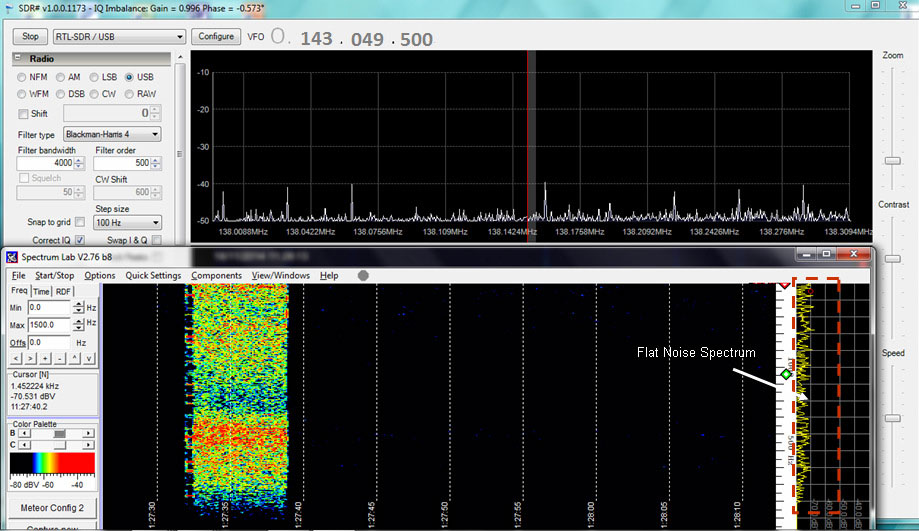
Combined SDR# and Spectrum Lab Display - Dr David Morgan 2W0CXV

Combined SDR# and Spectrum Lab Display – Dr David Morgan 2W0CXV

A new paper has been released by Dr David Morgan 2W0CXV on using the RTL2841 DVB TV Dongle as a SDR processor with SpectrumLab.

The paper Techniques for using the RTL Dongle for Detecting Meteors covers the setting up and use of the dongle to receive meteor pings from the Graves Radar on 143.050 MHz.

It can be downloaded from the Meteor Detection Projects page of the BAA-RAG website http://www.britastro.org/radio/projects/meteorproj.html

Join the BAA-RAG Yahoo Group at http://groups.yahoo.com/group/baa-rag

Download the free publication RAGazine from http://www.britastro.org/radio/downloads.html

Tweeting via the ISS

International Space Station - Image Credit NASA

International Space Station – Image Credit NASA

Harold Giddings KR0SIV describes how he Tweeted using amateur radio and the International Space Station.

He says: I sent a message to the International Space Station, it transmits it back down to groundstations in its view and those stations send the message to the APRS-IS network. My server then takes the message parses out useful data and posts it to Twitter as a tweet.

The ISS has two amateur radio stations. One is in the Russian Service Module and uses a Kenwood D710 and can do Slow Scan Television (SSTV) as well as FM voice. The other is in the Columbus Module and uses Ericsson handhelds for 145 and 435 MHz FM, the 2395 MHz HAM-TV system is also in this segment of the space station. In addition to voice contacts the 145 MHz Ericsson handheld is used to provide the APRS packet radio digipeater used by Harold.

Watch Twitter on the International Space Station

Ham Radio Tweets
http://hamradiotweets.com/
https://twitter.com/HamRadioTweets

How to hear the ISS https://amsat-uk.org/beginners/how-to-hear-the-iss/

How to work the ISS on APRS Packet Radio
https://amsat-uk.org/beginners/how-to-work-the-iss-on-aprs-packet-radio/

FUNcube-1 in full-time transponder mode

AO-73 (FUNcube-1) - Image credit Wouter Weggelaar PA3WEG

AO-73 (FUNcube-1) – Image credit Wouter Weggelaar PA3WEG

On December 23 FUNcube-1 / AO-73 was switched into full-time transponder mode with low-power beacon. It will remain in that mode for the next 5-7 days.

Enjoy the transponder.

With best wishes for the Festive Season, and for 2015

FUNcube Team

Russian ISS School Contacts

International Space Station - Image Credit NASA

International Space Station – Image Credit NASA

Both Dmitry Pashkov R4UAB and Michal Zawada SQ5KTM have released videos of ISS school contacts by cosmonaut Yelena Serov operating with the callsign RS0ISS which took place on Sunday, December 21, 2014.

Yelena Serova

Yelena Serova

The amateur radio station in the Russian Service Module was used and the Kenwood D710 operated on 145.800 MHz FM. The power setting used is not clear but may have been 25 watts. It is understood that ISS school contacts had been planned for Sunday with students at both Ekaterinburg and Chelyabinsk.

In his blog Dmitry Pashkov R4UAB said of the first Chelyabinsk contact: Radio session of the crew of the International Space Station with a children’s art school in Chelyabinsk. With great difficulty they contacted. Questions answered by Yelena Serov.

Watch the first Chelyabinsk contact ARISS RS0ISS г. Челябинск (R4UAB)

Watch the second Chelyabinsk contact – ARISS RS0ISS г. Челябинск (виток № 2) (R4UAB)

Michal Zawada SQ5KTM also received a signal from a school contact today and produced the following video.

Watch ISS / RS0ISS 21.12.2014 contact with Russian station R8AM(?)

Dmitry Pashkov R4UAB Blog http://tinyurl.com/R4UAB-Blog

ISS SSTV reception on a portable setup using RTL-SDR

Standing in a car park, I was able to successfully receive the images using a handheld 3 element 144 MHz Yagi antenna connected to a RTL-SDR USB dongle.

The dongle was connected to Windows-8 tablet using a USB OTG cable.
I was running SDR# to listen and record the FM audio on 145.800 MHz.
I had a LNA connected between the antenna and rtl-sdr but since the the downlink from the ISS was quite strong it was probably not required.

M0JJS

Watch ISS SSTV reception on a portable setup using RTL-SDR

ISS SSTV https://amsat-uk.org/2014/12/18/iss-sstv-success/