NoV suggestion for Airborne Ham Radio

Ofcom-logo-col-tThe RSGB response to the Ofcom licence consultation raises the suggestion of the use of NoV’s for aeronautical amateur radio operation.

The UK amateur radio licence currently prohibits airborne operation and amateurs have had to transmit using licence exempt spectrum instead.

The Society is critical of Ofcoms’ proposals regarding 470 kHz pointing out they do not align with the Wireless Telegraphy Act, nor are they the minimum necessary under the ITU Radio Regulations. The RSGB also say the 470 kHz proposals set a dangerous precedent in relation to interference.

Regarding the proposal to remove the 15 minute ID requirement and replace it with ‘as frequently as practicable’ the Society say it is open to too great a range of interpretation (and in some cases might be more burdensome than the well known 15-minute rule). The RSGB also suggests there is currently an ambiguity regarding embedding callsign data in modes such as Digital Voice.

In total over 2,000 people responded which is believed to be a record for an Ofcom consultation. It is thought Ofcom may take some time to publish all the responses but when they do they should be at
http://stakeholders.ofcom.org.uk/consultations/amateur-radio-licence/?showResponses=true

Read the full RSGB response, airborne is referenced in Question 9
http://rsgb.org/main/files/2014/09/141020_RSGB_LicenceReview-Response.pdf

RSGB – UK Amateur Licence Review http://rsgb.org/licencereview

Lunar Ham Radio Payload Launched

4M - Chang Zheng CZ-3C-G2 launch vehicle

4M – Chang Zheng CZ-3C-G2 launch vehicle

The 4M amateur radio payload with a WSJT JT65B 145.980 MHz beacon was launched on Thursday, October 23 at 1759 UT.

The Chang’e-5-T1 mission 4M payload launched on the Chang Zheng CZ-3C/G2 rocket from the LC2 launch complex at the Xichang Satellite Launch Center, Sichuan. The first telemetry from the JT65B beacon was received at 1918 UT by Roland Zurmely PY4ZBZ in Brazil.

A number of Australian radio amateurs have reported receiving the signals from 4M. Among them was Rob Whitmore VK3MQ at Mount Dandenong, Victoria (QF22qe) who reports that at best, the strength was -13 on the JT65B scale and could also be totally down into the noise with no decodes.

4M reception by Berend PA3ARK signal level -8 dB

4M reception by Berend PA3ARK signal level -8 dB

Rob VK3MQ says “I am using the “Before” TLE as published on the Luxspace website with Gpredict to stear my 6 element yagi and TS2000. With Doppler the frequency is 145.9787 MHz at the time of writing. So far the decodes have included callsign, telemetry and a story of Manfred Fuchs threading through alternate decodes.”

Sam Jewell G4DDK @DXING Tweeted “Had around 40 minutes of near 100% copy from the moon probe 4M transmitter from around 1725z [Oct 24]. 9 element Yagi and K3/2m on 2m /JT65B”

The spacecraft will head into a Lunar Transfer Orbit (LTO), before performing a flyby around the Moon. Radio amateurs are encouraged to receive and report the signals. http://moon.luxspace.lu/receiving-4m/

For tracking information just enter your latitude and longitude at http://moon.luxspace.lu/tracking/

See the 4M payload Blog at http://moon.luxspace.lu/blog/

4M Lunar Payload https://amsat-uk.org/2014/10/15/4m-lunar-payload-integrated-keps-released/

AMSAT-UK
Facebook https://www.facebook.com/amsatuk
Twitter https://twitter.com/AMSATUK

UK Students CubeSat Project

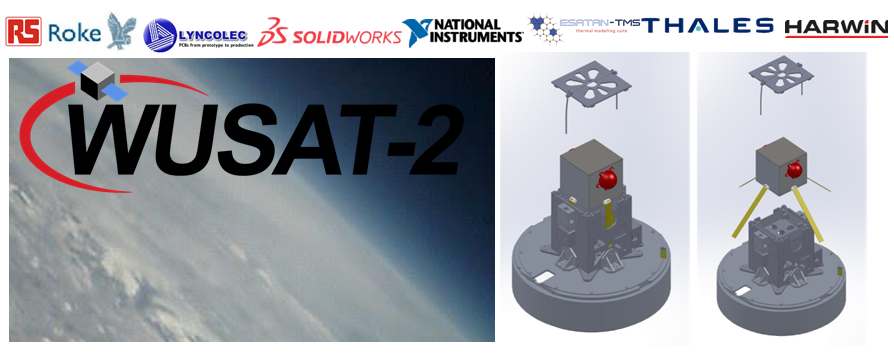
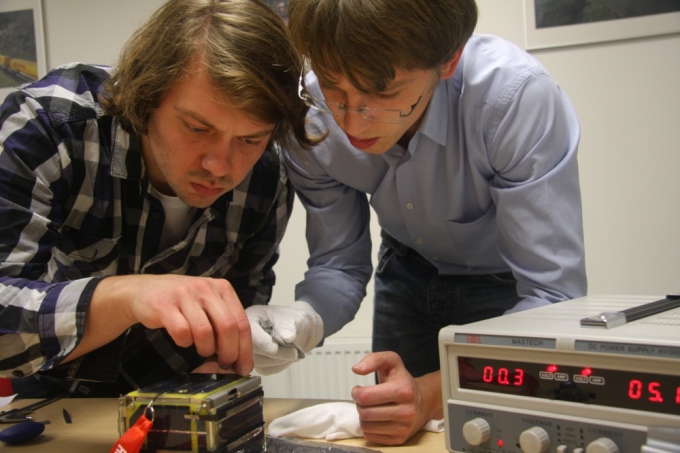
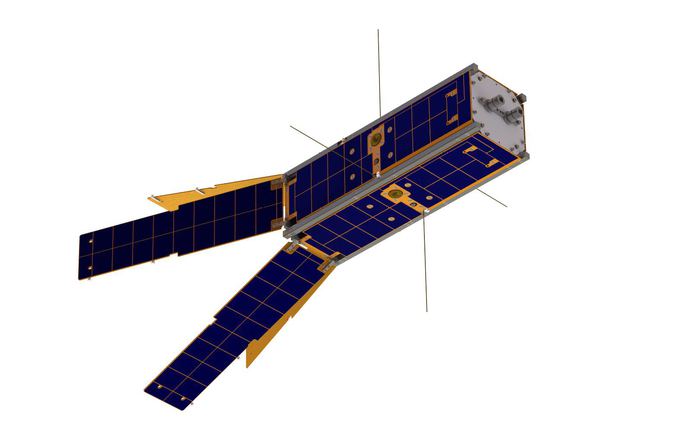
Warwick University WUSAT-2 CubeSat

Warwick University WUSAT-2 CubeSat

The Coventry Telegraph newspaper reports on students at Warwick University who are building their own satellite WUSAT-2.

Lucy Lynch writes that eight engineering students are designing their own satellite which will be sent into space. In February or March 2015 they and the project director Dr Bill Crofts will don winter woollies and take their creation to a launch site in northern Sweden, near the town of Kiruna.

It is the second student satellite designed at the university. The first one, last year, was sent up from mid Wales in a high altitude weather balloon.

Once the current satellite has been launched the next step is to create a satellite capable of orbiting the Earth.

Dr Crofts said: “This is a stepping stone to a full orbital launch.”

Read the full article at
http://www.coventrytelegraph.net/news/coventry-news/meet-warwick-uni-students-who-7971498

Twitter @WUSAT_Team
Facebook https://www.facebook.com/WarwickUniversitySatellite

UK Students Fly CubeSat to 30km https://amsat-uk.org/2013/04/10/uk-students-fly-cubesat-to-30km/

WUSAT Team

WUSAT Team

LituanicaSAT-2 Announced

LituanicaSAT-1 with Vytenis Buzas LY1ZY and Laurynas Maciulis LY1LM - Credit 15min.lt

LituanicaSAT-1 with Vytenis Buzas LY1ZY and Laurynas Maciulis LY1LM – Credit 15min.lt

The LituanicaSAT team has announced on Facebook that the LituanicaSAT-2 CubeSat will be coming soon.

It is hoped the CubeSat will be among 50 satellites launched in the 1st quarter of 2016 on the Ukrainian Cyclone 4 launcher from the Alcantara launch site built by Ukraine and Brazil. The new launch site is located near the Atlantic coast of Brazil just 2.3 degrees south of the equator.

LituanicaSAT-2 will be more complex than the first and will test a new propulsion system which will enable it to change orbit.

LituanicaSAT-2 - Credit 15min.lt

LituanicaSAT-2 – Credit 15min.lt

Currently CubeSats deployed in very low Earth orbit may only last 3 months before burning up in  the Earth’s atmosphere, the propulsion system could extend that up to 18 months.

Read the 15min.lt article about LituanicaSAT-2 in Google English at http://tinyurl.com/LituanicaSAT-2-15min

Facebook https://www.facebook.com/Lituanicasat1

You can watch a presentation by Gintautas Sulskus on the first LituanicaSAT CubeSat at
https://amsat-uk.org/colloquium/colloquium-2014/presentation-videos/

President tests LituanicaSAT-1 FM transponder
https://amsat-uk.org/2014/03/26/president-tests-lituanicasat-1-fm-transponder/

LituanicaSAT-1 https://amsat-uk.org/2014/02/27/lituanicasat-1-cubesat/

QB50 to use Alcantara launch site https://amsat-uk.org/2014/01/28/qb50-cubesat-launch-contract-signed/

GB1SS callsign for International Space Station

Sarah Brightman

Sarah Brightman

The RSGB report that on October 9, 2014 Ofcom confirmed that the callsign GB1SS will be made available for issue to UK astronauts who wish to operate from the ISS.

In May 1991 the first UK astronaut Helen Sharman GB1MIR talked to radio amateurs around the world from the Mir space station. After a gap of 24 years it looks as though two more UK astronauts may be flying to the International Space Station (ISS) in 2015.

One of the UK radio amateurs that Helen contacted all those years ago was Chris Lorek G4HCL he says: I remember it fondly! I and my three children all chatted with her on 2m using my club station call G4SMC (South Midlands Communications in Chandler’s Ford) on her next-but-last Mir pass over the UK before she came down. Steven (10 years old), David (8 years old) and Carolyn (5 years old) all said hello to her, each giving their name and age, with Steven asking whether there was a particular challenge she may have had. Helen replied, knowing it was very young children, that one difficult challenge she’d had was putting her socks on as she floated around the station!

In September 2015 Sarah Brightman hopes to become the 2nd UK astronaut, flying to the ISS on a 10 day mission. She is committed to encouraging young women to pursue careers in Science, Technology, Engineering, and Mathematics (STEM). In 2012 in conjunction with Virgin Galactic, she launched The Brightman STEM Scholarship program. It is not yet clear if she will operate the ISS amateur radio station during her mission.
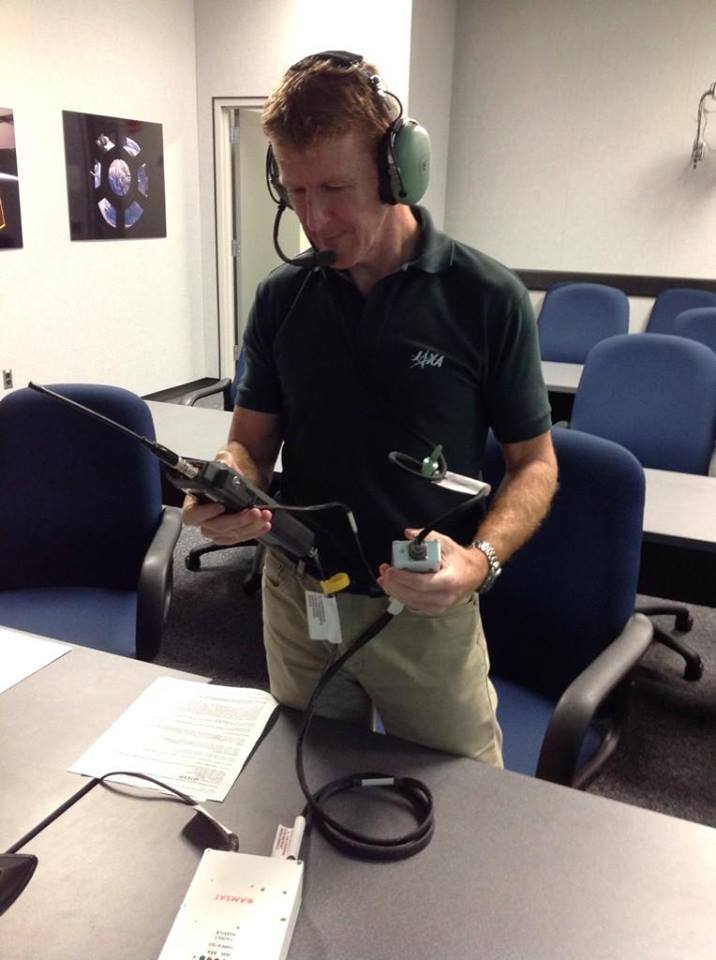
Tim Peake KG5BVI training on ISS Amateur Radio Station Equipment

Tim Peake KG5BVI training on ISS Amateur Radio Station Equipment

Tim Peake was selected to train as an astronaut in 2009 and hopes to go to the ISS in November 2015. He holds the USA callsign KG5BVI and has recently been learning to use the Ericsson 144 MHz handheld radio which is installed in the Columbus module of the ISS. On September 18 Tim said “Will be great to chat with schools next year from space using this ham radio on board the ISS.”

There are two amateur radio stations on the ISS, one in the Russian Service Module, the other in the ESA Columbus Module. Almost any 144 MHz FM rig will receive signals from the ISS, you can even use a general coverage VHF scanner with an external antenna. As far as the antenna is concerned the simpler the better. A ¼ wave ground plane is a good antenna for the ISS as it has a high angle of radiation. Large 2m colinears may not work quite as well since the radiation pattern is concentrated at the horizon.

You can receive the ISS outdoors using a 2 metre hand-held with its helical antenna but a 1/4 wave whip will give far better results.

In the UK we use narrow 2.5 kHz deviation FM but the ISS transmits using the wider 5 kHz deviation used in much of the world. Most rigs can be switched been wide and narrow deviation filters so select the wider deviation. Hand-held rigs all seem to have a single wide filter fitted as standard.

Voice contacts with astronauts usually take place using “split” frequencies. The astronauts transmit on 145.800 MHz and listen for replies on 145.200 MHz, you just need to activate your rig’s repeater shift. Recently, however, they have also been operating simplex listening on 145.800 MHz.

When astronauts are not on the air they usually leave the packet digi-peater running on 145.825 MHz so why not listen out for it.

ISS status and tracking information http://issfanclub.com/

The First UK Astronaut Helen Sharman GB1MIR
https://amsat-uk.org/about/history/first-uk-astronaut-helen-sharman-gb1mir/

Sarah Brightman to fly to ISS
https://amsat-uk.org/2014/09/04/sarah-brightman-to-start-space-flight-training-in-january/

Read the report of the Ofcom-RSGB meeting on October 9
http://rsgb.org/main/blog/news/rsgb-notices/ofcom-rsgb-forum/2014/10/22/ofcom-rsgb-forum-9-october-2014/
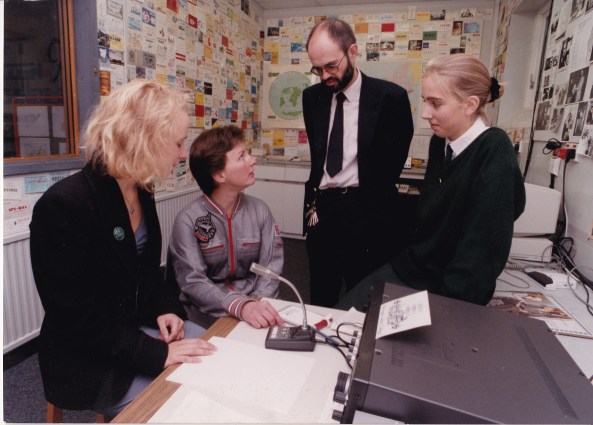
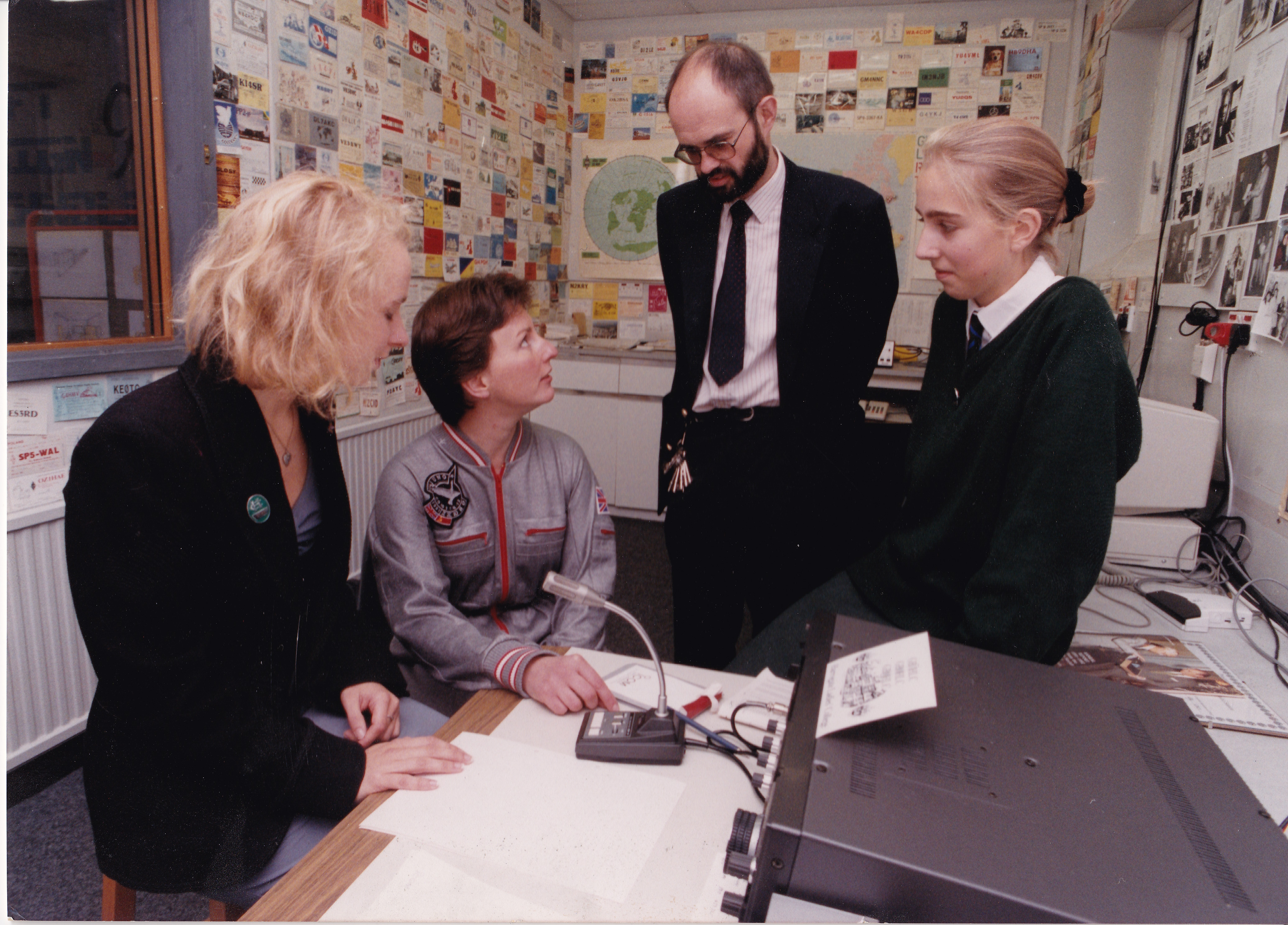
After her return to Earth the first UK astronaut Helen Sharman visited the Harrogate Ladies' College club station G0HCA From left to right are Anna-Karin G7IRR, Helen Sharman GB1MIR, Richard Horton G3XWH and Katy G7NST

After her return to Earth the first UK astronaut Helen Sharman visited the Harrogate Ladies’ College club station G0HCA
Left to right are Anna-Karin G7IRR, Helen Sharman GB1MIR, Richard Horton G3XWH and Katy G7NST
UK NoV’s for 146 MHz now available

Ofcom-logo-col-tUK Full licence holders can now apply for their NoV to use 146 MHz.

You just need to fill in your details on the RSGB NoV page and you will be instantly emailed a link to the PDF of your NoV certificate. The NoV’s currently being issued have an expiry date of October 31, 2015.

Apply now for your NoV at http://rsgb.org/main/operating/licensing-novs-visitors/online-nov-application/146mhz-147mhz-nov/

The application asks you for your Licence Number which appears on page 1 of your licence. If you don’t have it simply login to the Ofcom licencing page and download a new licence PDF at https://services.ofcom.org.uk/

UK radio hams start 146 MHz development
http://www.southgatearc.org/news/2014/october/uk_radio_hams_start_146_mhz_development.htm

New UK Amateur Radio 146 MHz allocation
https://amsat-uk.org/2014/10/13/new-uk-amateur-radio-146-mhz-allocation/