Online Amateur Radio Satellite Predictor


AMSAT-LU Satellite Predictions

Pedro Converso LU7ABF reports that AMSAT-LU have developed an online satellite prediction page which quickly provides on a single screen most data required for the amateur radio satellites and includes active maps and graphics.

The predictor allows selection of your location and satellite and shows current and future satellite passes.

The online satellite predictor is at http://amsat.org.ar/sat.htm

ISEE-3 Presentation Video Now Available

ISEE-3 - ICE Spacecraft - Image credit NASA

ISEE-3 – ICE Spacecraft – Image credit NASA

Mario Lorenz DL5MLO and Achim Vollhardt DH2VA from AMSAT-DL Bochum gave a presentation on the ISEE-3 (ICE) spacecraft to the AMSAT-UK International Space Colloquium in Guildford, on July 26, 2014.

The video of the presentation which included a live demonstration of telemetry reception from the spacecraft can now be viewed on the web or downloaded to your PC. The presentation slides and a recording of ISEE-3 telemetry are also available.

The International Sun-Earth Explorer (ISEE-3) is a NASA spacecraft that was launched in 1978 to study Earth’s magnetosphere. It was repurposed and renamed the International Cometary Explorer (ICE) in 1983 to study two comets and has been in a heliocentric orbit since then, traveling just slightly faster than Earth. It’s finally catching up with Earth from behind with the closest approach expected in August, 2014.

Since NASA no longer has the capability to receive and command the spacecraft a group of amateurs, with NASA’s permission, decided to do it for themselves.

Bochum Amateur Radio Facility

Amateur Radio Facility at Bochum

On March 1-2, 2014 radio amateurs at the Bochum Amateur Radio Facility in Germany were able to detect the beacon signal from the spacecraft over a distance of 43 million km. After some changes to the ground equipment and aligning the receive antenna to the predicted position in the sky, the 2 GHz beacon signal could positively be identified due to its frequency, the position in the sky and the frequency shift due to the radial velocity (Doppler shift).

The 20m dish at Bochum was used to receive the signals. In 2003, AMSAT-DL converted this former industrial monument into a fully functional groundstation for deep space probes. Since 2009 the facility is being used by volunteers almost full time as ground receive station for data from the STEREO mission with its two spaceprobes monitoring the sun from different viewing angles.

In June Dennis Wingo KD4ETA and other volunteers succeeded in commanding the spacecraft using the Arecibo dish in Puerto Rico.

Links to the ISEE-3 presentation video, slides and a recording of the ISEE-3 telemetry signal are at
https://amsat-uk.org/colloquium/colloquium-2014/presentation-videos/

Watch 2014 ISEE-3 Reboot Trajectory by Mike Loucks


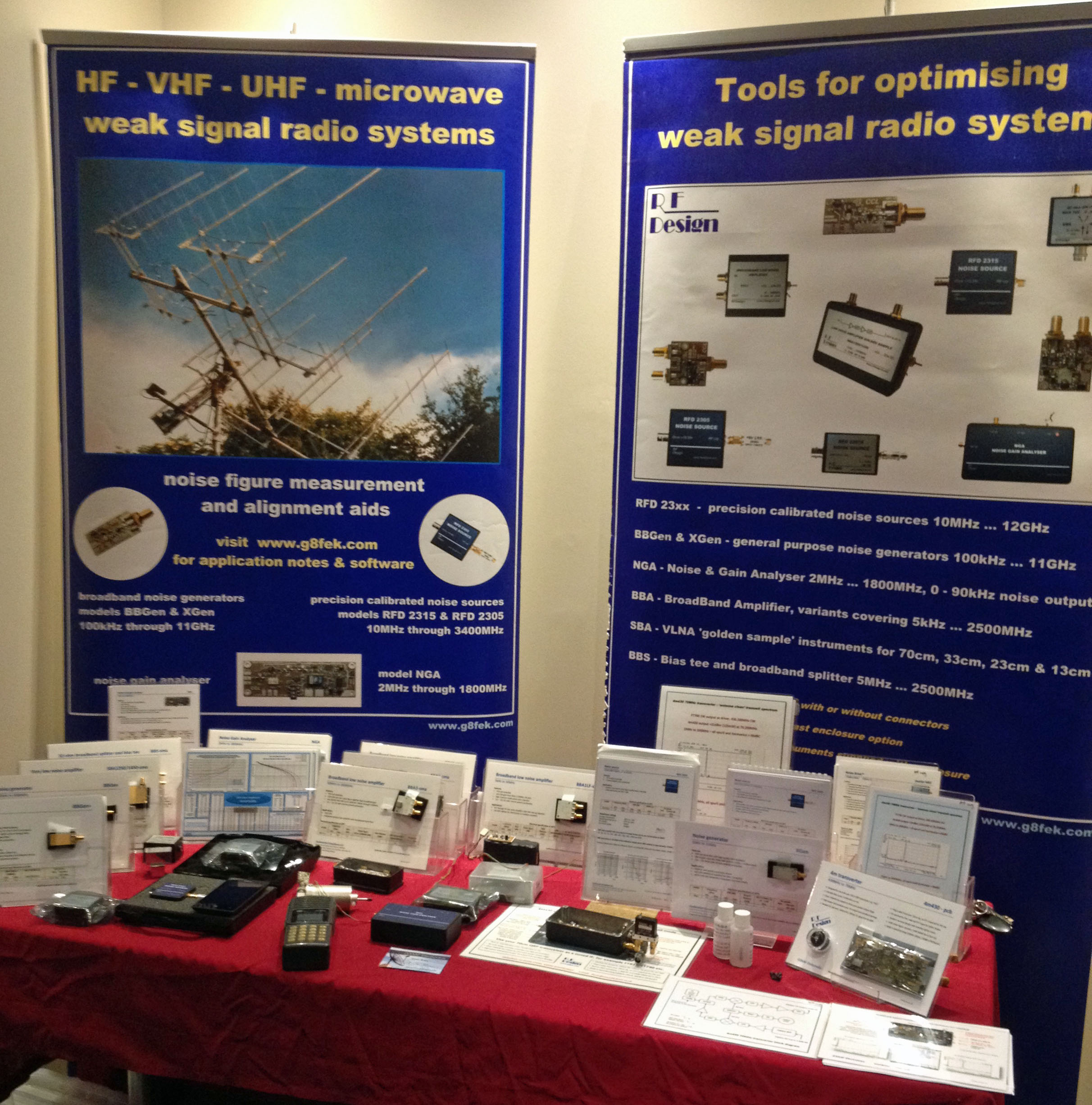
RF Design Stand at AMSAT-UK Colloquium

A delegate from the University of Surrey at the AMSAT-UK International Space Colloquium, Guildford

A delegate from the University of Surrey at the AMSAT-UK International Space Colloquium, Guildford

The RF Design stand of Kevin Avery G3AAF is a regular feature of the annual AMSAT-UK International Space Colloquium in Guildford and we were glad to see him again this year.

RF Design StandAs usual the stand was packed full of precision calibrated noise sources, low noise ampifiers, noise gain analysers and other equipment for frequencies up to 11 GHz.

The company also specialises in
● High power RF generation, e.g. CO2 laser plasma power supplies
● Solid state RF power amplifiers to 10kW from LF through UHF
● Short range wireless devices, e.g. Social Alarms

RF Design Amateur Radio and Radio Astronomy products http://www.g8fek.com/

RF Design http://www.rfdesignuk.com/

Videos of the presentations given at the AMSAT-UK International Space Colloquium can be seen at
https://amsat-uk.org/colloquium/colloquium-2014/presentation-videos/

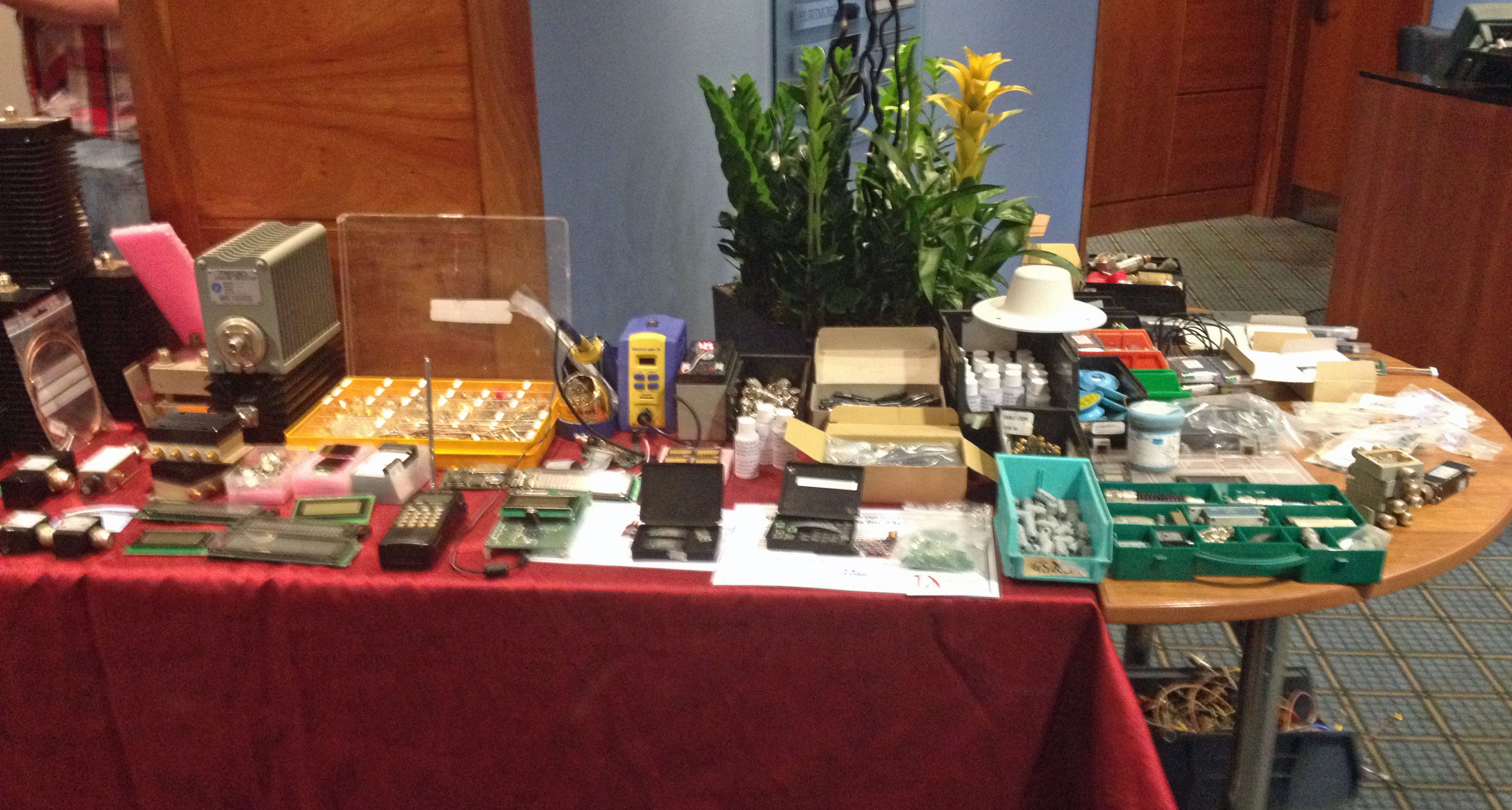
RF Design Table

G3YJO becomes Chair of Surrey Space Centre

Professor Sir Martin Sweeting G3YJO

Professor Sir Martin Sweeting G3YJO

Professor Sir Martin Sweeting G3YJO is to take up the position of Chair of Surrey Space centre (SSC), Professor Guglielmo Aglietti takes on the role of Director of the Centre.

“SSC has been steadily expanding its staff and activities and my new role as Chair will enable me better to help with the strategic research planning and external relations, as well as mentoring our staff and students – all of which is needed to take the Centre to even greater heights,” said Professor Sir Martin. “SSC grew from the original ‘UoSAT Unit’, a small research group I formed some 35 years ago as a PhD student. Its subsequent growth and international reputation established by the hard work of our excellent staff and students during these decades, alongside the remarkable success of Surrey Satellite Technology Ltd (SSTL), has been a source of great satisfaction to me and benefit to the University.”

“I am truly honoured to have been given the opportunity to lead the Surrey Space Centre, and I would like to thank Professor Sir Martin Sweeting and Professor Jonathan Seville for their trust in my capabilities, and all the colleagues in the Centre for their support,” added Professor Aglietti. “I believe that SSC staff is our greatest asset and I am very fortunate to work with such talented colleagues, who made the success of SSC, creating the largest and best known UK academic institution working in space engineering.  I believe that our partnership with SSTL and Airbus is best positioned to bridge the gap between academic research and industrial applications.  I am excited about working with my colleagues in my new position to ensure SSC’s continuous success.”

Professor Jonathan Seville, Dean of Surrey’s Faculty of Engineering and Physical Sciences, concluded, “I would like to take this opportunity to thank Martin for his many years of dedicated service as Director. SSC has shown substantial growth over the years with many notable successes under his leadership. Space continues to be a ‘flagship’ activity for the University. I look forward to working with Guglielmo in his new role and hearing of the continuing achievements of the Centre.”

Surrey Space Centre http://www.surrey.ac.uk/ssc/

UOSAT-1 https://amsat-uk.org/2011/10/12/30th-anniversary-of-uosat-1-oscar-9/

UOSAT-2 https://amsat-uk.org/2014/03/05/oscar-11-uosat-2-celebrates-30-years-in-orbit/

434 MHz Balloon B-64 Completes Epic Journey

B-64 Flight Path July 12 to July 31 2014

B-64 Flight Path July 12 to July 31, 2014

At about 16:30 GMT on Friday, July 31, the solar powered B-64 balloon launched by radio amateur Leo Bodnar M0XER crossed the 1 degree West longitude line completing its circumnavigation of the northern hemisphere in just over 19 days.

Oliver M6ODP receiving B-64 at St Michael's Mount

Oliver M6ODP receiving B-64 at St Michael’s Mount

The balloon, flying at an altitude of 12 km, completed its transatlantic crossing and came within range of Cornwall in the morning. Oliver De Peyer M6ODP happened to be visiting St Michael’s Mount in Cornwall at the time. He used his Kenwood TH-F7E handheld to receive an APRS packet from the balloon.

As the day progressed B-64 moved from just south of Cornwall up the English Channel and radio amateurs and listeners from Manchester to Nantes in France were able to receive the 10 mW Contestia 64/1000 and APRS signal on 434.500 MHz.

B-64 passed over the Isle of Wight and floated over Bognor Regis and across Kent heading out into the North Sea near Herne Bay. As of mid-day Saturday it was still flying and transmitting over Sweden and being tracked by members of AMSAT-SM.

B-64 APRS packet received by Oliver M6ODP

B-64 APRS packet received by Oliver M6ODP

Leo Bodnar M0XER launched his balloon carrying an 11 gram transmitter payload from Silverstone in the UK at 06:51 GMT on July 12, 2014. While Leo’s earlier balloons had been foil type party balloons B-64 was a  plastic foil envelope that he made himself.

Using the amateur radio APRS network and the UKHAS network the location of B-64 was tracked as it traveled over Europe, Siberia, with a brief sojourn across North Korea, before heading out over Japan and across the Pacific Ocean. It then briefly entered the United States before swinging north into Canada.

It was heard in Greenland by Peter Thulesen OX3XR and on Friday morning finally came within range of the British Isles.

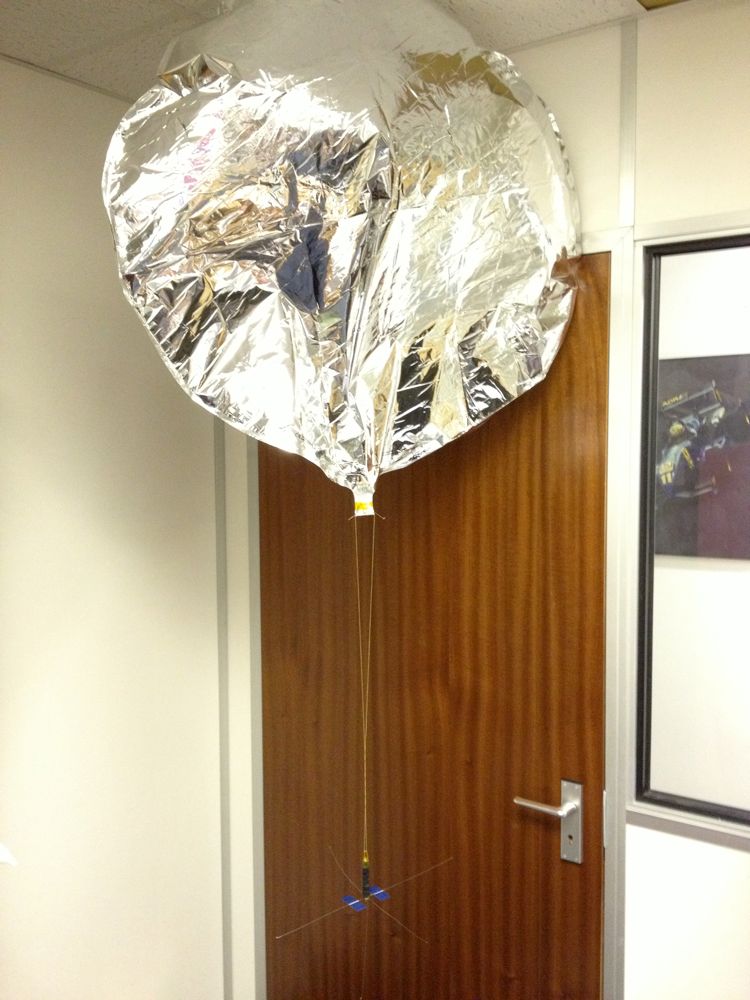
B-64 plastic foil envelope - Image credit Leo Bodnar M0XER

B-64 plastic foil envelope – Image credit Leo Bodnar M0XER

Leo has utilised some clever techniques storing positions when the balloon is out of radio contact then later transmitting a log file of previous locations in the comments field of the APRS packet. This enables a fairly complete path to be built up. B-64 only stores 5 days worth of data, where you get a straight line on the track it has been out of radio contact.

See the track of B-64 at http://spacenear.us/tracker/?filter=B-64 or at http://habitat.habhub.org/mobile-tracker/

Leo Bodnar M0XER balloons http://www.leobodnar.com/balloons/

Members of the Chelmsford Amateur Radio Society received the signal from B-64. Just 4 weeks earlier, thanks to Chris Stubbs M6EDF, the Society had launched a balloon CARS-1 from their meeting venue. That balloon didn’t have solar power so the signal only lasted for about 10 hours. CARS training organiser Clive G1EUC reported receiving a strong signal from B-64.

B-64 transmitter payload weighs just 11 grams

B-64 transmitter payload weighs just 11 grams

Clive is currently taking names for the next amateur radio Foundation course which starts on Thursday, September 4. If you’d like to join the course or wish to find out more about the hobby give him a ring on:
Tel: 01245-224577
Mob: 07860-418835
Email: training2014 at g0mwt.org.uk
Web: http://www.g0mwt.org.uk/training/

What is Amateur Radio ?
http://www.essexham.co.uk/what-is-amateur-radio

The UK High Altitude Society (UKHAS) Conference takes place Saturday, August 16, 2014 at the University of Greenwich in London
http://ukhas.org.uk/general:ukhasconference2014

Further 434 MHz balloon links at
https://amsat-uk.org/2014/07/30/434-mhz-balloon-goes-around-the-world/

Typical 434 MHz solar powered payload - Image credit Leo Bodnar M0XER

Typical 434 MHz solar powered payload – Image credit Leo Bodnar M0XER


434 MHz balloon goes around the world

Flight path of the B-64 balloon launched by Leo Bodnar M0XER

Flight path of the B-64 balloon launched by Leo Bodnar M0XER

The 434 MHz solar powered balloon B-64, launched by radio amateur Leo Bodnar M0XER, is approaching the UK at the end of a record breaking journey around the world.

Party balloon with tiny solar powered 434 MHz transmitter - Image credit Leo Bodnar M0XER

Party balloon with tiny solar powered 434 MHz transmitter – Image credit Leo Bodnar M0XER

Leo launched his balloon from Silverstone in the UK on July 12, 2014. It traveled east across Asia, the Pacific and the Americas and is expected to complete the final transatlantic crossing arriving over Cornwall on July 31 or August 1. It is then likely to continue eastwards into Europe.

Radio amateurs and listeners should be able to receive B-64’s Contestia 64/1000 signal on 434.500 MHz USB with the usual pips. When it is over the UK it will alternate the Contestia tranmission with APRS also on 434.500 MHz running 10 mW output.

During the circumnavigation of the northern hemisphere B-64 has traveled over 25,000 km across some of the most remote terrain in the planet.

See the track of B-64 at http://spacenear.us/tracker/?filter=B-64

Typical 434 MHz solar powered payload - Image credit Leo Bodnar M0XER

Typical 434 MHz solar powered payload – Image credit Leo Bodnar M0XER

Leo Bodnar M0XER balloons http://www.leobodnar.com/balloons/

Download the dl-fldigi software from http://ukhas.org.uk/projects:dl-fldigi

Beginners Guide to Tracking using dl-fldigi http://ukhas.org.uk/guides:tracking_guide

Listen to balloons online (when in range of south-east UK) from anywhere in the world with the SUWS 434 MHz WebSDR (select USB)
https://amsat-uk.org/2013/12/28/websdr-for-434-and-1296-mhz/

For High Altitude Balloon chat check the #highaltitude IRC channel. A web client is available at
http://webchat.freenode.net/?channels=highaltitude

To get up-to-date information on balloon flights subscribe to the UKHAS Mailing List by sending a blank email to this address: ukhas+subscribe@googlegroups.com