SimpleSat Look Down satellite tracking software now available

SimpleSat Look Down is a free easy to use software app for satellite tracking.

Written by Tom Doyle W9KE it includes a satellite look down window that displays the view from the satellite looking down at the earth as it moves along.

It uses .NET 4 and runs on Windows 8, Windows 7, Vista and XP.

Tom has released this collection of videos that explain how SimpleSat Look Down works:

Watch SimpleSat Look Down – best viewed full screen HD

Watch SimpleSat Look Down – Setup  – Best Viewed Full Screen HD

Watch SimpleSat Look Down – General Operation – Best Viewed Full Screen HD

Watch SimpleSat Look Down – Rotor Setup – best viewed full screen in HD

You can download SimpleSat Look Down from
http://www.tomdoyle.org/SimpleSatLookDown/SimpleSatLookDown.html

F-1 CubeSat is scheduled for launch in July, 2012

Latest update on F-1 CubeSat project:

At the moment, the flight safety review is coming to an end. The FSpace team together with their partner NanoRacks LLC has satisfied the technical requirements and standards set by the launch vehicle provider.

If everything goes according to plan, the F-1 CubeSat will be delivered to Japan by the end of June. Then along with four other CubeSats (RAIKO, WE-WISH, FITSAT-1 and TechEdSatF-1 will be loaded onboard HTV-3 “Kounotori” transfer vehicle for integration with the JAXA HII-B launch vehicle.

F-1 plans to launch to the International Space Station (ISS) on July 21 from Tanegashima, Japan, then in September the Japanese astronaut and radio amateur Akihiko Hoshide KE5DNI should deploy it into space from the ISS using the Kibo robot arm.

It carries two Yaesu VX-3R transceivers using 145.980 and 437.485 MHz.

The FSpace team are offering the public a chance to send their name/callsign and a message into space onboard the F-1 CubeSat. You will also be presented with a certificate! See this link http://fspace.edu.vn/?page_id=31

JAXA http://iss.jaxa.jp/kibo/about/jssod/ Google English http://tinyurl.com/7x79o6p

FSpace http://fspace.edu.vn/

Vietnam Student CubeSat F-1 http://www.uk.amsat.org/5025

Video of HTV-3 “Kounotori” and CubeSat Deployer http://www.uk.amsat.org/8078

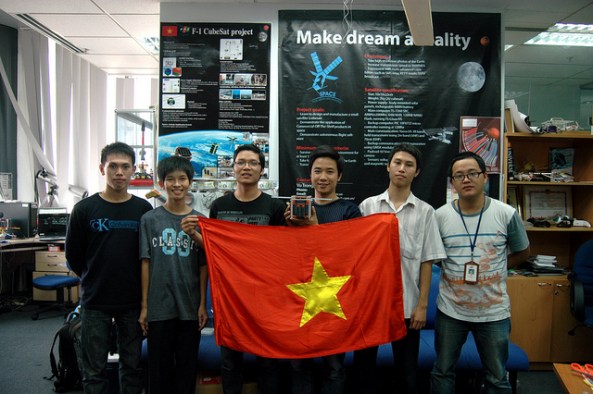
F-1 CubeSat Students

Jay Leno – SAREX – Shuttle Amateur Radio Experiment 1992

In 1992 Southern California Amateur Radio operators uplinked a video of  stand-up comedian Jay Leno, host of NBC’s The Tonight Show, to the Space Shuttle Columbia through Jim Steffen, KC6A’s station in Long Beach, California.

Watch Jay Leno – SAREX Shuttle Amateur Radio Experiment 1992

Past SAREX Missions
http://www.arrl.org/files/file/ARISS/ARRLWeb_%2520Past%2520SAREX%2520Missions.pdf

Radio Amateur VK5ZAI on TV Show

Tony Hutchison VK5ZAI

Tony Hutchison VK5ZAI

This video shows Tony Hutchison VK5ZAI on the Channel 7 Today Tonight TV show talking about amateur radio and the ARISS schools program.

Tony Hutchison, VK5ZAI's ARISS Satellite Ground Station in Kingston SE. South Australia

The show provides some great insights as to how Amateur Radio can provide support for NASA as well as raise public awareness through the ARISS schools program.

Tony VK5ZAI has provided many Telebridge links for the International Space Station (ISS) to schools around the world. An ISS Telebridge contact is where a dedicated ARISS amateur radio ground station, located somewhere in the world, establishes the radio link with the ISS. Voice communications between the students and the astronauts are then patched over regular telephone lines.

Watch ARISS Tony VK5ZAI on Today Tonight

ARISS co-ordinator VK5ZAI receives NASA award http://www.southgatearc.org/news/march2008/vk5zai.htm

ARISS and Ham Radio Opportunities video http://www.uk.amsat.org/8099

Amateur Radio on the International Space Station ARISS http://ariss.rac.ca/

Auburn Students Successfully Command AubieSat-1

Reception of AubieSat-1 at K5QXJ

John Klingelhoeffer, WB4LNM, AubieSat-1 Technical Mentor at Auburn University Alabama reports that the satellite has been successfully commanded to change the transmission mode.

John says “A short message was received Saturday evening indicating that uplink commands sent to AubieSat-1 were properly received, decoded, and initiated additional telemetry downlink data.  AS-1 has been in orbit for about 9 months.  Stations are asked to continue to monitor the downlink and pass any received telemetry to the group here for dissemination.”

Watch Reception of AubieSat-1 at K5QXJ

AubieSat-1 was launched from Vandenberg AFB, California in October,  2011. The CubeSat is an undergraduate built satellite developed by Auburn University. Over the weekend of June 9-11 the AubieSat-1 controllers changed the transmission mode of the satellite to increase the quantity of telemetry. The increased telemetry rate will provide data to indicate how well solar cell protection is working. It should also provide additional onboard housekeeping information.

AubieSat-1 transmits with a power of about 800 milliwatts on a frequency of 437.475 MHz. The beacon signal, along with telemetry, is sent using A1A continuous wave Morse code at 20 words per minute.  Additional telemetry from the onboard science experiment will use CW transmissions up to 60 WPM.

Auburn University video about the AubieSat-1 project http://www.uk.amsat.org/2256

Auburn University AubieSat-1 http://space.auburn.edu/

Source ANS and AMSAT-BB

Status of ISS Ham Radio Operations

ISS Amateur Radio Project Engineer Kenneth Ransom, N5VHO reports the ARISS AX.25 digipeater has changed frequency from 145.825 MHz (up/down) to 437.550 MHz (up/down). The same digi alias ARISS is still used.

This change was started with the docking of the ESA Automated Transfer Vehicle (ATV). The ATV is an expendable, unmanned resupply spacecraft delivering propellant, water, air, payloads and experimental supplies to the International Space Station (ISS).

International Space Station

International Space Station

Packet radio operations were moved to the Columbus Module UHF radio when the Kenwood D700 radio was recently powered off due to needing an  additional air purifier to support the ATV. Normally the air purifier is located in the ATV but recent power support issues related to the ATV and ISS necessitated the system be relocated to the Service Module.

The purifier is now using the power outlet that the Kenwood radio normally uses. The Russian team has agreed to briefly power the purifier off for the scheduled ARISS school events but then will re-activate the purifier right afterwards. This appears to be a long term impact as ATV is currently scheduled to depart from ISS in September.

ARISS and Ham Radio Opportunities Video http://www.uk.amsat.org/8099

Amateur Radio on the International Space Station ARISS http://ariss.rac.ca/