India launches ham radio satellites

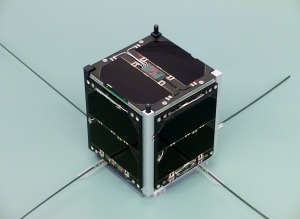
Swayam-1 CubeSat Flight Model - Credit COEP

Swayam-1 CubeSat Flight Model – Credit COEP

On June 22, 2016 the Indian Space Agency ISRO successfully launched several satellites carrying amateur radio payloads.

The CSAT Swayam satellite was one of those launched. The 1U CubeSat carries a digital store and forward messaging system for use by the amateur radio community.

Rupesh Lad VU2LRD / VU2COE from the College of Engineering Pune CSAT Team says:

“We are eagerly waiting for your reception report of CW Morse Beacon at 437.025 MHz. You can also get the decoded Beacon Data by entering beacon in Swayam Beacon Decoder available on our website.”

The post launch TLEs for tracking the satellite are at http://www.coep.org.in/csat

Download the COEP Swayam Leaflet PDF

Frequencies of other satellites on the launch
https://amsat-uk.org/2016/05/25/amateur-satellite-launch-from-india/

Spaceflight Now story https://www.nasaspaceflight.com/2016/06/pslv-xl-launch-20-satellites/

Amateur Satellites at Skills Night

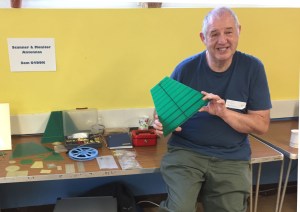
Steve Hedgecock M0SHQ with Elk 145/435 MHz Log Periodic Antenna

Steve Hedgecock M0SHQ with Elk 145/435 MHz Log Periodic Antenna

Steve Hedgecock M0SHQ explained how to operate via the amateur radio satellites at Skills Night hosted by the Chelmsford Amateur Radio Society on Monday, June 20, 2016.

He showed how to use the Elk dual-band 145/435 MHz Log Periodic Antenna to track the satellites and make contacts over thousands of kilometres using just 5 watts from a handheld transceiver.

Steve described how he recently managed to use the AO-85 satellite to contact the Isle of Arran DXpedition station GS3PYE using 5 watts and just the handheld’s quarter wave whip antenna. It should be noted though that a small handheld Yagi is recommended for AO-85.

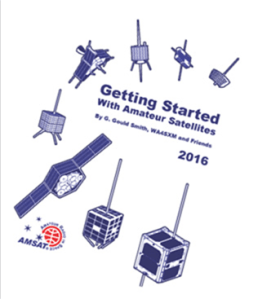
As part of his display Steve had the popular book Getting Started with Amateur Satellites which is an excellent introduction for newcomers.

Sam Jewell G4DDK with one of his popular Microwave antennas

Sam Jewell G4DDK with one of his popular Microwave antennas

Also attending the Skills Night was long-time supporter of AMSAT-UK Sam Jewell G4DDK. He brought along his stall of UHF/Microwave antennas, pre-amps and other useful accessories.

Dave Powis G4HUP had his extensive selection of his kits, plus tools for working with SMD (Surface Mount Devices). During the evening he provided advice to attendees on a range of RF and construction related topics.

Both Dave and Sam have been regular attendees at the AMSAT-UK International Space Colloquium in Guildford which this year takes place July 30-31, further information at https://amsat-uk.org/colloquium/

hupRF kits http://www.huprf.com/

G4DDK kits and accessories http://www.g4ddk.com/

Further information on the monthly Skills Night meetings can be found at http://g0mwt.org.uk/skills

Dave Powis G4HUP with his RF kits

Dave Powis G4HUP with his RF kits

Colloquium – Final Call for Speakers

FUNcube-1 flight model - Image credit Wouter Weggelaar PA3WEG

AO-73 (FUNcube-1) – Image credit Wouter Weggelaar PA3WEG

This is the final call for speakers for the AMSAT-UK International Space Colloquium 2016 which will be held from Saturday, July 30 to Sunday, July 31, 2016 at the Holiday Inn, Guildford, GU2 7XZ, United Kingdom.

AMSAT-UK invites speakers, to cover topics about Amateur satellites, CubeSats, Nanosats, space and associated activities, for this event.

They are also invited to submit papers for subsequent publishing on the AMSAT-UK web site or Oscar News.

Those wishing to participate should contact Dave, G4DPZ, dave at g4dpz dot me dot uk

Further information https://amsat-uk.org/colloquium/

73 Dave G4DPZ

K1D to Operate Satellites on Field Day

Drew Glasbrenner M-KO4MA AUK Colloquium 2015

Drew Glasbrenner M/KO4MA working FO-29 at the AMSAT-UK Colloquium 2015

Field Day is always the fourth full weekend of June, beginning at 1800 UT Saturday and running through 2059 UTC Sunday. Field Day 2016 is June 25-26.

In an effort to encourage more kids and their families to get involved in the hobby, the kids at Ham Radio (dot) World are working to put an all-kids Special Event ARRL Field Day station on the air in 2016. This station will have the special event call sign of K1D and it will be set-up, operated, and put away by kids who are ham radio operators.

Kids of all ages and their parents (both licensed hams and non-hams alike) are encouraged to come out and participate in this exciting event.  New hams and even non-hams can experience the excitement of talking to people around the world with the Get On the Air (GOTA) station, which will have the callsign K4G. Both stations will operate from grid EL99IA in Deland, Florida, USA.

The kids will be on the HF bands and on the Amateur Radio satellites.

K1D will be joined by AMSAT’s Vice-President Operations, Drew Glasbrenner, KO4MA, who will be a kid-for-a-day to help get the kids on the linear satellites.  Look for them and give them a shout!

Field Day http://www.arrl.org/field-day

Ham Radio World http://hamradio.world/

Source ANS http://www.amsat.org/?page_id=443

Data modes on ham radio satellites

Tony Bombardiere K2MO has released a video showing operation of PSK31, PSK63 and Hellshreiber on the amateur radio satellites.

He demonstrates WinPSK and IZ8BLY’s Hellschreiber which both have satellite capabilities. Essentially, the applications make it easy for the operator to monitor digital signals on the satellites downlink while simultaneously transmitting on the satellites uplink; it’s accomplished by utilizing the sound cards full-duplex operation.

Watch Digital Modes Via Satellite

DopplerPSK software http://www.frontiernet.net/~aflowers/dopplerpsk/dopplerpsk.html

Ham Radio – A golden age of opportunity

Rupert Goodwins G6HVY

Rupert Goodwins G6HVY

Broadcaster and technology journalist Rupert Goodwins G6HVY writes about amateur radio on the Technology and Gadget website ARS Technica. He highlights the STEM work carried out by the Amateur Radio on the International Space Station (ARISS) program.

Rupert says: It’s a good time to be technical. Maker communities are thriving around the world, tools and materials to create and adapt are cheaper and more powerful now than ever, and open source hardware, software, and information mean that if you can think it, you can learn how to do it and then make it happen.

For one group of technological explorers, this is more than just a golden age of opportunity: it’s providing the means to save one of the oldest traditions in electronic invention and self-education, one that helped shape the modern world: amateur radio.

Read the article at http://arstechnica.co.uk/gadgets/2016/06/when-everything-else-fails-amateur-radio-will-still-be-there-and-thriving/

Rupert Goodwins G6HVY
http://twitter.com/rupertg
http://www.zdnet.com/blog/ruperts-diary/

What is Amateur Radio? http://www.essexham.co.uk/what-is-amateur-radio

Find an amateur radio training course near you https://thersgb.org/services/coursefinder/

A free booklet is available aimed at introducing newcomers to the hobby that can also be used as a handy reference while getting started, see
http://rsgb.org/main/get-started-in-amateur-radio/alex-discovers-amateur-radio-2/

AMSAT-UK https://amsat-uk.org/
Twitter https://twitter.com/AmsatUK
Facebook https://facebook.com/AmsatUK
YouTube https://youtube.com/AmsatUK