IARU Coordination of Satellite Frequencies

IARU_LogoThe IARU have announced they are committed to only coordinate satellite frequencies within the internationally aligned IARU band plans.

The two metre amateur band is one of the most popular and populated bands in all the spectrum allocated to the amateur and amateur satellite services. This recently led to a request by satellite builders for coordination outside the spectrum reserved for satellites in the IARU band plans (145.800 – 146.000 MHz) as not enough channels are available to satisfy their requirements.

The IARU Satellite Adviser, Hans van de Groenendaal, ZS6AKV and his advisory panel are mandated to coordinate frequencies within the IARU band plans for amateur satellites. Coordinated frequencies must comply with band plans that are common to all three IARU Regions Satellites coordinated outside these plans could cause interference to terrestrial amateur operations in other regions. In theory satellites could be programmed so that they only operate over their country of origin.  Because satellite orbits make it difficult to pinpoint operations, spill over to other Regions may occur during parts of the orbit. Accordingly, IARU will not coordinate frequencies for satellites which are planned to operate outside the internationally aligned IARU band plans for amateur satellites.

The IARU offers frequency coordination in an effort to maximise spectrum utilisation and avoid possible interference to other satellites and ground stations.

The IARU requests that satellite groups work on a sharing plan or use other parts of the amateur service spectrum designated for satellite operation. When a large group of satellite sharing the same band are launched, they will soon drift apart which enhances the opportunity to share the same frequencies. For example, during the initial phase, just after launch, a time sharing system could be used to monitor the payloads before initialising transponders and other systems.

For instance, the 10 metre band, once popular with satellite builders, is today not significantly used. The band segment 29.300-29.510 MHz has been used for amateur-satellite downlinks for more than 40 years, beginning with Australis-OSCAR 5 in 1970 and AMSAT-OSCAR 6, AMSAT’s first communications satellite, in 1972.  The band segment was very popular for downlinks in the 1970s and 1980s.  Today, only one amateur satellite actively uses a 29 MHz downlink: AMSAT-OSCAR 7, launched in 1974 [and RS-15 on 29.3525 MHz – Editor].  While a 29 MHz downlink would not be practical for today’s very small satellites, owing to the size of the antenna required, the band could be used very practically for uplinks even with small receiving antennas, because transmitting power at the earth station is easy to obtain.  The IARU Satellite Adviser and his panel believe that the 10 metre band offers a good alternative to 2 metre uplinks

Currently the IARU team also coordinates frequencies for satellites built by universities and educational groups in an effort to maximise spectrum utilisation and mitigate any possible interference to Amateur Radio operations. The IARU is committed to work with these groups and with the ITU to find other spectrum for these satellites.

Rod Stafford W6ROD
Secretary
International Amateur Radio Union (IARU)

Two US Naval Academy satellites PSAT and BRICsat launched May 20, 2015 both have transponder uplinks on 28.120 MHz. Another US Naval Academy satellite PCSAT-2, which is currently undergoing coordination by IARU, plans to have a transponder uplink on 28.120 MHz.

IARU Satellite Frequency Coordination pages http://www.amsat.org.uk/iaru

IARU-R1 VHF Newsletter Released

IARU_Region_1_logoIARU Region 1 has released issue 65 of the VHF-UHF-uW newsletter, it covers WRC-15 which could affect a number of amateur radio bands.

The newsletter says agenda items at the ITU World Radiocommunication Conference includes topics that affect amateurs in the 5MHz, 5GHz, 10GHz, 24GHz and 77GHz bands.

WRC-15 decides the agenda items for the next conference (WRC-19). IARU Region 1 has proposals in CEPT concerning these potential agenda items:
• 50 MHz Amateur-Satellite Service allocation
• 3.4 GHz harmonisation

There may be a need to raise the option of a new allocation such as 1300-1310 MHz in order to mitigate restrictions that are appearing in the existing 23cm band.

Read the newsletter here

Video of FUNcube-1 demonstration at IARU-R1 conference

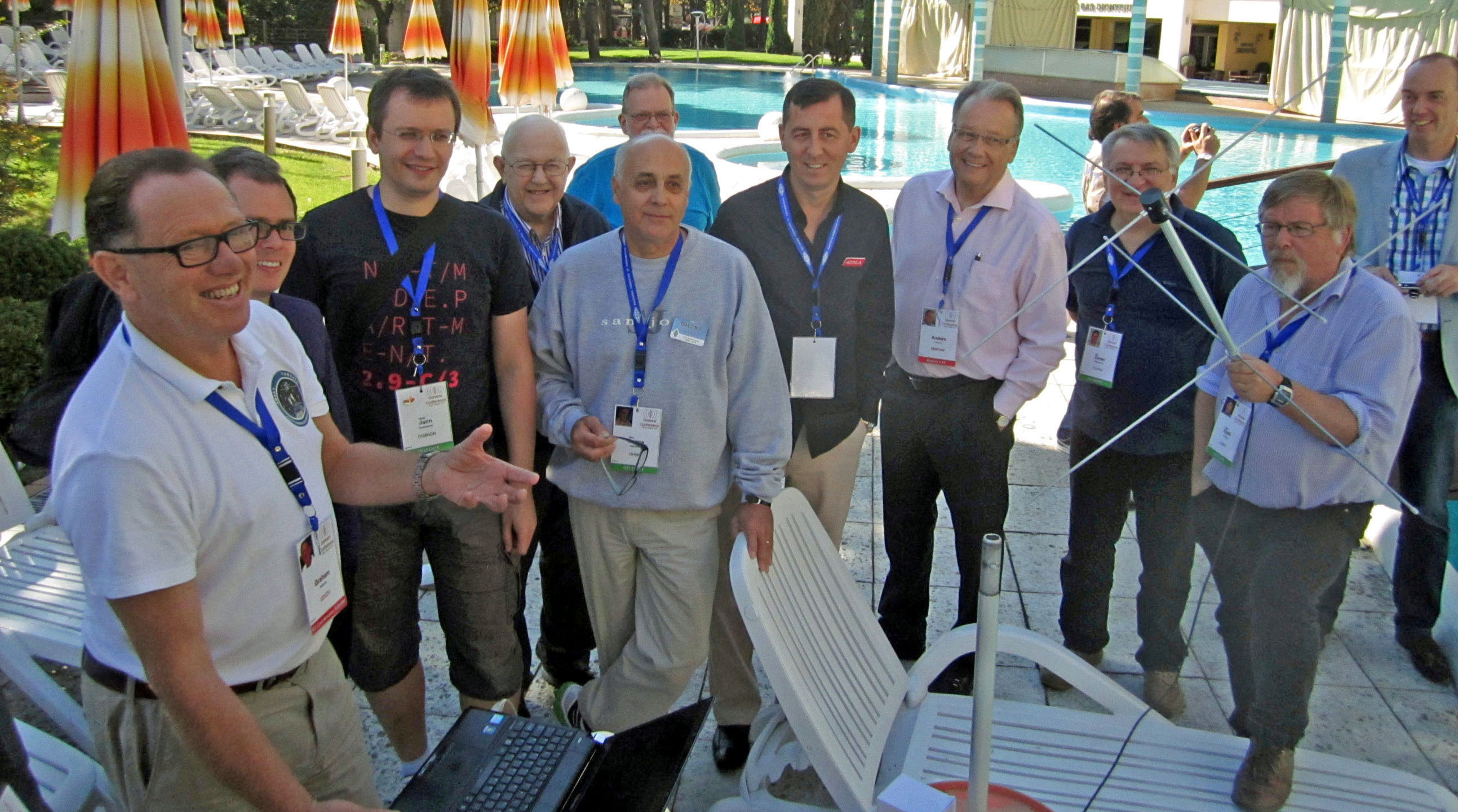
Graham Shirville G3VZV demonstrates FUNcube-1 with Kjetil Toresen LA8KV holding the antenna

Graham Shirville G3VZV demonstrates FUNcube-1 with Kjetil Toresen LA8KV holding the antenna

Riaan Greeff ZS4PR has released a video of the demonstration of the FUNcube-1 (AO-73) CubeSat by Graham Shirville G3VZV to delegates at the IARU Region 1 Conference in September 2014.

Watch the video Graham G3VZV demonstrates FUNcube satellite

Mats SM6EAN has posted a brief report on the Swedish Amateur Radio Society (SSA) website about the FUNcube-1 CubeSat presentation at the IARU Region 1 General Conference in Varna-Albena, Bulgaria.

The following is translated from the original Swedish post.

After the session of the VHF, UHF and Microwave C5 Committee had completed the delegates were given two interesting presentations.

Graham Shirville G3VZV did a poolside demonstration of the FUNcube-1 satellite which was launched in November 2013. Using a computer, FUNcube SDR dongle and a turnstile antenna, held by Kjetil Toresen LA8KV, he received FUNcube-1 and displayed the telemetry data on the computer screen. The satellite’s telemetry beacon on 145.935 MHz was also heard using a handheld SSB receiver.

A presentation was also made about Hamnet which is being expanded, especially in Germany. Hamnet is a high-speed multimedia network and it was discussed whether and how IARU Region 1 could support the expansion of this network.

Post by Mats SM6EAN in Swedish http://www.ssa.se/iaru-reg-1-dag-4/

FUNcube http://FUNcube.org.uk/

FUNcube SDR Dongle http://FUNcubeDongle.com/

FUNcube Yahoo Group https://amsat-uk.org/funcube/yahoo-group/

Dashboard App – Telemetry Decoder http://funcube.org.uk/working-documents/funcube-telemetry-dashboard/

Data Warehouse – Telemetry Archive http://warehouse.funcube.org.uk/

Hamnet http://hamnetdb.net/

IARU Region 1 Conference documents and pictures http://iarur1con2014.bfra.bg/

IARU Region 1 Approve Youth Budget and Satellite Allocation

Lisa Leenders PA2LS

Lisa Leenders PA2LS

The minutes of the Final Plenary, 23rd IARU Region 1 General Conference have been released.

The Conference approved these Youth budgets:
a. Youth Projects – 25,000 Swiss Francs for the years 2015, 2016 and 2017
b. Youth Working Group – 2,000 Swiss Francs for the years 2015, 2016 and 2017
One Swiss Franc is roughly equivalent to £0.65, $1.04, €0.83.

It was agreed to set up a Youth Working Group which will be Chaired for three years by Lisa Leenders, PA2LS.

A new satellite Space-to-Earth (downlink) band from 144.000 – 144.025 MHz with a maximum signal bandwidth of 2.7 kHz was agreed. This allocation is now available in all three IARU regions.

Read the minutes at
http://rsgb.org/main/files/2013/05/VA14_IARU-R1_Conference-Plenary-minutes.pdf

Additional information is in annexes/minutes which are awaiting release, check
http://rsgb.org/main/about-us/committees/spectrum-forum/sf-iaru-matters/sf-iaru-r1-conference/

IARU Administrative Council Plans for WRC-15

IARU_LogoThe Administrative Council (AC) of the International Amateur Radio Union (IARU) held its annual meeting on September 27-28, 2014 in Albena, Bulgaria. The AC is responsible for the policy and management of the IARU and consists of the three IARU international officers and two representatives from each of the three IARU regional organizations.

Here is a summary of the discussions and actions.

The Council reviewed the IARU positions on each of the WRC-15 agenda items that relate to amateur radio or may have an impact on amateur radio.  The Council made a number of modifications to the paper related to justifications for the IARU positions.  This information will be forwarded to all IARU member-societies.

The Council expressed support for Region 1 in its effort to obtain a CEPT proposal for post-WRC-15 conference agenda items for worldwide harmonization of 160 meters, harmonization of 6 meters and an allocation at 3.4 GHz.

The Council reviewed the participation of IARU at the upcoming WRC-15 and the President announced the members of the team who will represent IARU.

Upon the recommendation of the IARU EMC Coordinator, the Council adopted IARU Resolution 14-1 (“concerning the protection of the radio spectrum as a natural resource”) dealing with EMC issues related to the radio spectrum and which encourages IARU member-societies and regional organizations to pursue implementation of this resolution as a matter of high priority, requests standard-setting bodies and regulators to fully support this objective and implores designers and manufacturers to make every reasonable effort to minimize radio spectrum pollution emanating from their products.

The Council expressed the importance of obtaining the ITU Advance Publication Information (API) numbers from administrations for satellite projects operating in the amateur and amateur satellite bands so that information about the number of operating satellites can be maintained, for frequency coordination and for resolving interference issues.  IARU will work with administrations to establish protocols for satellite frequency coordination and to raise awareness of the satellite regulations.

The Council adopted the IARU Emergency Telecommunications Guide for use by the IARU member-societies to strengthen amateur radio disaster preparedness, response and mitigation.

The Council also adopted various strategies related to improving amateur radio disaster preparedness, response and mitigation and to promote the role of amateur radio in such activities to the general public and to government and non-government organizations.

The Council created the ad hoc “IARU Member-Society Relations Project Team” and adopted Terms of Reference for the project.  This action arose from Minute 10.10 from the 2013 Council meeting Summary Record dealing with “Second Society Issues.”

The Council adopted a system to provide more efficient remote monitoring of certain ITU meetings that may impact amateur radio.

The Plan for the Development of Support for Amateur Radio Frequency Allocations 2012-2017 was reviewed by the Council.  The September, 2013 version of the IARU Spectrum Requirements which is the working document that sets out the spectrum requirements of the amateur and amateur-satellite services, was reviewed, discussed and updated.

The International Telecommunication Union (ITU) meetings at which IARU representation will be required for the remainder of 2014 and for 2015 were identified, and plans for representation at these meetings were reviewed.

In view of the year 2015 being the 150th anniversary of the International Telecommunication Union, the theme “ITU & IARU:  Celebrating 150 years of Advancing the Telecommunication Art” was adopted for the next World Amateur Radio Day, April 18, 2015.

The budget for the years 2015-2017 as presented by the IS was reviewed and adopted. The budget is based upon anticipated financial contributions from the three regional organizations to defray a portion of the expenses, in accordance with previously adopted policy.

The Council received information about the Hamsphere Initiative from Martti Laine, OH2BH.  The Council will review the initiative and seek further information from the project leaders.

The Council was made aware of an ATV interference incident on the 23 cm band in which the German administration prohibited operation of an ATV repeater because of interference to the Galileo GPS system.

Attending the meeting were IARU President Tim Ellam, VE6SH/G4HUA; Vice President Ole Garpestad, LA2RR; Secretary Rod Stafford, W6ROD; regional representatives Hans Blondeel Timmerman, PB2T, Dennis Green, ZS4BS, Reinaldo Leandro, YV5AM, José Arturo Molina, YS1MS, Gopal Madhavan, VU2GMN, Wisnu Widjaja, YB0AZ and recording secretary David Sumner, K1ZZ. Also present as observers were Ramón Santoyo, XE1KK, observer from Region 2 and Don Beattie, G3BJ, observer and President-elect from Region 1.

The next scheduled in-person meeting of the AC will be held in the vicinity of Yogjakarta, Indonesia, in October, 2015 in conjunction with the IARU Region 3 Conference.

IARU http://www.iaru.org/

G3BJ elected IARU Region 1 President

IARU_Region_1_logoDon Beattie, G3BJ, former President of the RSGB, has been elected as IARU Region 1 President at the General Conference in Varna-Albena, Bulgaria.

During the Final Plenary of the 23rd IARU Region 1 General Conference, the following members were elected to serve on the Executive Committee:

President: Don Beattie, G3BJ

Vice President: Faisal Al-Ajmi, 9K2RR

Treasurer: Eva Thieman, HB9FPM / OK3QE

Secretary: Dennis Green, ZS4BS

Members:

Thilo Kootz, DL9KCE

David Court EI3IO

Oliver Tabakovski, Z32TO

Ivan Stauning, OZ7IS

Ranko Boca, 4O3A

The 24th IARU Region 1 General Conference will be held in Wildbad Kreuth, near Munich in Germany an hosted by the DARC.

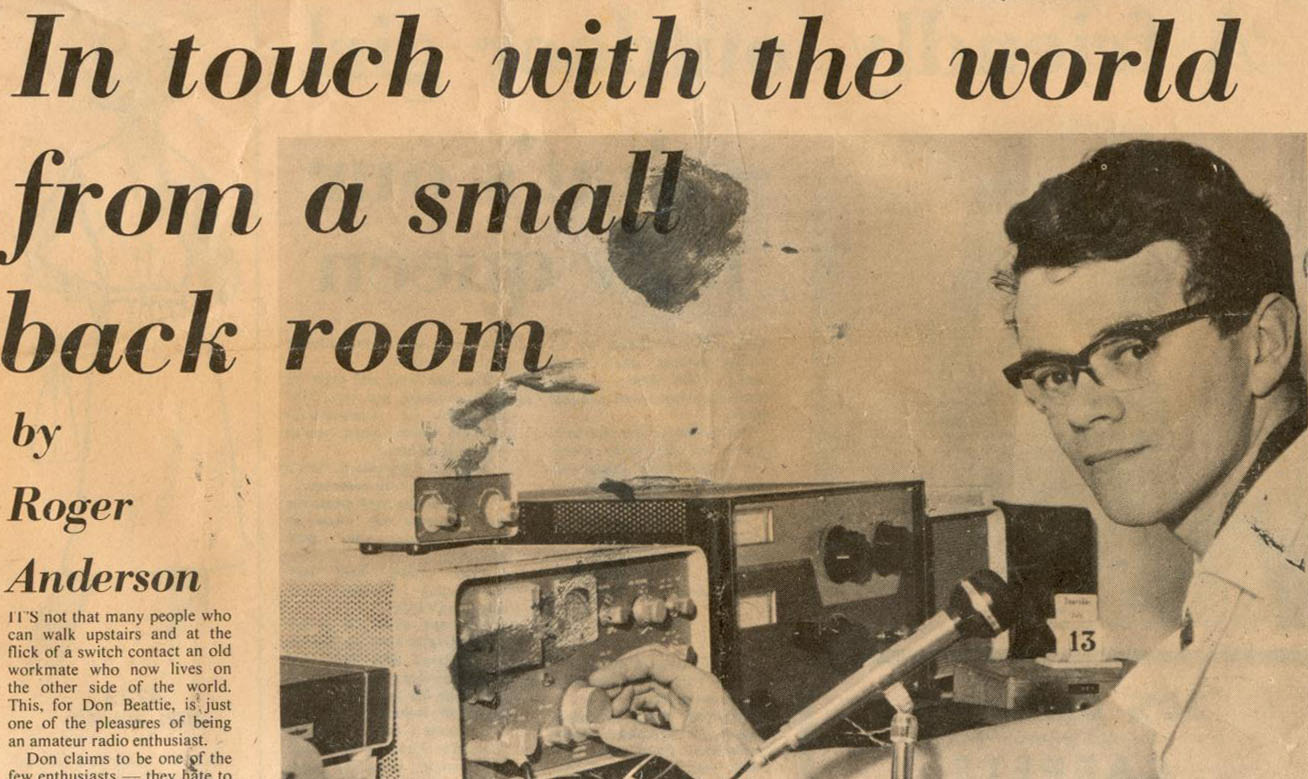
Don Beattie G3OZF (now G3BJ) in Essex Chronicle newspaper July 21, 1972

Don Beattie G3OZF (now G3BJ) in Essex Chronicle newspaper July 21, 1972

In the 1970’s Don Beattie, then G3OZF, lived at East Hanningfield in Essex. He was a member of the Chelmsford Amateur Radio Society (CARS) and was subsequently made an Honorary Member. He was featured several times in the Chelmsford press promoting amateur radio and defending the right to antenna masts.

CARS Amateur Radio Training http://g0mwt.org.uk/training

IARU Region 1 http://iaru-r1.org/