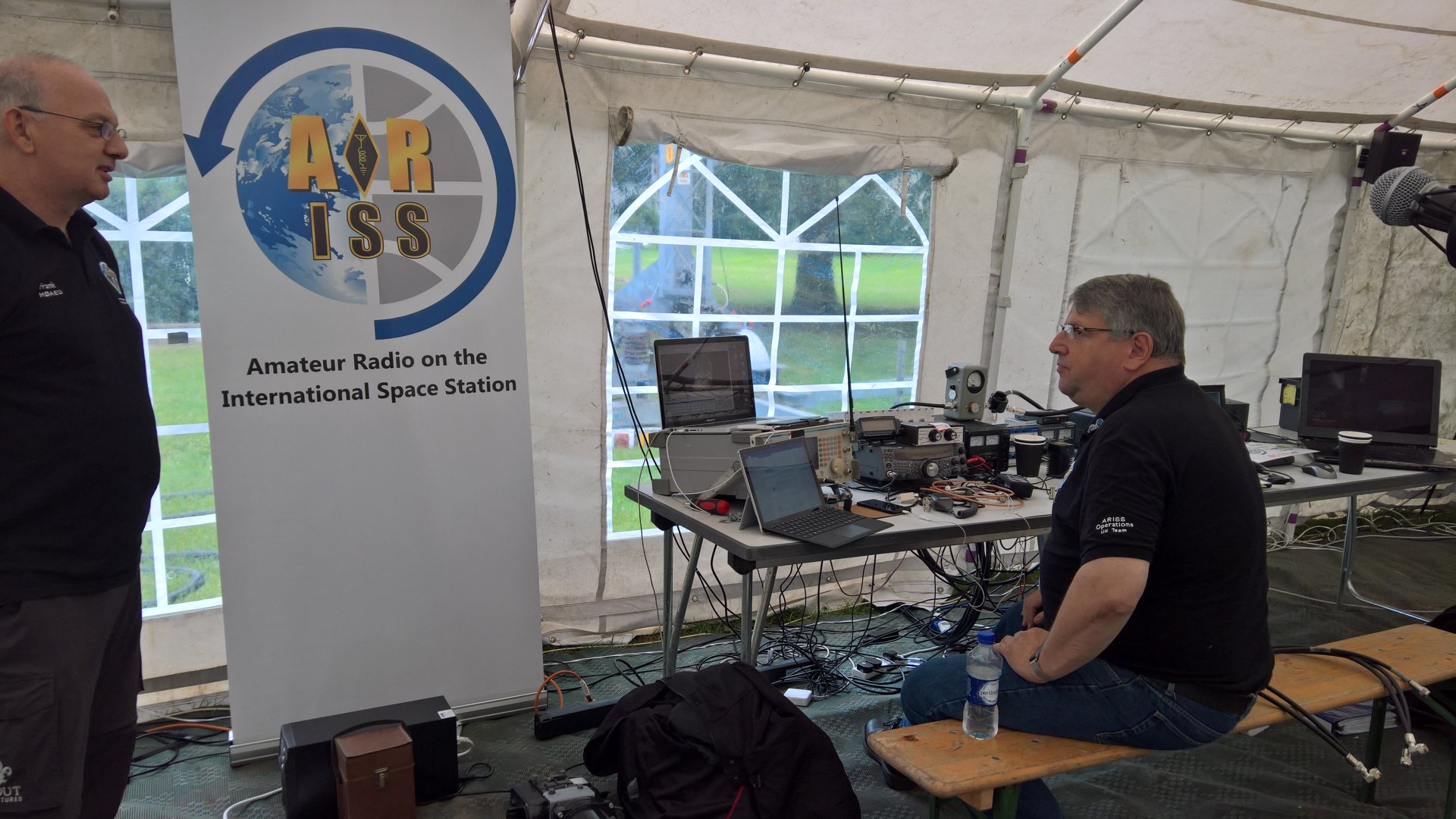
Young radio hams to talk to ISS astronaut

Paolo Nespoli IZ0JPA

Paolo Nespoli IZ0JPA

Some of the young radio amateurs attending the YOTA 2017 event at Gilwell Park will get the chance to talk to astronaut Paulo Nespoli IZ0JPA on the International Space Station using amateur radio.

Paulo will be operating the amateur radio station NA1SS in the Columbus module of the ISS and will to talk to attendees at the Youngsters On The Air 2017 event taking place at Gilwell Park on the Essex/London border. The callsign of the Gilwell Park station will be GB4YOTA and the contact is planned to take place at 1838 GMT on Tuesday, August 8.

The RSGB are hosting YOTA 2017 the prestigious IARU international summer camp at Gilwell Park, the UK Scouting HQ, on August 5-12, 2017.

There will be 80 young people under the age of 26 from 30 countries – from all over IARU Region 1 (Europe/Africa) as well as Japan — representing their national amateur radio societies at this event.

By taking part in a mix of amateur radio and intercultural activities, the young people will be able to build relationships with like-minded people from other countries and develop international friendships through amateur radio—and have a lot of fun!

YOTA 2017 http://rsgb.org/main/about-us/yota-2017/

Amateur Radio on the International Space Station (ARISS)
http://www.ariss.org/contact-the-iss.html

AMSAT-UK: https://amsat-uk.org/
Twitter: https://twitter.com/AmsatUK
Facebook: https://facebook.com/AmsatUK
YouTube: https://youtube.com/AmsatUK

Press reports ISS success of Chertsey Radio Club

International Space Station – Image Credit NASA

The Surrey press report radio amateurs at the Chertsey Radio Club received test transmissions by two satellites inside the International Space Station (ISS). The club also received ISS Slow Scan Television images.

On July 5, the Space Station sent greeting messages in Russian, English, Spanish and Chinese, which were picked up by club members. The messages were sent during test transmissions from two small educational Russian amateur radio satellites, known as Tanusha-1 and Tanusha-2. They will be deployed from the ISS during a spacewalk in August.

As part of the celebrations for the 20th Anniversary of Amateur Radio on the International Space Station (ARISS), the ISS sent a set of 12 images using slow scan television (SSTV). The transmissions took place over four days from July 20.

Chertsey Radio Club member James Preece M0JFP was able to receive the signal and convert them into images using a Raspberry Pi 3.

Read the article at
http://www.getsurrey.co.uk/news/surrey-news/surrey-radio-enthusiasts-make-contact-13396651

Chertsey Radio Club ISS SSTV on Raspberry Pi
http://chertseyradioclub.blogspot.co.uk/2017/07/iss-sstv-decoded-on-raspberry-pi3.html
http://chertseyradioclub.blogspot.co.uk/2017/07/iss-sstv-0058-uk-celebrating-20-years.html

Follow Chertsey Radio Club https://twitter.com/chertseyRC

Summer is a great time to get publicity for amateur radio
http://www.southgatearc.org/news/2017/june/summer-is-a-great-time-to-get-publicity-for-ham-radio.htm

What is Amateur Radio? http://www.essexham.co.uk/what-is-amateur-radio

Find a short Amateur Radio Foundation training course at https://thersgb.org/services/coursefinder/

Packet Module status on board ISS

Amateur Radio on the International Space Station (ARISS) logoARISS has received several reports stating that the packet radio system on ISS is down. Here is what we know and our current forward plan.

The packet system in the Columbus module started to act up late last week, sending only a beacon. The ARISS team requested a power recycle by the crew, and with that power recycle, the packet system appears to have stop functioning completely. Note that this unit has been on-orbit for 17 years. It was launched on the STS-106 Space Shuttle Atlantis mission in September 2000 and was built, tested and certified for flight about 20 years ago.

The ARISS team has had some extensive discussions on the way forward. We would first like to do some additional troubleshooting with the existing packet module. It will take some time (weeks) to develop troubleshooting procedures, get the procedures approved by NASA and then conduct the tests with the crew. This includes an additional power cycle. The turnaround time is much longer than usual because a new crew will soon be arriving on ISS. The current crew is focused on the new crew arrival and there will be about a one- to two-week transition after the new crew arrives. On the positive side, one aspect of our troubleshooting-a second power cycle-will occur automatically because ARISS is shut down during crew docking and turned on afterwards. However, there will be more to our troubleshooting than just the power cycle.

We have some additional plans with alternative solutions, but those are currently being discussed and prioritized within the ARISS team. All solutions will require international ARISS team coordination, additional procedures and crew interaction. People who have carefully followed ISS operations know that crew time continues to evolve with the more extensive research that is occurring on-board. Suffice it to say, it will take longer than what it has taken in the past to work through this issue.

The above information is to make sure that ARISS properly sets expectations on how long it will take to resolve this. At this point, expect a few months with no ARISS packet.

As you all can see, deploying the Interoperable Radio system that is currently under development by ARISS has become even more critically important. The ARISS team is laser focused on getting that system developed and deployed. We are conducting a final design review with NASA on this system next week. But we cannot get to the finish line without your help. If you can, please consider a donation to the ARISS radio fund by clicking on the ARISS donate button on the ARISS web page. All donations, large and small are appreciated http://www.ariss.org/donate.html

On behalf of ARISS, we thank you for your sustained interest and support of our program.

Sincerely,

Frank H. Bauer, KA3HDO
ARISS International Chair

About ARISS

Amateur Radio on the International Space Station (ARISS) is a cooperative venture of international amateur radio societies and the space agencies that support the International Space Station (ISS). In the United States, sponsors are the Radio Amateur Satellite Corporation (AMSAT), the American Radio Relay League (ARRL), the Center for the Advancement of Science in Space (CASIS) and the National Aeronautics and Space Administration (NASA). The primary goal of ARISS is to promote exploration of science, technology, engineering, and mathematics (STEM) topics by organizing scheduled contacts via amateur radio between crew members aboard the ISS and students in classrooms or informal education venues. With the help of experienced amateur radio volunteers, ISS crews speak directly with large audiences in a variety of public forums. Before and during these radio contacts, students, teachers, parents, and communities learn about space, space technologies and amateur radio.

Amateur Radio on the International Space Station (ARISS)
http://www.ariss.org/
https://twitter.com/ARISS_status
https://www.facebook.com/Amateur-Radio-on-the-International-Space-Station-ARISS-153679794647788/

QIKCOM-1 team expect Eclipse day ISS deployment

International Space Station – Image Credit NASA

The US Naval Academy team say their amateur radio QIKCOM-1 APRS Digipeater payload may be deployed from the International Space Station on August 21.

The QIKCOM-1 page says:

The Ham Radio QIKCOM-1 module attached to the NovaWurks NanoRacks SIMPL spacecraft is now finally scheduled for release from the ISS on 21 August 2017!

This is being released on the same day as the solar Eclipse when the ISS will also be passing over the USA during the eclipse 2 hour window around 1800z. We are not clear on any correlation with the Eclipse and our release, but there will be lots of hams in the field and it is a good day to tune in!

Read about QIKCOM-1 at http://aprs.org/qikcom-1.html

ARISS Celebrates its 20th Anniversary through SSTV Event

ISS SSTV image 2 received by Mike Rupprecht DK3WN April 12, 2016 at 1556 UT

ISS SSTV image 2 received by Mike Rupprecht DK3WN April 12, 2016 at 1556 UT

In commemoration of the 20th Anniversary of ARISS, a Slow Scan Television (SSTV) event is planned for Thursday, July 20 starting around 21:25 UT.

Update 2017-07-21: Crew schedule now indicates activity will conclude at 18:00 UT on Monday, July 24.

The event plans to feature images from ARISS activities both past and present. This opportunity should cover most of the world during the operation period.

The event plans to use a computer on the ISS Russian Segment, which stores images that are then transmitted to Earth using the ham radio, specifically the onboard Kenwood TM-D710 transceiver. Those receiving the images can post them at https://ariss-sstv.blogspot.com/ for viewing by the public.

The 20 year history of ARISS will be displayed through a collection of 12 unique images sharing the amazing accomplishments of ARISS over the last two decades. SSTV signals will be sent to earth at 145.800 MHz using FM. The SSTV mode of transmission is expected to be PD 120 (PD 180 may be a second option). The event is expected to continue over a two day period.

Since it’s inception, Amateur Radio on the International Space Station (ARISS) has provided students an opportunity, through ham radio, to engage in conversation with orbiting astronauts and inspired many to seek careers in science, technology, engineering and math. Consider how you might inspire students in your area through this chance to capture images directly from space to their computers.

Please note that the event, and any ARISS event, is dependent on other activities, schedules and crew responsibilities on the ISS and are subject to change at any time.

While preparations are being finalized please check for new and the most current information on the ARISS website or  Twitter, or Facebook or  the AMSAT Bulletin Board for the latest information on this event.

Amateur Radio on the International Space Station (ARISS) logoAbout ARISS

Amateur Radio on the International Space Station (ARISS) is a cooperative venture of international amateur radio societies and the space agencies that support the International Space Station (ISS). In the United States, sponsors are the Radio Amateur Satellite Corporation (AMSAT), the American Radio Relay League (ARRL), the Center for the Advancement of Science in Space (CASIS) and the National Aeronautics and Space Administration (NASA). The primary goal of ARISS is to promote exploration of science, technology, engineering, and mathematics (STEM) topics by organizing scheduled contacts via amateur radio between crew members aboard the ISS and students in classrooms or informal education venues. With the help of experienced amateur radio volunteers, ISS crews speak directly with large audiences in a variety of public forums. Before and during these radio contacts, students, teachers, parents, and communities learn about space, space technologies and amateur radio. For more information, see

Amateur Radio on the International Space Station (ARISS)
http://www.ariss.org/
https://twitter.com/ARISS_status
https://www.facebook.com/Amateur-Radio-on-the-International-Space-Station-ARISS-153679794647788/

ARISS SSTV Blog https://ariss-sstv.blogspot.com/

Note the ISS transmissions on 145.800 MHz FM use the 5 kHz deviation standard rather than the narrow 2.5 kHz used in Europe. If your transceiver has selectable FM filters try the wider filter.

The ISS Fan Club website will show you when the space station is in range http://www.issfanclub.com/

Useful links on receiving SSTV from the ISS https://amsat-uk.org/beginners/iss-sstv/

ARISS-SSTV Images http://ariss-sstv.blogspot.co.uk/

Listen to the ISS online when it is over Russia with the R4UAB WebSDR

Listen to the ISS online when in range of London with the SUWS WebSDR http://websdr.suws.org.uk/

The RSGB produce a handy Media Guide and Template press release, see
http://rsgb.org/main/clubs/media-guide-for-affiliated-societies/

If you receive a full or partial picture from the Space Station your Local Newspaper may like to know http://www.southgatearc.org/news/2016/july/now-is-a-great-time-to-get-ham-radio-publicity.htm

Example of the publicity you can get for the hobby by telling your Local Newspaper
https://amsat-uk.org/2015/04/15/iss-sstv-in-the-press/

BIRDS-1 constellation of five CubeSats deployed

BIRDS-1 CubeSat Constellation Deployment

BIRDS-1 CubeSat Constellation Deployment

On Friday, July 7, 2017 five CubeSats carrying amateur radio payloads were deployed from the Japanese Kibo module on the International Space Station.

ISS astronaut Jack Fischer KG5FYH @Astro2fish tweeted:
Another great example of International Cooperation today on @Space_Station –launched 5 micro-satellites from 5 countries off the JAXA arm!

The BIRDS-1 constellation consists of five 1U CubeSats (BIRD-B, BIRD-J, BIRD-G, BIRD-M and BIRD-N). They launched to the ISS on a SpaceX Falcon 9 CRS-11 on June 3, 2017. The satellites are made of the exactly same design and use the same amateur radio frequency.

The main mission of the constellation is to do experiments on radio communication with a CubeSat constellation via a network of UHF/VHF amateur radio ground stations all over the world.

BIRDS CubeSat NationsThe challenge is to distinguish each satellite from the others sharing the same transmit frequency, hand over operation of a satellite from one ground station to another and assemble the satellite data, such as housekeeping telemetry, music and the Earth images, obtained at different ground stations.

Amateur radio enthusiasts are asked to join the network to assist in the data downlink and reconstruction of the patchy satellite data into one meaningful data. Orbit information and operational plan of each satellite will be made available to the amateur radio community in the world. Software to decode the satellite data will be also made available.

The respective amateur ground stations that can successfully decode the telemetry data, music and the Earth images, shall receive a QSL card from the BIRDS team.

The data reconstructed by the effort of the amateur ground station network will be made public to share the sense of satisfaction and achievement.

BIRDS CubeSat Project LogoA particularly interesting mission of BIRDS project is the SNG mission that exchanges music via a digi-singer. It is an outreach-oriented mission. First, music in MIDI format is uploaded from ground. Then the MIDI file is processed on-board using a vocal synthesizer. Finally, the processed music is sent back to Earth using UHF antenna as voice FM data.

During organized events on space utilization with schools or general public, music could be heard using a common hand-held receiver and hand-made Yagi antenna positioned to track the satellite at each given pass over the region. This has a tremendous effect on awareness of radio communication among school children and general public, especially in the countries participating in the BIRDS project, Japan, Ghana, Mongolia, Nigeria and Bangladesh.

The satellites transmit CW on 437.372 MHz and 9k6 FSK, 1k2 AFSK FM, audio FM and 9k6 GMSK downlinks on 437.375 MHz.

A QSL is issued for a reception report. Please check the BIRDS web site.
http://birds.ele.kyutech.ac.jp/amateur.html

BBC News has a story about one of the satellites GhanaSat-1 (BIRDS-G, ANUSAT-1)
http://www.bbc.co.uk/news/world-africa-40538471

BIRDS-1 CubeSat Constellation
https://amsat-uk.org/2017/07/01/birds-1-cubesat-constellation-deployment/
https://amsat-uk.org/2016/08/11/ham-radio-birds-constellation/