ESA invites radio amateurs to listen for AAUSAT-5 CubeSat

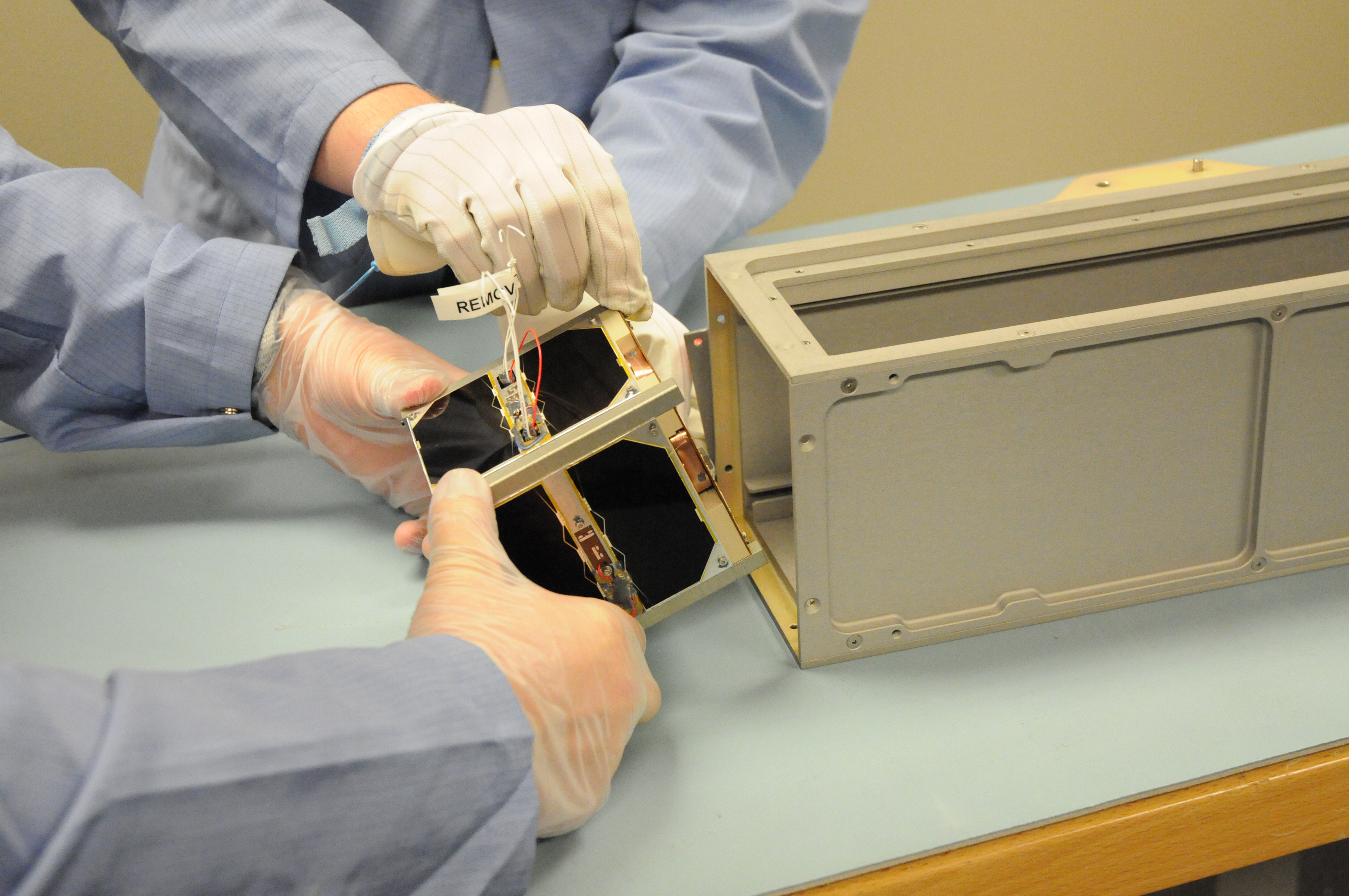
AAUSat-5 and Deployer - Credit ESA

AAUSat-5 and Deployer – Credit ESA

The AAUSAT-5 amateur radio CubeSat built by students at the University of Aalborg, Denmark is planned to be released from the International Space Station sometime in the week of October 5.

The European Space Agency (ESA) is inviting radio amateurs to listen out for the signals from the satellite. The first to send in a recorded signal from AAUSAT-5 will receive a prize from ESA’s Education Office.

Launched on August 19, 2015 to the ISS, the Danish student CubeSat is now waiting for its deployment from the Japanese Kibo module’s airlock. An astronaut will manipulate the Kibo robotic arm to lift AAUSAT-5 from the airlock and place it in orbit.

Once deployed from the ISS the CubeSat will begin transmitting signals to Earth that can be picked up by anyone with common amateur radio equipment. ESA challenges anyone to record the signal and send it to ESA (cubesats@esa.int) and Aalborg University (studentspace@space.aau.dk).

The satellite will transmit on 437.425 MHz using CW and GMSK. The 30 WPM CW beacon will transmit every 3 minutes and the 9600 bps GMSK every 30 seconds.

The first correct email received will win the following prizes:
• ESA/AAUSAT5 poster with signatures of the team members
• ESA Education goodie bag
• Scale 1:1 3D printed model of the AAUSAT-5 satellite

Read the ESA article at
http://www.esa.int/Education/CubeSats_-_Fly_Your_Satellite/Be_the_first_to_catch_the_signals_from_a_new_Satellite_in_orbit

AAUSAT-5 amateur radio information http://www.space.aau.dk/aausat5/index.php?n=Main.HamInfo

ESA AAUSAT-5 Twitter hashtag #AAUSAT5 https://twitter.com/ESA__Education

Danish CubeSats head for ISS https://amsat-uk.org/2015/08/19/danish-cubesats-head-for-iss/

15-year-old radio ham receives ISS Apollo-Soyuz SSTV Award

ISS SSTV Apollo-Soyuz Award #0289 received by Sakshi Vagadia VU3EXP

ISS SSTV Apollo-Soyuz Award #0289 received by Sakshi Vagadia VU3EXP

Rajesh Vagadia VU2EXP reports that he and his15 year old daughter, Sakshi Vagadia VU3EXP, have each received ISS Apollo-Soyuz SSTV Awards for their reception of Slow Scan Television images transmitted using amateur radio from the International Space Station (ISS).

Sakshi Vagadia VU3EXP

Sakshi Vagadia VU3EXP

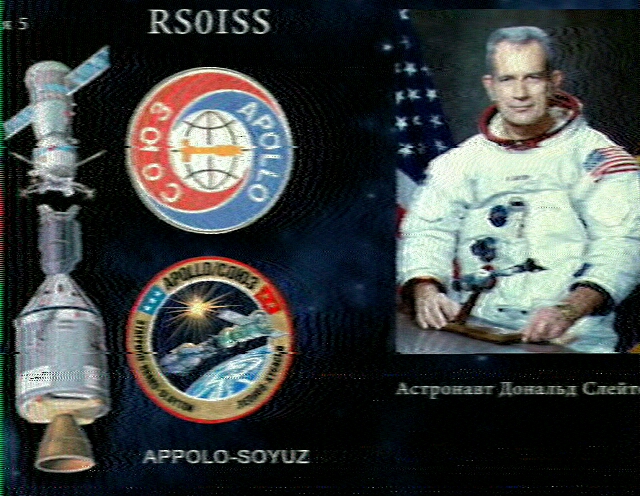
These special transmissions from the ISS during July 18-19, 2015 were made to commemorate the 40th anniversary of the Apollo-Soyuz mission, which was the first joint collaboration in space between the United States and the Soviet Union. The ARISS organisation has issued a special limited edition diploma to award those who received one of the SSTV images.

Rajesh writes: After getting ticket [amateur radio licence] few months back, It was first successful attempt by Sakshi VU3EXP to receive SSTV Image from International Space Station and get such memorable & precious Wallpaper (award). She received ISS SSTV image on July 18, 2015 @ 19:36:44 (UTC).

My ISS SSTV Image was received on July 19 @ 05:24:27 (UTC). It was my 5th successful attempt.

I highly appreciate ARISS International, Russian Cosmonauts, various Radio Clubs and ARISS SSTV Award Managers (incl. SQ3OOK) joint efforts to give such wonderful opportunity to we Ham community.

73 VU2EXP
Rajesh P. Vagadia
Rajkot – Gujarat

Image received by Sakshi Vagadia VU3EXP on July 18, 2015 at 1936 GMT

Image received by Sakshi Vagadia VU3EXP on July 18, 2015 at 1936 GMT

Amateur Radio on the International Space Station (ARISS) – Contact the ISS
http://www.ariss.org/contact-the-iss.html

ISS Slow Scan TV https://amsat-uk.org/beginners/iss-sstv/

Youngest radio ham in Gujarat state
https://amsat-uk.org/2015/05/04/youngest-radio-ham-in-gujarat-state/

What is Amateur Radio ? http://www.essexham.co.uk/what-is-amateur-radio

ISS CubeSat Deployment

Kibo Robot Arm CubeSat Deployment

Kibo Robot Arm CubeSat Deployment

Masahiro Arai JN1GKZ reports CubeSats may be deployed from the International Space Station (ISS) on September 17.

On the AMSAT Bulletin Board he writes:

ISS Kibo Japanese Experiment Module (JEM)

ISS Kibo Japanese Experiment Module (JEM)

JAXA has announced CubeSats will deploy from the ISS via the J-SSOD on 17th September but the CubeSat name is not shown in the announcement. However, NASA’s ISS On-Orbit Status Report 09/09/15 shows the following:

JAXA-Small Satellite Orbital Deployer (SSOD) #4 Install: Kelly installed the J-SSOD#4 on the Slide Table with the Multi-Purpose Experiment Platform (MPEP) attached.  The J-SSOD #4 has two satellites that will be deployed next week.  The first satellite is designed to observe the Ultraviolet (UV) spectrum during the Orionid meteor shower in October.  The second satellite, sponsored by the University of Brasilia and the Brazilian government focuses on meteorological data collection.

So, the first one must be S-CUBE and the second is SERPENS.

SERPENS operates in the amateur band. The SERPENS Amateur Radio page shows these downlink frequencies:
145.980 MHz using GFSK modulation at 9600 bps and AX.25 protocol
and
437.365 MHz using CW/MSK modulation at 1200 bps and CSP protocol

S-CUBE seems not to operate in an amateur band.

SERPENS Amateur Radio page http://www.aerospace.unb.br/serpens_radioamateurs

United Nations – ISS CubeSat Deployment

Amateur Radio CubeSats TechEdSat, F-1 and FITSAT-1 pass the ISS solar panels

Amateur Radio CubeSats TechEdSat, F-1 and FITSAT-1 pass the ISS solar panels

The United Nations Office for Outer Space affairs has announced the United Nations/Japan Cooperation Programme on CubeSat Deployment from the ISS Kibo module “KiboCUBE”.

The first of the Planet Lab Dove CubeSats were deployed from the ISS on February 11, 2014 about 0831 UT

The first of the Planet Lab Dove CubeSats were deployed from the ISS on February 11, 2014 about 0831 UT

The United Nations Office for Outer Space Affairs (UNOOSA) and the Japan Aerospace Exploration Agency (JAXA) are pleased to announce the United Nations/Japan Cooperation Programme on CubeSat Deployment from the International Space Station (ISS) Japanese Experiment Module (Kibo) “KiboCUBE”.

KiboCUBE is the dedicated collaboration between UNOOSA and JAXA in utilizing the ISS Kibo for the world. KiboCUBE aims to provide educational or research institutions from developing countries of United Nations membership with opportunities to deploy, from the ISS Kibo, cube satellites (CubeSats) which they develop and manufacture.

Currently, the only way to deploy CubeSats from the ISS is from Kibo. Kibo’s unique capability is comprised of an airlock system and a robotic arm. The first orbital deployment of CubeSats from Kibo was successfully conducted in October 2012 through the Small Satellite Orbital Deployer developed by JAXA. Since then, nano-satellites and CubeSats from various countries around the world have been deployed from Kibo.

The deployment of CubeSats from ISS is easier than the direct deployment by a launch vehicle thanks to the lower vibration environment during launch. With this comparatively less demanding interface requirements, UNOOSA and JAXA believe that KiboCUBE will lower the threshold of space activities and will contribute to build national capacity in spacecraft engineering, design and construction.

UNOOSA and JAXA are looking forward to many applications!!

How to Apply information is at http://www.unoosa.org/oosa/en/ourwork/psa/hsti/kibocube.html

QB50 CubeSats to be deployed from ISS

Planet Lab Dove CubeSats leaving the Nanoracks Deployer on February 11, 2014

Planet Lab Dove CubeSats leaving the ISS Nanoracks Deployer on February 11, 2014

It has been announced that the fifty CubeSat QB50 constellation should be shipped to the International Space Station (ISS) in July 2016 for subsequent deployment. It had been planned for them to be launched by Alcantara Cyclone Space, a joint venture between the governments of Ukraine and Brazil, but that option is not longer available.

QB50p1 and QB50p2 Precursor 2U CubeSats - Image Credit ISIS

QB50p1 and QB50p2 Precursor 2U CubeSats – Image Credit ISIS

The AlbertaSat website reports on the 9th QB50 Workshop, held September 8, 2015 in Liège, Belgium. The CubeSats are now planned to be deployed from the ISS using the Japanese Experiment Module (JEM) and the Nanoracks CubeSat Deployers.

Eight NanoRacks deployers are installed on the Multi-Purpose Experiment Platform (MPEP). Each deployer has a capacity of 6U and so can hold up to six 1U, three 2U or two 3U CubeSats. They are carried by Japanese Experiment Module-Remote Manipulator System (JEM-RMS).

AlbertaSat provide an update on the QB50 precursor CubeSats P1/P2 which were launched in 2014. The first payload is working, and while it has been resetting, no damage appears to have occurred. It is possible that the second payload is damaged, but it is still functioning.

Representatives from QB50 also took the time to clearly define their goals and specify the details of the project. The project aims to probe probe thermosphere with about 40 sensors which study atmospheric science. These sensors include the Langmuir Probes that will be on Ex Alta-1. 40 CubeSats will be fitted with one of these sensors. The other 10 CubeSats will have in-orbit demonstrations.

QB50 project https://www.qb50.eu/

Launch of QB50 precursor CubeSats QB50p1 (EO-79) and QB50p2 (EO-80)
https://amsat-uk.org/2014/06/19/successful-launch-of-amateur-radio-satellite-payloads/

January 2014 original QB50 CubeSat launch contract signed
https://amsat-uk.org/2014/01/28/qb50-cubesat-launch-contract-signed/

AlbertaSat
http://albertasat.ca/
https://www.facebook.com/AlbertaSa

Radio hams launch to ISS Wednesday

Danish Astronaut Dr Andreas Mogensen at an AMSAT-UK International Space Colloquium

Danish Astronaut Dr Andreas Mogensen at AMSAT-UK International Space Colloquium

Denmark’s first astronaut Andreas Mogensen KG5GCZ is expected to blast-off to the ISS from Baikonur in Kazakhstan on Wednesday, September 2.

While on the ISS he plans to deploy two Danish CubeSats, GomX-3 and AAUSat-5 which both carry amateur radio payloads.

Onboard the Soyuz TMA-18M with Andreas will be Kazakhstan’s first cosmonaut Aydin Aimbetova who takes the mission place vacated by the UK’s Sarah Brightman. The commander is Sergey Volkov RU3DIS who, during an ISS spacewalk in 2011, deployed the KEDR/Radioskaf-B/ARISSat-1 satellite which carried an amateur radio transponder and Slow Scan TV.

These dates and frequencies are from Dmitry R4UAB http://r4uab.ru/?p=10087
• Soyuz TMA-18M launch – Sept 2 at 07:37:43 (04:37:43 GMT)
• Docking with the ISS – Sept 4 at 10:42 (07:42 GMT) ± 3 minutes
• Planned mission duration for Sergey Volkov RU3DIS is 188 days.
• Planned mission duration for Andreas Mogensen KG5GCZ and Aydin Aimbetova is 10 days
• Soyuz frequency 130.167 MHz
• ISS frequency 143.625 MHz

Danish CubeSats head for ISS https://amsat-uk.org/2015/08/19/danish-cubesats-head-for-iss/

iriss mission blog http://blogs.esa.int/iriss/

Follow Andreas KG5GCZ on Twitter https://twitter.com/Astro_Andreas

AMSAT-UK
Web https://amsat-uk.org/
Twitter https://twitter.com/AmsatUK
Facebook https://facebook.com/AmsatUK
YouTube https://youtube.com/AmsatUK
Flickr https://flickr.com/AmsatUK