On Thursday, August 20, Onno VK6FLAB was interviewed by Gillian O’Shaughnessy for the ABC 720 Breakfast Show to talk about Amateur Radio after a UK based radio ham, Adrian 2E0SDR, managed a contact with the ISS from his garden shed.
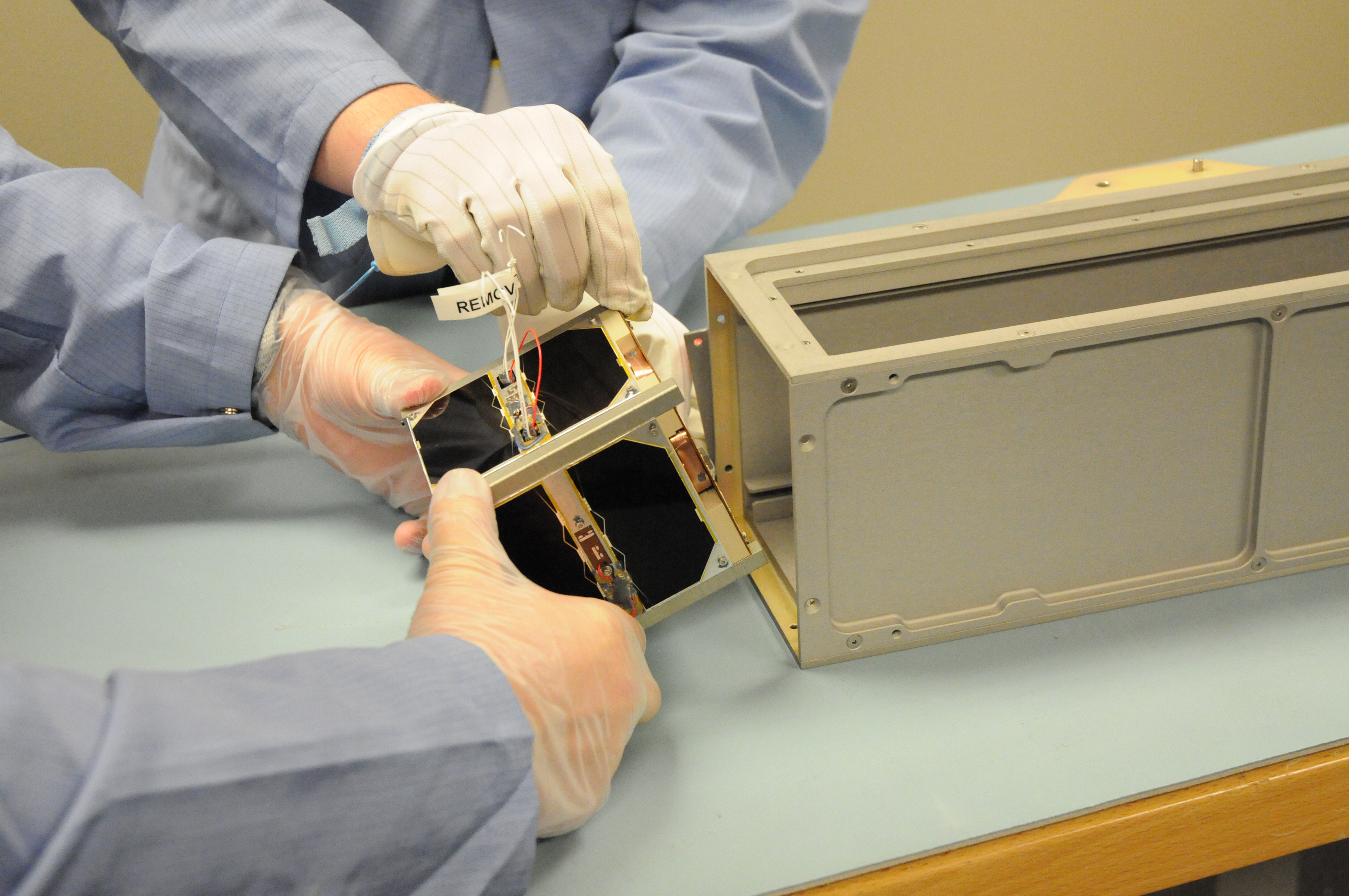
Two CubeSats built in Denmark, GomX-3 and AAUSat-5, are on their way to the International Space Station.
Danish Astronaut Andreas Mogensen KG5GCZ and Murray Niman G6JYB
Japan’s fifth H-II Transfer Vehicle blasted off from Tanegashima Space Center on Wednesday, August 19 at 1150 UT. The HTV-5 is expected to arrive at the ISS on August 24 and the CubeSats will be unloaded for later deployment.
The 3 Unit CubeSat GomX-3 is part of the outreach programme for the visit of the Danish astronaut, Andreas Mogensen KG5GCZ@Astro_Andreas, to the ISS. His Soyuz spacecraft is expected to launch on September 2. The project is supported and coordinated with ESA and the Danish Ministry of Science and Education.
A number of outreach activities are being planned that will involve schools, radio amateur societies and social media both during the astronaut mission and continuing with the CubeSat mission. The IARU have coordinated 437.250 MHz for the 1k2-9k6 bps beacon.
AAUSat-5 and Deployer – Credit ESA
AAUsat-5 is a 1 Unit CubeSat built by students at Aalborg University. The primary mission is to test an improved receiver for detecting Automatic Identification System signals emitted by ships. Down on the ground, these signals are short-range, operating mainly on a ship-to-shore and ship-to-ship basis, leaving large spans of the world’s oceans uncovered. But signals also travel up to orbital altitude, opening up the prospect of worldwide monitoring. The IARU have coordinated 437.425 MHz for the GMSK beacon.
Once deployed the two spacecraft may have a lifetime of around 6-9 months before they burn up in the Earth’s atmosphere.
Watch AAUSAT5 CubeSat mission from the International Space Station
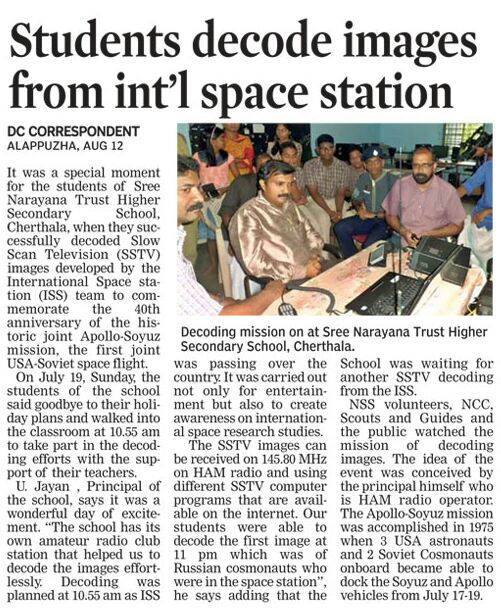
Students at Sree Narayana Trust Higher Secondary School returned to the classroom during their holidays to receive amateur radio Slow Scan Television from the International Space Station.
The special ISS transmissions were made in July to commemorate the 40th anniversary of the Apollo-Soyuz mission.
The Deccan Chronicle newspaper reports that with the support of their teachers the students were able to decode the SSTV images on a frequency of 145.800 MHz FM.
The school has an amateur radio club, callsign VU2SQL, and the Principal is licenced radio amateur U.Jayan VU2JYU. http://www.qrz.com/db/vu2sql
ARISS Amateur Radio on the International Space Station
Mike KC8YLD has posted some guidance as to when the Amateur Radio stations on the ISS would be turned off.
Current flight rules require all the ham radios to be off during an EVA. Technically, the VHF radios needs to be off for Russian EVAs and the UHF radio needs to be off for US EVAs.
For dockings and undockings, again the ISS operates under a flight rule that has the VHF/UHF radios off for Progress, Soyuz and ATV vehicle activity. Note that Cygnus, Dragon, HTV and formerly the Shuttle did not require the radios to be off.
For Ham TV, it will be off for any EVA. It needs to be off for ATV (the last one November) docking and undocking. It also has to be off when the Robotics arm is in close proximity.
ARISS International Delegates, its Board of Officers, and international team members will meet at Big Sight, Tokyo, Japan on August 20-23, 2015 for a critical meeting to discuss ARISS strategy, teamwork, hardware and operations.
Delegates are voting members of ARISS-I representating the 5 ISS member regions: United States, Russia, Japan, Canada and Europe.
The meeting will open with remarks from meeting host Keigo Komuro, JA1KAB from ARISS Japan and JARL.
Other agenda items will include:
• Welcome by the Japanese Space Agency JAXA & an Overview of the JAXA Innovative Satellite Technology Demonstration Program
• ARISS working group business discussions and reports, including: regional reports, ARISS Terms of Reference update, space agency coordination status, sustainability & fundraising and ARISS future endeavors
• Technical discussions on current and future hardware developments, including: Next Generation ARISS Radio Systems, the Astro-Pi Project, and an update on the Ham-TV system
• Operations discussions, including presentations on: Educational Activities, International Expansion & Planning of SSTV. School
Selection and Regional Scheduling Procedures and plans for the
upcoming Tim Peake Mission
Along with their ambitious schedule the delegates will begin each day with an opportunity for informal discussions and will have the opportunity to visit the Tsukuba Space Center.
A newspaper story says a Swindon radio amateur was believed to be the first in the UK to contact an astronaut on a space station, the Russian Mir, which hosted UK and USA astronauts.
The story published in the Swindon Advertiser on August 7 says: “…it took place almost 20 years before another amateur hit the headlines this week for doing the same thing.
Radio ham Donald Shirreff [G3BGM], who died in 2010, was believed to be the first amateur radio enthusiast to successfully make contact with astronauts aboard an international space station more than 19 years ago.
In 1996, former MI5 agent Donald, then 77, took an unusual approach to his retirement and set his sights on contacting cosmonauts aboard Russian space station Mir.”
On Aug 7, commenting on the Daily Mail website on the story about a recent ISS amateur radio contact, Donald Shirreff’s son (User ID crunchbard) posted:
“My father Donald Shirreff (1918-2010) used to communicate in the 1990s with Russian cosmonauts on the Mir space station as it flew over his Wiltshire farmhouse. He was a keen radio ham, with a 40-foot mast in the garden. Though he spoke some Russian he often used Yana, a Russian friend, as translator. The cosmonauts seemed to enjoy this light relief after hard work over Russian territory. His greatest coup was to talk to British-born Michael Foale when he was a guest on Mir.”
You must be logged in to post a comment.