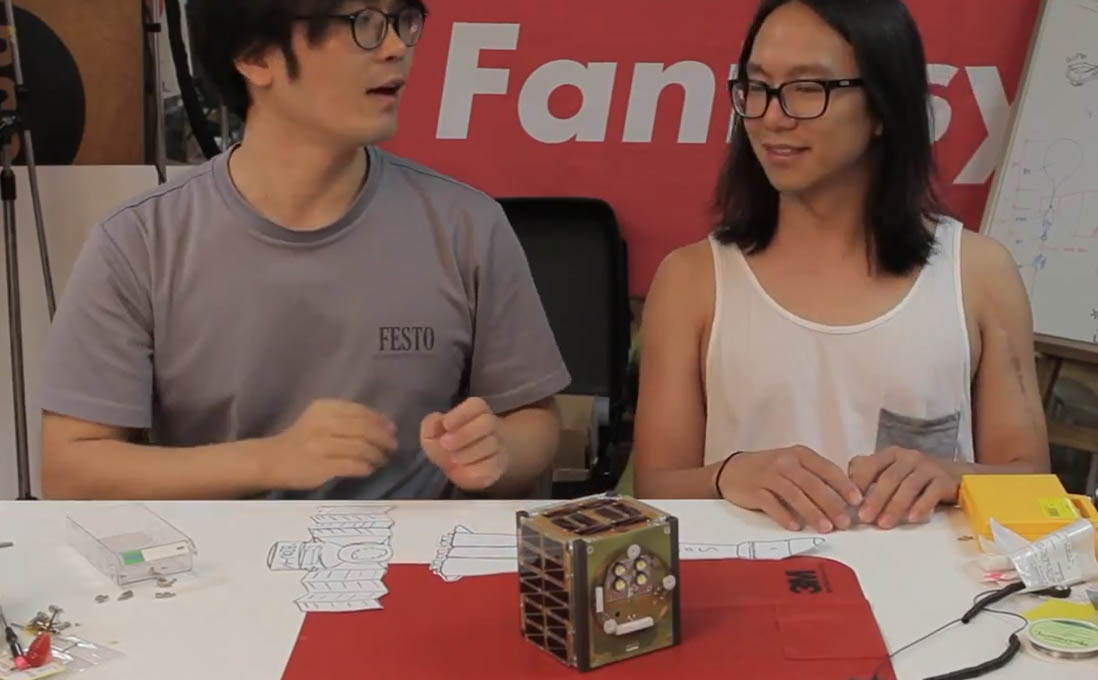
Donghee Park and Hojun Song with OSSI-1 CubeSat
In this 20 minute video Korean artist Hojun Song DS1SBO and Donghee Park describe the Open Source Satellite Initiative amateur radio CubeSat OSSI-1.
Donghee Park and Hojun Song with OSSI-1 CubeSat
In this 20 minute video Korean artist Hojun Song DS1SBO and Donghee Park describe the Open Source Satellite Initiative amateur radio CubeSat OSSI-1.

RSGB VHF-UHF Manual and Radio Communication Handbook used by Korean satellite pioneer Sungdong Park
The RSGB amateur radio books VHF-UHF Manual and the Radio Communication Handbook were referenced by Korean satellite pioneer Sungdong Park when he made the first Korean satellite KitSAT-OSCAR-23 in early 90’s.

Funds for the OSSI CubeSat have been raised by selling T-shirts
The amateur radio CubeSat OSSI is planned to launch in December according to an Antara News article. [UPDATE rocket launch has been delayed and may now be April 2013]
The article describes how Korean artist Hojun Song DS1SBO developed his own home made satellite and says radio operators will be able to communicate with the satellite. If all goes well, it will repeat a message in Morse code using its LED lights at a set time and location.
The DIY satellite OSSI is planned to launch on a Soyuz-2-1b from the Baikonur launch facility in Kazakhstan in December with the Bion-M 1 and Dove 2 satellites. (The Dove 2 CubeSat will transmit images on a 2.4 GHz downlink). The satellites will be placed into an orbit with an apogee of 575 km, perigee of 290 km and inclination of 64.9 degrees. They are expected to remain in orbit for about a year before burning up on re-entry into the Earth’s atmosphere.
The OSSI uplink is in the 145 MHz band and the downlink in the 435 MHz band.
Read the Antara News story Homemade Korean satellite to go boldly into space
http://www.antaranews.com/en/news/83628/homemade-korean-satellite-to-go-boldly-into-space
Read the Telegraph newspaper article South Korean artist set to launch homemade satellite http://www.telegraph.co.uk/news/worldnews/asia/southkorea/9428047/South-Korean-artist-set-to-launch-homemade-satellite.html
Daily Mail newspaper Watch out, Nasa! Korean launches $500 satellite built from scavenged parts – and could kick off a DIY space race http://www.dailymail.co.uk/sciencetech/article-2179151/DIY-space-race-South-Korean-artist-launches-500-satellite-built-scavenged-parts.html
The Times of India Artist makes satellite at home in just $500 http://timesofindia.indiatimes.com/tech/personal-tech/computing/Artist-makes-satellite-at-home-in-just-500/articleshow/15162830.cms
BBC TV report South Korean artist has high hopes for his homemade satellite http://www.bbc.co.uk/news/world-asia-19007475
Open Source Satellite Initiative (OSSI) http://opensat.cc/
OSSI CubeSat – Ground Station Video http://www.uk.amsat.org/7218
OSSI Art CubeSat to Launch in August http://www.uk.amsat.org/6993

Korean artist Hojun Song DS1SBO creator of the OSSI CubeSat

Hojun Song with Hannes Gassert wearing OSSI Ground Station Backpack and holding a Yagi antenna
Korean artist Hojun Song DS1SBO has made available videos showing the construction of his satellite OSSI.
In addition to radio communications (145 MHz uplink, 435 MHz downlink) OSSI is fitted with LED’s that can flash in Morse Code and is also flying Super-Capacitors.
The backpack ground station that he’s developed features a novel fold up antenna.
OSSI will take off on a Soyuz rocket from Baikonour in Kazakhstan this August.
Watch Setting up the OSSI Satellite Ground Station
The OSSI ground station has been delivered to etoy. etoy is art and invests all resources in the production of more art, see http://www.etoy.com/
OSSI carries LED’s that can signal in Morse Code
Watch Building the Onboard Computer (OBC)
OSSI Art CubeSat to Launch in August http://www.uk.amsat.org/6993
Funds have been raised by selling T-shirts
On August 3, 2011, the Amateur Radio satellite, ARISSat-1 began its education-based mission after deployment from the International Space Station. Students, teachers and amateur radio operators are invited to learn more about the satellite as a tool for education and its other features at http://www.arissat1.org/
The ARISSat-1 mission is to provide a variety of information through its many broadcast modes promoting STEM based education initiatives in the classroom. One of its modes is CW transmission. CW stands for “continuous wave” and is transmitted in Morse code.
To entice student interest in receiving Morse code, a CW contest has been created and all listeners are invited to participate.
Throughout recent history, a number of amateur radio operators, also known as hams, have made significant strides in developing space communications via ham radio. These are hams such as Owen Garriot, W5LFL making the first amateur radio contact from space and Jim White, WD0E, a technical contributor to the amateur satellite program.
To celebrate their accomplishments, the call signs of over 200 of these hams have been digitally stored on board ARISSat-1 and are being transmitted in rotation using Morse code at 145.92 MHz. The call signs can be heard between the RS01S CW identification and the CW telemetry in the repeated code transmission sequence.
To be a participant in the CW contest, all you have to do is copy and submit any 6 of the 200+ call signs you hear during multiple satellite passes, then submit the following information to: cwreport@arissat1.org
+ Your name or group’s name
+ Your ham call sign if applicable
+ Time in UTC and date of reception of each call sign
+ Your City, State, Country
+ Your email address
+ Your list of 6 call signs you have received
A major goal for this contest is to promote student interest in learning Morse code which continues to play an important role in emergency communications and is a fun way of sending messages using ham radio. In that spirit, we ask that participants copy the code by hand and refrain from using artificial means, e.g., electronic decoders, to decode the call signs. Due to the possibility of interference or excessive ambient noise that might be present during the pass, recording the code for playback and deciphering after the pass is permissible.
A copy of this information on the contest can also be found by going to http://www.arissat1.org and choosing the subtitle marked CW CONTEST under the Education menu.
For more detailed information on how to receive and decipher the CW transmissions, visit http://www.arissat1.org/ and choose the menu labeled FAQ and subtitle Receiving ARISSat-1.
We invite everyone to participate and be an important part of the ARISSat-1 mission experience.
Questions concerning the contest should be directed to: kc0zhf@yahoo.com.
A Very Important Note:
———————-
All ARISSat-1 listeners should refrain from publically disclosing any received call signs from their list. The call signs should only be posted to the CWreport email address mentioned above. Posting the contest call signs on the internet, amsat-bb, other bulletin boards or any areas for public viewing will result in the listener or group being disqualified from the contest along with the disclosed call signs.
More information on the transmission schedule and overall mission of ARISSat-1/KEDR can be found at:
ARISSat-1 Web site: http://www.arissat1.org/
AMSAT-NA Web site: http://www.amsat.org/
ARISS Web site: http://www.ariss.org/
ARISS Facebook Page: Amateur Radio on the ISS (ARISS)
ARISS Twitter site: @ARISS_status
The Radio Amateur Satellite Corporation (AMSAT) is a non-profit, volunteer organization which designs, builds and operates experimental amateur radio satellites and promotes space education. We work in partnership with government, industry, educational institutions and fellow amateur radio societies. We encourage technical and scientific innovation, and promote the training and development of skilled satellite and ground system designers and operators.
Our vision is to deploy satellite systems with the goal of providing wide area and continuous coverage for amateur radio operators world-wide. AMSAT is also an active participant in human space missions and supports satellites developed in cooperation with the educational community and other amateur satellite groups.
Amateur Radio on the International Space Station (ARISS) is a volunteer program which inspires students, worldwide, to pursue careers in science, technology, engineering and math through amateur radio communications opportunities with the International Space Station on-orbit crew. Students learn about life on board the ISS and explore Earth from space through science and math activities.
ARISS provides opportunities for the school community (students, teachers, families and local residents) to become more aware of the substantial benefits of human space flight and the exploration and discovery that occur on space flight journeys along with learning about technology and amateur radio.
OSCAR News is published quarterly by AMSAT-UK and posted to members. To get your copy join AMSAT-UK online at http://tinyurl.com/JoinAMSAT-UK/
Free sample issue at http://www.uk.amsat.org/on_193_final.pdf
 AMSAT-UK
You must be logged in to post a comment.