
Aeneas – University of Southern California
The launch of the amateur radio CubeSats on an Atlas 5 rocket from Vandenberg Air Force Base has been postponed until at least Tuesday, August 14.
Aeneas – University of Southern California
The launch of the amateur radio CubeSats on an Atlas 5 rocket from Vandenberg Air Force Base has been postponed until at least Tuesday, August 14.

The Carpcomm Space Network aims to brings together ham radio operators, university ground stations and interested people around the world to form a global space communication network.

Illustration of the EDT concept – image Wiki
The amateur radio satellite Tethersat is a 3U CubeSat that splits into two joined by a 1 km tether to test electrodynamic tether propulsion.
Both spacecraft will use 9600 bps AX25 GFSK packet downlinks on UHF. A launch is planned on ORS-3 in July 2013 from the Wallops Flight Facility on Wallops Island, Va.
Electrodynamic tether propulsion propulsion has the potential to make space travel significantly cheaper. It is a simplified, very low-budget magnetic sail. It can be used either to accelerate or brake an orbiting spacecraft. When direct current is pumped through the tether, it exerts a Lorentz force against the magnetic field, and the tether accelerates the spacecraft.
Potentially this technique could be used to raise the orbit of a satellite from 600 to 1000 km using a Ward Spiral maneuver. See the 2009 paper Tethered Satellite Dynamics, Mission Design and Applications by Chadwick Healy http://ccar.colorado.edu/asen5050/projects/projects_2009/healy/
Wiki http://en.wikipedia.org/wiki/Electrodynamic_tether
IARU Satellite Frequency Coordination Panel status http://www.amsat.org.uk/iaru
 Built by students at the University of Southern California (USC) Aeneas is a 3U CubeSat planned to launch August 2, 2012 from the Vandenburg Air Force Base on an Atlas-5 rocket into a 880 x 450 km 60.4 degree inclination orbit.
It aims to prove the concept of WiFi based tag tracking from Low Earth Orbit using the first ever 0.5 meter dish deployed from a CubeSat.
Small 1 watt asset tags will be on the ground and a similar transceiver is in feed piece of the deployed dish in the CubeSat. The satellite will surface track the position of the tag.
It plans to use a 436.00 MHz AX25 1200 bps beacon every 10 secs and a spread spectrum two-way link elsewhere in the 70cm band.
The WIFI transmitter will transmit on 2425.0 MHz with 1 watt of output power.
CP5, Cinema, CXBN, CSSWE, Horus, Re, ORSES and Aerocube-3 are expected to be deployed from the same launch.
More information at http://www.isi.edu/projects/serc/aeneas
Watch USC Aeneas Baseline Mission
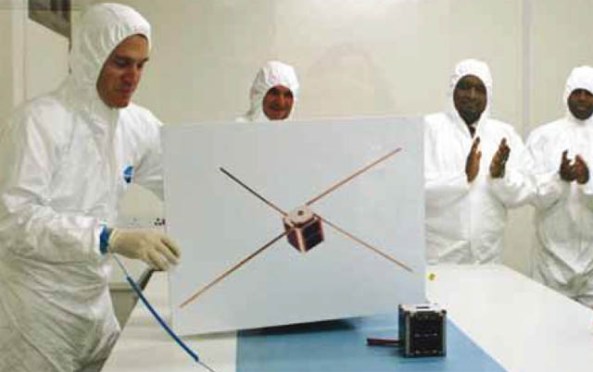
Dr Sandile Malinga, CEO of the South African Space Agency
unveils South Africa’s CubeSat Program – Image credit CPUT
Since the defenceWeb article was written it is believed ZACUBE-1 and ZACUBE-2 have changed designation and the references to the 3U Cubesat ZACUBE-1 should instead read ZACUBE-2.
Students at the Cape Peninsula University of Technology (CPUT) have been building an amateur radio 3U CubeSat ZACUBE-1 that will carry out propagation research using a beacon on 14.099 MHz.
The objectives of the mission are:
1) Training of post-graduate students in Satellite Systems Engineering.
2) Earth observation using a visible band matrix imager payload and an S-Band payload data transmitter (2.4 to 2.45 GHz).
3) UHF Store & Forward system (70 cm amateur band).
4) Experimental 115200 bps L-Band to S-band data transponder.
5) HF beacon payload for characterization of Hermanus Magnetic Observatory’s Dual Auroral Radar Network antenna at SANAE base in Antarctica (14 MHz).
ZACUBE-1 will conform to the 3U CubeSat standard with a maximum separated mass of 4 kg. The spacecraft will be 3-axis stabilized using a novel Attitude Determination and Control System (ADCS) developed by the University of Stellenbosch. The spacecraft’s Telemetry, Tracking, and Command (TT&C) system will operate in the 70 cm band and will be commanded from the amateur ground station at CPUT.
The website defenceWeb quotes a launch date of 2013.
The IARU Satellite Frequency Coordination Panel have agreed these frequencies:
Uplinks on 437.525 MHz and 1260.25 MHz and downlinks on 437.345 MHz and 2405.00 MHz.
Renier Siebrits ZS1MIR gave this presentation about the project on August 7, 2011.
Watch ZACUBE-1
CPUT students are currently involved in the development of a second amateur radio CubeSat, ZACUBE-2, which will be 10x10x10 cm with a mass of one kilogram.
CPUT unveils South Africa’s first CubeSat http://www.cput.ac.za/files/images_folder/news/newsletters/mojo/Moja%20Newsletter%20October%202011.pdf
CPUT CubeSat Projects http://active.cput.ac.za/fsati/public/index.asp?pageid=956
defenceWeb: South Africa’s CubeSats promoting space ambitions http://www.defenceweb.co.za/index.php?option=com_content&view=article&id=23165:south-africas-cubesats-promoting-space-ambitions&catid=90:science-a-technology&Itemid=204
Southern African Amateur Radio Satellite Association (SA AMSAT) http://www.amsatsa.org.za/
United Nations General Assembly Committee on the Peaceful Uses of Outer Space – Implementing small satellite programmes: technical, managerial, regulatory and legal issues November 28, 2011 http://www.oosa.unvienna.org/pdf/reports/ac105/AC105_1005E.pdf

Planetary Society’s LightSail-1 Spacecraft
The Planetary Society’s amateur radio spacecraft Lightsail-1 carries a 32m square metre solar sail demonstration.
After launch LightSail-1 will spend a few weeks in orbit during which the team will check out the subsystems. The side panels will then be deployed, exposing a folded sail, and a motor driven sail deployment will extend rigid booms.
With the sail deployed, the primary operation for the spacecraft are performing 90 degree slews to get the sail normal to the sun vector, or edge on with the sun vector.
A combination of ground based sensors and on board sensors will be used to characterize the acceleration due to solar pressure. Imagers on the deployed panels will be used to capture the sail deployment.
It is proposing to have a downlink in the 435 MHz band with a 1.5W output, semi-duplex 9k6 GMSK AX25 with a CW preamble to a single monopole. LightSail-1 is a 3U CubeSat weighing around 4.5 kg. More information will be available at http://polysat.calpoly.edu/LightSail.php
Watch deployment of the solar sail
Watch deployment of the solar panels
Watch antenna deployment in slow motion
The Planetary Society‘s LightSail program will launch three separate spacecraft over the course of several years, beginning with LightSail-1. Lightsail-2 will attempt a longer duration flight to higher Earth orbits, demonstrating that solar sails can increase their orbital energy and taking the next major step toward using solar sails for missions in and beyond Earth orbit.
LightSail-3 will fly to the Sun-Earth Libration Point, L1, where solar sail spacecraft could be permanently placed as solar weather stations, monitoring the geomagnetic storms from the Sun that potentially endanger electrical grids on Earth as well as satellites in Earth orbit.
Planetary Society LightSail-1 http://www.planetary.org/explore/projects/lightsail-solar-sailing/
 AMSAT-UK
You must be logged in to post a comment.