Winner of HORYU-2 Receiving Competition

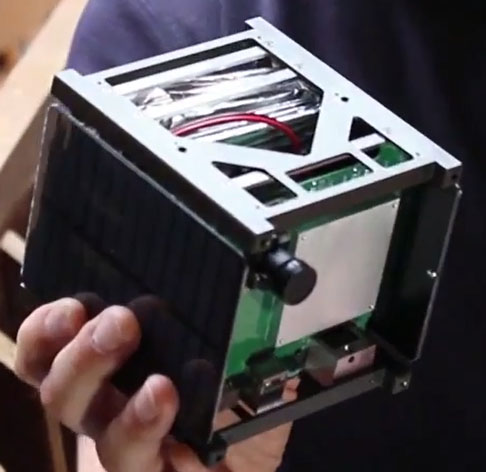
Testing_HORYU-2_Solar_Panels

Testing HORYU-2 Solar Panels

Built by students at the Kyushu Institute of Technology (KIT) the amateur radio satellite HORYU-2 was launched on May 17 at 1639 UT.

HORYU-2 Receiving Competition Prize

Radio amateurs from around the world sent in telemetry and the winner with the most points has been announced as Yoshitomo Iji JA6PL who will be presented with a bottle as the prize.

The top three places were:

1st place: JA6PL (91 points)
2nd place: ZL2BX (36 points)
3rd place: JF1EUY (35 points)

The satellite’s callsign is JG6YBW and the CW telemetry beacon frequency is 437.375 MHz (+/- Doppler shift).

The free KIT HORYU-2 telemetry software can be downloaded from
http://kitsat.ele.kyutech.ac.jp/Documents/information_launch_english.html

KIT HORYU Blog in Google English http://tinyurl.com/HORYU-Blog

Japanese HORYU website in Google English http://tinyurl.com/HoryuSatellite

English language version of HORYU website http://kitsat.ele.kyutech.ac.jp/index_e_new.html

Further information on HORYU-2 is at http://www.uk.amsat.org/7404

HORYU-2 online WebSDR receiver http://sdr.opt.ro:8901/

KIT HORYU-2 Facebook Group https://www.facebook.com/groups/277436165678985/

HORYU-2 CW Telemetry Decoder by DK3WN http://tinyurl.com/SatSoftwareDK3WN/

SimpleSatLookDown satellite tracking software http://www.uk.amsat.org/?p=8217

Students Build Supercapacitor Battery for next ARISSat

Penn State Behrend students Jacob Sherk, Kathleen Nicholas and David Jesberger put final touches to the amateur radio satellite supercapacitor battery – Image Credit Pennsylvania State University

On Feb. 3, 2006, astronauts tossed an old spacesuit off the International Space Station. Inside was an amateur radio transmitter, a temperature sensor and some batteries.

The suit was a DIY satellite. It circled the Earth twice, repeating a greeting recorded in multiple languages; ham radio operators listened in as it passed overhead.

Then the batteries died.

The Radio Amateur Satellite Corporation, or AMSAT, tried again in 2011. The battery in that satellite, a more traditional box design, also failed.

Penn State Nittany Lions Paw Print

For the next model, AMSAT, a volunteer group, turned to the School of Engineering at Penn State Erie, The Behrend College. Three students designed a brand-new battery: a 1.8 kg cube powered by 15 supercapacitors, each roughly the size of a film canister.

The battery was built to handle 16 charge cycles in a 24-hour period. That will power the satellite in dark orbits, when the solar panels are not facing the sun.

To activate the battery before those solar panels charge, the students – David Jesberger, of St. Marys; Kathleen Nicholas, of Pittsburgh; and Jacob Sherk, of Elizabethtown – added four 9-volt Duracells.

AMSAT hopes to fit the satellite into a rocket payload and onto the International Space Station sometime in 2013. The astronauts won’t have to do much with it.

“It’s simple by design. They flip a switch, and they throw it out,” said Dakshina Murthy Bellur, an assistant professor of electrical and computer engineering at Penn State Behrend. He supervised the battery work, which counted as the students’ senior capstone project.

All three students have since graduated. All three have jobs: Nicholas and Jesberger signed on with defense contractors, and Sherk works at the Three Mile Island nuclear power plant.

They continue to track the AMSAT project. They want to know when their battery, upon which they laser-etched with their names and a Nittany Lion paw print, gets a launch date.

“That’s going to be cool,” Jesberger said. “We’ll have our signatures in space.”

Source Pennsylvania State University http://live.psu.edu/story/60125

ARISSat http://www.arissat.org/

10th Anniversary of OSCAR 7’s Return To Life

Artists impression of OSCAR 7 in Space

Artists impression of OSCAR 7 in Space

The amateur radio satellite AMSAT-OSCAR 7 was launched by a Delta rocket from Vandenberg Air Force Base on November 15, 1974 and provided many years of service until it went silent from battery failure in mid 1981.

Pat Gowen G3IOR

Pat Gowen G3IOR

For 21 years nothing more was heard until June 21, 2002 when Pat Gowen G3IOR came across a beacon sending slow 8 -10 wpm CW on 145.973.8 MHz. It sounded like old OSCAR satellite telemetry, it had the familiar HI HI followed by a string of numbers in groups of three. After monitoring by many radio amateurs it turned out to be OSCAR-7, and it seemed to have come back from the dead.

Pat’s email to the AMSAT Bulletin Board announcing his discovery can be seen at
https://web.archive.org/web/20180517020245/https://www.amsat.org/amsat/archive/amsat-bb/200206/msg00525.html

It is believed that in 1981 the batteries failed short-circuit, however, in 2002 they became open-circuit enabling the satellite to run again from the solar panels. Since that day OSCAR 7 has been operational when in sunlight and provided radio amateurs with many long distance (DX) SSB/CW contacts.

Remember when working OSCAR 7 use the least uplink power possible to minimize your downlink power usage, and maximize the number of simultaneous contacts supported in the passband.

A BBC News report Radio ham finds lost satellite about the reception of OSCAR 7 by Dave Rowan G4CUO can be seen at http://news.bbc.co.uk/1/hi/england/2149381.stm

A collection of photos by Dick Daniels W4PUJ taken during the construction, test and launch of the AMSAT-OSCAR 7 spacecraft in 1973 and 1974 can be viewed at http://n4hy.smugmug.com/AMSAT/AMSAT-Oscar-7

Details of the June 1981 battery failure and a list of AO-7’s achievements can be found on pages 37-40 of the 1981 AMSAT Satellite Report Archive at http://www.ka9q.net/asr-1981.pdf

Later pages of the 1981 ASR archive note that amateurs continued listening to the AO-7 frequencies in the hope it would return. They were reports of a weak beacon carrier in July and August 1981 but although amateurs continued listening nothing was heard in the months after that.

ARRL report June 24, 2002 – It’s Aliiiiive! AMSAT-OSCAR 7 Satellite Returns from the Dead https://web.archive.org/web/20051104135636/http://www2.arrl.org/news/stories/2002/06/24/101/

Oscar 7 Information https://web.archive.org/web/20110605102903/https://www.amsat.org/amsat-new/satellites/satInfo.php?satID=9

Video of 2E0HTS Working the OSCAR-7 Satellite
https://amsat-uk.org/2012/01/26/2e0hts-working-the-oscar-7-satellite/

2010 video of the then AO-7 distance record
http://www.southgatearc.org/news/january2010/new_ao7_record.htm

‘Getting started on amateur radio satellites’ by G7HIA published in the March 2007 RadCom. Download the article at https://amsat-uk.org/wp-content/uploads/2011/05/satellites_radcom_mar07.pdf
Copyright 2007 Radio Society of Great Britain. For personal use only – no copying, reprinting or distribution without written permission from the RSGB.

Join the AMSAT Bulletin Board AMSAT-BB http://www.amsat.org/amsat-new/tools/maillist/maillist.php

Pat Gowen G3IOR in radio shack circa 1975

Pat Gowen G3IOR in radio shack circa 1975

Interview with author of DIY Satellite Platform

Tubesat - Image Credit Interorbital Systems

Have you ever wanted to build your own personal satellite but your last name doesn’t start with Gates or Branson? Well, now there’s good news. For the price of a car you can now build, test and launch your own personal satellite at home.

Dr. Sandy Antunes, Author of DIY Satellite Platform, talks about building his own amateur radio personal spacecraft Project Calliope. The best part (besides having your own satellite) is that you can now do some serious science.

Find out what kind of satellite Dr. Antunes is building and how he’s running the same kinds of tests the large Aerospace companies do, but for a fraction of the cost.

Project Calliope: http://www.projectcalliope.com/

Watch How to build your own personal satellite

Dr. Sandy Antunes used Kickstarter to raise funds for the project
http://www.kickstarter.com/projects/ghostlibrary/capturing-the-ionosphere-ground-station-calliope

Amazon – DIY satellite Platform
http://www.amazon.co.uk/DIY-Satellite-Platforms-Space-Ready-Picosatellite/dp/1449310605/

Interorbital Systems http://www.interorbital.com/

SkyCube Proposes Tweets from Space

Tim DeBenedictis and Anna Vital with the SkyCube satellite

Tim DeBenedictis and Anna Vital with the SkyCube satellite

In this video Tim DeBenedictis founder of San Francisco based Southern Stars describes the SkyCube satellite project to Funders and Founders host Anna Vital, following Southern Stars’ second-place finish at the Life 3.0 forum in San Francisco on May 31, 2012.

SkyCube-SatelliteTim aims to open up space exploration to millions of people across the planet. He hopes to do for space exploration what Southern Stars have done for astronomy with the SkySafari App.

The 1U CubeSat carries a camera that will send pictures back to Earth to be made available to people around the world with the appropriate App.

SkyCube has an unusual feature, a deployable 3m (10ft) reflective balloon, which it is hoped will be visible from Earth. The balloon also serves as a de-orbiting mechanism.

A launch to the ISS for subsequent deployment is planned for November 2013.

Tim says a donation of $1 will sponsor 10 seconds of the mission and what you get for that 10 seconds is the ability to broadcast a message from space, “effectively tweet from space”.

Watch SkyCube Interview

Watch SkyCube at Funders and Founders

Southern Stars http://www.southernstars.com/

Funders and Founders http://meetup.fundersandfounders.com/

SkyCube Proposes “Tweets from Space”

Tim DeBenedictis and Anna Vital with the SkyCube satellite

In this video Tim DeBenedictis founder of San Francisco based Southern Stars describes the SkyCube satellite project to Funders and Founders host Anna Vital, following Southern Stars’ second-place finish at the Life 3.0 forum in San Francisco on May 31, 2012.

Tim aims to open up space exploration to millions of people across the planet. He hopes to do for space exploration what Southern Stars have done for astronomy with the SkySafari App.

The 1U CubeSat carries a camera that will send pictures back to Earth to be made available to people around the world with the appropriate App.

SkyCube has an unusual feature, a deployable 3m (10ft) reflective balloon, which it is hoped will be visible from Earth. The balloon also serves as a de-orbiting mechanism.

A launch is planned on a SpaceX rocket in the 1st quarter of 2013.

Tim says a donation of $1 will sponsor 10 seconds of the mission and what you get for that 10 seconds is the ability to broadcast a message from space, “effectively tweet from space”.

Watch SkyCube Interview

Watch SkyCube at Funders and Founders

Southern Stars http://www.southernstars.com/

Funders and Founders http://meetup.fundersandfounders.com/