Update on Es’hail-2 given at AMSAT-DL symposium

Es'hail-2 coverage area

Es’hail-2 coverage area

DARC reports on Saturday, September 29, the annual symposium of AMSAT-DL took place in the IUZ observatory Bochum.

The Google translation reads:

There were lectures on current amateur radio satellites and space projects. The focus was on the first geostationary amateur radio satellite Es’hail-2, whose launch is expected later this year, as well as the MEGINASAT project, the first CubeSat from a German grammar school.

The lecture series was opened by Thilo Elsner, DJ5YM, whose article gave an overview of the ESERO office Germany opened in Bochum on May 16. ESERO stands for “European Space Education Resource Office”. The aim of the initiative is to bring space travel in the context of STEM subjects exciting and innovative in the classroom. After a lengthy selection process, Bochum was chosen as the location for Germany. In cooperation with the Ruhr-Universität Bochum, the observatory Bochum, the AMSAT-DL and other partners are founding members of this educational and scientific consortium.

Afterwards, AMSAT-DL-President Peter Gülzow, DB2OS, and Achim Vollhardt, DH2VA, talked about the current status of Es’hail-2 (called AMSAT-intern P4-A), whose launch will start in the fourth quarter of 2018 according to operator Es’hailSat should be done. A concrete start date is still not available. Recently, the AMSAT-DL completed and finalized the individual components for the Es’hail-2 ground station in Doha / Qatar. “Last week we finished the work and made the equipment ready to ship,” reported DB2OS. The components will soon be installed in Qatar. Another facility will be back up at the Qatar Amateur Radio Society (QARS) in Doha. A third ground station will be installed at the AMSAT-DL in the Bochum observatory. Two transponders are available on the satellite for amateur radio: a narrowband and a broadband transponder to be used for DATV broadcasts. “We hope to be able to present live broadcasts in DATV at the next HAM RADIO from June 21 to 23, 2019,” said Gülzow optimistically.

How satellite radio can also contribute to the successful recruitment of youngsters was demonstrated by the MEGINASAT team headed by project leader Thomas Leister, DG2PU. The project originated from an ISS contact of the Megina Gymnasium Mayen in 2012 and a stratospheric balloon launch in 2016. Specifically, MEGINASAT is the first CubeSat from a German grammar school. The students Florian Jüngermann, Max von Wolff (Physics Bundessieger at Jugend forscht) and Max Schild presented the project and pursue ambitious goals: The CubeSat is to serve Earth observation and send its image data by light transmission to Earth. Also sponsorship funds in five-digit amount have already been collected, now the team is looking for only one.

Source DARC https://www.darc.de/

AMSAT-DL President Peter Gülzow DB2OS will be giving a presentation “Es’hail-2 and its amateur radio payload” at the AMSAT-UK International Space Colloquium which is being held as part of the RSGB Convention at the Kents Hill Park Conference Centre in Milton Keynes, October 13-14 https://amsat-uk.org/colloquium/
ESEO student satellite to enter final test phase

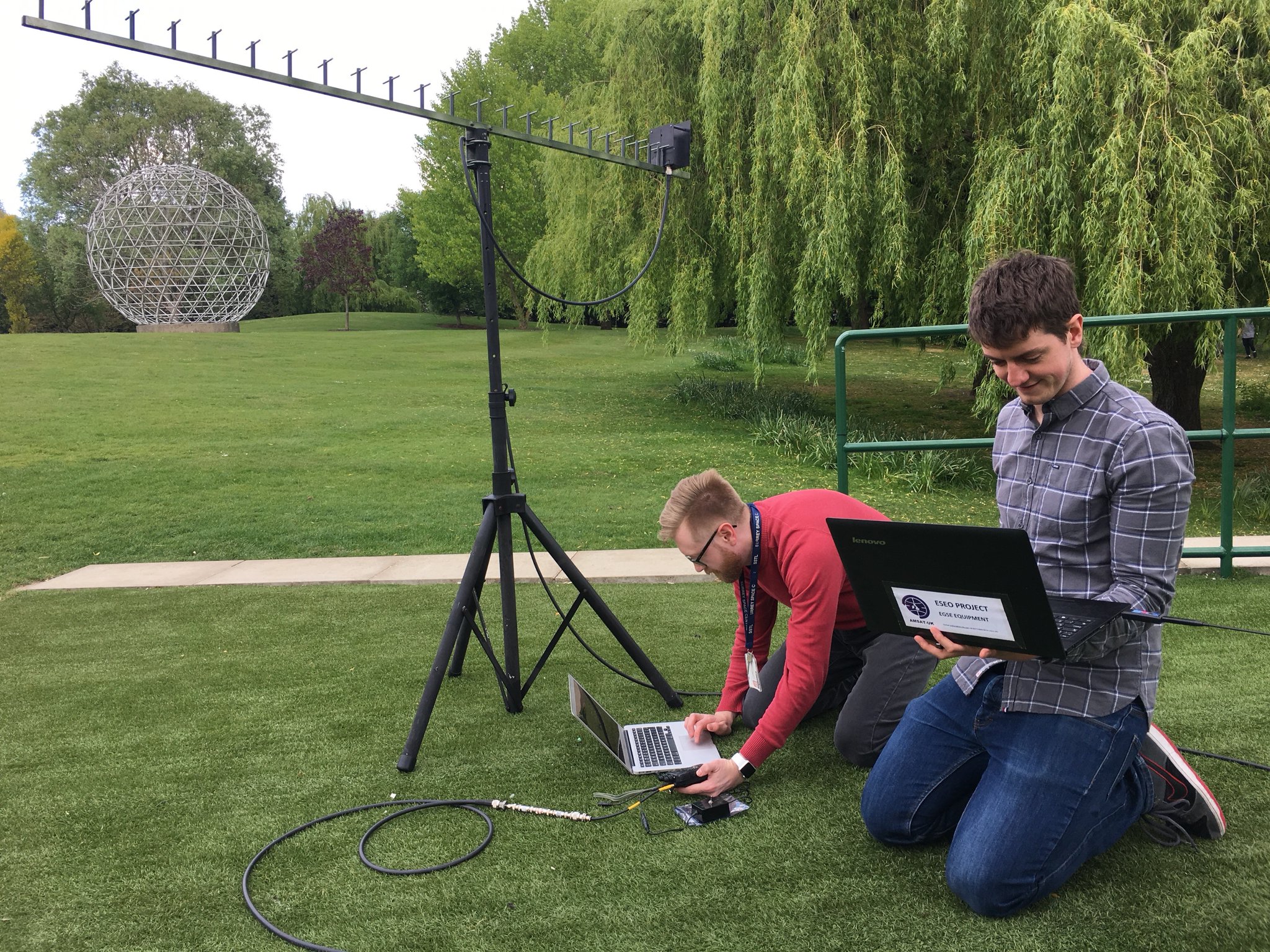
Dr Chris Bridges M0IEB and Pete Bartram conduct uplink command testing on the ESEO payload in the grounds of University of Surrey

Dr Chris Bridges M0IEB and Pete Bartram conduct uplink command testing on the ESEO payload in the grounds of University of Surrey

The European Student Earth Orbiter (ESEO) satellite carries the AMSAT-UK FUNcube-4 amateur radio 1260/145 MHz FM transponder. On September 27 it successfully completed the vibrations test.

In the past few years, ten student teams from different European universities have combined forces to produce essential equipment for the spacecraft, including subsystems parts, scientific or technology demonstration instrumentation, and the ground mission control support for this micro-satellite mission, planned to fly to Low Earth Orbit later this year.

The project reached an important milestone on August 28, 2018, when the assembly integration of the ESEO spacecraft was declared complete. In this phase all the satellite’s physical parts were assembled together, and all functional interconnections were checked to confirm they work as required.

On September 27, 2018 ESEO reached another key milestone, when it successfully completed the vibrations test campaign at SITAEL’s premises in Mola di Bari, Italy. ESEO has now demonstrated that its design is solid enough to safely withstand the mechanical solicitations it will undergo during the rocket launch.

In the next couple of weeks it will undergo the so-called thermal vacuum and electromagnetic compatibility (EMC) tests at ESA’s ESTEC site in the Netherlands.

Read the full ESA story at
http://www.esa.int/Education/ESEO/A_step_closer_to_launch_-_ESEO_student_satellite_to_enter_final_test_phase

AMSAT-UK ESEO page
https://amsat-uk.org/satellites/communications/eseo/

ESEO satellite FUNcube-4 transponder talk will take place at the RSGB Convention on Sunday, October 14. The talk will be streamed live to a global audience, details at
https://amsat-uk.org/2018/08/27/eseo-satellite-funcube-4/

FCC 24 and 47 GHz 5G spectrum auction

The FCC has announced it is to make additional spectrum available for 5G services by auctioning spectrum that includes 24.25-24.45, 24.75-25.25 and 47.2-48.2 GHz.

The RSGB joint response to the 2018 Ofcom WRC-19 consultation expressed concern about the use of this spectrum.

“the RSGB does not support the allocation of the range 24.25 – 25.25 GHz to the mobile service in Region 1 and its subsequent identification for IMT. The amateur and amateur-satellite services have a global primary allocation in 24 – 24.05 GHz and the out of band emissions from a mass deployment of mobile broadband systems operating in very wide channels in adjacent frequencies will appear as interfering noise in the primary amateur allocation. An identification that starts at 25.25 GHz could mitigate this difficulty.”

“We would not wish to see adjacent out-of-band emissions causing interference to our primary amateur and amateur-satellite service allocations at 24.0-24.05 and 47.0-47.2 GHz”

The FCC’s 5G FAST Plan
https://docs.fcc.gov/public/attachments/DOC-354326A1.pdf

RSGB joint response to Ofcom WRC-19 Consultation
http://rsgb.org/main/files/2018/06/180912_WRC-19_RSGB-Response.pdf

AMSAT-UK Construction Competition

29.450 MHz Receiver - Image credit David Bowman G0MRF

AMSAT-UK will be hosting a Construction Competition at our 2018 Colloquium on October 13/14th at Kents Hill Park, Milton Keynes. The competition is open to all.

The rules are simple:

1. Entries must be built from Kits or Home Constructed

2. The judging will take place during in the presentation room during the Lunch breaks on Saturday and Sunday. The entries need only be present for one of these sessions.

3. Three judges, nominated by the AMSAT-UK Chairman, will judge each entry on:

• External Appearance and Ergonomics

• Mechanical Construction

• Standard of Internal Wiring

• Standard of PCBs or internal circuitry

• Originality

4. The winners will be announced at the end of the Colloquium on Sunday afternoon. Prizes will be forwarded if the winner is not present.

5. A £50 Amazon Voucher will be awarded to the winner with a £25 Amazon Voucher for the runner-up.

6. The decisions of the Judges are final, and their marking will remain confidential!

7. Multiple entries for individuals are allowed and encouraged.

AMSAT-UK International Space Colloquium https://amsat-uk.org/colloquium/

Home constructed dual-band satellite antenna by Steve M0SHQ

AM1SAT Special Award

AMSAT-EA LogoAMSAT EA will be on air on all available satellites with callsign AM1SAT from Sept 10-17 to celebrate IberRadio 2018 – IV Radiocommunications Fair, the biggest HAM party event in Spain and Portugal, Sept 15-16

Main grid will be IN70 but other ones will be activated as well. Our operators will work transatlantic QSOs too. QSLs by LOTW and eqsl

Any questions, please write to contacto@amsat-ea.org

AMSAT-EA will be transmitting its special call AM1SAT via all active satellites from September 10-17 as part of the IV RadioHam Fair IberRadio 2018 activities. IberRadio is the biggest event for the ham community in SouthWest Europe and will open doors September 15th and 16th. AM1SAT callsign will be active from a minimum of 14 different grids during that time to help satellite operators to collect as much EA locators as possible.

As part of this activity and in order to promote the participation, AMSAT-EA is sponsoring the AM1SAT Special Award in two categories: SILVER and GOLD.

AWARD RULES

1. This award can be requested and issued to any licensed amateur station and also SWLs

2. Will be valid contacts all those done via AMSAT satellites from September 10th 2018 to September 17th 2018 in all transmission modes.

3. There are two different requirements to get the awards, depending of the applicant location.

Applicant in a EU entity.

To get the award in its SILVER category, the applicant has to contact AM1SAT in 5 different grids (We consider “grid” as a 4-digits main locator. For example IN71, IM68, JN00, etc). To get the award in its GOLD category the applicant has to contact AM1SAT in 10 different grids.

Applicant in a Non-EU entity.

To get the award in its SILVER category, the applicant has to contact AM1SAT in 2 different grids (We consider “grid” as a 4-digits main locator. For example IN71, IM68, JN00, etc). To get the award in its GOLD category the applicant has to contact AM1SAT in 4 different grids.

4. There is no need of paper QSLs nor EQSLs to ask for the award. When the applicant gets the requirements, s/he has to send via email a log with the QSOs, listing his callsign, name, and QSO data (Date, GMT time, frequencies, mode, received grid and used satellite). Also we need the applicant email to send the award. The awards will be send, latest in 2 months and only in PDF format, free of charge.

5. Logs and any question about this activity must be send to eb1ao@amsat-ea.org

6. Logs must be received by October 1st 2018. We will consider the AM1SAT operators logs as the valid ones to check and cross the QSOs. Disputes or open issues will be solved by AMSAT-EA committee.

AMSAT-EA https://www.amsat-ea.org/

English AMSAT-EA newsletter
https://www.amsat-ea.org/app/download/10708456/AMSAT-EA-Newsletter_09-2018.pdf

IberRadio 2018 http://www.iberradio.es/en/

JAXA to launch FM voice transponder satellite Diwata-2

Diwata-2 satellite

Diwata-2 satellite

The Philippine Diwata-2 satellite carrying an amateur radio FM transponder and APRS digipeater is expected to launch in October.

The Business Mirror reports:

The 50-kilogram satellite shall soon be sent into orbit by the Department of Science and Technology (DOST) through its partner, Japan Aerospace Exploration Agency (Jaxa).

It should be recalled that the DOST had the Philippines’s first microsatellite—the maiden Diwata-1 that was designed, developed and assembled in Japan by nine pioneering Filipino engineers and scientists along with their “sensei” (instructors) from the Tohoku University (TU) and Hokkaido University (HU).

Diwata-1 was launched into the International Space Station onboard the Orbital ATK’s Cygnus spacecraft on March 23, 2016. It was deployed from the ISS into her orbit on April 27 by the Japanese Experimental Module (JEM)—”Kibo” or Hope—around 400 km above Earth’s surface.

Now, two years and four months later, the government is about to unveil the second iteration of Diwata-1—named Diwata-2 targeted for launching onboard Jaxa’s H-IIA rocket from Tanegashima Island in Japan.

Ariston Gonzalez, a researcher/lead research and development engineer for PHL-Microsat at DOST-Asti, is quoted in the article as saying:

“All one has to do is tune in [a ham radio] to the frequency of Diwata-2 to send voice messages while the other party stands by to receive the voice message.”

“target use for ham radio [of Diwata-2] is for emergency situations wherein all commercial communications are down.”

“What Diwata-2 does is to serve as a relay or connecting point for two persons communicating with each other,” he pointed out.”

“One can also store messages on Diwata-2 that can be broadcasted repeatedly across and over the Philippines, such as prerecorded emergency messages in times of disasters, calamities and other kinds of emergency.”

The IARU has coordinated these frequencies for Diwata-2:
– 145.900 MHz downlink
– 437.500 MHz uplink

Read the full Business Mirror story at
https://businessmirror.com.ph/diwata-2-microsatellite-nears-completion-handover-to-jaxa/

Diwata-2 information
http://phl-microsat.upd.edu.ph/diwata2
https://www.facebook.com/PHLMicrosat