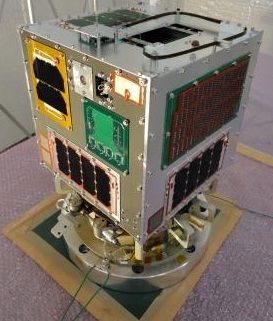
PrintSat – An Amateur Radio 3D Printer CubeSat

The image shows the building of a CubeSat with Additive Manufacturing with the WINDFORM XT. Image Credit Windform

Students at Montana Sate University (MSU) are planning to build their new amateur radio satellite PrintSat with nano-carbon-impregnated plastic using a 3D printer.

David Klumpar KD7MFJ of MSU said 3D printing “will further lower the costs and speed the development of very small satellites, enabling future scientific missions comprised of dozens of satellites flying in formation.”

Jim White WD0E, president of Colorado Satellite Services, explained that “Additive manufacturing (also called 3-D printing) has evolved in the past few years to be a very inexpensive and fast way to make mechanical parts. With PrintSat, the entire structure of the small satellite will be printed. As the first use of additive manufacturing for a satellite, we plan to show it’s not only cheaper and faster, but that we can make parts that cannot be made in traditional ways.”

When in orbit PrintSat will measure and report on the characteristics of the Windform XT2.0 printed material and plating during its mission life in order to verify the utility of additive manufacturing for spacecraft structures and mechanisms.

PrintSat plans to use the same frequencies as RAMPART and use GMSK 9k6 Ax.25 packet radio. It is aiming for a May 2103 launch from the Wallops Flight Facility into a 500km 40 degree inclination orbit.

Other satellites planning to fly on the same launch include Blacknight-1, Spa-1 Trailblazer, Phonesat, Kysat- II, Rampart, NPS-SCAT, Copper, TJSat, Tethersat, Lunar orbiter/lander CubeSat, Swampsat, Cape-2, Dragonsat-1 and Ethersat.

Montana State University Space Science and Engineering Laboratory https://ssel.montana.edu/

Windform XT2.0 http://www.windform.it/windform-xt-2-0-en.html

IARU Amateur Satellite Frequency Coordination Status Pages http://www.amsat.org.uk/iaru

TEDxKhartoum Presentation on KN-SAT1 CubeSat

KN-SAT1 Students at ST2UOK Khartoum

KN-SAT1 Students at ST2UOK Khartoum

Abubakr S. Eltayeb ST2AB is an Electrical Engineer specializing in communications systems. He is currently a member of the Cube Satellite Project which belongs to the Faculty of Engineering at University of Khartoum.

The team includes his colleagues Hala M. Othman, Mustafa Atta Mohamed and Yasir M. Osman ST2YM, and together they constructed the first satellite in Sudan with the help of Dr. Tahani Abdalla, their project manager and Dr. Nader Abdelhameed, the team manager. They designed, tested and experimentally launched a fully functional Cube Satellite prototype named KN-SAT1.

The team is now developing the Flight Model of the KN-SAT1, in preparation for its launch into outer space.

This TEDxKhartoum presentation is not in English, however, the segment from 09:12 until 13:25 contains video showing the development of the KN-SAT1 CubeSat including a test of the deployment of the antennas.

Watch TEDxKhartoum 2012: Abubakr S. Eltayeb, A Sudanese Satellite

Khartoum Amateur Radio Satellite Ground Station http://www.uk.amsat.org/4316

KN-Sat1 http://cubesat.uofk.edu/

Sudanese Amateur Radio and SWL History http://www.st2nh.com/sudanamateurradioandswlhistory

Listen to HORYU-2 on the Web

Andrei YO8SSQ and Cezar YO8TLC have made available a web based receiver to enable listeners to hear the new amateur radio satellite HORYU-2 when it’s within range of Romania.

The WebSDR receiver is located at the Astronomical Observatory Department of “Stefan cel Mare” University in Suceava, Romania, latitude 47.6417N longitude 26.2453E, grid locator KN37cp. The height ASL is 350m.

The hardware consists of two SDR receivers which are fed into 48 kHz sound cards on an AMD Sempron 2600+ computer running Vector Linux.

The web page displays a track showing the current position of HORYU-2 and also provides coverage of the 3.5 MHz (80m) band.

Listen to the HORYU-2 and 80m WebSDR at http://sdr.opt.ro:8901/

More information about HORYU-2 437.375 MHz (+/- 9 kHz Doppler shift) at
http://www.uk.amsat.org/7404

HORYU-2 Telemetry Software and Competition http://www.uk.amsat.org/7474

HORYU-2 CW Telemetry Decoder by DK3WN http://tinyurl.com/SatSoftwareDK3WN/

HORYU-2 Separation Video http://www.uk.amsat.org/7540

Keplerian Two Line Elements (TLEs / KEPS) for new satellites launched in past 30 days
http://celestrak.com/NORAD/elements/tle-new.txt

Amateur satellite Keplerian Two Line Elements (TLEs / KEPS) http://celestrak.com/NORAD/elements/amateur.txt

More information about the WebSDR project can be found at http://www.websdr.org/

SpaceX Dragon to Blast-Off to ISS

Classroom preperation for the student spaceflight experiments program SSEP

On Tuesday, May 22 at 07:44 UT SpaceX’s Dragon hopes to transport the student payload Aquarius on SSEP Mission 1 to the International Space Station (ISS).

The set of SSEP Mission 1 experiments, called Aquarius, was originally slated to fly aboard the Soyuz 30. But in an interesting twist of fate, the experiments were re-manifested on the maiden voyage of the SpaceX Dragon to the ISS. Aquarius not only becomes part of a historic first but also allows the space station to remain an out-of-this-world platform to engage students in STEM — science, technology, engineering and mathematics.

The SpaceX Dragon launch will be broadcast live on the Internet details at
http://www.nasa.gov/nasatv

NASA – Space Station — Here We Come!
http://www.nasa.gov/audience/foreducators/station-here-we-come.html

Glasgow school wins CanSat launch competition

The UK’s Alpha team from Bearsden Academy in Glasgow were awarded first place in the second European CanSat Competition. 14 secondary school teams, from different ESA member states, participated in the finals of the competition at the Andøya Rocket Range in Norway.

The first prize was awarded to team Alpha, from the UK. Credits: ESA / J Makinen. (JPG, 61 Kb) CanSats are miniature simulation satellites the size of a soda can. The students had to build their own space experiments, fitting all the major subsystems including radio communications on 433/434 MHz and power into just 350ml.

The tiny CanSats were designed to separate from their rocket and conduct their missions as they descended on parachutes to the ground for recovery by the teams. They were launched in pairs from seven small Intruder rockets up to an altitude of about 1km.

Setting up an Intruder rocket for launch. Credits: ESA / J Makinen. (JPG, 68 Kb) Despite very strong winds, all of the CanSats were successfully recovered, with the exception of the Spanish one, which failed to communicate with the ground station.

The UK team received good telemetry data on 434.25 MHz, but were a little disappointed that their miniature rover deployed earlier than planned. The other teams, from Denmark, Belgium, the Netherlands, France, Spain, Austria, Czech Republic, Norway, Romania, Italian, Irish, Greek, Portugese had varying degrees of success.

Once they analysed the results of their missions, the teams were judged by a board composed of technical experts from space agencies and industry. Following the UK team in second place was the Icaromenippus 3D team from the 3rd General Lyceum of Mytilini, Strati Myrivili, Greece, with the Portuguese Azorean Shearwater team from EBS Santa Maria, Vila do Porto in the Azores in third place.

“The standard of the projects was really high and the judges were very impressed by the professional attitude of the students,” said Helen Page, the ESA CanSat Project Coordinator. “They learned an enormous amount about space science, engineering and technology, as well as developing practical skills and experiencing the excitement of a launch campaign at a world-class rocket range.”

Students from the Norwegian team Navican testing their CanSat's parachute. Credits: ESA / J Makinen. (JPG, 72 Kb) The 2012 European CanSat competition was organised by ESA’s Education Office in collaboration with the Norwegian Centre for Space-related Education (NAROM). For more details about the teams involved visit the ESA website.

The Scottish CanSat Competition was organised using the STEM Ambassador Network, a list of the Scottish schools involved and 70cm frequencies is at
http://www.fistraltraining.co.uk/index.php?option=com_content&view=article&id=126&Itemid=75

Scottish CanSat Facebook http://www.facebook.com/pages/Scottish-Cansat-Competition/136524309785701

CanSat website http://cansat.eu/

High School Students Build Amateur Radio CubeSat

TJ3Sat (pronounced TJ CubeSat) is scheduled to be the first satellite to be flown and built by high school students.

The satellite is a product of Thomas Jefferson High School for Science and Technology’s Systems Engineering class. During this three year long endeavor approximately 30 high school students ranging from sophomores to seniors will have contributed.

The project is broken down into individual subsystems that are assigned to groups of students. Each subsystem is assigned an industry representative that acts as a mentor to the students. In the end TJ3Sat will act as an educational resource for K-12 education worldwide.

The primary payload of the TJ3Sat is a TextSpeak module, which converts serial data into spoken voice. Coupled with the Stensat Radio, coded data will be transmitted to the satellite and will be relayed back to Earth over an Amateur Radio frequency.

It is understood the CubeSat uplink with be in the 435 MHz band with the downlink in the 145 MHz band.

Watch TJ CubeSat Fit Check

TJ3Sat http://tj3sat.wikidot.com/